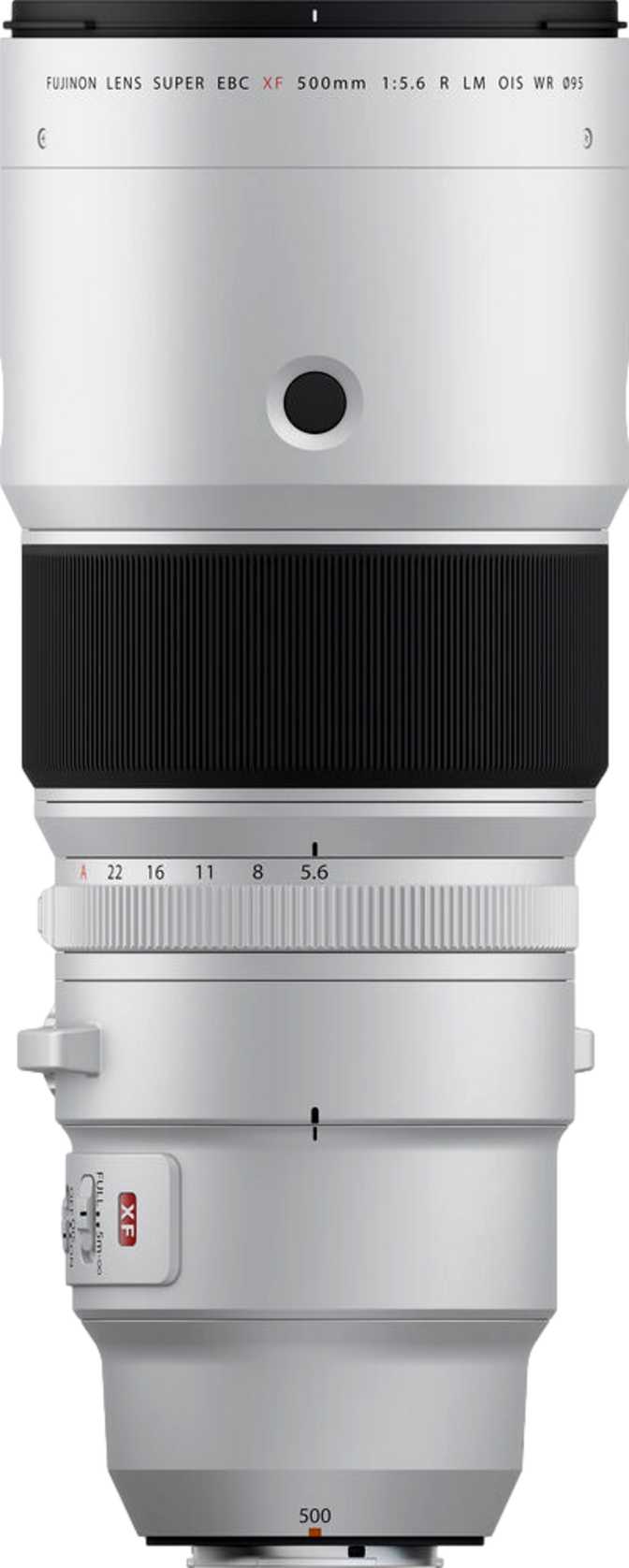
Fujifilm XF 500mm f/5.6 R LM OIS WR – Full Review & Real-World Test
Camera LensesA purpose-built super-telephoto prime for Fujifilm X-system shooters who need extreme reach without the weight penalty of full-frame alternatives. On any X-series body, this lens delivers a 750mm-equivalent field of view — a number that redefines what is achievable with APS-C glass.
Editor's Rating
4.5 / 5
Wildlife & Telephoto Specialist
What 500mm Means on a Fujifilm X Body
Super-telephoto photography has always been the domain of professionals carrying enormous, bank-account-draining glass. The Fujifilm XF 500mm f/5.6 R LM OIS WR challenges that assumption — not by cutting corners, but by exploiting one of APS-C's most underrated advantages. Mounted on any Fujifilm X-series body, this lens delivers a field of view equivalent to a 750mm lens on a full-frame camera. That number is not a typo.
For wildlife photographers, birders, motorsport shooters, and anyone who has ever squinted at a distant subject and wished they were closer, 750mm-equivalent reach changes what is possible — entirely.
The APS-C Crop Advantage
Fujifilm X-mount bodies use an APS-C sensor with a 1.5× crop factor. A 500mm lens therefore produces a field of view matching 750mm on full-frame — giving you more reach from the same optics, at a fraction of the size and weight of a full-frame 700–800mm prime.
Build Quality and Physical Design
Construction & Weather Resistance
Pick this lens up and the first thing you notice is that it means business. At just over 1.3 kilograms, it is substantial — heavier than most X-mount glass by a significant margin, yet remarkably manageable for a lens of this reach. Comparable full-frame 500mm primes can weigh two to three times as much.
The metal mount resists the wear of thousands of attachment and detachment cycles over a lens's lifetime, maintains tight tolerances, and signals genuine longevity. Weather sealing is present throughout, protecting against dust and moisture — not a luxury for the target audience, but a professional requirement.
For photographers working in rain, at dawn on wet sand, or at outdoor events where weather is never guaranteed, this level of protection belongs in the specification, not the wish list.
Handling & Practical Ergonomics
The 95mm front filter diameter is large but consistent with the physics involved. Pushing this much glass through a telephoto design while maintaining optical quality demands that front element real estate. Photographers planning to use polarizers or neutral density filters should budget accordingly — 95mm filters carry a meaningful price premium.
The front element does not rotate during focusing. When using a circular polarizer — which requires precise rotational alignment — a rotating front element would undo your adjustment with every focus change. Here, it stays fixed throughout the full focus range.
The reversible lens hood can be stored in the reverse position on the lens during transport, keeping it attached and protected without demanding separate storage.
Key Physical Specifications at a Glance
1,335g
Total Weight
95mm
Filter Diameter
WR
Weather Resistant
Metal
Mount Type
Optical Performance
Reach and Angle of View
The 3.3-degree angle of view this lens produces on an X-series body is extreme by any measure. To put that in tangible terms: at a distance of 100 meters, the frame width captured is roughly 5.8 meters. A standing adult at that distance fills a substantial portion of the frame. A bird perched in a tree 40 meters away becomes a subject that fills the frame entirely.
This is a prime lens with no zoom capability — a deliberate optical and engineering choice. Prime lenses at this focal length can be optimized in ways that zoom designs cannot, resulting in better resolution, better contrast, and more consistent performance across the full aperture range.
Aperture and Low-Light Reach
The f/5.6 maximum aperture is constant — it does not shift as you focus. For a 500mm prime, f/5.6 represents a careful balance: going faster (f/4) at this focal length would significantly increase both the physical size and weight of the lens. In practical low-light terms, you will be relying on your camera body's ISO performance during dawn and dusk shoots — the hours when many wildlife subjects are most active.
Nine rounded aperture blades produce smooth, circular bokeh at open apertures. At 500mm with subject isolation this extreme, background blur is essentially guaranteed. The rounded blades ensure that out-of-focus specular highlights render as circles rather than polygons — a detail that elevates the aesthetic quality of the final image.
Minimum Focus Distance and Magnification
The closest this lens can focus is 2.75 meters — an impressively short minimum for a 500mm telephoto. At that range, the lens achieves 0.2× magnification. That is not macro territory, but for insects, reptiles, or small birds approached closely in field conditions, it enables close-up detail that a longer minimum focus distance would simply deny.
Autofocus System
Linear Motor Technology
The autofocus system uses a linear motor built directly into the lens. Linear motors operate without the mechanical lag of traditional focus motor designs — they respond to electrical signals almost instantly and move focus elements with high precision and no significant momentum overshoot.
For tracking fast-moving subjects — birds in flight, diving raptors, motorsport vehicles — the responsiveness of the focus motor is as important as the accuracy of the camera's tracking algorithms. This implementation meets that bar.
Silent Operation & Manual Override
The motor is silent. In wildlife photography, shutter noise is often unavoidable, but focus motor noise can disturb sensitive subjects. A photographer working near nesting birds or skittish deer does not want audible mechanical whirring giving their position away.
Full-time manual focus override means you can reach for the focus ring and take control at any moment without switching modes. If autofocus locks onto a branch in front of your subject, a nudge of the focus ring corrects it instantly — no menu hunting, no broken shooting position.
-
Linear Motor (LM)
Near-instant response with no mechanical lag — critical for erratic subject tracking at extreme telephoto distances.
-
Silent Operation
Inaudible during operation — essential for wildlife work where subject disturbance must be minimized.
-
Full-Time Manual Override
Instant manual control at any point without mode switching — lets experienced photographers intervene precisely when AF hunts.
-
Infinity Focus Capable
Focus range extends to infinity — confirmed by specification, with no hard stop limitation at the far end of the range.
Image Stabilization
Built-in optical image stabilization adds a dedicated set of lens elements designed to counteract camera shake. At 500mm — or 750mm equivalent — even the slight tremor from a heartbeat can translate into visible blur in a handheld shot. Stabilization allows photographers to use shutter speeds that would otherwise produce motion blur from camera movement, meaning more keepers in situations where tripod use is impractical or impossible.
The stabilization system works alongside any in-body image stabilization present in the camera body. Fujifilm X bodies that include sensor-shift stabilization can coordinate with the lens's optical stabilization for a combined effect, extending the usable handheld range further.
Important Distinction
Optical stabilization controls camera shake — not subject motion. A kingfisher diving into water at speed requires a fast shutter speed regardless of how well-stabilized the lens is. These are two separate challenges requiring separate solutions.
Who This Lens Is For — and Who Should Look Elsewhere
Ideal For
-
Wildlife & Bird Photographers
The primary audience. Extreme reach, fast silent AF, weather sealing, and practical weight align precisely with field wildlife demands. Getting close to most wild subjects is either impossible or undesirable — 750mm-equivalent reach collapses that distance optically.
-
Motorsport & Airshow Photographers
Aircraft at distance, cars on the far side of a circuit, fast action that cannot be physically approached — this reach and AF tracking capability serves all of these scenarios.
-
Safari & Expedition Photographers
Serious reach without full-frame logistics. Weight and size are genuine advantages when traveling to remote locations with limited carry capacity.
-
Field Sports Photographers
Athletics events, cycling, any field sport where photographers remain at fixed distances from action — this lens brings subjects close from the stands or press areas.
Not Suited For
-
Portrait Photographers
The minimum focus distance and extreme focal length make this impractical for controlled studio work or environmental portraits. Other X-mount options serve portraiture far better.
-
Travel & Lightweight Photographers
At 1.3 kilograms, this is a specialized tool, not a versatile travel companion. Packing it alongside a body and other lenses is a significant commitment.
-
Dim Indoor Venue Shooters
Concerts, indoor arenas with poor lighting — f/5.6 combined with this focal length makes the lens poorly matched to those conditions.
-
Videographers
The optical capabilities exist, but the extreme focal length amplifies any movement or vibration in ways that can be difficult to manage even with stabilization active.
Competitive Positioning
The fundamental case for this lens over a full-frame 500mm alternative is the APS-C crop advantage: more reach from the same optics by virtue of the smaller sensor. For a photographer already invested in the Fujifilm X system, this means native, optimized reach that no full-frame shooter achieves at equivalent size and weight.
| Consideration | Fujifilm XF 500mm f/5.6 | Full-Frame 500mm f/5.6 | APS-C 100–400mm Zoom |
|---|---|---|---|
| Effective Reach (35mm equiv.) | ~750mm | 500mm | Up to ~600mm equiv. |
| Weight Category | ~1.3 kg | 1.5–3+ kg | ~0.6–1 kg |
| Aperture Flexibility | Fixed prime | Fixed prime | Variable |
| Compositional Flexibility | None (prime) | None (prime) | Full zoom range |
| Weather Protection | Yes | Varies | Varies |
| Autofocus Type | Linear motor, silent | Varies | Varies |
Against the XF 100–400mm zoom, the 500mm prime sacrifices versatility entirely but gains the optical benefits of a dedicated prime design and 100mm of additional effective reach. The choice comes down to whether you need compositional flexibility or maximum reach — they serve genuinely different working styles.
Strengths and Weaknesses — An Honest Assessment
Where It Excels
The most compelling quality is what this lens enables that nothing else in the X-mount system does: a 750mm-equivalent prime with serious weather sealing, a modern linear autofocus motor, and a weight that does not demand a personal assistant to carry. That combination, for a wildlife or telephoto-specialist photographer, is difficult to replicate any other way within the Fujifilm ecosystem.
The autofocus implementation is a genuine strength. Linear motors at this focal length are not universal, and the silent operation alongside full-time manual override makes the focus system feel designed by someone who actually uses long telephoto glass in the field — not just specified on paper. The non-rotating front element and reversible hood are further evidence of considered, practical design rather than specification padding.
Where It Asks for Patience
The f/5.6 aperture is the right aperture for a lens of this size and price — but photographers coming from faster glass at shorter focal lengths will notice that pre-dawn and post-dusk shooting requires either accepting elevated ISO noise from the body or a compromise in shutter speed. Neither is fatal, but the trade-off is real and worth entering with clear expectations.
The 95mm filter thread is a practical consideration that deserves direct acknowledgment: high-quality 95mm filters are expensive. If your workflow demands regular filter use, that cost compounds meaningfully. The 2.75-meter minimum focus distance is, in context, a strength relative to category norms — but it is still 2.75 meters, and any subject requiring close physical proximity reveals the practical constraints of extreme telephoto geometry.
Answers to Common Buyer Questions
Full Specification Overview
| Specification | Value |
|---|---|
| Lens Type | Prime Telephoto |
| Mount | Fujifilm X |
| Focal Length | 500mm (750mm equiv. on APS-C) |
| Maximum Aperture | f/5.6 (constant) |
| Minimum Aperture | f/22 |
| Aperture Blades | 9 (rounded) |
| Angle of View | 3.3° |
| Minimum Focus Distance | 2.75 m |
| Maximum Magnification | 0.2× |
| Autofocus Motor | Linear Motor (LM) — silent |
| Full-Time Manual Focus | Yes |
| Infinity Focus | Yes |
| Optical Image Stabilization | Yes (OIS) |
| Weather Sealing | Yes (WR) |
| Mount Material | Metal |
| Front Element Rotation | Non-rotating |
| Lens Hood | Reversible |
| Filter Diameter | 95mm |
| Weight | 1,335 g |
Final Verdict
The Fujifilm XF 500mm f/5.6 R LM OIS WR is a specialized instrument that earns its place without apology. For a wildlife, bird, or extreme-reach sports photographer working within the Fujifilm X system, this lens addresses a gap that no other native option fills — a dedicated prime at this focal length, with professional weather sealing, fast silent autofocus, and a weight penalty that remains manageable compared to full-frame alternatives delivering equivalent reach.
It is not the right choice for a photographer who wants versatility, shoots primarily indoors, or is exploring telephoto work experimentally. Those shooters are better served by the XF 100–400mm zoom or by a shorter telephoto prime offering more flexible minimum focus distances and a wider aperture.
For the photographer who knows they need reach above everything else — who has stared at a distant subject through binoculars and wished the camera could see what their eyes could — this lens is a direct and capable answer. Buy it knowing exactly what it is, and it will not disappoint.
Overall Score
4.5
out of 5
For Telephoto Specialists