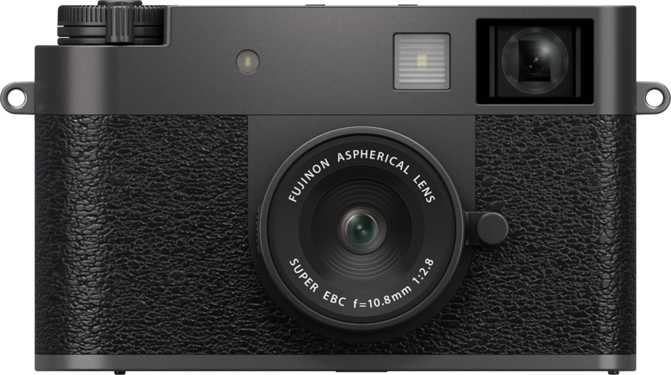
Fujifilm X Half Review: A Fixed-Lens Compact Built on Philosophy
CamerasEditor's Score
7.8
out of 10
Recommended — Right Buyer OnlyPerformance at a Glance
What the Fujifilm X Half Actually Is
Not every camera exists to win specification battles. The Fujifilm X Half arrives as something rarer: a camera built around a philosophy. Drawing direct inspiration from the half-frame film cameras of the 1960s and 70s — compact bodies that shot portrait-orientation frames on standard 35mm film, yielding twice as many exposures per roll — the X Half translates that analog spirit into a digital body designed for a generation that grew up on vertical-format content.
This is a fixed-lens compact mirrorless camera. It does not accept interchangeable lenses. It does not shoot RAW files. It does not offer image stabilization. What it does offer is a carefully curated shooting experience optimized for casual, expressive, portrait-format photography — with just enough manual control to keep serious photographers engaged.
Understanding what the X Half is, and what it deliberately is not, is the only honest way to evaluate it. This camera succeeds entirely on its own terms. Judging it against the wrong expectations produces the wrong verdict.
The Most Important Thing to Understand
The constraint built into the X Half is not a limitation to be overcome — it is the product. The fixed lens, the JPEG-only output, the portrait orientation emphasis: these are design choices, not cost-cutting compromises. Buy it because of those choices, not despite them.
Design and Build: Compact by Conviction
Physical experience, build quality, and what the dimensions mean in your hands
105.8mm
Width
64.3mm
Height
30mm
Thickness
240g
Body Weight
At those dimensions, the X Half sits comfortably in a jacket pocket or a small bag side pouch. The 240-gram weight feels almost startlingly light in hand — lighter than most smartphones. At roughly the footprint of a thick deck of cards, this is a camera you will actually carry.
The 2.4-inch rear touchscreen offers 920,000 dots of resolution. At this screen size, that density is clear enough to review images and navigate menus without squinting. The touch functionality adds genuine usability, particularly for quick menu adjustments. The screen does not tilt or flip out, which is a notable absence for a camera so oriented toward portrait shooting and social content creation. Tripod and low-angle framing will require working around this limitation.
There is no hot shoe. External flash units and third-party accessories that mount via shoe cannot be attached. The built-in flash handles fill-light duties when needed. Fujifilm's design lineage is evident throughout — this is clearly a camera designed to be held, looked at, and enjoyed as an object, not just a tool.
Weather Sealing: An Important Warning
The X Half is not weather-sealed. Its supported operating range runs from 0°C to 40°C. Shooting in light rain, dusty environments, or winter cold below freezing is officially outside its supported use case.
For a lifestyle camera designed to be carried everywhere, this limitation deserves serious consideration before purchasing — particularly for outdoor or travel use.
Screen Quick Facts
- Screen Size2.4 inches
- Resolution920,000 dots
- Touch EnabledYes
- Tilts / FlipsNo
- Hot ShoeNo
The Lens and Sensor: A Deliberate Fixed Perspective
What a single fixed lens and a 1-inch BSI sensor actually mean for your photos
The Fixed 32mm Lens
The X Half uses a single, non-interchangeable 32mm lens. On a 1-inch sensor — which carries a crop factor of approximately 2.7x relative to full-frame — a 32mm focal length translates to a roughly 86mm full-frame equivalent field of view. In practical terms, this is a short telephoto perspective: flattering for portraits, comfortable for street scenes, subtly compressive rather than wide and distortion-prone.
Maximum aperture is f/2.8. At 86mm equivalent, f/2.8 delivers meaningful subject separation and noticeably blurred backgrounds in close-up work, while still providing enough depth of field for candid scenes. It is a pragmatic aperture choice — not the wide-open drama of a fast prime, but versatile across most available-light situations.
The minimum focus distance of just 10 centimeters allows genuinely close macro-style work — close enough to fill the frame with small objects, food details, or text. For a fixed-focal-length compact, this close-focus capability is a practical creative asset.
The 1-Inch BSI CMOS Sensor
The back-illuminated 18-megapixel sensor at the heart of the X Half is a meaningful step above the typical compact camera tier. Back-illuminated (BSI) architecture rearranges the sensor's wiring layer behind the photodiodes rather than in front of them, allowing more light to reach each pixel — a real advantage in low-light and mixed-light shooting.
At 18 megapixels on a 1-inch surface, individual pixels are large enough to collect light efficiently. Maximum ISO reaches 12800 — sufficient for indoor available-light shooting and dimly lit social environments.
Full Manual Controls Available
- Manual ISO (up to 12800)
- Manual shutter speed (up to 1/2000s)
- Manual aperture (f/2.8 – f/11)
- Manual white balance
- Two-stage shutter button
- Long exposure up to 30 seconds
The Optical Viewfinder: A Deliberate Design Statement
Why a glass viewfinder matters — and what 90% frame coverage means in practice
Most compact mirrorless cameras at this size rely entirely on the rear screen for composition. The X Half includes an optical viewfinder (OVF) — a real glass-and-optics window through which you see the world directly, with approximately 90% frame coverage.
The 90% coverage means a small amount of the final image falls outside what you see through the viewfinder. Experienced photographers instinctively compensate for this. For newcomers, it means occasionally discovering slightly more content in a shot than anticipated when reviewing — rarely a problem, and often a pleasant surprise.
Zero Electronic Lag
An optical viewfinder shows the world in real time — no display delay, no electronic processing between your eye and the scene in front of you.
Works in Any Light
Bright sunlight, which washes out LCD screens, has no effect on an OVF. You are looking through glass at the world itself — not a display trying to replicate it.
Zero Battery Cost
Unlike an electronic viewfinder, the OVF draws no power. Every composition through the viewfinder costs nothing — a meaningful contributor to the X Half's outstanding battery endurance.
Pressing the camera to your face and looking through the viewfinder rather than holding it at arm's length is not a technical advantage in any measurable sense — it is an experiential one. For many photographers, it is the whole point of carrying a dedicated camera at all.
Battery Life: Genuinely Impressive for Its Class
How 880 CIPA-rated shots compares — and what it means for a full day of shooting
880
shots per charge
CIPA-rated standard test
Charges via USB-C
Removable & rechargeable
The removable battery is rated for approximately 880 shots per charge under CIPA testing standards. CIPA ratings are standardized and deliberately conservative — measured under conditions that include frequent flash use and repeated power cycling. Real-world shooting will often yield more than the rated figure, particularly for a shooter who uses the viewfinder frequently rather than the screen.
880 shots is an excellent result for a camera of this size. Many premium compact cameras with larger sensors deliver 300–400 CIPA shots per charge. The X Half nearly triples that baseline, which means confident all-day shooting without carrying a spare battery for most users — though the battery is removable, and carrying a backup remains easy given the small form factor.
Charging is handled via USB-C, which means any modern phone charger or power bank can top up the camera. The underlying USB standard is version 2.0, so data transfer to a computer is slower than USB 3.0 equivalents. For bulk image transfers, a card reader or Wi-Fi is the more practical route.
CIPA Shot Rating Comparison
880
Fujifilm X Half
~350
Typical Premium Compact
~500
Entry Mirrorless (est.)
Competitor figures are categorical estimates for the product tier — individual models vary.
Connectivity: Modern Enough for Everyday Sharing
What connects, what does not, and what that means for your workflow
What Is Included
-
Wi-Fi 5 (802.11ac)
Fast wireless transfer to Fujifilm's companion app for quick social sharing without removing the memory card
-
Bluetooth 5.2
Always-on low-power connection for instant pairing and continuous image transfer without draining the battery significantly
-
Remote Smartphone Control
Wireless shutter triggering via the app — useful for self-portraits and group shots without a physical cable release
-
USB-C Charging & Transfer
Universal cable convenience — any modern charger or power bank works. Cable transfers run at USB 2.0 speeds
-
External Memory Card Slot
Standard single card slot — no dual slots, but adequate for the camera's intended casual shooting use
What Is Missing
-
No NFC
No tap-to-pair shortcut — pairing with a smartphone requires opening the app and going through the Wi-Fi or Bluetooth flow
-
No GPS
No automatic geotagging of images. Location data must be logged separately or via the companion app if it supports location embedding
-
No HDMI Output
Cannot connect to external monitors or display images on a TV directly. Unlikely to affect the target user, but worth noting for workflow completeness
-
USB 2.0 Transfer Speed
Cable image transfers are meaningfully slower than USB 3.0 equivalents. Anyone transferring large volumes of images by cable will feel this regularly
Video Capabilities: Competent, Not the Focus
What to expect from the X Half's video recording — and what to temper expectations on
1080p
Max Resolution
24fps
Frame Rate
50Mbps
Recording Bitrate
Stereo
2 Built-In Mics
The 24p frame rate carries the cinematic look associated with film — deliberate, slightly motion-blurred, filmic in aesthetic. The 50Mbps bitrate is sufficient for quality playback and social sharing, and retains reasonable editing latitude. Two built-in microphones capture stereo audio, which is more than many cameras in this class provide.
This is not a videographer's tool
There is no 4K recording, no high-frame-rate option, no LOG profile, no slow-motion capability, no timelapse function, and no HDMI output for external monitoring. For the person who occasionally wants to capture a short clip, the X Half is perfectly capable. For anyone who treats video as a serious priority, it will feel limiting very quickly.
Who the Fujifilm X Half Is For
Matching the camera to its buyer — before you commit
An Excellent Fit If You...
Want a pocketable, consistently available camera that produces noticeably better results than any smartphone
Are naturally drawn to vertical, portrait-orientation framing and social-first photography
Appreciate the feel of an optical viewfinder and deliberate, tactile shooting over screen-first composition
Prefer JPEG-first photography and trust Fujifilm's well-regarded film simulation processing
Value battery endurance and carrying convenience above maximum photographic flexibility
Are a film photography enthusiast looking for a digital body that captures the same analog sensibility
Will Likely Frustrate You If You...
Need RAW files for serious post-processing control — the X Half is JPEG-only, full stop
Regularly shoot in dim restaurants, evening events, or indoor environments where stabilization matters
Require interchangeable lenses and the ability to vary your focal length for different situations
Shoot significant video and care about 4K resolution or high-frame-rate recording
Work in environments that include rain, dust, or temperatures that drop below freezing
How It Compares to the Obvious Alternatives
Fujifilm X Half measured against two common alternatives in the same consideration set
| Feature | Fujifilm X Half | Premium Compact (1-inch zoom) | Entry Mirrorless (+ kit lens) |
|---|---|---|---|
| Sensor Size | 1 inch | 1 inch | APS-C or Micro Four Thirds |
| Lens Type | Fixed 32mm | Zoom (variable focal lengths) | Interchangeable |
| Viewfinder | Optical | Electronic or none | Usually electronic |
| RAW Shooting | No | Yes | Yes |
| Image Stabilization | None | Usually optical in lens | Often available |
| Body Weight | 240g | 300–400g | 400–700g with lens |
| Battery Life (CIPA) | ~880 shots | ~300–500 shots | ~400–600 shots |
| Form Factor | Shirt-pocket | Jacket-pocket | Bag-required |
Competitor figures are categorical estimates for the product tier. Individual models within each category will vary.
Honest Strengths and Weaknesses
A balanced assessment for buyers who want the full picture, not a sales pitch
Where the X Half Earns Its Keep
The X Half's strongest arguments are interconnected: the combination of a 1-inch sensor, optical viewfinder, and 880-shot battery life in a body this small is genuinely unusual. Few cameras in any category offer all three simultaneously — each one typically trades off against the others in size-constrained designs.
Fujifilm's JPEG color science — the film simulations refined across decades — means JPEG-only shooting is less of a sacrifice on this camera than it would be on a rival body. The fixed lens simplifies decision-making and typically delivers sharper, more optimized results than a zoom designed to cover many focal lengths at once.
The 10cm minimum focus distance opens up close-up photography that feels almost macro in character — an unexpected capability that adds creative range to a deliberately constrained camera. It is a genuine surprise tucked into the specification sheet.
What Should Give You Pause
No image stabilization means anyone who regularly shoots in dim restaurants, evening events, or indoor environments will encounter more blurred frames than they would on a stabilized competitor. This is a real, daily constraint — not an edge case — and it should factor heavily into your decision if low-light shooting is part of your life.
The absence of RAW is a philosophical commitment. Fujifilm is betting that their JPEG output is good enough, and for many photographers it is. But it removes the safety net of recovering an image in post, and makes the X Half essentially incompatible with any serious editing workflow.
The 1.7-second power-on delay will cause missed moments for decisive street or event shooters. The lack of weather sealing adds a layer of anxiety that cameras designed for adventure do not carry — a notable tension for a lifestyle body designed to go everywhere.
Questions Real Buyers Are Asking
Direct answers to the questions that come up before purchase
A Camera That Knows Exactly What It Is
The Fujifilm X Half is a deliberate, philosophically coherent object designed to be carried everywhere and to make the act of taking pictures feel worthwhile again — not a specification exercise. Its constraints are the product. Its limitations are the point.
For the photographer who has stopped carrying a dedicated camera because their phone is easier, the X Half offers a compelling reason to reconsider: meaningfully better image quality, the irreplaceable experience of an optical viewfinder, and battery endurance that genuinely supports all-day casual shooting without anxiety. It fits in a pocket. It rewards a slower, more intentional relationship with photography.
For the RAW shooter, the video-focused creator, the low-light specialist, or anyone who needs flexibility across different focal lengths, the X Half will feel like an exercise in frustration by constraint rather than creative freedom. Know which one you are before you buy.
Buy It If...
You want a camera that accompanies your life rather than occupying a bag. A camera you carry everywhere takes more photos than a better camera left at home. That is the X Half's most powerful argument — and it is a good one.
Skip It If...
You need your camera to be a technical workhorse with full RAW output, flexible focal lengths, and stabilized low-light performance. The X Half is not trying to be everything — and that honesty is precisely what limits it for the serious shooter.
Overall Score
7.8
out of 10