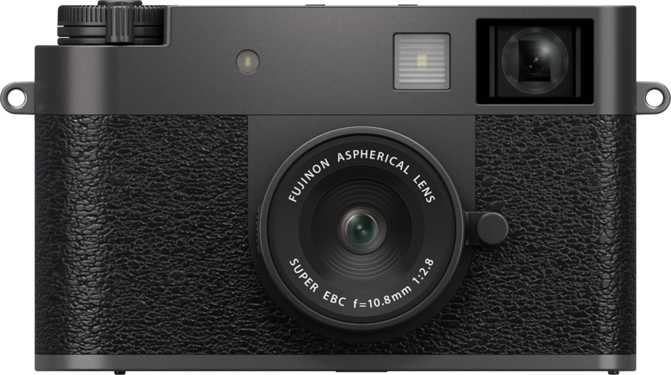
Fujifilm GFX100RF Review: Medium Format Genius in a Compact Body
CamerasA 102-megapixel medium format sensor in a compact, weather-sealed body with a fixed 28mm prime. Exceptional image quality with clear, deliberate trade-offs.
A Camera That Rewrites the Rules
For most of photography's modern history, medium format has been the domain of tripods and studios. The sensors are large, the lenses are substantial, and the cameras are systems — meaning commitment not just to a body but to a hierarchy of glass that can reach six figures in total. The GFX100RF is a direct challenge to that assumption. It takes a 102-megapixel medium format sensor — the kind of imaging hardware that would typically anchor a professional studio setup — and packages it into a compact, fixed-lens body you could fit in a large jacket pocket.
This is not a camera for everyone. It costs a serious amount of money, it offers a single focal length with a relatively modest maximum aperture, and it has no stabilization whatsoever. Anyone who buys this camera without understanding those trade-offs will regret it. But for the photographer who understands exactly what it is, the GFX100RF offers something rare: the tonal depth, color fidelity, and resolving power of medium format imaging without the bulk of a system camera.
Sensor and Image Quality
The GFX100RF's most fundamental advantage — its reason to exist — is the sensor. Medium format refers to sensors physically larger than the 35mm full-frame standard used by most professional cameras. On a larger sensor, each individual photosite can be made larger, capturing more light and recording finer gradations of tone and color before noise becomes an issue.
Resolution That Redefines the Word “Crop”
At 102 megapixels, the GFX100RF delivers files that most photographers will never fully exhaust. A single image can be printed at billboard scale and remain sharp. More practically, the resolution gives photographers the ability to crop dramatically in post-production — effectively producing multiple compositional choices from a single frame.
For editorial and commercial photographers building tight layouts, advertising photographers supplying agencies, or landscape photographers who want to extract a distant detail from a wide scene, this is not a vanity specification. It changes how you work.
The sensor uses a back-illuminated architecture, a design that reorganizes the sensor's internal components to allow each photosite to collect light more efficiently. The real-world benefit shows up in the tonal transitions between highlights and shadows — the smooth, layered gradations that photographers who have worked with medium format describe as distinctive, and find difficult to replicate on smaller formats.
ISO Range and Low-Light Realities
The native sensitivity range extends to a modest ceiling relative to some full-frame cameras of comparable resolution. Expanded sensitivity modes push considerably further, but with the noise increase any experienced photographer expects. More critically, the GFX100RF carries no optical or sensor-based stabilization, meaning that in low light, sharp handheld results depend entirely on shutter speed and technique. The wide-angle character of the fixed lens helps, but in genuinely dark environments, this camera demands either elevated sensitivity or a support of some kind.
The Fixed 28mm Lens: Commitment as Philosophy
The GFX100RF is not a system camera. There is no lens to swap, no adapter to fit, no roadmap of future glass to plan around. You get one focal length, and that focal length is 28mm on a sensor larger than full frame.
What This Field of View Looks Like in Practice
Because the GFX sensor is larger than a standard full-frame sensor, a 28mm lens here delivers a wider angle of view than the same focal length provides on a full-frame body. The perspective is expansive — appropriate for landscapes, architecture, environmental portraiture, and documentary photography where showing the subject within their world matters as much as the subject itself.
This is not a telephoto look. You will not isolate a subject against a dissolved background from ten meters away. What you can do is get physically close to people and scenes and render a rich, sharp, context-filled image that feels immersive rather than extracted. Photographers who have built their visual language around 28mm will recognize this camera as a tool built around their way of seeing.
The f/4 Aperture: An Honest Assessment
The maximum aperture of f/4 will cause the most hesitation among prospective buyers, and that hesitation is reasonable. On a full-frame camera, f/4 is considered moderate — usable in good light, limiting in dim interiors. On medium format, the larger sensor's inherent depth-of-field characteristics mean f/4 here renders focus fall-off more like f/3.2 on full frame — slightly more subject separation than you might expect, but nothing close to the aggressive background dissolution of fast prime lenses.
What f/4 does allow, paired with a purpose-designed prime, is edge-to-edge sharpness. A lens with a fixed focal length and moderate aperture is significantly easier to design without optical compromises. The GFX100RF's lens can reasonably be expected to deliver precise rendering across the full 102-megapixel sensor from corner to corner — which is precisely what maximum-resolution photography demands.
Aperture Character and Close-Focus Capability
Smooth, circular out-of-focus rendering at all apertures — no polygonal edges in background blur.
Close-up photography of objects, food, and fine details — a practical range rarely found in wide-angle lenses.
For very bright shooting conditions, an electronic shutter option reaches extremely high shutter speeds, allowing f/4 shooting in direct sunlight without a neutral density filter.
Body Design and Build Quality
Size, Weight, and What “Compact” Really Means
The phrase “compact medium format camera” requires calibration. The GFX100RF is compact relative to other GFX system bodies and to the medium format cameras that preceded this era. It is not compact in the sense of a shirt-pocket camera. At 735 grams before accessories, the camera weighs more than many full-frame mirrorless bodies without any lens attached.
Carry it on a neck strap for a full day and you will feel it. Use it with a good wrist strap and the weight becomes manageable. This is a dense, substantial piece of equipment that trades pocketability for imaging output that no pocketable camera can match.
Weather Sealing and Operational Range
The body is sealed against splashing water and rated to operate in temperatures as low as -10°C. This is not a nominal specification for marketing materials — it reflects real engineering that expands the camera's working environment. Architecture photographers caught in rain, landscape photographers working in coastal mist, and documentary shooters operating in unpredictable conditions all gain real reliability from this protection.
Sealed against water splash and airborne particles for real-world outdoor use in demanding conditions.
Sub-zero certified — functional in winter conditions where unprotected electronics struggle.
No built-in flash is present. A hot shoe accommodates external flash units and wireless triggers — the correct approach for a camera at this positioning. Casual shooters who occasionally want fill light will need to carry an additional accessory. A lens hood is included in the box.
Viewfinder and Screen
The Electronic Viewfinder
The EVF in the GFX100RF resolves an exceptional amount of fine detail — among the finest in any compact camera body. The practical benefit is confidence: you can critically evaluate manual focus, check for motion blur in your hands, and compose with the precision that 102-megapixel output demands. The viewfinder covers one hundred percent of the captured frame, meaning what you see through the finder is exactly what the sensor records. No framing surprises arrive after the fact.
The viewfinder does not tilt, which is a real limitation for overhead or low-angle compositions where access to the eyepiece becomes awkward.
The Flip-Out Touchscreen
The 3.15-inch rear screen articulates away from the body on a flip-out mechanism, enabling shooting at angles the fixed viewfinder cannot serve — waist level, above a crowd, or from a low perspective close to the ground. The touch functionality extends to autofocus placement: tapping any region of the screen redirects the focus point instantly, which is particularly effective for off-center compositions where navigating a joystick through multiple inputs would slow reaction time.
Autofocus Performance
The GFX100RF uses phase-detection autofocus across 425 individual points spanning the frame. Phase detection evaluates focus error directly, making it faster to acquire and more reliable in tracking than older contrast-detect systems — and it operates for both still photography and video without requiring a mode switch.
Subject tracking maintains focus on a moving subject as it crosses the frame — a useful addition for candid and street photography, though not sufficient for the demands of sports or wildlife where speed and reach are paramount.
Continuous shooting reaches six frames per second. For portrait sessions, documentary work, and landscapes this pace is adequate. For action photography of any kind, it would frustrate. The camera powers on in approximately 0.6 seconds — fast enough to be ready before a spontaneous moment fully passes.
The Stabilization Trade-Off
The absence of any image stabilization — in either the sensor or the lens — is the GFX100RF's most significant technical limitation and must be stated without softening. At 102 megapixels, the consequences of camera movement during exposure are amplified. Pixel-level detail that would survive slight motion blur at lower resolutions will not survive it here.
The wide-angle focal length helps considerably. Shorter focal lengths require less precision to hold still at a given shutter speed than telephoto lenses. Photographers who consistently use proper hand-holding technique and default to appropriately fast shutter speeds in handheld situations will adapt without great difficulty.
Where the absence of stabilization becomes a real constraint is in low interior light, during long-exposure work without a tripod, or when shooting slow-moving subjects in dim conditions. In these scenarios, the camera demands either a higher ISO, a support, or both. Photographers whose work frequently places them in these conditions should weigh this carefully before committing.
Video Capabilities: Serious but Specialized
What the GFX100RF Can Do for Video
The video specifications are more capable than the camera's overall positioning might suggest. It records 4K footage with an internal bitrate significantly higher than most cameras in any class — approximately three times what many professional hybrid cameras offer internally. This means footage preserves an exceptional amount of color information, compresses gently, and responds well to grading in post-production without falling apart under heavy correction.
- 720 Mbps internal bitrate — among the highest in any camera body
- 4K at both 30fps and cinema 24p modes
- Phase-detection continuous AF during recording
- Dual stereo mics plus 3.5mm external mic input
- HDMI output for external recorders and monitors
- Built-in timelapse function
- No slow-motion capability at any resolution
- Maximum 4K/30fps — no 4K at 60fps
- No high-frame-rate mode at any resolution
- No image stabilization — requires careful handling or gimbal
- No live streaming support
Bottom line on video: For photographers who occasionally capture video, the very high bitrate footage is a real asset. For videographers hoping to use this as a primary production tool, the frame rate ceiling and absence of slow motion are firm and defining constraints.
Battery Life: A Reliable Strength
Medium format cameras are not traditionally associated with generous battery endurance. The GFX100RF is an exception. Its CIPA-rated shot count is exceptional for the category, outperforming most full-frame mirrorless cameras at comparable resolution points. A working photographer can complete a standard portrait, landscape, or architectural session without a battery change.
The battery is removable, making it straightforward to carry a spare and swap in the field. The USB-C connection allows in-camera charging from a power bank, providing flexibility for travel photographers without access to wall power between shoots. A battery level indicator offers enough granularity to plan shooting time around what remains.
Connectivity and Workflow
The GFX100RF's connectivity supports the workflow demands of professional photographers without unnecessary complexity.
Simultaneous backup writing and overflow protection. For commissioned work where losing files is not acceptable.
Full sensor data depth for post-processing. Files are large and demand fast cards, ample storage, and capable hardware.
File transfer, remote shutter, and persistent low-energy smartphone pairing. Useful for tripod work and self-portraits.
USB-C handles both charging and data. HDMI connects to external recorders, monitors, or tethered capture workflows.
Geotagging is available via paired smartphone only. On-board location logging is absent.
Near-field pairing is absent. Bluetooth and Wi-Fi achieve the same result, with slightly more initial setup.
Who This Camera Is Built For — and Who Should Look Elsewhere
Built For You If…
- Landscape & Architecture PhotographersWho need maximum resolution, a wide-angle perspective, and weather sealing to work in real environmental conditions.
- Committed Travel PhotographersWho prioritize image quality over versatility and have the discipline to shoot with a single, deliberate focal length.
- Portrait & Editorial PhotographersWorking in natural light or with studio strobes who need files capable of aggressive cropping for publication layouts.
- Documentary & Street PhotographersWorking in the tradition of wide-angle immersive storytelling, who value environmental sealing for unpredictable conditions.
Look Elsewhere If…
- Video-First CreatorsWho need slow-motion capability, 4K/60fps, or the full range of tools that primary production cameras provide.
- Sports & Wildlife PhotographersWho require faster burst rates, longer focal lengths, and the reach of a telephoto-capable interchangeable-lens system.
- Photographers New to Medium FormatWho have not yet confirmed commitment to a single focal length. An interchangeable-lens MF body allows more freedom to explore.
- Low-Light SpecialistsEvent photographers and astrophotographers who need stabilization and a faster aperture for sharp results in the dark.
How the GFX100RF Stacks Up Against the Competition
The GFX100RF occupies a position in the market with no exact parallel. Premium full-frame fixed-lens compacts offer faster apertures and lighter bodies, but smaller sensors. Interchangeable-lens medium format cameras in the same sensor family offer adaptability, but require a system of lenses to reach that potential. APS-C fixed-lens cameras come at substantially lower prices with substantially lower resolution. The GFX100RF's argument is that none of these alternatives combines medium format sensor size, 100-megapixel-class resolution, and a compact fixed-lens form factor simultaneously.
| Feature | Fujifilm GFX100RF | Premium Full-Frame Compact | APS-C Fixed-Lens Compact |
|---|---|---|---|
| Sensor Size | Medium Format | Full Frame | APS-C |
| Resolution | 102 MP | ~60 MP class | 26–40 MP class |
| Lens Type | Fixed 28mm f/4 | Fixed fast prime | Fixed moderate prime |
| Weather Sealing | Varies | ||
| Image Stabilization | None | Optical | Sensor-Based |
| Portability | Moderate Compact | Compact | Very Compact |
| Video Bitrate | Very High (720 Mbps) | Moderate to High | Moderate |
Strengths and Weaknesses: An Honest Assessment
Where the GFX100RF Excels
Sensor Output Quality
At 102 megapixels on a medium format BSI sensor, image files carry a tonal quality — particularly in highlight-to-shadow gradations — that photographers familiar with this format recognize immediately. This is the camera's defining advantage and its reason to exist.
Exceptional EVF Resolution
The viewfinder resolves enough detail for critical manual focus evaluation and precise composition at the full resolution of the sensor. Combined with 100% frame coverage, what you see is precisely what you get.
Battery Endurance
The CIPA-rated shot count is exceptional for a medium format camera — better than most full-frame mirrorless cameras at comparable resolution points. A full working session without a battery change is consistently achievable.
All-Weather Capability
Sealed against splash and rated to operate below freezing, the GFX100RF expands into environmental conditions that many premium cameras cannot follow. This is real-world reliability built into the engineering.
Where It Falls Short
No Image Stabilization
The most significant limitation by a considerable margin. At 102 megapixels, any camera movement is amplified beyond what smaller sensors would reveal. Low-light handheld work demands deliberate technique, higher shutter speeds, or a support.
f/4 Maximum Aperture
Moderate by full-frame standards and limiting in low light. Medium format physics soften the depth-of-field impact slightly, but f/4 remains the most-cited specification among buyers who ultimately choose a faster-aperture competitor.
Video Frame Rate Ceiling
The high internal bitrate is genuinely useful, but 4K/30fps as the maximum — with no slow-motion option at any resolution — narrows the camera's video usefulness compared with competing hybrid cameras at this price point.
Weight Relative to “Compact” Billing
735 grams is appropriate for what the camera contains, but buyers expecting a lightweight portable will be surprised. It is compact relative to the GFX system — not relative to the broader camera market.
Final Verdict
The Fujifilm GFX100RF is a camera for a specific type of photographer — one who has decided that the quality ceiling matters more than the flexibility floor. It answers the question of what the highest image quality looks like in a compact, single-lens body that can be carried without a dedicated bag and used in real weather conditions.
The answer is 102 megapixels on a medium format BSI sensor, a precisely designed 28mm prime with nine rounded aperture blades, an EVF that shows you the scene with exceptional clarity, and a battery that lasts a full working day. That answer requires accepting a fixed focal length, an f/4 aperture, and no stabilization of any kind.
Buy it if you are a…
Landscape, travel, architecture, or editorial photographer who has outgrown full-frame resolution and is committed to the 28mm wide-angle perspective.
Skip it if you need…
Zoom flexibility, image stabilization for low-light work, slow-motion video, or a faster aperture for subject isolation and available-light shooting.