Fairphone Fairbuds XL Full Review: The Case for Buying Differently
HeadphonesMost headphones ask you to make a trade-off between sound quality, comfort, and conscience. The Fairphone Fairbuds XL refuse that compromise. Built by a company that has spent years proving consumer electronics can be ethical without being mediocre, these over-ear headphones enter a crowded market with a proposition that goes beyond spec sheets: buy something you can repair, keep for years, and feel genuinely good about owning.
That pitch only works if the product is competitive on its own technical merits. Does the Fairbuds XL hold its own against rivals that carry none of Fairphone's philosophical overhead? The answer is more interesting than a simple yes or no.
Build Quality and Design: Durability With a Purpose
How It Feels in Your Hands
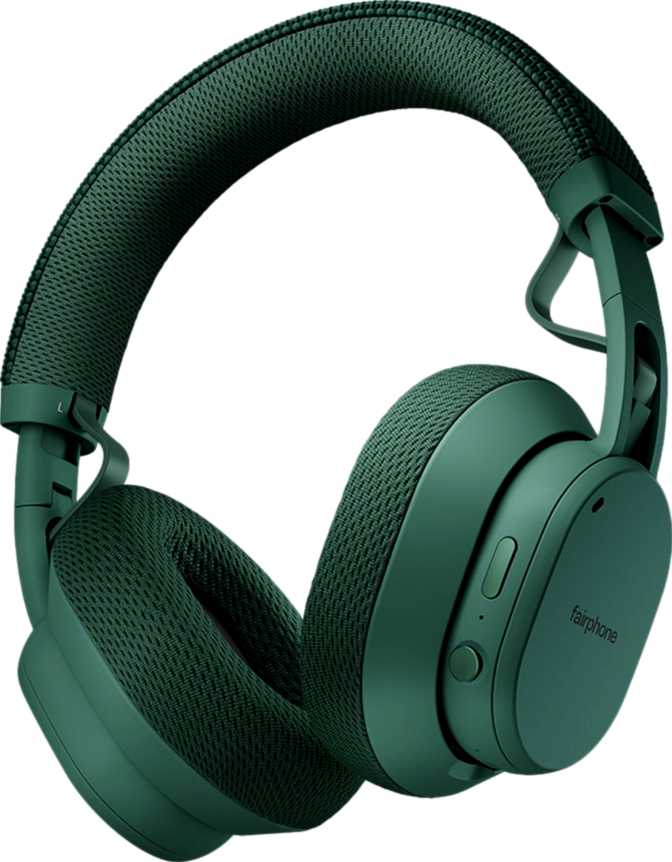
At 330 grams, the Fairbuds XL sits toward the heavier end of the over-ear category. Many popular consumer headphones hover between 250 and 285 grams, so this is noticeable if you are used to lighter options. That weight is not unusual for headphones built with longevity in mind — the engineering philosophy here prioritizes modularity over shaving every gram.
The headphones fold flat, which is exactly what you want from a pair designed for travel and daily commuting. The included travel bag makes this a ready-to-go package out of the box without requiring a separate accessory purchase.
Built to Last — Literally
The IP54 rating carries real meaning. The first digit (5) signals protection against dust particles. The second digit (4) means they handle water splashes from any direction — rain, workout sweat, caught-off-guard weather. This is not full waterproofing, but it is genuine environmental resilience rather than a marketing asterisk.
What sets the Fairbuds XL apart structurally is the detachable cable and, more significantly, the removable battery. These are engineering decisions most manufacturers abandoned years ago in pursuit of thinner profiles. Fairphone kept them because a battery you can swap at home means a headphone that does not become landfill when the cell degrades after two or three years. Combined with a three-year warranty — at least twice the industry standard — this is a product designed to remain functional for the long term, not just through the return window.
The tangle-free cable is a small but daily-relevant detail. Anyone who has spent time unknotting headphone cables inside a bag will appreciate it without needing further justification.
- Fit: Over-ear, closed-back
- Weight: 330 g
- Protection: IP54 — dust + splash resistant
- Foldable: Yes — compact for travel
- Cable: Detachable and tangle-free
- Battery: User-replaceable
- Warranty: 3 years
- Travel bag: Included
Sound Performance: What the Drivers Actually Deliver
The Fundamentals
The Fairbuds XL uses 40-millimeter dynamic drivers — the moving components inside each ear cup that convert electrical signal into sound. Forty millimeters is a well-established size for over-ear headphones, large enough to move air convincingly at low frequencies without the engineering complications of larger custom drivers.
The impedance of 32 ohms means the Fairbuds XL drives well directly from a smartphone or laptop without any external amplification — you will not need a dedicated headphone amp to reach full volume and dynamic range. The sensitivity rating delivers adequate loudness from typical devices without distortion at comfortable levels, while the frequency response covers the complete range of human hearing from the lowest bass tones to the upper ceiling of audibility.
The driver specifications suggest a headphone tuned for broad consumer appeal rather than hyper-analytical listening — a sensible choice for a product with this positioning and intended audience.
Active Noise Cancellation: What to Expect
With six microphones distributed across the headphones, the Fairbuds XL has the hardware foundation for capable ANC. Multiple microphones allow the system to sample ambient noise from different positions — outside the ear cup, inside, and at various angles — giving the processing engine more information when generating the cancellation signal.
Passive noise reduction — the physical blocking of sound through the ear cup seal and padding — works alongside the active system. The closed-back over-ear design tends to block mid-to-high frequency noise even without ANC engaged: office chatter, air conditioning hum, keyboard noise. The ANC layer then targets lower-frequency rumble that the physical seal cannot stop as effectively, such as aircraft engine noise or subway vibration.
Battery Life and Power: The Practical Numbers
How Long Will It Actually Last?
Thirty hours of playback on a single charge is a strong result in the over-ear category. That covers roughly five full working days of eight-hour listening, or three long-haul international flights with time to spare. Enabling ANC draws the battery down to approximately 26 hours — still excellent, and the reduction is smaller than many competing headphones experience when active cancellation is running.
The removable battery changes the long-term calculus entirely. Standard rechargeable cells in sealed headphones degrade over charge cycles, typically losing meaningful capacity within two to four years. The Fairbuds XL lets you replace the battery yourself when that happens. For buyers who plan to keep headphones for five years or more, this is the difference between a product that stays useful and one that quietly becomes unreliable.
Charging is handled via USB-C, so you almost certainly already own compatible cables. Wireless charging is absent — an omission that buyers with charging pads on their desk will notice. In practice, USB-C charges faster and more efficiently, so the absence rarely becomes a real daily friction point.
A battery level indicator keeps you informed of remaining charge, making unexpected silence mid-commute an avoidable situation with basic awareness of the readout.
Battery at a Glance
- USB-C charging
- Battery level indicator
- User-replaceable cell
- No wireless charging
Connectivity and Codec Support: Where Nuance Matters
Bluetooth Basics
Bluetooth 5.1 handles the wireless connection with a practical range of around 10 meters — standard for personal headphone use. In real-world conditions, a room or two between you and your source device, performance is reliable. Multipoint connection supports two devices simultaneously, so you can stay paired to your laptop and phone at the same time and switch between them without manual re-pairing each time.
Codec Support: The Honest Assessment
The Fairbuds XL supports aptX HD and AAC over Bluetooth. AAC is particularly relevant for Apple device users — iPhones and iPads default to AAC when available, delivering noticeably better wireless audio quality than the SBC baseline. aptX HD supports high-resolution audio transmission for compatible Android sources, theoretically enabling quality beyond CD-standard over Bluetooth.
What is absent is also worth stating clearly. There is no LDAC (Sony's codec for the highest Bluetooth audio quality currently available), no aptX Adaptive (Qualcomm's next-generation variable-bitrate codec), and no Bluetooth LE Audio. For most listeners, this will never matter in practice — the audible difference between aptX HD and LDAC is detectable only in controlled environments with high-quality source material. Buyers who specifically prioritize LDAC for high-resolution Android streaming should factor this in before purchasing.
There is no NFC pairing or Google Fast Pair support. Pairing follows the standard Bluetooth menu process — a one-time step most people complete without difficulty, but worth noting for those who value streamlined device setup.
| Codec | Supported | Best For |
|---|---|---|
| AAC | iPhone, iPad, and Mac users | |
| aptX HD | Hi-res audio from Android sources | |
| LDAC | Not supported | |
| aptX Adaptive | Not supported | |
| aptX Low Latency | Not supported | |
| Bluetooth LE Audio | Not supported |
Microphone and Call Performance
Six microphones is a count that appears in premium headphones aimed at hybrid workers and frequent callers. The noise-canceling microphone system is designed to isolate your voice from background noise during calls — an important distinction from ANC, which is about what you hear. Together, they address both sides of a conversation simultaneously.
The Fairbuds XL functions as a full headset for calls and voice applications. There is no dedicated mute button, which is a practical gap for anyone who frequently toggles their microphone during video calls. Most platforms include a software mute shortcut, but a physical button on the headset itself is a convenience that power users will notice is missing.
Auto-pause — which detects when you remove the headphones and pauses playback automatically — is also absent. Not a dealbreaker, but a feature that has become expected at this price tier and its absence adds small daily friction for certain use patterns.
Who Should Buy the Fairbuds XL — and Who Shouldn't
- Sustainability-conscious buyers who want a product designed for longevity, repairability, and reduced environmental impact without sacrificing daily performance.
- Commuters and frequent travelers who need reliable ANC, excellent battery endurance, and robust physical protection in one foldable package.
- Apple ecosystem users whose devices pair well with AAC and who benefit from dual-device multipoint when moving between iPhone and MacBook.
- Long-term owners — the removable battery and three-year warranty make this a compelling five-plus-year investment that most rivals simply cannot match.
- Hybrid workers who need ANC for deep focus and ambient mode for situational awareness throughout the working day.
- Android audiophiles who specifically need LDAC for high-resolution streaming from services like Tidal or Amazon Music HD — this headphone does not support it.
- Gym and intense workout users — IP54 handles sweat and light rain, but at 330 grams this is not a fitness-first product and will feel heavy during vigorous exercise.
- Video editors and gamers who need low-latency audio — the absence of aptX Low Latency can introduce noticeable audio-to-video sync delay over Bluetooth.
- Premium feature seekers expecting spatial audio, auto-pause, a dedicated mute button, NFC pairing, or fast pair support — none of these are included.
Competitive Positioning: How It Stacks Up
The Fairbuds XL competes credibly on the features most buyers use every day — ANC, battery life, call quality, and connectivity. Where it falls behind premium rivals is in codec breadth and convenience features. Where it surpasses them is long-term ownership value: no competitor at this level combines a removable battery, a three-year warranty, and an explicit design commitment to repairability.
| Feature | Fairbuds XL | Premium Rivals (Sony / Bose tier) |
Mid-Range Competition |
|---|---|---|---|
| ANC | Sometimes | ||
| Removable Battery | Only option here | ||
| aptX HD | Varies | ||
| LDAC | Often (Sony) | ||
| Warranty | 3 years | 1–2 years | 1 year |
| IP Rating | IP54 | IP44–IP54 | Often none |
| Repairability | Designed for it | Sealed unit | Sealed unit |
| Multipoint | 2 devices | 2 devices | 1–2 devices |
| Auto-Pause | Sometimes |
Strengths and Weaknesses: The Honest Take
The Fairbuds XL makes a strong case for itself on the substance that matters most to daily listeners. But the compromises are real and worth understanding fully before you commit.
Where It Excels
Battery endurance is genuinely excellent — five working days of eight-hour listening between charges is a practical advantage that competing headphones rarely match without compromises in size or feature set.
ANC backed by six microphones gives the system more hardware than many rivals include at a comparable price point. The IP54 rating and foldable design make this a practical commuter headphone built to handle real-world conditions without precious treatment.
The removable battery addresses a problem the entire headphone industry typically ignores: what happens when the cell ages. This single feature makes the Fairbuds XL more valuable in year three than most rivals are in year one — and that is before factoring in the three-year warranty.
Where It Falls Short
Codec support is narrower than the current state of the art. Buyers with LDAC-capable Android devices and high-resolution audio libraries will find the Fairbuds XL does not unlock that capability — and the gap between aptX HD and LDAC is one that committed listeners can sometimes detect with quality source material.
The missing auto-pause and physical mute button are not dealbreakers individually, but they are the kind of small daily frictions that accumulate over months of use. Their absence feels more pronounced given this headphone's positioning and price tier.
The Bluetooth range ceiling — tighter than some rivals that extend to 30 meters or beyond — can surface as an occasional issue if you routinely leave your source device in one room and move freely around a home or office.
Common Buyer Questions Answered
Final Verdict: The Case for Buying Differently
The Fairphone Fairbuds XL is not the headphone that wins every spec comparison. It does not have LDAC. It does not auto-pause. It is heavier than some alternatives and its Bluetooth range is unremarkable by current standards.
What it has is a coherent reason to exist — and that matters more than individual spec victories. A replaceable battery, a genuine three-year warranty, IP54 protection, capable ANC with a six-microphone array, and excellent stamina between charges form a package that most buyers will find genuinely excellent in daily use. The design philosophy is not a marketing angle applied to an average product — it is embedded in the engineering choices that make this headphone more valuable in year three than most rivals are in year one.
- Value longevity over chasing the latest feature
- Listen primarily through Apple or AAC-capable Android devices
- Need reliable ANC and durability for daily commuting
- Plan to own your headphones for five or more years
- Require LDAC compatibility for high-resolution streaming
- Rely on spatial audio, auto-pause, or a physical mute button daily
- Play video games and need low-latency Bluetooth audio
- Expect the full premium convenience feature set at this price
and anyone who plans to own their headphones long-term.