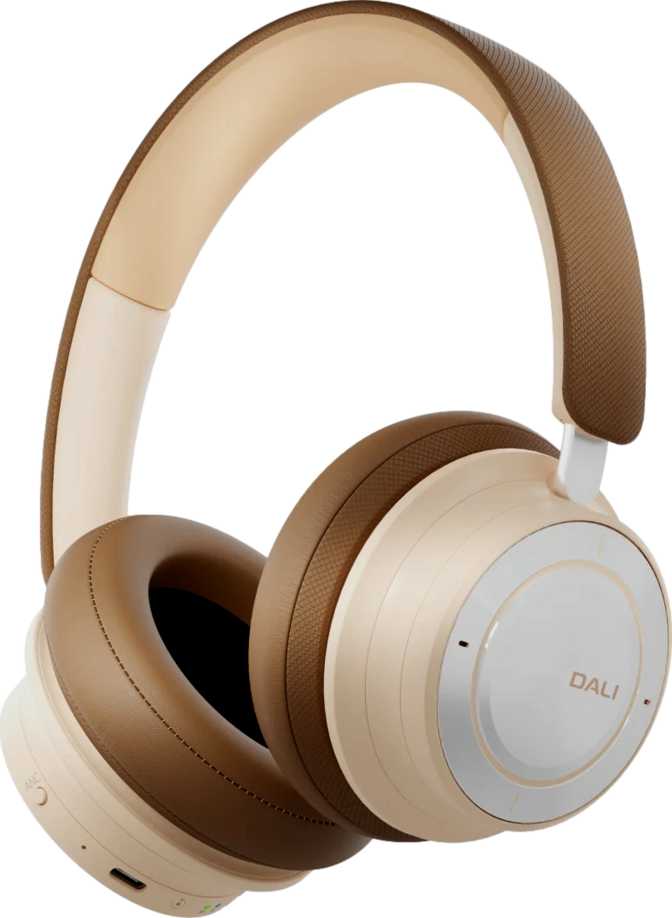
Dali IO-8 Overview
DALI has spent decades refining how sound moves through air, building transducers for loudspeakers that appear in high-end listening rooms and serious home audio setups across the world. The IO-8 is the company's assertion that the same engineering discipline applied to speakers belongs in a wireless headphone. That's a meaningful claim in a market crowded with consumer electronics brands optimizing for convenience features, app integrations, and lifestyle marketing.
The IO-8 is not competing for the widest possible audience. It's competing for the listener who has watched wireless headphones improve year after year while still feeling that something essential, the fidelity, the physical authority of reproduced sound, gets left behind the moment the cable comes off. Whether DALI's argument holds up, and where the headphone asks you to accept genuine trade-offs, is what this review lays out in full.
Up to 35 Hours
Rated battery life
50mm Drivers
DALI-engineered
aptX Adaptive
High-res wireless
325g Foldable
Over-ear build
Quick Take
Best For
- Audiophiles who want wired-grade sound without the cable
- Long desk and office sessions needing all-day battery
- Android owners with Qualcomm aptX Adaptive support
Not Ideal For
- Gym, running, or any sweat and rain exposure
- Sony ecosystem owners who rely on LDAC
- Travelers who need an included carry case
Design and Build Quality
Form, Weight, and Wearing Experience
The IO-8 is a closed-back, over-ear headphone, the format that serious headphone engineering has favored for decades because the closed capsule around each ear serves both passive noise attenuation and sonic consistency. Sound stays where it should, and the physical environment contributes to the listening experience rather than fighting it.
At 325 grams, these are headphones you'll feel on your head. That's not a disqualifying statement, but it is an honest one. Some of the most popular noise-canceling headphones in the premium tier weigh 70 to 80 grams less, a difference that becomes noticeable across a long work session or a four-hour flight. Listeners who are particularly sensitive to head pressure should try a similarly weighted pair before committing. For most people, the fit adapts within fifteen or twenty minutes of wear.
The IO-8 folds, which makes it practical to store and carry without taking up a fixed amount of space. The folding mechanism is the correct response to the headphone's size, without it, packing these would be a consistent inconvenience.
- Fit
- Closed-back, over-ear
- Weight
- 325 g
- Cable
- Detachable, 1.2 m, tangle-resistant
- Folding
- Yes
- Travel Case
- Not included
- Water Resistance
- None
The Missing Travel Case
DALI has not included a carry case or even a basic protective pouch in the box. For a headphone at this price point, that is a notable omission worth stating plainly. Every direct competitor discussed later in this review ships with some form of protective storage. Buyers who want to travel with the IO-8, or simply protect it from dust and scratches between uses, will need to source their own solution before the headphone leaves the house.
Cable Design
The detachable cable design deserves more credit than it usually gets in headphone reviews. Cables are statistically the most common component to fail on any headphone, they flex, they fray, they develop intermittent connections. A cable you can simply unplug and replace extends the practical life of the headphone considerably, and it allows the use of third-party cables if a different length or termination is preferred.
The included cable runs 1.2 meters, right for connecting to a laptop on a desk or a phone in a pocket, but short for connecting to desktop audio equipment across a room. The cable finish is tangle-resistant, meaning it won't coil up into a frustrating knot at the bottom of a bag. There is no in-line remote on the cable, all controls sit on the headphone itself, which is consistent with a primarily wireless device.
Where It Won't Go
The IO-8 carries no water or sweat resistance rating. Rain, gym use, humid environments, and outdoor exercise are outside its intended context. This is a focused listening headphone, home, office, and controlled environments. Using it in conditions where moisture contact is a realistic possibility puts an expensive piece of audio hardware at risk.
Sound Performance
Driver Engineering: DALI's Distinctive Approach
The IO-8 uses 50-millimeter dynamic drivers, larger than what most competitors fit into their ear cups. Larger drivers move more air per cycle, which tends to produce more natural bass extension and a wider dynamic range, though driver size alone never tells the complete story. What DALI has done differently from virtually every other headphone in this market is abandon the neodymium magnet configuration that has become the default for high-performance audio drivers.
This reflects DALI's identity as a company that designs its own transducer systems from first principles rather than selecting from the same pool of components used across the industry. The specific magnetic architecture they've chosen in place of the industry standard is the kind of engineering detail that separates a speaker company applying genuine expertise from a consumer electronics firm purchasing components to specification.
Frequency Response and What It Actually Means
The IO-8's driver reproduces frequencies beginning well below the threshold of human hearing, into the range where bass is felt as much as heard. Sub-bass frequencies this low carry the physical weight of an organ's pedal notes, the foundation of orchestral bass sections, and the chest-presence of electronic music's lowest registers. Most headphones in this category roll off before reaching that depth or reproduce it weakly.
On the high end, the IO-8 extends well past the upper boundary of human hearing, deep into ultrasonic territory. This matters specifically for high-resolution audio. Standard CD-quality audio and most compressed streaming runs up to 20,000 Hz. High-resolution recordings capture harmonic and overtone information beyond that ceiling. A driver that physically cannot reproduce those frequencies simply discards that information. The IO-8's hardware puts no ceiling on what the source material can deliver, though for listeners using standard streaming quality, this extended range offers no immediate benefit beyond future-proofing.
Driving the IO-8 from Different Sources
At 25 ohms, the IO-8 is straightforwardly easy to power. A smartphone, a laptop, a tablet, any of these can drive it adequately via the cable connection without requiring a separate headphone amplifier. This is the right impedance choice for a headphone that is also expected to function wirelessly, it ensures the wired fallback is genuinely convenient, not an option that requires additional equipment. Audiophiles who own dedicated headphone amplifiers will find that better-quality output from a capable source is rewarded, but such equipment is not a prerequisite for good results.
Active Noise Cancellation and Ambient Listening
How the IO-8 Manages Ambient Noise
The IO-8 approaches noise management as two reinforcing layers rather than a single system.
Passive Isolation
The closed-back ear cups create a physical seal that attenuates higher-frequency environmental sound, voices, keyboards, background music, simply through the barrier they create. This requires no electronics and costs no battery life.
Active Cancellation
Electronic ANC targets continuous low-frequency noise that passive isolation handles poorly, aircraft cabin drone, air conditioning hum, transit rumble. The electronics sample incoming sound and generate a counteracting signal.
The practical advantage of this combined approach is that the ANC system is not doing all the work alone. A well-sealing closed-back design means the ANC is managing residual noise rather than compensating for a fundamentally open acoustic environment, which generally produces a cleaner and less processed result.
Ambient Sound Mode
When full isolation is unsafe or socially inappropriate, crossing a street, being spoken to in an office, checking in at a counter, the IO-8 includes an ambient sound mode that allows environmental audio to pass through the electronics to the listener. This is toggled directly on the headphone without requiring a phone or an app.
Wireless Performance and Codec Support
The Codec Question Explained
Bluetooth audio quality is determined by two things working together: the Bluetooth connection infrastructure and the audio codec, the method used to compress and transmit sound wirelessly. The IO-8 supports multiple codecs, which means different users will get different levels of wireless audio quality depending on what their playback device supports.
| Codec | Supported | Quality Tier |
|---|---|---|
| aptX Adaptive | Yes | High-resolution, interference-adaptive |
| aptX HD | Yes | High-resolution |
| aptX (standard) | Yes | Standard wireless |
| AAC | Yes | Standard, used by iPhone |
| LDAC | No | Not available |
| LE Audio | No | Not available |
aptX Adaptive is the highest-quality wireless codec the IO-8 supports, and its inclusion is significant. It is capable of transmitting audio at genuine high-resolution quality, 24-bit audio at elevated sample rates, and it does so by dynamically adjusting its data rate in response to wireless interference. On a compatible Android device, which means most current flagship phones from Samsung, Google, OnePlus, and similar manufacturers, aptX Adaptive brings the IO-8's wireless performance close to what the wired connection delivers.
aptX HD provides a high-resolution wireless tier for devices that support that standard but not the newer Adaptive version. Standard aptX and AAC cover the broader device landscape. AAC is the relevant codec for Apple device users, iPhones and iPads do not support the aptX family at all, and AAC represents the ceiling of wireless audio quality those devices can negotiate with any headphone. iPhone users will get a genuinely listenable wireless experience from the IO-8, they will not access its highest wireless capability.
LDAC is absent. Sony's high-resolution wireless codec, which Android has supported for several years and which Sony's own headphones, DAPs, and some Bravia televisions use, is not supported. This matters specifically to listeners who have deliberately chosen Android hardware that supports LDAC, or who own Sony wireless audio equipment and expected codec interoperability.
Bluetooth Infrastructure and Range
Bluetooth 5.2 manages the connection, providing stable pairing, efficient power negotiation, and compatibility with essentially all current devices. The wireless range reflects use within a single room, roughly the distance from a seated listening position to the other end of a medium-sized living room or office. This headphone is built for focused, contained listening, not for whole-home wireless coverage. There is no NFC one-tap pairing and no platform-native fast pairing protocol, so first-time setup per device requires the standard pairing process, a one-time inconvenience that becomes irrelevant within the first week of use.
Battery Life and Charging
Endurance That Fits Real Listening Habits
Thirty-five hours of rated battery life is substantial. A listener who puts in three hours of listening per day charges the IO-8 roughly twice a week. A heavier user at six or seven hours daily charges just over once a week. For context, many well-regarded noise-canceling headphones in the premium tier rate between 20 and 30 hours, the IO-8 sits at the top of the competitive range on endurance. The battery level indicator on the headphone itself means you can check remaining charge at a glance without opening a companion app.
Charging: What's There and What Isn't
USB-C handles charging, the same connector used by most current phones, laptops, and tablets. Owning the IO-8 does not require a proprietary cable or adapter, and the charger already on your desk is the right charger.
Wireless charging, the kind where you set the headphone on a pad, is not supported. The IO-8 must be plugged in to charge. For the focused listening audience this headphone is built for, plugging in during a desk session or overnight is unlikely to be a friction point.
Controls and Microphone
Physical Controls on the Headphone
All playback controls, ANC toggling, and ambient mode switching are handled through the physical control panel built into the headphone. This is the correct design for a wireless-first device, the user's hands reach for the cup rather than for the cable or the phone. There is no in-line remote on the wired cable, which means wired listening routes all control through the headphone's on-device buttons or directly through the connected device.
Headset Capability and Microphone Quality
The IO-8 includes a noise-canceling microphone, making it a functional headset for calls, video conferences, and voice input. The microphone's noise-canceling processing works to distinguish the speaker's voice from background noise, a meaningful improvement over a standard microphone pickup in office environments, busy transport settings, or anywhere the ambient sound level competes with the user's voice. This positions the IO-8 as a viable single pair of headphones for both music and work communication without requiring a separate headset.
Who the Dali IO-8 Is Built For
The Right Buyer Profile
- Audiophiles who have resisted wireless. aptX Adaptive wireless and 50-millimeter drivers with a wide-bandwidth response directly address the usual objection that wireless compromises sound quality.
- Office and home listeners with long sessions. A 35-hour battery, strong ANC, a noise-canceling microphone, and closed-back isolation combine into a headphone built for all-day desk use.
- Android users with Qualcomm flagship hardware. Most current Samsung Galaxy, Google Pixel, OnePlus, and Qualcomm-based Android flagships get the full aptX Adaptive capability the IO-8 was designed to deliver.
- Listeners who already have a carry solution. If you have a headphone bag or laptop sleeve that fits an over-ear headphone, the missing carry case is a non-issue.
When to Look Elsewhere
- Active lifestyle, gym, and outdoor use. No protection against moisture means no margin for error around sweat or rain.
- Sony ecosystem and LDAC users. If LDAC is your expectation, because your phone supports it or your existing Sony gear uses it, the IO-8 is genuinely incompatible with that priority.
- iPhone users prioritizing wireless fidelity. The high-resolution wireless capability that distinguishes the IO-8 is inaccessible on Apple devices, which are limited to AAC.
- Frequent travelers needing a complete kit. The absence of a carry case is a recurring inconvenience for anyone moving the IO-8 in and out of bags regularly.
How the Dali IO-8 Compares to Key Alternatives
| Feature | Dali IO-8 | Sony WH-1000XM5 | Sennheiser Momentum 4 | Bose QC Ultra |
|---|---|---|---|---|
| Driver Size | 50 mm | 30 mm | 42 mm | Undisclosed |
| Best Wireless Codec | aptX Adaptive | LDAC | aptX Adaptive | AAC |
| Active Noise Cancellation | ||||
| Battery Life (rated) | 35 hours | 30 hours | 60 hours | 24 hours |
| Foldable | ||||
| Water Resistance | None | None | None | IPX4 |
| Spatial Audio | ||||
| Carry Case Included | ||||
| Weight | 325 g | 250 g | 293 g | 254 g |
| LDAC Support |
Competitor specifications reflect published data and are subject to change. Verify current specs independently before purchase.
Reading this table reveals the IO-8's strategic positioning clearly. It leads on driver size and matches the field on noise cancellation architecture. Its battery endurance is strong but not the category leader, the Sennheiser Momentum 4 runs significantly longer on a single charge. The Sony WH-1000XM5 is lighter, adds LDAC, NFC pairing, and spatial audio, and costs comparably. The Bose QuietComfort Ultra adds spatial audio and the only water resistance in this group. What the IO-8 brings that none of these offer is DALI's transducer engineering heritage applied to a 50-millimeter driver, a meaningful distinction for listeners who weigh sound quality above feature count.
An Honest Assessment of Strengths and Weaknesses
The IO-8's core strength is its identity. DALI has not built a generic premium headphone and branded it with a speaker company's name. The driver design philosophy, the non-standard magnet configuration, the large-diameter capsule, the frequency extension well beyond what most headphones attempt, reflects the company's actual engineering competence applied to a new form factor. For listeners who can hear the difference between a commodity driver and a purpose-engineered transducer, this distinction is real and worth paying for.
aptX Adaptive is the right codec choice for an audiophile-positioned wireless headphone, and including it rather than defaulting to LDAC reflects a considered technical position. The two codecs are broadly competitive in quality at their best, and aptX Adaptive's advantage in handling a congested wireless environment is a practical benefit for real-world listening, not just a specification point. However, the IO-8 is not served by the absence of LDAC. Whatever the technical merits of the alternative approach, LDAC has become a de facto expectation in high-resolution wireless audio, and its absence creates a gap in the headphone's compatibility with a large segment of the premium Android market.
The battery life is genuinely excellent, one of the few areas where the IO-8 leads rather than matches the competitive field. The USB-C charging is correct and convenient. Neither of these require qualification.
The missing travel case is an irritant that compounds in practical impact. It's not an audio quality concern, but it signals a packaging decision that doesn't match the price tier. Competitors include purposeful cases because buyers at this price level expect to protect what they've spent.
Weight requires an honest treatment: 325 grams sits toward the upper end of what premium wireless headphones weigh. For most listeners, this is manageable and adapts quickly. For listeners who have previously found similar-weight headphones uncomfortable over time, this specific pair will not solve that problem. The Bluetooth range specification is modest, appropriate for a room, not a home, which is not a deficit for the IO-8's intended use scenario, but is worth stating for anyone expecting to wander freely from their source device.
Answers to Common Questions Before You Buy
Final Recommendation
The Dali IO-8 earns a clear and unhedged recommendation for a specific buyer: someone for whom audio quality is the dominant purchase criterion, who listens primarily in controlled environments, and who either uses a compatible Android device or accepts that AAC is the ceiling for iPhone pairing.
For that listener, the IO-8 delivers something the Sony and Bose alternatives in its price range do not, a transducer built by people whose professional expertise is transducer design, with the frequency capability and driver size to let high-quality source material breathe rather than compress it. aptX Adaptive wireless keeps the high-fidelity intent intact for compatible devices. The battery life removes charging from the daily routine. The ANC and passive isolation create the quiet environment that serious listening deserves.
The IO-8 is the wrong headphone if moisture protection, low weight, LDAC, spatial audio, or a travel case in the box are meaningful requirements. Those gaps are real and they are not minor if your use case runs into any of them.
A speaker engineer's first principles applied to a wireless headphone, for people who believe wireless audio doesn't have to sound like a compromise.