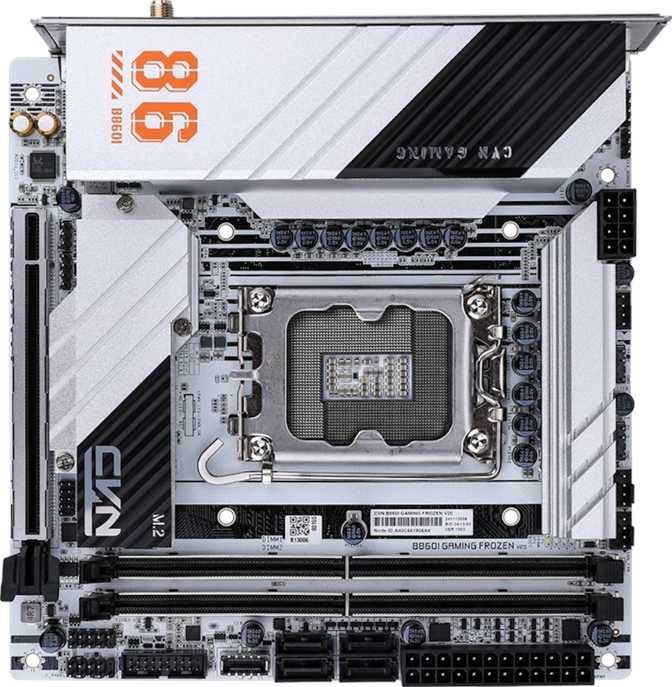
Colorful CVN B860I Gaming Frozen V20 Review: The Honest B860 Verdict
MotherboardsThe Case for Mini-ITX Gaming on Current Intel Hardware
Compact PC builds have never had a stronger argument behind them. The notion that going small means accepting crippled performance or stripped connectivity has steadily eroded, and the Colorful CVN B860I Gaming Frozen V20 is a product of that evolution.
Built around Intel's current mid-range B860 chipset on the LGA 1851 socket, this 170 x 170mm board targets a specific and deliberate buyer: someone who wants a genuinely capable gaming or productivity system in the smallest standard form factor that remains practical — and who doesn't want to sacrifice wireless, storage speed, or USB flexibility to get there.
Whether it delivers depends on a set of real trade-offs worth understanding clearly before you buy. This review covers the full picture — what works, what doesn't, and who this board is actually built for.
- PCIe 5.0 x16 — GPU slot fully future-proofed
- Wi-Fi 6E built-in — no extra card needed
- DDR5 with high-speed XMP overclocking support
- 20 Gbps USB-C port on the rear I/O
- RAID 0/1/5/10 across four SATA ports
- No CPU overclocking — B860 chipset limitation
- Only two fan headers — plan accordingly
- No dual BIOS failsafe included
Design and Physical Character
What Colorful has fit into 170 x 170mm — and one hardware limitation every builder should know before ordering a case.
The 170 x 170mm Footprint
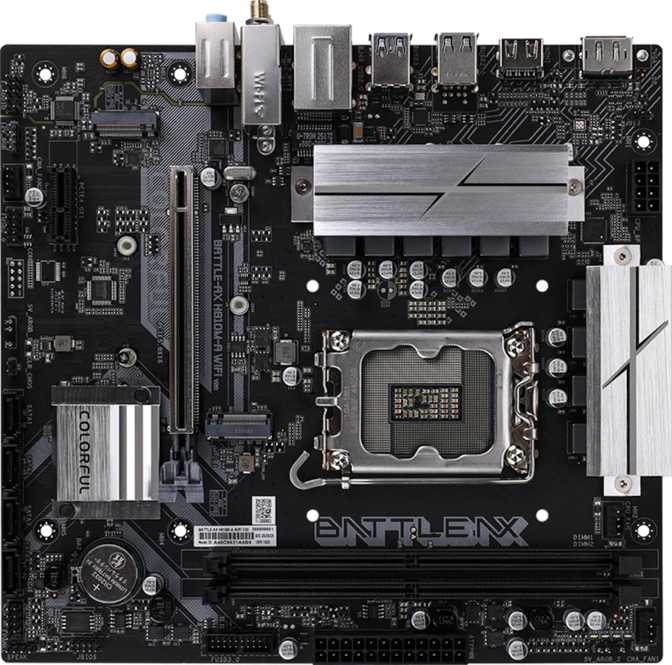
The CVN B860I Gaming Frozen V20 occupies the standard Mini-ITX form factor, fitting any case built to ITX specification. Within that space, Colorful packs two DDR5 slots, a full-length PCIe 5.0 slot, two M.2 sockets, four SATA ports, and a fully loaded rear I/O panel. Component placement follows the expected gaming build workflow, with the GPU slot, NVMe sockets, and I/O panel all logically positioned.
The Frozen Aesthetic
The Frozen V20 carries the CVN gaming line's signature visual identity — onboard RGB lighting with a cool-toned, icy aesthetic direction. Heatsink styling and PCB accents lean toward silver and blue rather than the aggressive black-and-red of many competing gaming boards. For windowed case builds where the motherboard is part of the visual composition, the Frozen theme creates a coherent visual story. Lighting is controllable through Colorful's software suite.
Fan Headers: Plan Ahead
The board provides two fan headers. One handles the CPU cooler fan; the other a single case fan. If your chosen Mini-ITX case includes two or more airflow fans — which is common — a fan hub or splitter is required before you finalize your parts list. This is the single most impactful daily-use constraint on the board.
Platform Foundation: What the B860 Chipset Actually Means
The B860 sits between the budget H610 and the enthusiast Z890. Its position determines both the board's capabilities and its ceiling — and one distinction matters more than all others.
CPU Overclocking: The Key Limitation
The B860 chipset does not allow raising the CPU multiplier beyond factory boost speeds. If unlocked CPU overclocking is a priority, a Z890 board is required. For the majority of Mini-ITX builders, this is practically irrelevant. Sustained CPU overclocking in compact enclosures runs into thermal ceilings quickly — small cases limit airflow, and compact coolers limit heat dissipation. Running processors at factory boost specifications is what most small form factor builders do in practice anyway.
Memory OC: Where the Real Tuning Happens
Memory overclocking is fully supported via XMP profiles — the pre-validated speed presets embedded in DDR5 memory kits. Enabling XMP in BIOS takes a single toggle; the board reads timing and voltage data from the kit automatically. The practical payoff is measurable in 1080p gaming, video encoding, and threaded productivity workloads that depend on memory bandwidth. No manual tuning expertise is required.
B860 vs. the Alternatives at a Glance
| Feature | B760 Prev. Gen | B860 This Board | Z890 Premium |
|---|---|---|---|
| Platform Gen | Prev. (LGA 1700) | Current (LGA 1851) | Current (LGA 1851) |
| Memory Type | DDR4 or DDR5 | DDR5 Only | DDR5 Only |
| XMP Memory OC | |||
| CPU Multiplier OC | |||
| Price Tier | Budget | Mid-Range | Premium |
| Best For | Budget / Legacy | Gaming Builds | OC / Power Users |
DDR5 Memory: Speed, Capacity, and Overclocking Headroom
Two DDR5 slots in dual-channel configuration, with the ability to push speeds well beyond rated defaults using XMP profiles. Here is what that means in practical terms.
Native High-Speed DDR5
Supports DDR5 at high-performance native rated speeds, delivering substantially more memory bandwidth than previous-generation DDR4 platforms offered even at their ceiling.
XMP One-Click Overclocking
XMP profile support lets validated DDR5 kits run at their rated high speeds. A single BIOS toggle applies all timing and voltage settings automatically — no manual expertise needed.
Up to 96GB Capacity
Two slots support up to 96GB total — enough for the most demanding creative workflows. Gaming builds typically run 32–64GB, leaving headroom for years of application growth.
Dual-Channel Bandwidth
Running two matched DDR5 sticks doubles effective memory bandwidth vs. a single stick. Always populate both slots — the performance benefit is immediate and costs nothing extra.
Storage and Expansion: More Than Most Compact Builds Need
One PCIe 5.0 graphics slot, two NVMe M.2 sockets, and four SATA ports with full RAID support — a complete storage ecosystem in 170mm.
PCIe 5.0 x16 GPU Slot
The single expansion slot runs at PCIe Generation 5 — the same standard found on flagship-tier boards. This delivers full bandwidth to current and upcoming discrete GPUs. There is no bottleneck between the CPU and your graphics card for any card on the market today.
No additional expansion slots — standard for Mini-ITX.
Dual M.2 NVMe Sockets
Two M.2 sockets handle the practical two-drive NVMe configuration: a fast primary drive for OS and active applications, and a secondary slot for games, media, or backups. On the B860 platform, current-generation NVMe drives reach sequential read speeds well above 5,000 MB/s on the primary socket.
Check your SSD's heatsink compatibility with the case.
4x SATA 3 + Full RAID
Four SATA 3 ports extend storage to conventional SSDs or mechanical drives for mass storage. All four major RAID configurations are supported — striped arrays for maximum throughput, mirrored arrays for redundancy, distributed parity, or combined stripe-plus-mirror. Practical for a compact NAS-adjacent setup.
Connectivity: Rear I/O, Wireless, and Networking
Nine rear USB ports, Wi-Fi 6E, Bluetooth 5.3, and Gigabit Ethernet — a dense I/O panel for a Mini-ITX board, with one gap worth flagging.
Rear USB Port Breakdown
| Port Type | Count | Speed | Best Used For |
|---|---|---|---|
| USB 3.2 Gen 2x2 Type-C | 1 | 20 Gbps | External NVMe enclosures, high-bandwidth storage |
| USB 3.2 Gen 1 Type-A | 4 | 5 Gbps | Peripherals, hubs, external SSDs |
| USB 3.2 Gen 1 Type-C | 1 | 5 Gbps | Modern devices with reversible connector |
| USB 2.0 Type-A | 2 | 480 Mbps | Keyboards, mice, USB receivers |
Internal Expansion Headers
Front-panel expansion headers support additional USB connections depending on the case: USB 3.0 headers for front-panel I/O, a USB-C Gen 2 header for cases with front Type-C, and USB 2.0 headers. Exactly how much of this is usable depends entirely on your case selection.
Wireless and Wired Networking
Wi-Fi 6E (802.11ax)
All three frequency bands: 2.4 GHz, 5 GHz, and the less-congested 6 GHz band. Falls back to Wi-Fi 6 and Wi-Fi 5 for older router compatibility. Built-in — no M.2 card or PCIe slot required. Invaluable in Mini-ITX builds where every slot counts.
Bluetooth 5.3
Current-generation Bluetooth for peripherals, audio devices, and accessories. Note: the aptX audio codec is not supported, which affects wireless audio quality on select high-end headsets that rely on it.
Gigabit Ethernet
One RJ45 port at standard Gigabit speed — sufficient for most users, but competing boards increasingly offer 2.5G Ethernet at similar price points. Users who regularly transfer large files across a local network will notice the difference.
Display Output and Onboard Audio
The rear panel includes HDMI and DisplayPort outputs. These function only when the installed CPU includes Intel integrated graphics — they are inactive with a discrete GPU alone. All video output for dedicated gaming builds routes through the GPU directly.
The HDMI port operates at version 2.0, supporting 4K at 60Hz or 1080p at up to 120Hz. It does not support 4K at high refresh rates or the variable refresh rate and HDR extensions introduced in HDMI 2.1. For HTPC builds without a discrete GPU targeting high-refresh 4K, this is a real constraint.
Onboard audio delivers a 5.1 surround-capable implementation through three 3.5mm connectors: headphone and speaker output, microphone input, and line input. This handles headset users and standard desktop speaker setups without complaint.
Optical S/PDIF audio output is not present. Users routing audio to an AV receiver via optical connection or using an external DAC with an optical input will require an add-in solution. For dedicated gaming audio with a USB headset or USB DAC, the onboard audio is bypassed entirely.
BIOS, Overclocking Controls, and Quality of Life
The features present here make day-to-day use easier. The absent one — dual BIOS — is worth understanding before committing.
- Dedicated CMOS ResetOne-button BIOS reset without disassembling the system. Essential on Mini-ITX where physical jumper access is awkward once the board is cased.
- XMP Memory Profile SupportSingle-toggle activation of validated DDR5 speed profiles. The board reads timing and voltage data from the memory kit and applies optimal settings automatically.
- RGB Lighting ControlFull onboard RGB management through Colorful's software suite, including color selection, lighting effects, and synchronization with compatible components.
- Windows 11 Ready via CPU fTPMIntel Core Ultra 200-series processors include built-in firmware TPM 2.0, satisfying Windows 11's requirement without a dedicated TPM module. No external hardware needed.
- No Dual BIOSA redundant BIOS backup — standard on many competing boards in this tier — is absent. BIOS corruption is rare in normal operation, but users who frequently update firmware should note this.
- No Physical TPM HeaderA dedicated TPM connector is not present. The CPU's integrated firmware TPM addresses this for most builders, but users with existing discrete TPM modules cannot install them.
- No CPU Multiplier OverclockingA B860 chipset limitation, not a board-specific flaw. The chipset locks the CPU multiplier. A Z890 board is required for this capability.
Who Should Buy the CVN B860I Gaming Frozen V20?
- You are committed to Mini-ITX and want a compact gaming or productivity system without major feature sacrifices.
- You plan to pair it with a mid-to-high-end discrete GPU and have no requirement for CPU overclocking.
- You want built-in Wi-Fi 6E and Bluetooth without consuming an expansion slot or M.2 socket.
- You value visual aesthetics in a windowed build and want the Frozen theme's distinctive, cool look.
- You need RAID capability across SATA drives for data redundancy or a light NAS-like local storage setup.
- CPU overclocking is a priority. B860 locks the multiplier. You need a Z890 board for this capability.
- Your case ships with more than two fans and you'd rather not add a hub or splitter to the build.
- You need multiple simultaneous high-speed Type-A connections. The 20 Gbps rear port is Type-C only; Type-A tops out at 5 Gbps.
- You require optical S/PDIF output for an AV receiver or external DAC with an optical audio input.
- Local network transfers at 2.5G speeds matter. Gigabit Ethernet is the only wired option here.
Competitive Positioning
Where the CVN B860I Gaming Frozen V20 sits relative to the logical alternatives — and when you should spend more or less.
| Comparison Point | B760 Mini-ITX Previous Gen | B860 Mini-ITX This Board | Z890 Mini-ITX Premium |
|---|---|---|---|
| Platform Generation | Previous (LGA 1700) | Current (LGA 1851) | Current (LGA 1851) |
| Memory Standard | DDR4 or DDR5 | DDR5 Only | DDR5 Only |
| CPU Overclocking | |||
| XMP Memory Overclocking | |||
| PCIe 5.0 GPU Slot | Varies by board | ||
| Dual BIOS (typical) | Varies | Common | |
| Price vs. B860 | Lower | Reference Point | Significantly Higher |
| Best For | Budget / Legacy | Gaming / Mid-Range | Performance / OC |
Comparison reflects general chipset and platform characteristics. Individual board features vary by manufacturer and model.
Honest Assessment: Strengths and Weaknesses
Where It Delivers
The CVN B860I Gaming Frozen V20 is strongest as a platform choice. The combination of PCIe 5.0 GPU bandwidth, DDR5 with meaningful overclocking headroom, integrated Wi-Fi 6E, two M.2 sockets, and a dense rear USB roster builds a genuinely competitive board in the B860 Mini-ITX segment.
The 20 Gbps USB-C port at the rear is genuinely useful and not guaranteed on competing boards at this tier. Most Mini-ITX B860 alternatives offer only 10 Gbps at best on their fastest USB connection — the extra headroom matters for anyone running fast external NVMe storage.
The three-year warranty adds long-term confidence, extending beyond what some competing products in this tier offer. Combined with competitive pricing for the feature set, the value proposition is strong for the intended use case.
Where It Falls Short
The weaknesses are real but predictable. Two fan headers limits cooling flexibility without a hub, which adds cost and cable management complexity some builders will find frustrating, particularly in tightly routed compact cases.
The absence of dual BIOS is a tangible missing feature when boards one tier up routinely include it. Gigabit Ethernet, while sufficient for most users, lags behind the 2.5G implementations increasingly available at competing price points.
There is no USB 3.2 Gen 2 Type-A port — the fastest rear USB is Type-C only. Users with existing high-speed Type-A peripherals either accept the speed ceiling or use adapters. Together, these shortfalls define the board's ceiling clearly: capable for its segment, not a premium board at a mid-range price.
Common Buyer Questions Answered
The questions real buyers search before purchasing — answered directly.
Final Verdict
The Colorful CVN B860I Gaming Frozen V20 is a well-considered Mini-ITX board for builders who have made the deliberate choice to build compact and want a platform that matches that ambition with current-generation specifications. The feature-per-dollar ratio in the B860 Mini-ITX segment is competitive, and the three-year warranty offers reassurance that is not universal at this tier.
Buy It If
- You are building a compact gaming system on the current Intel platform with a dedicated GPU
- You want Wi-Fi 6E built-in without sacrificing any expansion slot
- You need PCIe 5.0 GPU bandwidth for current or next-generation graphics cards
- CPU overclocking is not a requirement for your build goals
Consider Alternatives If
- CPU multiplier overclocking is a firm requirement — step up to a Z890 Mini-ITX board
- You need dual BIOS failsafe protection for frequent firmware updates
- Your build needs 2.5G Ethernet or multiple rear high-speed Type-A USB ports
- Your Mini-ITX case has more than two fans and you prefer not to add a hub