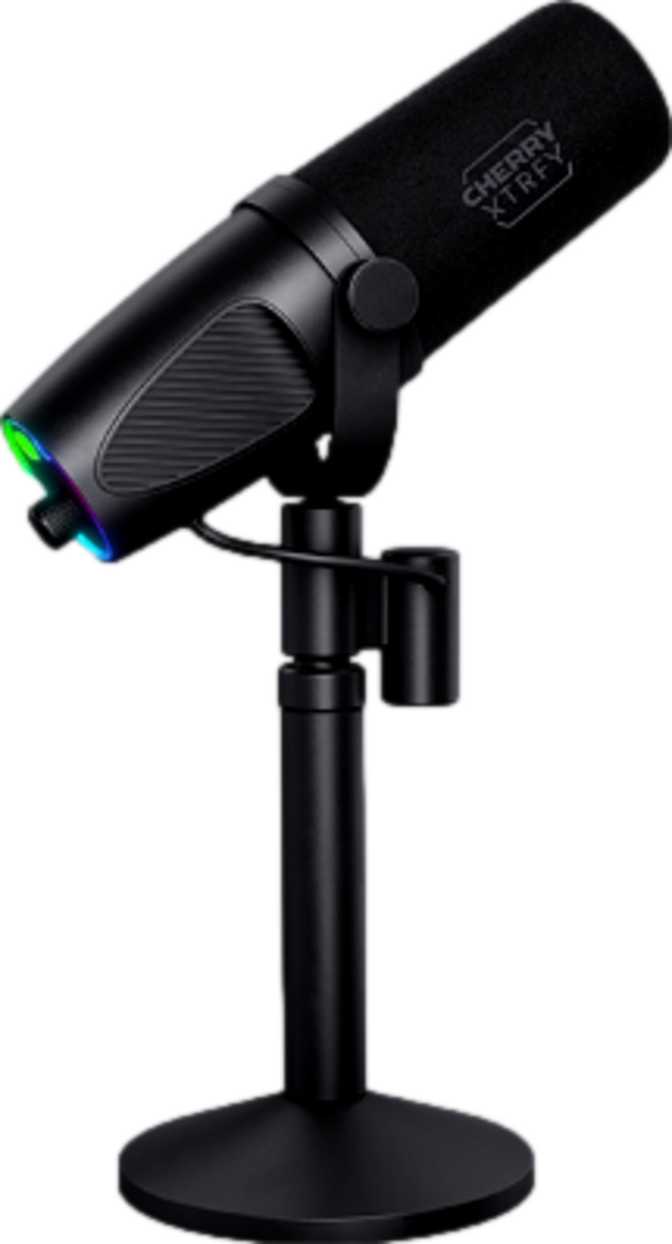
Cherry Xtrfy Ngale X Review: USB/XLR Streaming Mic for Creators
MicrophonesMost people shopping for a desktop microphone eventually hit the same wall. USB mics are convenient, instant, and work without additional hardware — but they have a ceiling. XLR microphones unlock professional audio quality, but they require an audio interface, extra money, and a steeper learning curve. The Cherry Xtrfy Ngale X takes a clear position against that forced choice: both connections, one microphone, one purchase decision.
That is the promise. What follows is a detailed assessment of what it actually delivers — including where the trade-offs are and who will get the most out of it.
Build Quality and Physical Presence
A Microphone That Feels Like It Means Business
At just over half a kilogram and standing roughly 205mm tall, the Ngale X makes its intentions clear the moment you pick it up. The casing feels solid, the physical controls have meaningful resistance, and the overall construction inspires confidence that this unit will not develop rattles or loose connections after a year of daily use. It is the kind of build quality that communicates seriousness before a single word is recorded.
The dimensions place it on the larger end of the category. The mic is notably wide — the footprint extends approximately 150mm across and nearly 91mm deep — which means it commands a real chunk of desk. If your workspace is already crowded with monitors, keyboards, and peripherals, plan the placement before it arrives. A boom arm is almost always the right answer, giving the unit adjustable positioning while keeping the desk surface clear.
Boom arm buyers: The Ngale X needs an arm rated for its heft. Many lightweight arms marketed toward gaming microphones will sag under this unit over time. A properly rated arm is a requirement, not an optional accessory.
Physical Specs
- Standing Height 205 mm
- Footprint Width 150 mm
- Footprint Depth 91 mm
- Build Weight ~510 g
- USB Cable 2 m
RGB Lighting: Streaming Aesthetic, Personal Choice
The Xtrfy brand carries a defined visual identity built around gaming culture, and the Ngale X carries that forward with built-in RGB lighting. For streamers and content creators whose cameras face the desk, a glowing microphone fits naturally alongside lit keyboards, backlit monitors, and RGB-ringed headphones — the cohesion reads as deliberate production design rather than accidental excess. For anyone who actively dislikes glowing peripherals, the lighting is a factor worth weighing: it shapes the visual identity of the setup around it, even though it has no bearing on audio quality.
On-Device Controls and One Notable Absence
The control panel mounted on the microphone body is the right design decision. Being able to adjust gain and cut audio mid-session without reaching for a mouse or pulling up software matters more than it might appear. The mute function — reachable in a single movement — is the kind of feature you use once in a genuine emergency and immediately understand why it belongs here.
Dual Connectivity: What USB and XLR Mean for Your Workflow
The Ngale X ships with both connection types, and the difference between them matters more than it might first appear. You are not simply choosing a cable — you are choosing how much of the signal chain you want to control, and how far you want to take your setup in the future.
USB Mode
Plug and Play- Driver-free on Windows and Mac — recognized by the system immediately
- Onboard conversion at 96kHz / 24-bit — professional quality without extra hardware
- Two-meter cable included — sufficient for most standard desk setups
- Powered entirely over USB — no battery, no charging, always ready when your computer is on
Best for: streamers, podcasters, and remote workers who want immediate, high-quality audio with zero setup friction.
XLR Mode
Future-Proof- Pure analog output — your audio interface handles conversion and sets the quality ceiling
- Bypasses onboard processing entirely — full signal chain control is yours to shape
- Works with any XLR-capable interface, mixer, or preamp you own or buy later
- No architecture ceiling — upgrade your interface without replacing your microphone
Best for: podcasters upgrading setups, voice-over artists, and anyone building toward a professional studio signal chain.
Audio Performance: Translating the Numbers
Frequency Response and the Honest Upper-Limit Conversation
The Ngale X captures sound from the deep low frequencies where room character and the fundamental body of deep voices live, upward to 16,000 Hz. For voice recording, which is its clear primary purpose, this coverage is well-matched to how human speech actually distributes across the frequency spectrum. Vocal fundamentals for most speakers land between roughly 80 Hz and a few hundred Hz; the harmonics and consonant articulation that give voices presence and intelligibility all sit comfortably within the Ngale X's capture window.
The upper limit is where candor matters. The full extent of human hearing reaches several thousand hertz beyond where the Ngale X stops. Those highest frequencies — sometimes called "air" in mixing parlance — contribute to the shimmer on a cymbal's sustain, the sparkle on an acoustic guitar's upper register, and the open quality at the very top of a singing voice. Voices recorded through the Ngale X will sound clean, present, and clear. They may not carry the last few degrees of top-end openness that a dedicated high-end studio condenser pursues.
The frequency range is well-suited for voice-forward applications. Practical difference vs. a full-spectrum condenser is minimal to undetectable in these contexts.
The frequency ceiling means high-frequency shimmer on guitars, cymbals, and strings is not fully captured. A dedicated studio condenser would better serve this use case.
Bit Depth: The Dynamic Range Advantage You Will Actually Notice
The Ngale X records at 24-bit depth, significantly exceeding the 16-bit floor common in basic USB microphones. Moving to 24-bit dramatically widens the range of loud-to-quiet sound the microphone can faithfully capture: quiet passages stay clean and free of noise at low signal levels, loud peaks have more room before the signal clips into distortion, and when you apply EQ, de-noise filters, or compression in post, the software has far more data to work with.
For home studio users recording in untreated rooms — which is most people — this advantage appears most clearly when applying noise reduction. The additional bit depth means aggressive noise reduction can reduce background noise without simultaneously degrading the voice signal, because the gap between the noise floor and your vocal is wider to begin with.
Cardioid Pickup: One Pattern, Fully Committed
The Ngale X uses a single cardioid polar pattern — a teardrop-shaped pickup zone that focuses sensitivity in a forward arc while rejecting audio arriving from the sides and rear. For solo voice work at a desk, this is the correct choice, and making it the only available choice is a defensible design decision.
Streamers do not need to record the room; they need to isolate their voice from it. Podcasters speaking directly into the microphone benefit from the forward focus and rear rejection, which reduces keyboard clatter, fan noise, and environmental sound from adjacent rooms. A cardioid pattern's geometry is designed precisely for the "one person, talking at a desk" use case that describes most of the Ngale X's audience.
The single-pattern commitment also carries a quiet engineering benefit: the capsule and internal electronics can be optimized for one task rather than divided across several. Multi-pattern microphones are useful when the flexibility is actually needed — which is less often than the marketing around them suggests.
What Comes in the Box: Shock Mount and Pop Filter
Many microphones in this category arrive in a box with a USB cable and little else. The Ngale X includes both a shock mount and a pop filter, and this is worth more than it might appear on first read. Together, they solve the two most common recording problems that beginners encounter and that intermediate users pay separately to fix.
Shock Mount
Mechanically isolates the microphone capsule from vibrations traveling through your desk. Every keystroke, mouse click, and nearby footstep registers as a low-frequency vibration that conducts directly into the microphone body and appears in your recording as a dull, low thump — unless a shock mount absorbs it first.
The Ngale X suspends in a cradle of elastic elements that absorb this mechanical energy before it reaches the capsule. For a microphone of this size and weight, a compatible aftermarket shock mount carries a non-trivial price tag. Having one included closes that cost gap from day one.
Pop Filter
Addresses the burst of air pressure that plosive consonants generate. Say a "P" or "B" directly at an unprotected microphone and the air burst hits the capsule as a sudden low-frequency pressure spike — audible in the recording as a thumping intrusion that has nothing to do with your voice.
A pop filter positioned between mouth and mic disrupts that burst before it arrives. The consonant comes through cleanly; the accompanying air pressure does not. This is not a subtle improvement — pop filtering is clearly audible in any direct comparison, and having it included removes a common beginner frustration immediately.
Headphone Monitoring: Hearing Yourself Without the Echo
The 3.5mm headphone output on the Ngale X is not simply a convenient jack — it is the path to monitoring your own voice in real time, bypassing the latency that computer processing introduces.
When audio travels from your microphone input, through your computer's processing chain, through your software, and back out to your headphones, that journey takes time. Typically a few dozen milliseconds — imperceptible when listening to music, but distinctly noticeable when it is your own voice you are hearing. Even small delays produce a subtle echo effect that makes natural speech feel strange and forces most people to speak more deliberately.
Direct monitoring through the Ngale X's headphone output skips the computer entirely. You hear yourself as the microphone hears you, in real time, with no perceptible delay. The result is a more natural speaking experience and the ability to catch problems — gain set too high, mic positioned poorly, too much room reverb — immediately rather than after the recording is already finished.
Larger connector users: The 3.5mm output accommodates the vast majority of wired headphones. If you use studio-style headphones with the larger professional connector format, a simple and inexpensive adapter resolves the difference — no specialty hardware required.
Platform Compatibility: Desktop Is the Focus
The Ngale X is a desktop microphone in the truest sense. It operates on Windows computers and Mac systems, both of which recognize it immediately over USB without requiring driver installation. Mobile devices are not supported — this is a defined design boundary, not an oversight.
-
Windows PC Plug-and-play via USB, no drivers needed
-
Mac OS X Plug-and-play via USB, no drivers needed
-
Any XLR Audio Interface Via the XLR output connection
-
Android Devices No USB audio support for this connection type
-
iOS / iPhone No USB audio support for this connection type
Real-World Usage: Who Gets the Most From This Microphone
Who This Microphone Is Built For
Streamers on PC
The aesthetic fits the culture. USB simplicity matches the workflow. Cardioid isolates voice from desk noise. The on-body mute handles moments when silence is needed immediately. Every element maps directly to what a streamer actually needs.
Solo Podcasters
USB simplicity now, XLR flexibility later. The included accessories mean setup begins correctly without extra shopping. The headphone output enables proper real-time review of every take. The same microphone transitions with growing production ambitions.
Remote Professionals
The quality gap between a laptop microphone and a proper cardioid condenser is audible to every person in a meeting. If you spend several hours daily on video calls, this investment improves the experience for everyone — not just yourself.
Entry-Level Voice-Over Artists
The 24-bit recording performance supports clean, uncompressed audio that survives editing and processing well. The XLR path means the microphone stays relevant as the studio evolves. A professional starting point, not a starter piece to replace.
Who Should Consider Something Else
Multi-Speaker Recording
Interviewing a guest face-to-face, recording a roundtable, co-hosting with someone across the desk — the cardioid-only design doesn't serve these scenarios. Separate microphones for each speaker, or a multi-pattern mic with a figure-eight mode, are the appropriate tools.
Mobile Recording Workflows
If you regularly capture audio on a phone or tablet while away from a computer, the Ngale X cannot accommodate it. Its desktop focus is absolute. A mobile-compatible microphone or a phone-friendly audio interface handles that requirement separately.
Acoustic Instrument Enthusiasts
Buyers who want the full high-frequency character of acoustic sources — the upper register of a piano, the shimmer of a guitar — may find the frequency ceiling limiting. A studio condenser designed for instrument capture would better serve that specific purpose.
Interface-Owning Buyers
If you already own a quality audio interface and are shopping for an XLR-only capsule, you may be paying for USB circuitry you will never use. An XLR-focused microphone at this price point may represent better value for your specific situation.
How It Compares to the Main Alternatives
The dual USB/XLR category is where the most interesting positioning decisions live. Here is how the Ngale X compares to the microphones buyers most commonly weigh against it.
| Feature | Cherry Xtrfy Ngale X | Shure MV7 | Blue Yeti |
|---|---|---|---|
| Connection | USB + XLR | USB + XLR | USB only |
| Polar Patterns | Cardioid | Cardioid | 4 selectable |
| Shock Mount Included | Yes | No | No |
| Pop Filter Included | Yes | No | No |
| Headphone Monitoring | Yes (3.5mm) | Yes (3.5mm) | Yes (3.5mm) |
| RGB Lighting | Yes | No | No |
| On-Device Controls | Yes | Yes | Yes |
| Mobile Compatible | No | No | No |
Against the Shure MV7
The MV7 is the most structurally similar competitor: USB and XLR, cardioid only, aimed at podcasters and streamers. Its reputation for broadcast-warm voice quality is well-earned. It arrives, however, without a shock mount or dedicated pop filter. The Ngale X's inclusion of both means the real cost gap between the two is narrower than the raw sticker prices suggest.
Against the Blue Yeti
The Yeti's four selectable polar patterns give it range that the Ngale X cannot match for varied recording scenarios. Its USB-only architecture, though, caps what is possible as a setup grows. Buyers who know they will only ever use cardioid — which describes most streamers and solo podcasters — pay for pattern flexibility they will never access.
Strengths and Honest Limitations
What It Gets Right
The dual USB/XLR architecture is the defining feature and a smart design choice — it means buyers are not locked into a choice between beginner convenience and professional capability. The 96kHz/24-bit USB performance is beyond what most streaming and podcasting workflows will fully tax, which means real quality headroom is built into the unit from day one.
The included shock mount and pop filter represent meaningful accessory savings and ensure the first recording session starts properly rather than producing easily avoidable problems. The on-device controls and mute function reflect a design team that understood what actually happens during a live session.
The build quality communicates seriousness, and the Xtrfy RGB aesthetic lands perfectly for a streaming-oriented setup. The two-meter USB cable and powered-over-USB design remove friction from setup and daily use alike.
Where to Manage Expectations
The frequency response ceiling is the most technically notable limitation. It is a real constraint for buyers whose ambitions extend to acoustic instrument recording or vocal capture that chases the ultra-high-frequency openness that premium studio condensers pursue. For voice-focused applications — which is most of this microphone's audience — the practical impact is minimal.
The absence of a hardware signal level indicator is a minor friction point: the kind of feature you only notice missing when you reach for it and it is not there. The weight, while a sign of solid construction, makes boom arm selection a considered decision rather than an afterthought.
The RGB lighting sits in a category of its own — neither a strength nor a weakness in audio terms, but a design position that fits some setups perfectly and jars with others. The microphone's performance is entirely unaffected either way.
Questions Real Buyers Ask Before Purchasing
The Ngale X Earns a Confident Recommendation
The Cherry Xtrfy Ngale X makes a focused, coherent argument: a microphone built for streaming and content creation can deliver professional-quality USB audio, offer a genuine XLR upgrade path, ship complete with the accessories needed to record correctly from the start, and carry the visual character that gaming-oriented setups expect. It delivers on that argument.
The dual connectivity is more than a checkbox feature — it is a real reason to consider this microphone a long-term investment rather than a starter purchase that gets replaced in two years. The accessory inclusions are meaningful and represent real money saved. The audio performance at the USB level is strong. The build is solid. The control layout is thoughtful.
The frequency response ceiling and the absence of a hardware level indicator are real limitations — narrow ones for most buyers. The weight requires a capable boom arm. These are factors to understand before purchasing, not reasons to walk away unless your use case specifically requires extended high-frequency capture or a pure XLR-only value calculation. If you are currently using a headset mic or a basic USB microphone and want to sound noticeably more professional without a major technical undertaking, this is a well-considered, capable upgrade — and if your ambitions eventually grow toward a proper XLR studio signal chain, this microphone makes that transition with you.