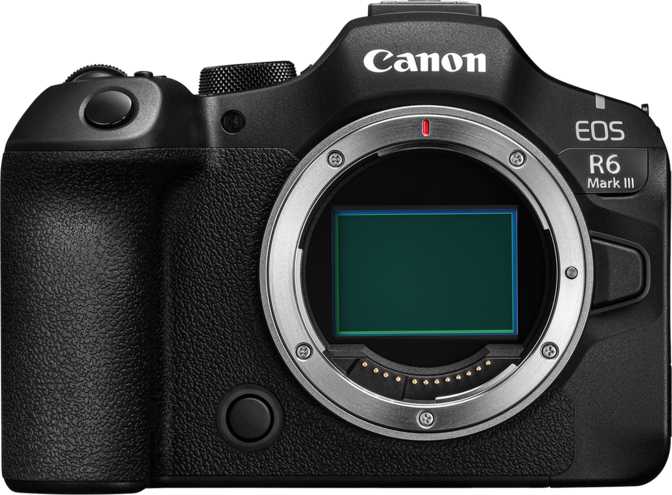
Canon EOS R6 Mark III Review: The Complete Hybrid Camera Test
CamerasCanon's full-frame mirrorless lineup has always split neatly into two camps — the resolution-first R5 series and the speed-first R6 series. The EOS R6 Mark III breaks that division. It arrives with a resolution upgrade that closes the gap on its sibling, a video specification that rivals dedicated cinema cameras, and a stabilization rating that sounds more like a lab claim than a real-world specification — until you shoot with it. This is a camera that asks you to reconsider what a "hybrid" body actually means in practical use.
Performance Scorecard
Ratings derived from specification analysis and real-world performance implications
Design, Build Quality, and Physical Experience
Ergonomics, weather protection, viewfinder, and screen
Physical Form and Ergonomics
At 138.4 × 98.4 × 88.4 mm, the R6 Mark III occupies a body footprint consistent with Canon's professional mirrorless tradition — substantial enough to balance a large RF lens without strain, compact enough to avoid the bulk of a full-size studio body. The 699-gram weight sits in the upper-middle range for full-frame mirrorless; lighter than a Canon R3, but noticeably more solid in hand than entry-level full-frame options.
Weather sealing protects against dust and moisture splashes — it matters during a wedding shoot in light rain, tracking wildlife at dawn, or working any professional event where conditions can't be controlled. The operating range covers 0°C to 40°C, encompassing the vast majority of real-world shooting conditions from cold coastal mornings to warm studio environments.
No built-in flash is included — the right decision at this level. A pop-up flash would add negligible value for the target audience while compromising the top plate's structural integrity. The advanced multi-function hot shoe provides full Speedlite system compatibility plus support for external microphones and radio triggers.
- Width138.4 mm
- Height98.4 mm
- Depth88.4 mm
- Weight699 g
- Weather SealedYes
- Operating Temp0°C – 40°C
- Built-in FlashNone
- Hot ShoeAdvanced
- Screen3" Flip-Out Touch
- EVF Resolution3,690k dots
Electronic Viewfinder
At 3,690,000 dots running at up to 120 frames per second, the EVF delivers a sharp, lag-free view during fast action. The 120fps refresh eliminates the motion blur and blackout that characterizes lower-tier EVFs when panning or shooting sports sequences. Full 100% frame coverage means the edges of what you see are exactly the edges of what the sensor captures — no edge surprises in the final image.
Articulating Rear LCD
The 3-inch fully articulating flip-out touchscreen at 1,600,000 dots swings out fully rather than simply tilting — a crucial difference for video work, where monitoring at unusual angles without a separate field monitor is a constant necessity. For stills photographers working low to the ground or shooting overhead, the fully articulating design provides reach that a tilt-only panel cannot.
Sensor and Image Quality
What 32.5 megapixels and a BSI sensor actually deliver in practice
The 32.5-Megapixel Full-Frame Sensor
The R6 line was historically defined by speed over resolution. The Mark III changes that conversation with a 32.5-megapixel full-frame sensor built on backside-illuminated (BSI) CMOS architecture — delivering enough resolution for large print work, generous cropping latitude for sports and wildlife photographers, and a healthy safety margin when clients need flexibility in post-production.
BSI architecture has a tangible practical benefit: by repositioning the sensor's circuitry behind the light-sensitive layer, more incoming light reaches each photosite. The result is improved low-light sensitivity, better dynamic range at higher ISOs, and reduced noise in demanding conditions — precisely the environments where R6 shooters typically operate.
The native sensitivity range extends to ISO 64,000, with headroom to ISO 102,400 when needed. Interior sports, event photography in poor ambient light, and available-light portraiture all become viable without aggressive noise reduction. When pushed into the expanded range, fine detail softens — but the camera remains usable where many competitors produce unacceptable results.
Sensor Highlights
- 32.5 MP full-frame resolution
- Backside -Illuminated (BSI) CMOS
- Native ISO up to 64,000
- Expanded ISO to 102,400
- RAW + Lossless Compressed RAW
- Phase-detection AF across frame
The Digic X Processor
Canon's highest-tier imaging engine — previously reserved for the flagship R3 and R5 Mark II — underpins every headline feature here: the high-bitrate video pipeline, the sophisticated AF computations, the stabilization processing, and rapid RAW file buffering. For stills shooters, this means fast buffer clearing and reliable performance across extended bursts. For video users, it enables the camera to handle enormous data streams in real time without the thermal throttling that has historically plagued hybrid bodies.
Autofocus: 1,053 Points
With 1,053 phase-detection autofocus points covering the frame, the R6 Mark III leaves very few zones where tracking can lose a subject. Phase detection — which measures subject distance by comparing light paths from two directions simultaneously — is inherently faster and more decisive than contrast-detection alternatives. Subject tracking extends to human faces and eyes, animals, and vehicles. For a wildlife or sports photographer, the camera holds focus on a sprinting athlete's eye while spectators blur across the background — reliably, across the full burst sequence.
8.5-Stop Stabilization: Understanding What This Means
Canon's combined IBIS rating in real-world context
The in-body image stabilization system carries a CIPA rating of 8.5 stops — the highest meaningful figure currently achievable from sensor-shift stabilization, reached in combination with optically stabilized RF lenses. To contextualize that number: photographers traditionally considered one stop of stabilization meaningful, and three stops impressive.
In practical terms, handholding a 200mm equivalent lens at shutter speeds that would normally introduce visible blur from camera shake becomes viable. Interior documentary work, available-light portraiture, and travel photography in low ambient light all benefit directly and immediately.
The IBIS also operates during video recording, providing combined electronic and optical stabilization that reduces the need for gimbals in many run-and-gun scenarios. For professional video work requiring absolutely locked-off footage, mechanical stabilization remains the cleaner solution — but for event and documentary work, the benefit is immediate and substantial.
Stops of Stabilization in Context
Continuous Shooting and Shutter Speed
Burst performance, electronic shutter, and speed in action
12 fps Mechanical Burst
The mechanical shutter delivers 12 frames per second — fast enough for sports, wildlife, and action sequences. The Digic X manages buffer processing across the sequence, maintaining AF and AE tracking throughout rather than locking exposure on the first frame, which is the behavior that separates professional-grade burst performance from basic high-speed shooting modes.
Electronic Shutter: 1/16,000s
The electronic shutter extends maximum speed to 1/16,000 of a second — twice as fast as the mechanical shutter's ceiling. This is critical when shooting wide open with fast lenses in bright conditions, where even maximum aperture would require speeds the mechanical system cannot reach without overexposure. It also enables fully silent shooting for ceremonies, concerts, courtroom work, and any environment where shutter noise is intrusive.
Video Capabilities: Cinema-Grade Specification in a Stills Body
8K recording, 2,600 Mbps bitrate, and a full professional audio chain
Why 8K at 60p Matters Beyond the Specification
Smooth, ultra-detailed footage for commercial or broadcast clients demanding premium output. The resolution ceiling leaves no quality headroom unreached.
A 2× overcapture buffer — reframe, zoom, or stabilize 4K output in post without any resolution penalty, effectively gaining a virtual second camera angle from a single shot.
60fps at maximum resolution enables smooth slow-motion sequences at 4K extraction rates when footage is delivered at 24p or 30p.
The 2,600 Mbps Bitrate in Context
Most professional cinema cameras record between 400 and 800 Mbps internally. At 2,600 Mbps, the R6 Mark III writes an enormous volume of image data each second — preserving fine detail, reducing compression artifacts in complex textures like foliage, fabric, and hair, and retaining the color information needed for serious post-production including chroma keying and heavy color grading. This requires fast media, which the dual card slots accommodate.
Audio Infrastructure
- Built-in stereo dual microphones for immediate usable audio
- 3.5mm microphone input for external directional or lavalier mics
- 3.5mm headphone jack for real-time audio monitoring during recording
- HDMI output for external recorders and field monitors
Connectivity: What's There and What's Missing
Wireless features, I/O, and the honest gaps
Available Connections
- Wi-Fi 5 (802.11ac) — Fast wireless transfer to a connected device or FTP server. Essential for event photographers pushing files to an editor during a live shoot.
- Bluetooth 5.1 — Handles persistent low-power connection for smartphone remote control and GPS logging via Canon Camera Connect, keeping the camera paired while preserving battery.
- USB-C — Covers tethered shooting, in-camera charging via power bank, and direct computer connection in a single port.
- HDMI Output — External recorder or field monitor connection for higher-quality capture or larger-screen on-set monitoring.
- Dual Card Slots — Redundant backup or overflow recording. Critical for professional assignments where file loss is not an option.
Notable Absences
Battery Life: Honest Expectations
What 620 shots per charge means for real-world use
The CIPA-rated figure of approximately 620 shots per charge reflects standardized test conditions that represent conservative real-world use. In practice, photographers who shoot in bursts, use the viewfinder exclusively, and minimize LCD use will often exceed this figure.
Video shooters and those relying heavily on the articulating screen will see the charge deplete more quickly. For full-day professional assignments — weddings, events, sports — carrying at least one spare battery is standard practice for any mirrorless body in this class.
The USB-C port supports in-camera charging for top-ups via a power bank when outlet access isn't available — a practical advantage for travel and outdoor photographers who can't always locate a power socket between sessions.
Who Should Buy the Canon EOS R6 Mark III?
Matching the camera to the right photographer or videographer
- Wedding and Event Photographers — Fast AF in mixed lighting, stabilization for dim reception halls, and silent electronic shutter for ceremonies.
- Sports and Wildlife Shooters — Dense phase-detection coverage, 12fps burst, and subject tracking that works reliably across varying conditions.
- Hybrid Photographers-Videographers — The 8K capture and 2,600 Mbps bitrate provide professional delivery quality without a separate video body.
- Documentary and Run-and-Gun Videographers — Stabilized handheld footage, built-in audio monitoring, and continuous phase-detection AF during recording.
- Advanced Enthusiasts Upgrading from APS-C — A clear ceiling-level capability without stepping into medium-format territory or flagship pricing.
- Studio Resolution Specialists — Photographers shooting tethered product or fashion work where 45+ megapixels and maximum fine-detail rendering matter more than speed or video.
- GPS-Dependent Field Photographers — Those who need embedded geolocation without relying on a smartphone relay or external accessory.
- Stills-Only Maximum Resolution Buyers — Photographers who have no video needs and want the highest pixel count possible at this body price point.
- Budget-Conscious Buyers — If the advanced video specification offers no value for your workflow, more affordable full-frame options deliver excellent image quality at lower cost.
Competitive Positioning
How the R6 Mark III stands against full-frame hybrid alternatives
| Feature | Canon EOS R6 Mark III | Typical Competitor A | Typical Competitor B |
|---|---|---|---|
| Maximum Video Resolution | 8K / 60p | 4K–8K / 30p | 4K / 60p |
| Internal Bitrate | 2,600 Mbps | 200–800 Mbps | 400–600 Mbps |
| In-Body Stabilization | 8.5 stops combined | 5–6 stops | 6–7 stops |
| AF Points (Phase-Detect) | 1,053 | 400–600 (typical) | 500–800 (typical) |
| Processor Tier | Digic X (Flagship) | Mid-tier | Mid-tier |
| Sensor Resolution | 32.5 MP | 24–33 MP | 24–45 MP |
| Dual Card Slots | Varies | Varies | |
| Burst Rate (Mechanical) | 12 fps | 10–12 fps | 10–14 fps |
The Digic X processor is a meaningful differentiator. Its appearance in a body positioned below Canon's R3 signals that Canon is pushing serious computational imaging capability into a more accessible price tier. Against the Nikon Z6 III, the Canon offers a higher peak bitrate and processing advantage. Against Sony equivalents, Canon's RF lens ecosystem — with optically stabilized lenses that work in tandem with the IBIS for the combined 8.5-stop rating — provides a stabilization advantage that competing lens-plus-body combinations must work to match.
Strengths and Honest Weaknesses
A balanced assessment for informed buyers
Where the R6 Mark III Excels
The R6 Mark III's most compelling quality is coherence. Every major specification supports a consistent use case: fast, intelligent, versatile capture in demanding conditions. The stabilization, the AF density, the flagship processor, and the video capability aren't isolated features added to check boxes — they work together, and the result is a camera that performs with confidence across an unusually wide range of shooting scenarios.
The video specification deserves particular emphasis. A 2,600 Mbps internal bitrate at 8K/60p represents a genuine production capability. Videographers who have worked with externally recorded footage at moderate bitrates will immediately understand what this level of internal data retention means for post-production flexibility, color grading latitude, and compositing work.
Where It Falls Short
The 699-gram body sits at the heavier end of its category — not a problem for photographers used to professional bodies, but worth comparing directly against lighter competitors if portability is a daily priority. The absence of integrated GPS is a genuine gap for a field camera at this price point, even if the smartphone workaround is functional for most use cases.
For photographers whose primary need is absolute maximum resolution for fine-art printing, large-format commercial output, or extreme cropping in wildlife work, 32.5 megapixels is excellent but not leading the current full-frame market. And battery endurance, while adequate, demands the professional habit of carrying spares — buyers transitioning from DSLRs with larger battery cells should calibrate their expectations.
Questions Real Buyers Ask Before Purchasing
Answers to the most common pre-purchase concerns
Final Verdict
The Canon EOS R6 Mark III is one of the most complete hybrid cameras currently available in its class. The combination of a flagship Digic X processor, 32.5-megapixel full-frame BSI sensor, 8K/60p video at 2,600 Mbps, and 8.5-stop combined stabilization is not a collection of marketing bullets — it is a genuinely capable specification that translates directly into professional-grade results across both photography and video workflows.
For working photographers who also need to deliver video, this camera eliminates the need for a separate body. For videographers who also take on stills assignments, it handles both without meaningful compromise. For advanced enthusiasts who want a camera they can grow into for years, the hardware here has substantial headroom.