Austrian Audio OC-S10 Review: An Honest Look at This XLR Condenser Mic
MicrophonesIf you've shopped for a microphone before, you already know the split: convenient USB mics that plug into a laptop and go, versus traditional XLR microphones that ask more of your setup but give more back in return. The Austrian Audio OC-S10 belongs firmly to the second camp. Judging by its size, weight, and switchable polar patterns, this is a large-diaphragm condenser microphone designed for people who already have — or are ready to invest in — a proper audio interface, and who want a mic that rewards careful placement and a well-thought-out signal chain rather than masking a weak one. This is not a microphone for casual video calls. It's a tool for vocalists, voiceover professionals, podcasters running a full studio chain, and instrumentalists who need a mic capable of handling both delicate and punishing sound sources without flinching.
Design and Build: What You're Actually Holding
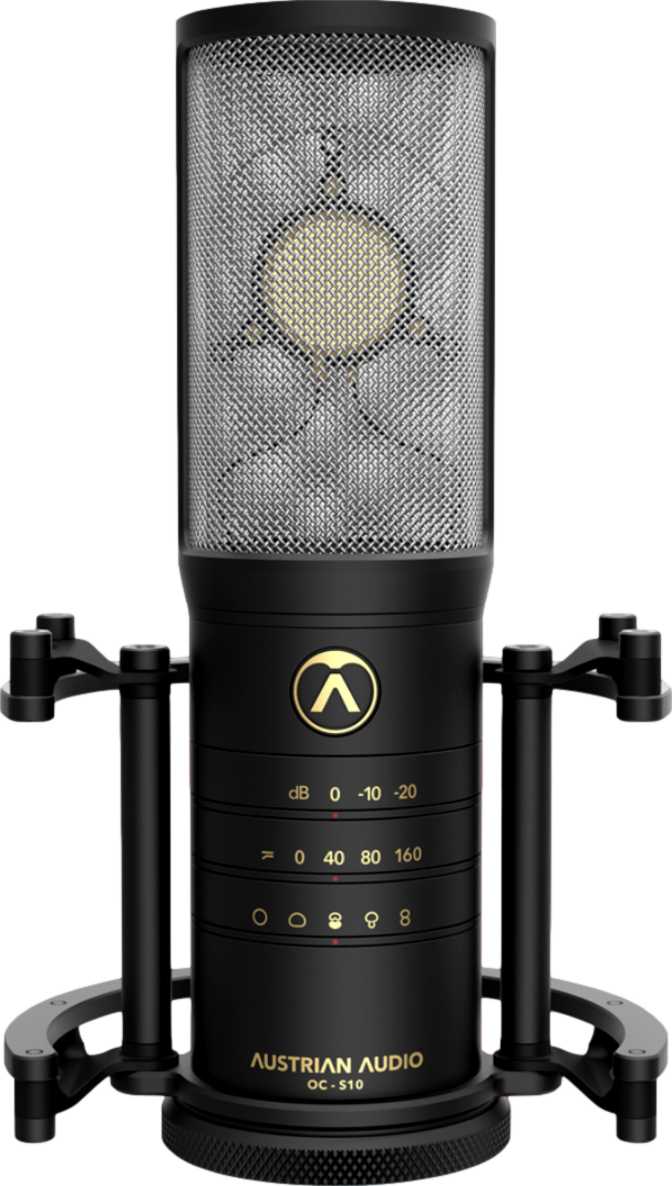
Pick up the OC-S10 and the first thing you notice is heft. It sits noticeably heavier in the hand than the entry-level condensers many home-studio owners cut their teeth on, and that weight isn't filler — it signals a denser internal build, which typically translates into better mechanical isolation from handling noise and a sturdier capsule housing.
The body itself is substantial too. It stands taller and carries a noticeably broader housing than the slim, pencil-style mics often used for acoustic instruments or overhead drum work — closer in stature to the classic large-diaphragm studio condensers you'd find anchoring a professional vocal booth. The amount of internal volume packed into that housing hints at a sizeable capsule and electronics package, exactly what you'd expect from a microphone built to capture detail across a wide frequency range.
Unusually for a mic at this size, the control panel lives directly on the microphone body itself, not on a separate breakout box or remote unit. That means polar pattern switching and other onboard adjustments happen exactly where your hand already is — no fumbling for a separate control unit clipped somewhere else on your desk or rack. It's a small design decision, but it removes one extra cable and one extra point of failure from your signal chain.
What's in the Box
Shock Mount
Isolates the capsule from vibrations traveling up your mic stand or desk, which is the difference between a clean vocal take and one littered with low-frequency thumps every time someone shifts in their chair.
Pop Filter
Tames plosives ("p" and "b" sounds) before they hit the capsule, essential for any vocal or voiceover work recorded at close range.
Together, these mean you're not immediately shopping for extra accessories the moment the box is opened — a detail that matters more on a mic in this class than it would on a budget USB condenser, where bundled extras are sometimes treated as an afterthought.
Sound Quality: Frequency Response and What It Means for Your Recordings
The OC-S10 captures a frequency range stretching from the deepest rumble audible to the human ear up to the very top edge of human hearing. In practical terms, that means it isn't selectively tuned to flatter one type of source — it's built to faithfully reproduce everything from chest-resonant low vocals and the low end of a bass instrument, up through crisp consonants, cymbal shimmer, and the sense of air that makes a recording feel open rather than boxed-in.
For vocalists, this full-range capture is what separates a recording that sounds merely fine from one that sounds like it was tracked in a real studio. A mic with a narrower or more colored response can make a voice sound thin or honky; a mic that captures the complete range gives your engineer — or your EQ plugin — raw material to shape rather than a compromised starting point.
Headroom: Handling Loud Sources Without Breaking a Sweat
Here's where the OC-S10 quietly distinguishes itself from a lot of mics in its size class. Its maximum sound pressure level rating sits at an exceptionally high threshold — well beyond what many studio condensers can tolerate before the signal starts to distort. Plenty of condenser microphones are perfectly fine for a vocalist standing a foot from the capsule but start clipping the moment you point them at a snare drum, a cranked guitar cabinet, or a brass instrument at close range.
The OC-S10's headroom puts those loud, transient-heavy sources well within its comfort zone. Practically, that means you can use this single microphone for delicate spoken-word narration in the morning and close-mic a guitar amp in the afternoon without swapping in a dedicated dynamic microphone or worrying about an external pad. That kind of versatility is genuinely valuable if you're building a one-microphone home studio and don't want to buy a second, more rugged mic just for loud sources.
Polar Patterns: Cardioid and Hyper-Cardioid, Explained
A polar pattern describes the shape of the area around a microphone where it picks up sound most sensitively — and where it rejects it. The OC-S10 offers two.
| Pattern | Pickup Shape | Best Used For |
|---|---|---|
| Cardioid | Heart-shaped pickup focused on the front of the mic, rejecting sound from directly behind | Solo vocals, voiceover, podcasting, single-instrument recording in untreated or moderately treated rooms |
| Hyper-Cardioid | Tighter, narrower front pickup with stronger rear and side rejection, with a small amount of pickup directly behind | Noisier environments, broadcast booths, situations demanding maximum isolation from nearby sound sources |
Cardioid is the workhorse pattern most home-studio owners reach for by default — forgiving, natural-sounding, and good at keeping room noise and bleed from other sources out of your recording. Hyper-cardioid trades a little of that natural openness for tighter isolation, which is exactly what you want when you're recording in a room with a noisy computer fan, an HVAC system, or another performer nearby.
What's Missing: Omni and Figure-8
Connectivity, Output, and Onboard Controls
The OC-S10 connects exclusively via XLR, the standard balanced connector used throughout professional audio. There's no USB output here, which means this microphone needs to plug into an audio interface, mixer, or preamp — it will not connect directly to a computer's headphone jack or USB port. Like virtually every condenser microphone in this class, it will also need 48V phantom power supplied by that interface or mixer, since condenser capsules rely on an external power source to operate, unlike dynamic microphones.
This is the single biggest thing for anyone moving up from a USB mic to understand: you cannot use the OC-S10 without an interface in between. If you don't already own one, factor that into your budget before you buy.
On the electrical side, the microphone's output impedance is comfortably low. That's good news for two practical reasons. First, it keeps the signal stable over longer cable runs without the high-frequency signal loss that can creep in with higher-impedance designs. Second, a low-impedance output is broadly compatible with the input impedance of nearly any preamp you're likely to pair it with, so you don't need to hunt for a matched interface.
One thing the OC-S10 does not offer is a built-in headphone monitoring jack — there's no 3.5mm or 6.35mm output on the mic itself for zero-latency monitoring. That's not unusual for a traditional XLR studio condenser, since most don't include one — that's normally a feature reserved for USB mics or dedicated headphone amps. But if you were expecting to plug headphones straight into the microphone, you'll need to monitor through your interface or mixer instead.
Software and Platform Compatibility
The OC-S10's companion control software runs on Windows and macOS. There's no iOS or Android app, which tracks with what this microphone is: a desk-bound studio tool tethered to a DAW-based workflow, not a mobile recording accessory you'd pair with a tablet for on-the-go podcasting. If your workflow lives entirely on a phone or iPad, this isn't the microphone built for it.
Where the OC-S10 Cuts Corners
No microphone does everything, and being clear-eyed about the omissions here will save you a surprise later.
- No physical mute button — muting has to happen at your interface, mixer, or DAW rather than with a quick tap on the microphone itself.
- No LED sound level indicator — you'll need to rely on the metering in your interface or recording software instead.
- No RGB lighting or integrated touchpad — confirms this is a microphone built for audio quality, not a streaming-desk centerpiece.
None of these are dealbreakers for the audience this microphone is built for, but they're worth knowing before you unbox it.
Who Should Buy the Austrian Audio OC-S10
- Home studio owners who already have, or are ready to buy, an audio interface with phantom power
- Vocalists and voiceover artists who want full-range, uncolored frequency capture for tracking or narration
- Podcasters and streamers running a real studio chain — mixing through an interface or mixer, not plugging straight into a laptop
- Instrumentalists recording loud sources — guitar amps, brass, percussion — who want one mic that handles both quiet and loud material without distortion
- Anyone prioritizing isolation in imperfect rooms, thanks to the hyper-cardioid option
- Anyone wanting a plug-and-play USB microphone with no interface required
- Mobile podcasters or streamers who need iOS or Android compatibility for phone-based recording
- Two-person interview setups on a single mic, or anyone needing figure-8/bidirectional pickup
- Room-ambience or orchestral capture work, which calls for an omnidirectional pattern this mic doesn't offer
- Anyone wanting onboard headphone monitoring without adding separate gear
How It Stacks Up Against the Alternatives
It helps to place the OC-S10 against the two categories of microphone most buyers are choosing between.
| Category | Connection | Polar Patterns | Monitoring | Mobile Use | Best For |
|---|---|---|---|---|---|
| Entry-level USB condenser | USB, plug-and-play | Usually cardioid only | Often a built-in headphone jack | Sometimes, via companion mobile apps | Casual streaming, beginner podcasting, no interface needed |
| Austrian Audio OC-S10 | XLR, needs interface + phantom power | Cardioid + Hyper-cardioid | Via external interface only | Windows/macOS only | Serious home studios, vocal tracking, loud-source recording |
| Premium multi-pattern studio condenser | XLR, sometimes dual USB/XLR | Cardioid, omni, figure-8, and pattern blends | Sometimes onboard jack | Varies | Professional studios needing maximum pattern flexibility |
The OC-S10 sits in the middle of that spectrum — more capable and more demanding than a beginner USB mic, but more focused than a full multi-pattern flagship that adds omni and figure-8 modes you may never actually use. If your recording needs are squarely one performer, one source, isolated and clean, a flagship's broader pattern selection may be more than you'll ever use — which is exactly the gap this microphone is built to fill.
Strengths and Weaknesses
Strengths
The OC-S10's biggest strength is consistency under pressure: the combination of full-range frequency response and exceptionally high SPL handling means it doesn't have an obvious weak spot among the kinds of sources a home or project studio is likely to throw at it. Add in the build quality implied by its weight, the genuinely useful included shock mount and pop filter, and onboard pattern switching that doesn't require a separate controller, and you have a microphone that feels considered rather than assembled from a parts bin.
Weaknesses
The honest weaknesses are about workflow friction rather than sound quality. The complete absence of mobile compatibility and the requirement for an outboard interface will frustrate anyone hoping to start recording the moment the box is open. The missing mute function and LED level indicator are small but real conveniences that competitors at this level sometimes include, and the lack of omni or figure-8 patterns means this is a specialist's tool for focused single-source capture rather than an all-in-one solution for every recording scenario you might encounter.
Frequently Asked Questions
Final Verdict
The Austrian Audio OC-S10 is built for one specific kind of buyer: someone who already understands, or is ready to learn, how a proper XLR signal chain works, and who wants a single microphone capable of handling both delicate vocal work and loud, transient-heavy sources without distortion. Its full-range frequency response, genuinely high SPL ceiling, low-impedance output, and onboard control panel add up to a microphone that punches above casual expectations once it's paired with a decent interface.
It is not the right choice if you want something that works the moment you plug it into a laptop, if your recording happens on a phone or tablet, or if your workflow depends on omnidirectional or figure-8 patterns. But for home studio owners, voiceover professionals, and instrumentalists who've outgrown a USB mic and want a focused, isolation-friendly tool that can keep up with both whispers and walls of sound, the OC-S10 earns its place on the stand.