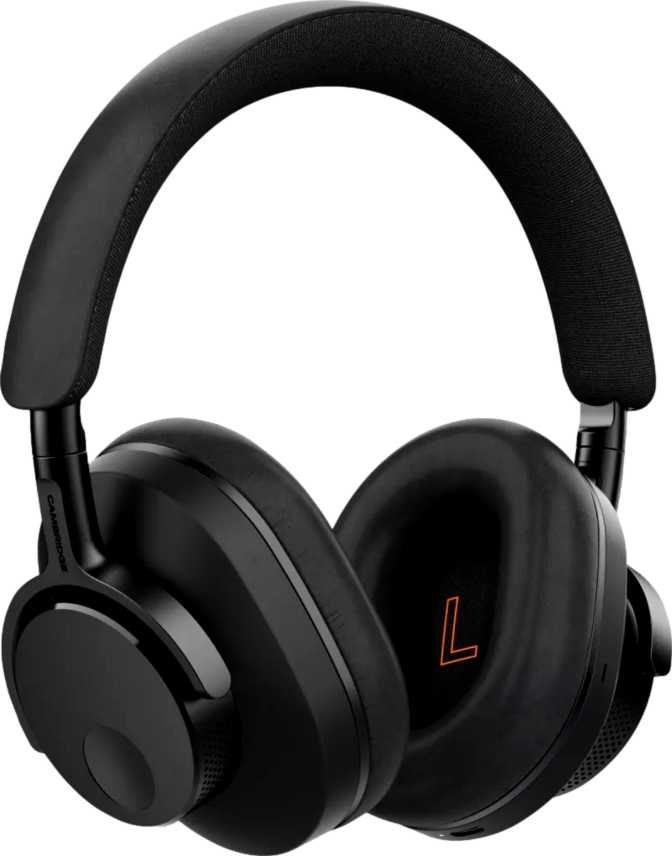
Cambridge Audio Melomania P100 SE: Full Review and Real-World Analysis
HeadphonesExpert Verdict
Category Breakdown
Key Specifications
Wireless Battery
Up to 100 Hours
With ANC Active
Up to 60 Hours
Bluetooth
Version 5.3
Premium Codec
aptX Lossless
Microphones
6-Mic Array
Multipoint
2 Devices
Charging Port
USB-C
Audio Cable
Detachable
The Battery-First Wireless Headphone Cambridge Audio Was Born to Make
Cambridge Audio has spent decades building a reputation on one conviction: that audio reproduction should serve the music, not the marketing. The Melomania P100 SE, the brand's over-ear wireless flagship, carries that philosophy into a segment crowded with feature competition and thin on substance. What immediately sets it apart is a battery endurance figure so extreme it almost reads like a misprint — and a deliberate set of audio priorities that will either match your needs precisely or expose a real mismatch. Understanding which camp you fall into is exactly what this review is for.
Design and Build Quality
Construction, Form Factor, and Portability
The Melomania P100 SE is an over-ear, closed-back design — meaning the ear cups fully surround your ears rather than resting on them, and the drivers fire into a sealed enclosure. For everyday listening this matters: closed-back designs contain more sound in both directions, contributing to the passive noise reduction the P100 SE delivers before any active electronics engage.
The headband folds for storage, a practical choice for a headphone clearly aimed at people who move. Paired with the included travel bag, it signals that Cambridge Audio expects this headphone to live in carry-ons and backpacks, not on a permanent desk hook. If you travel with headphones regularly, the absence of a case is one of those small omissions that accumulates into real frustration; here it is resolved before you even open the box.
The audio cable detaches from the headphone, and the cable itself is tangle-resistant. A detachable cable means that a damaged lead does not retire the entire headphone — you replace the cable, not the product. It also means the P100 SE functions fully in wired mode: connected directly to a seat-back system on a long-haul flight, a studio monitoring chain, or any source device where Bluetooth is unavailable or inadvisable. Many wireless headphones claim wired compatibility as a footnote; here it is a genuine design commitment.
What Is Missing from the Build
No Water or Sweat Resistance
There is no water or sweat resistance — not even a light splash rating. For a headphone built for all-day wear and travel, this is a real boundary. Outdoor commutes, light exercise, or caught-in-the-rain moments create genuine risk. This is not a deal-breaker for desk sessions, cabin environments, and focused listening rooms — but it matters enough to state clearly.
Build at a Glance
-
Over-Ear Closed-BackFull cup coverage and strong passive isolation
-
Foldable HeadbandCompact for carry-ons and storage
-
Travel Bag IncludedReady for backpacks and cabin luggage
-
Detachable Audio CableReplace the lead, not the headphone
-
Tangle-Resistant CableNo frustrating knots on the road
-
Wireless and Wired ModesFull compatibility with both connection types
-
No Water ResistanceAvoid moisture exposure and outdoor sweat
Sound Quality: Cambridge Audio's Core Argument
Driver Architecture and Sonic Philosophy
The P100 SE uses 40mm dynamic drivers — a size that sits in the mainstream sweet spot for over-ear headphones, large enough to develop controlled bass extension without requiring excessive physical bulk. The frequency range covers the full span of human hearing, which is an expected baseline at this level. The more meaningful question is tuning: how the driver is voiced, what the crossover prioritises, and what the acoustic engineering delivers in practice.
Cambridge Audio built its name on amplifiers, DACs, and source components consistently praised for neutrality and transparency — equipment that gets out of the music's way rather than adding character. If that philosophy extends into the P100 SE, and the brand's track record strongly suggests it does, expect a sound that reproduces what was recorded rather than flattering it with exaggerated bass or artificially brightened treble. This tuning approach rewards well-mastered audio and reveals the quality of your source material — which is either exactly what you want or precisely what you do not, depending on your preferences.
Active Noise Cancellation and Passive Isolation
The P100 SE deploys active noise cancellation supported by a six-microphone array — a count that enables a layered sensing strategy. Some microphones sample the noise environment outside the ear cup before sound reaches the driver; others monitor what penetrates the physical seal, allowing the electronics to cancel what slips through. This architecture is more sophisticated than headphones relying on two or three microphones, and it suggests genuine investment in both ANC effectiveness and call voice quality.
Passive noise reduction adds a second, independent layer. The closed-back seal and over-ear fit block mid and high-frequency noise physically, before any active electronics activate. In practice, this means meaningful ambient attenuation even with ANC switched off — a benefit in quiet environments where full ANC would feel excessive. When ANC is active, both mechanisms work simultaneously, which compounds their effectiveness.
The ambient sound mode pipes external audio through the drivers so you remain aware without removing the headphones. With six microphones handling this task, the hardware is present for natural ambient rendering rather than the hollow, artificial quality common in lesser implementations.
The Codec Situation: An Honest Assessment
This is where the P100 SE places a specific demand on its buyer — and where transparency matters more than comfort.
Wireless audio quality depends not just on hardware, but on the codec — the algorithm that compresses audio for Bluetooth transmission and decodes it at the headphone. The P100 SE supports aptX Lossless, a Qualcomm technology capable of delivering CD-quality audio over Bluetooth when source and headphone are both compatible. For listeners with Android devices built on Qualcomm's Snapdragon Sound platform, the wireless connection can carry the full resolution of a losslessly stored track without degradation.
The complication is what lies outside that scenario. The P100 SE does not support AAC — Apple's audio codec, the standard that governs wireless audio quality on every iPhone, iPad, and Mac. On Apple devices, and on Android devices without Snapdragon compatibility, the Bluetooth connection falls back to SBC, the baseline codec that all Bluetooth audio hardware supports by obligation. SBC functions, but it is the least capable option in the current codec landscape, and for a headphone positioned around audio quality, this creates a measurable gap between its ambition and its real-world delivery for many listeners.
There is also no LDAC support — Sony's high-resolution wireless codec that has become broadly available on Android devices and is offered by competing headphones across multiple price tiers.
Practical Breakdown by Device
- Android + compatible Snapdragon chipset: aptX Lossless delivers genuinely exceptional wireless audio — the full ceiling of the hardware.
- Android on other chipsets: SBC applies wirelessly. The wired connection is the meaningfully better quality route.
- iPhone, iPad, and Mac users: SBC applies wirelessly. Again, the wired cable delivers what the headphone is truly capable of.
Codec Support Matrix
| Codec | Supported |
|---|---|
| aptX Lossless | |
| LDAC | |
| AAC | |
| aptX HD | |
| aptX Adaptive | |
| aptX Low Latency | |
| SBC (Baseline) |
aptX Lossless requires a compatible Qualcomm Snapdragon Sound device. All other devices default to SBC.
Battery Life: The Defining Feature
The battery endurance is the Melomania P100 SE's most extraordinary characteristic, and the numbers deserve proper context before moving on.
ANC Off Endurance
Approximately one month of daily two-hour commutes on a single charge
ANC On Endurance
Still well above the category average, which typically peaks at 30 hours
Full Recharge Time
USB-C charging — the same cable as your phone and laptop
What These Numbers Mean in Practice
Frequent Flyers
A two-week international trip covered entirely on one charge. Leave the USB-C cable in your luggage as a formality.
Remote Workers
Eight-hour listening days translate to multiple working weeks per charge. Battery anxiety is genuinely eliminated.
Daily Commuters
Two hours of daily commuting, five days per week — approximately one charge every five weeks.
Category Context
Most premium competing headphones require charging every one to two days. The P100 SE reframes what "wireless" means.
Note on wireless charging: The P100 SE does not support wireless charging. Given how infrequently charging is actually needed, this omission is difficult to identify as a practical frustration in real-world use.
Features That Matter in Daily Use
Two-Device Multipoint
The P100 SE maintains an active Bluetooth link to two source devices simultaneously. Audio from your laptop automatically yields when a call arrives on your phone, then resumes when the call ends. For anyone working across a computer and smartphone throughout the day, this eliminates a constant, accumulating friction point.
Automatic On/Off Detection
When you lift the headphone off your head, playback pauses. When you put it back, it resumes. A small detail, but it removes the reflex of reaching for your source device every time you need to respond to someone, and prevents audio continuing into the room when the headphone is set down.
Six-Microphone Call Array
Arrays at this count are capable of distinguishing your voice from ambient noise — isolating speech while suppressing a café background, open-plan office, or train carriage. Combined with on-device controls for answering and ending calls without touching a phone, the P100 SE functions as a legitimate professional communication tool.
Ambient Sound Mode
When a boarding announcement requires attention, a colleague approaches, or a delivery arrives, the mode pipes external audio through the drivers so you remain fully aware without removing the headphones. The six-microphone hardware base means the ambience rendering has the infrastructure for a natural, transparent sound.
Bluetooth 5.3 Stability
The wireless connection runs on the current Bluetooth generation, which delivers improved connection stability and battery efficiency over earlier versions. The operational range is ten metres — standard for everyday use within a room, but users who routinely move between rooms while leaving their source device behind will notice this ceiling.
On-Device Controls
Physical controls sit on the ear cup itself, allowing you to manage playback, calls, volume, and mode switching without touching a phone or laptop. There is no inline cable control panel — all interaction happens at the headphone, which is the more ergonomic placement for an over-ear design.
Who the Melomania P100 SE Is Built For
This Is the Right Headphone For You If...
-
You are a long-haul traveller who wants a single charge to cover an entire journey without planning around power outlets
-
You work remotely or professionally and spend extended hours in calls and focused listening — and you are worn out by daily charging routines
-
You own a compatible Android device with Qualcomm Snapdragon Sound support and want the highest wireless audio quality currently achievable over Bluetooth
-
You trust Cambridge Audio's tuning philosophy and want a wireless headphone where sound reproduction is the genuine first priority
-
You value a wired fallback as part of your kit — the detachable cable enables direct use on aircraft entertainment systems and in recording environments
Look Elsewhere If...
-
Your primary device is an iPhone, iPad, or Mac — the absent AAC support constrains wireless performance to baseline SBC regardless of the hardware's ceiling
-
You use an Android phone on a non-Snapdragon chipset and prioritise wireless audio quality — LDAC is unavailable, leaving SBC as the wireless ceiling
-
You are an active user, gym-goer, or outdoor exerciser — no moisture protection makes this a genuine investment risk in those environments
-
You regularly move around large spaces and expect the Bluetooth connection to follow you room to room — ten metres is the operational ceiling
-
You require the broadest current feature set including spatial audio, modern pairing shortcuts, or LDAC high-resolution wireless audio on a wide variety of devices
Competitive Positioning
How the P100 SE stacks up against what you would otherwise buy in this category.
| Feature | Melomania P100 SE | Category Benchmark |
|---|---|---|
| Battery Life (ANC Off) | ~100 hours — class-leading | 20–40 hours typical |
| Battery Life (ANC On) | ~60 hours — outstanding | 20–30 hours typical |
| aptX Lossless | Uncommon at any tier | |
| LDAC Support | Common at premium tier | |
| AAC Support | Near-universal | |
| Spatial Audio | Increasingly standard | |
| Wireless Charging | Available at this tier | |
| Water / Sweat Resistance | IPX4 increasingly common | |
| Microphone Count | 6 microphones | 2–6 at this tier |
| Simultaneous Device Connections | Standard (2 devices) | |
| Detachable Wired Cable | Common | |
| Travel Case Included | Common |
The P100 SE wins on battery life without a close comparison — not a marginal lead, but a different order of magnitude entirely. Competing alternatives from Sony and Bose pull ahead on broader codec support, spatial audio, and splash resistance. Whether that trade-off works depends entirely on your device ecosystem and how heavily endurance weighs in your priorities.
Genuine Strengths and Honest Shortcomings
What the P100 SE Gets Right
The most compelling quality of the Melomania P100 SE is not any single specification — it is what happens to your experience of headphone ownership when charging becomes a monthly errand rather than a daily task. The psychological shift is larger than the spec sheet captures. Anxiety about dying batteries mid-flight, mid-meeting, or mid-listening session simply disappears, replaced by a quiet confidence in the tool that is difficult to quantify.
The six-microphone system reflects genuine engineering investment in call performance and ANC quality rather than a checkbox specification. The ambient sound mode has the hardware to render external audio naturally. Two-device multipoint covers the most common professional use pattern without configuration headaches.
The detachable wired cable is not an afterthought — it is a meaningful quality option for users who understand that wired audio bypasses every Bluetooth codec limitation entirely. For Apple users in particular, the cable turns a compromised wireless experience into the full Cambridge Audio-quality connection. Cambridge Audio's audio heritage provides real confidence in the tuning behind the drivers, even without independent testing of the final voicing.
Where It Falls Short
The codec picture is the most consequential limitation this headphone carries. A product positioned around sound quality that delivers baseline SBC wireless audio on iPhones, iPads, and a large portion of Android devices creates a meaningful distance between its ambition and its real-world delivery for many listeners. This is not a minor technical footnote — it affects what the headphone sounds like every single time a majority of wireless users press play.
The absence of any moisture resistance tightens the use case more than the design's portability features might suggest. A headphone this capable of extended all-day wear invites exactly the situations where even a basic splash rating would protect the investment. The omission is a deliberate choice, but it carries real consequences.
The ten-metre Bluetooth range and the absence of modern pairing conveniences — no NFC tap, no fast pair — are secondary concerns. But they reinforce the broader profile: the P100 SE is deep in specific dimensions and deliberately restrained in others. It was designed with a precise user in mind and rewards that user considerably. For everyone outside that alignment, the gaps accumulate into a real mismatch.
Questions Buyers Ask Before Purchasing
Final Verdict
Cambridge Audio Melomania P100 SE
The Cambridge Audio Melomania P100 SE is a headphone built around specific convictions: that battery anxiety should be engineered away entirely, that audio quality should follow from principled tuning rather than spec accumulation, and that a wired connection remains a legitimate and valuable option in a wireless product.
For the buyer those convictions align with — the Android user on a compatible Snapdragon device, the frequent traveller, the professional worn down by daily charging rituals — the P100 SE delivers something genuinely differentiated. No other headphone in its class operates at this endurance level. Cambridge Audio's audio heritage justifies confidence in the tuning. The call quality infrastructure is serious hardware, not a marketing checkbox.
For everyone outside that alignment — particularly iPhone users, Android users on non-Snapdragon devices who prioritise wireless audio quality, and anyone who needs even minimal weather protection — the codec picture is a limitation that battery life cannot compensate for, and competing headphones offer broader capabilities at comparable prices.
Buy It If
- You use a compatible Android device with Snapdragon Sound support
- You are genuinely exhausted by constant charging schedules
- You want a headphone tuned by a brand that treats audio as the mission, not the marketing
Look Elsewhere If
- Your primary device is an iPhone, iPad, or Mac
- You exercise or commute in conditions where moisture exposure is realistic
- LDAC, spatial audio, or broad codec compatibility is non-negotiable for your setup