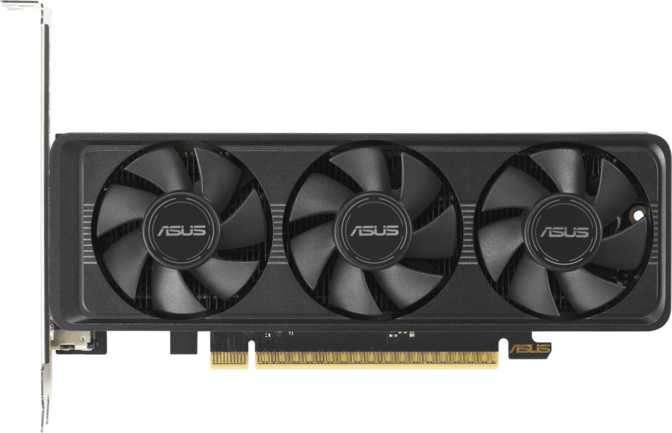
Asus GeForce RTX 5060 LP BRK Review: Blackwell Power in Low Profile
Graphics CardsA Full-Fat GPU in a Half-Height Body
Most gaming PCs are built around full-tower or mid-tower cases with room to spare. But a substantial portion of the market — home theater PCs, compact office builds, small form factor desktops, and pre-built slim systems — simply cannot accommodate a standard dual-slot graphics card. That is precisely the gap the Asus GeForce RTX 5060 LP BRK targets.
The "LP" designation stands for Low Profile, and the "BRK" indicates the card ships with both a standard full-height bracket and a low-profile bracket included in the box. This single detail makes it one of the more versatile compact GPU options available, covering a wider range of chassis than competing low-profile cards that force you to source alternate brackets separately.
What makes this card genuinely interesting is not just its small footprint — it is that Asus has managed to pack Nvidia's latest Blackwell-generation silicon into that footprint without gutting the specification sheet. Whether that ambition translates into real-world performance without thermal compromise is the central question this review answers.
Specifications at a Glance
Design and Build: Purposefully Small, Practically Designed
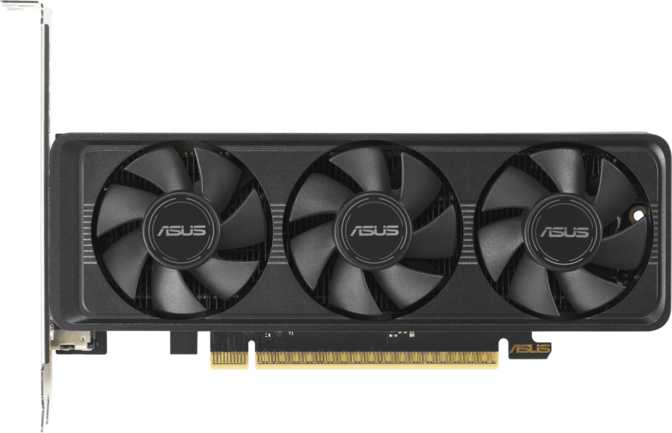
At 175.8mm long and just 69mm tall, the Asus RTX 5060 LP BRK is built for enclosures where a standard card simply will not fit. To put those numbers in context: most dual-fan full-size cards run between 280mm and 340mm in length. This card is roughly half the length of a typical mid-range GPU.
The card occupies a dual-slot width, which is the practical minimum for keeping a GPU of this power level adequately cooled within its form factor constraints. Its compact dimensions mean it is physically compatible with low-profile PCIe slots found in slim desktops, Mini-ITX enclosures designed for half-height cards, and small form factor pre-built systems from major OEMs.
There is no RGB lighting on this card. For a build where the GPU lives inside a sealed HTPC chassis or a corporate-style small desktop, that is exactly right — there is nothing to illuminate through a case that has no window, and the absence of lighting hardware marginally reduces both cost and power draw.
The included dual-bracket configuration is a practical inclusion that sets this card apart from some competitors. Many low-profile cards ship with only one bracket, requiring buyers to hunt for the correct aftermarket option. Asus eliminates that friction entirely.
The Blackwell Architecture: What It Actually Means
The RTX 5060 LP BRK is built on Nvidia's Blackwell architecture, fabricated on a 5-nanometer process. Blackwell is Nvidia's current flagship GPU generation, and while this card sits at the accessible end of that lineup, the architectural benefits cascade all the way down the product stack.
This transistor density enables more compute capability per millimeter of silicon than any previous Nvidia generation — which is part of how Asus can deliver a card of this computational caliber in a form factor this compact.
The GPU runs at a base clock of 2,280 MHz and boosts to 2,497 MHz under gaming load. The narrow gap between base and boost clock suggests mature clock management — the card sustains its peak speed reliably rather than spiking up and dropping back. That consistency matters more in practice than a high peak boost figure that the card rarely holds.
Being on Blackwell also means a PCIe 5.0 interface, ensuring this card will not bottleneck on current or next-generation platforms. The interface bandwidth headroom is generous relative to what the card actually requires, which leaves room for the platform to use it as software evolves.
Compared to the previous Ada Lovelace generation, Blackwell brings improved AI-accelerated features, updated ray tracing hardware, and a more capable DLSS pipeline. These are not merely marketing distinctions — they produce tangible differences in supported titles at this performance tier.
Memory: Where This Card Punches Above Its Weight
If there is one specification on this card that punches above its weight class, it is the memory subsystem. The RTX 5060 LP BRK uses 8GB of GDDR7 — the latest generation of graphics memory — and its adoption here produces real-world bandwidth figures that would have seemed exceptional at this price point just two generations ago.
Enabled by GDDR7 running at an effective 28,000 MHz. Bandwidth is a primary determinant of performance at higher resolutions and in texture-heavy environments — this figure is a genuine step forward for the compact GPU category.
A wider bus would cost more, draw more power, and produce a physically larger chip. The GDDR7 speed compensates for this constraint — and the math largely works, especially at 1080p and 1440p targets.
At 1080p, this card has bandwidth to spare. At 1440p — which is increasingly the resolution target for mid-range builds — the headroom means less performance throttling in demanding scenes compared to GDDR6-equipped predecessors at similar bus widths.
ECC memory support is present as well. This is not a feature most gamers will use, but it is relevant for workstation or compute use cases in compact form factor deployments where data integrity is a requirement rather than a preference.
Raw Performance: Numbers Translated Into Reality
The card delivers approximately 19.18 trillion floating-point operations per second. For everyday gaming, this positions the RTX 5060 LP BRK to handle 1080p gaming at high-to-ultra settings across the vast majority of current titles, and 1440p gaming at medium-to-high settings in less demanding games. The texture throughput of nearly 300 billion texel operations per second feeds directly into how detailed and sharp environments look during gameplay.
Core Performance Metrics
| Metric | Value | Real-World Meaning |
|---|---|---|
| Compute Power | 19.18 TFLOPS | Handles 1080p ultra and 1440p medium-high settings across current game catalogues |
| Texture Throughput | 299.6 GTexel/s | Feeds detailed, sharp environments without texture pop-in at standard gaming resolutions |
| Pixel Fill Rate | 119.9 GPixel/s | Supports high-framerate 1080p output; appropriate balance for the shader count at this tier |
| Shader Units | 3,840 | Primary driver of gaming and compute workloads; well-matched for 1080p–1440p targets |
| Render Output Units | 48 ROPs | Conservative for the shader count; fill-rate-heavy scenes at very high resolutions show earlier constraints |
| Boost Clock Speed | 2,497 MHz | Narrow base-to-boost gap indicates consistent, sustained clock behaviour under gaming load |
The ROP count is somewhat conservative relative to the shader count. Fill-rate-heavy scenarios at very high resolutions will show earlier constraints — but at 1080p and moderate 1440p targets, the balance is practical and well-matched to real-world use for a card in this form factor and power class.
Key Features: What Blackwell Adds Beyond Raw Performance
Architectural features that translate into meaningful real-world advantages at this tier.
DLSS and AI-Accelerated Rendering
DLSS (Deep Learning Super Sampling) support is arguably the most impactful practical feature on this card. Nvidia's DLSS uses AI-trained upscaling to render frames at a lower internal resolution and reconstruct them at the display resolution — with results that in many scenarios are visually comparable to native rendering at a fraction of the performance cost.
For a card in this form factor and power envelope, DLSS is not just a nice-to-have; it is the mechanism that makes 1440p and even 4K output viable at playable frame rates in supported titles. In a compact card constrained by thermal limits, DLSS is effectively extra performance that requires no additional power. The growing catalogue of DLSS-supported titles makes this increasingly relevant with each release cycle.
Ray Tracing
Hardware-accelerated ray tracing is present on this card. Ray tracing simulates how light bounces realistically off surfaces, producing shadows, reflections, and ambient lighting that look physically accurate rather than pre-baked. On a card of this performance tier, ray tracing is best used selectively — enabling it in titles where the visual payoff is significant while adjusting quality settings to maintain frame rate targets. The sweet spot is medium ray tracing settings rather than maximum, where visual gains are substantial and the performance cost remains manageable.
Feature Overview
Display Output Configuration
The output configuration is practical and future-proof: two HDMI 2.1 ports and one DisplayPort output, supporting up to four simultaneous displays. Both HDMI 2.1 outputs support 4K at 120Hz — directly relevant for users connecting to modern gaming monitors or televisions. The dual HDMI setup is particularly useful in HTPC and living room contexts where a TV and a secondary display may need to be connected simultaneously without a hub.
| Port Type | Count | Specification |
|---|---|---|
| HDMI | 2 | HDMI 2.1 — supports 4K at 120Hz per output |
| DisplayPort | 1 | Full-size DisplayPort output |
| USB-C | 0 | Not present — adapter required for USB-C monitors |
| DVI | 0 | Not present — legacy format not supported |
Power, Thermal Envelope, and What That Means for Compact Builds
The card is rated at 145 watts. For a low-profile card, this is a significant power figure, and it deserves direct discussion.
Most low-profile cards historically topped out at 75W, drawing power entirely from the PCIe slot without a supplemental connector. The RTX 5060 LP BRK's 145W rating changes that. Many OEM slim desktops ship with PSUs in the 180–250W range — this card would consume a substantial portion of that budget, leaving limited headroom for the CPU and peripherals. Verify your system's PSU capacity before purchasing.
For builders working in a purpose-built compact gaming case or a Mini-ITX build with a proper SFX PSU, 145W is entirely manageable. The concern is specific to users retrofitting this into a branded slim desktop with a limited OEM power supply — a scenario that is common for this card's target audience.
The card uses conventional air cooling — there is no liquid cooling system, which would be impractical at this size. The cooler must dissipate 145W within a low-profile thermal design. In an enclosure with good airflow, the card manages its temperatures comfortably. In a sealed, passively ventilated HTPC chassis, thermal headroom will be tighter — enclosure planning matters as much as PSU capacity.
The absence of RGB lighting removes one source of heat load, and the card's clean industrial design prioritizes thermal function over aesthetic features — a sensible trade-off for this application.
Who This Card Is For — and Who Should Look Elsewhere
- The HTPC and Living Room GamerWants a gaming-capable PC under the television. Dual HDMI 2.1 outputs make TV connectivity direct and adapter-free at up to 4K@120Hz.
- The Compact Office-to-Gaming BuildUses a small form factor desktop for work and wants gaming capability after hours without building or buying a second machine.
- The Slim Desktop UpgraderReplacing an integrated or entry-level GPU in a branded slim pre-built. The most practical upgrade path available — provided PSU capacity is confirmed first.
- The 1080p Competitive GamerPrioritises high, stable frame rates over maximum graphical fidelity. At 1080p in competitive titles, this card delivers consistently.
- The 1440p / 4K Max-Settings EnthusiastThe 128-bit memory bus and 8GB VRAM ceiling will show in memory-hungry titles at maximum quality. An RTX 5060 Ti or higher provides meaningfully more headroom.
- Standard Mid-Tower BuildersNo reason to choose low-profile without a form factor requirement. Full-size cards offer better cooling and performance headroom at comparable price points.
- OEM Slim Desktop Owners With Weak PSUsIf the existing PSU cannot handle sustained 145W load alongside the rest of the system, this upgrade will be problematic. Verify before purchasing.
Competitive Positioning
The RTX 5060 LP BRK's clearest advantage over previous-generation low-profile cards is the GDDR7 memory subsystem: substantially higher bandwidth at the same 128-bit bus width compared to GDDR6-based alternatives translates to better headroom at 1440p and more comfortable performance at 1080p ultra settings. Its 145W power draw is higher than most competing low-profile cards, which have traditionally stayed in the 75–130W range — this is the price of current-generation performance in a compact package.
| Card | Form Factor | Architecture | VRAM | Memory | TDP |
|---|---|---|---|---|---|
| Asus RTX 5060 LP BRK | Low-Profile | Blackwell (5nm) | 8GB | GDDR7 | 145W |
| RTX 4060 LP (typical) | Low-Profile | Ada Lovelace | 8GB | GDDR6 | ~115W |
| RX 6600 LP (typical) | Low-Profile | RDNA 2 | 8GB | GDDR6 | ~100–130W |
| RTX 5060 (full-size) | Full-Size | Blackwell (5nm) | 8GB | GDDR7 | ~150W |
Against the full-size RTX 5060, the low-profile version trades some thermal efficiency for form factor compatibility. For the user who requires a low-profile card, that trade-off is non-negotiable — and Asus manages it as well as the engineering constraints allow.
Honest Assessment: Strengths and Limitations
The RTX 5060 LP BRK does something genuinely difficult: it delivers current-generation GPU architecture in a format that most previous-generation competitors cannot match for performance. GDDR7 in a low-profile card is a meaningful step forward, and the Blackwell architecture brings DLSS and ray tracing capabilities that were not available to compact-build users at this tier before.
Where It Excels
- GDDR7 memory is a genuine differentiator — more bandwidth per dollar than any previous-generation compact card at the same bus width
- Full Blackwell architecture: DLSS, hardware ray tracing, and DirectX 12 Ultimate with no features cut or compromised
- Dual-bracket inclusion eliminates the most common installation friction point for buyers moving from another low-profile card
- Dual HDMI 2.1 outputs make HTPC and living room gaming connectivity direct — no adapters needed for 4K@120Hz television setups
Where It Falls Short
- 8GB VRAM ceiling will matter over a multi-year lifespan — future AAA titles at 1440p and above will increasingly strain this limit
- 145W TDP is high for a low-profile card — a mandatory PSU check is required before any slim desktop installation
- Air cooling must manage 145W in a compact thermal design — sealed or passively ventilated cases will see tighter thermal headroom
- No USB-C output — a minor gap for most users, but relevant for those connecting USB-C monitors or portable displays directly
Common Questions Buyers Ask
Answers to the questions real buyers search for before making a decision on this card.
Final Verdict
The Asus GeForce RTX 5060 LP BRK is the best low-profile GPU available for buyers who have no choice but to use a low-profile slot and refuse to compromise entirely on performance. It is not a card for someone who can use a standard full-size GPU — in that situation, better options exist at or near the same price. But for the specific buyer it targets, it is nearly purpose-built.
The GDDR7 memory subsystem is a genuine differentiator against previous-generation compact cards. DLSS support makes 1440p a realistic target. The dual-bracket inclusion eliminates a common friction point in the installation process. The 145W power requirement demands due diligence — specifically a PSU check in any slim or OEM desktop. And the 8GB VRAM ceiling is a fair criticism that should factor into decisions for buyers seeking multi-year longevity at higher resolutions.
Buy this card if you need a low-profile form factor, want current-generation Blackwell architecture, and have confirmed your chassis power supply can accommodate the load. Pass if you have the physical space for a full-size card, or if your available PSU headroom is limited.