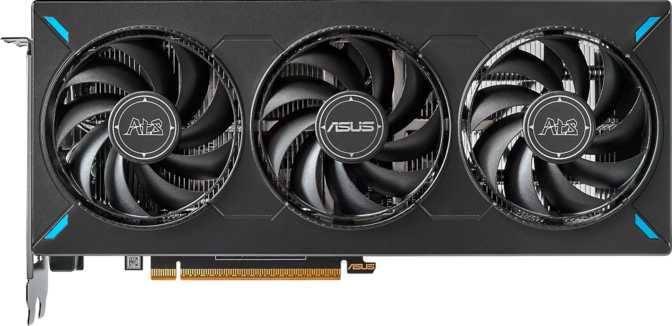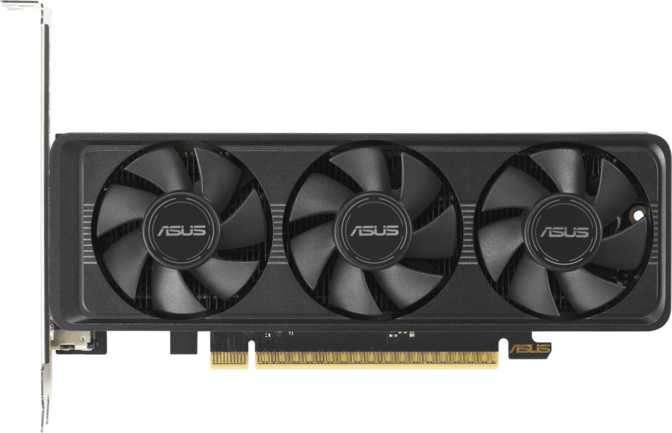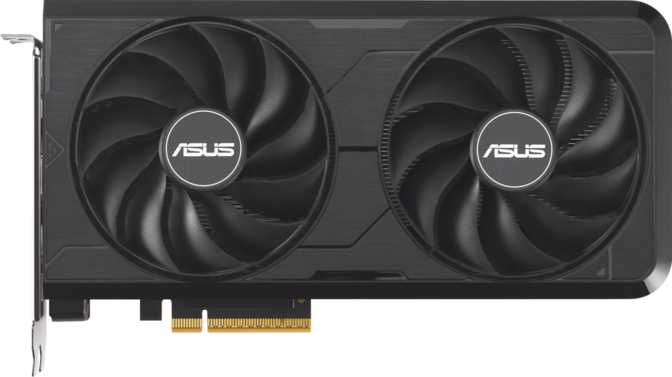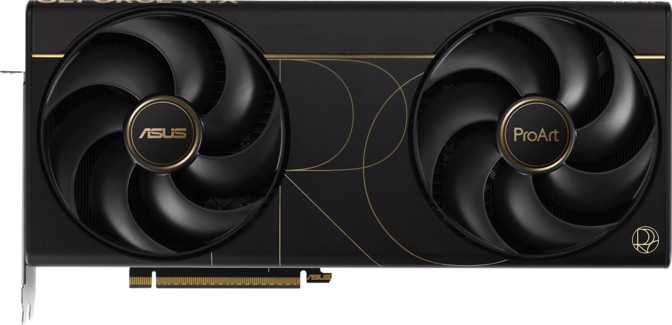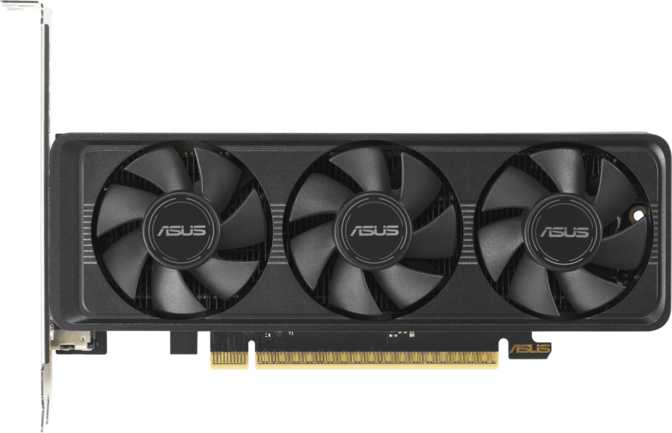
Asus GeForce RTX 5060 LP BRK OC Edition – Full Review
Graphics CardsSmall form factor PC building has grown from a niche hobby into a genuine mainstream choice. Mini-ITX cases, compact home theater systems, office workstations, and slim home servers all share one frustrating constraint: most capable graphics cards simply will not fit. The Asus GeForce RTX 5060 LP BRK OC Edition exists precisely to close that gap — bringing Nvidia's current-generation Blackwell architecture into a card small enough to slot into cases that would reject virtually every other modern GPU worth considering.
This is not a cut-down, compromised product. It is a low-profile card built around the same foundational technology powering full-size RTX 5060 boards, factory overclocked out of the box, and aimed at a buyer who refuses to choose between a compact build and respectable gaming performance.
At a Glance — Key Specifications
Design and Physical Build
Size — the Whole Point
The defining characteristic of this card is its physical footprint. At roughly 176mm in length and just 69mm in height, it conforms to the standard low-profile (half-height) form factor. That height measurement is critical: standard full-height graphics cards stand around 111–120mm tall, immediately disqualifying them from low-profile slots. This card fits where nothing else from the current RTX generation typically can.
The "LP BRK" designation signals that Asus ships it with the appropriate low-profile bracket pre-installed. A full-height bracket is also typically included for cases that accept standard cards but have a shorter PCIe slot — giving the card flexibility in non-standard enclosures.
Cooling and Build Choices
Because the card is air-cooled in a physically constrained form factor, the cooling solution is purpose-designed for low clearance. There is no water cooling option, and the card does not feature RGB lighting — both deliberate omissions that make engineering sense at this size. The absence of RGB is irrelevant in practice; most compact system builders install these cards in cases with limited lighting visibility anyway.
The thermal design has to work harder per square centimeter than a full-length dual-fan card. That the factory overclock was still applied — rather than being thermally throttled away — signals that Asus's engineers found adequate headroom within this compact footprint.
Connector Layout
The card runs on PCIe 5.0, meaning the physical slot connection and power delivery are current-generation. Three display outputs are present — two HDMI 2.1 ports and one DisplayPort — a well-chosen configuration for living room setups, multi-monitor office builds, or home theater PCs. There are no USB-C display outputs and no DVI, which is entirely appropriate for this product class.
Core Performance — What Blackwell Delivers
Processing Horsepower
The RTX 5060 LP BRK OC Edition is built on Nvidia's Blackwell GPU architecture, manufactured using a 5-nanometer process node. To put that in perspective: 5nm fabrication means transistors are extremely small and tightly packed, translating to better performance per watt compared to older process nodes. The die houses approximately 21.9 billion transistors — a figure that speaks to the fundamental complexity of hardware doing things like real-time ray tracing.
The card fields 3,840 shader processors — the individual computational units handling the bulk of graphical workloads. The OC Edition pushes those processors to a boost clock of 2,550 MHz, slightly above the reference spec for this GPU class, the direct result of Asus's factory overclocking. Frames are processed marginally faster than a standard RTX 5060 baseline with no effort required from the user.
Performance at a Glance
Bars represent relative standing within the mainstream GPU segment.
Memory Configuration — GDDR7 Changes the Equation
Why GDDR7 matters more than the 8GB figure suggests
The 8GB VRAM capacity is the first figure skeptics will latch onto — and fairly so. But what matters equally is speed. This card uses GDDR7 memory — the latest generation — delivering 448 gigabytes of data per second between the GPU and its memory. Many prior-generation cards in a similar price tier managed 256–336 GB/s on GDDR6. The jump to GDDR7 is substantial. Games that would have strained older 8GB cards face a different constraint here because the GPU can retrieve texture data so quickly that the 8GB ceiling is reached far less frequently at typical gaming resolutions. At 4K with heavy texture packs, the limit will eventually be felt — but at 1080p and 1440p, GDDR7 speed compensates meaningfully.
Key Features With Real-World Meaning
DLSS — the Performance Multiplier
Nvidia's AI-based upscaling technology allows the GPU to render a game at a lower internal resolution and intelligently reconstruct it at a higher output resolution — with visual quality that often matches native rendering. For this card specifically, a game taxing the hardware at native 1440p can instead be rendered lower and upscaled using DLSS. Frame rates improve significantly, and the visual difference is often imperceptible in motion. The current-generation DLSS supported here includes Frame Generation, which can further multiply perceived frame rates in supported titles by generating intermediate frames using AI. DLSS is not a gimmick on this card — it is the mechanism that makes the performance envelope substantially more capable than raw specs alone suggest.
Ray Tracing — the Honest Assessment
Ray tracing support is present, and the hardware acceleration for it is genuine — dedicated RT cores in the Blackwell architecture handle this directly. That said, ray tracing is computationally expensive, and expectations should be calibrated accordingly.
At 1080p with DLSS engaged, ray tracing in moderately demanding implementations is achievable. Attempting ray tracing at high settings in the most demanding titles at 1440p will push the card. The honest position: ray tracing is possible and often enjoyable here, but it is not the card's primary use case. Use DLSS alongside it and be selective about quality presets.
Display Connectivity — More Than Expected
Supporting up to four simultaneous displays from a low-profile card is genuinely unusual. Both HDMI 2.1 outputs support 4K at 144Hz or 8K at 60Hz in compatible configurations — the current top-tier HDMI standard. The DisplayPort output adds a third high-bandwidth connection. Practical applications include dual-monitor workstation setups, home theater multi-display arrangements, or connecting a gaming monitor plus a secondary productivity display simultaneously.
Resizable BAR & ECC Support
Intel Resizable BAR: Allows the CPU to access the full GPU memory at once rather than in small chunks, removing a legacy bottleneck in CPU-GPU communication. In supported games, this provides a measurable performance uplift at essentially no cost. Requires enabling in BIOS on a compatible platform.
ECC Memory Support: Allows the GPU to detect and correct single-bit memory errors — primarily relevant for scientific computing, machine learning inference, and similar tasks. Its presence signals genuine utility beyond gaming for compact workstation builds.
Feature Compatibility Summary
| Feature | Supported | Relevance |
|---|---|---|
| DLSS (AI Upscaling + Frame Gen) | Essential for performance at 1440p+ | |
| Hardware Ray Tracing | Best used with DLSS at 1080p–1440p | |
| DirectX 12 Ultimate | Full compatibility with current titles | |
| Intel Resizable BAR | Free performance uplift on Intel platforms | |
| ECC Memory | Professional / compute workloads | |
| Double Precision Floating Point | Scientific / engineering software | |
| Multi-Display (up to 4) | Productivity and home theater setups | |
| OpenGL 4.6 / OpenCL 3.0 | CAD, creative apps, compute | |
| RGB Lighting | N/A — intentionally omitted | |
| XeSS / XMX | Not applicable (Nvidia platform) |
Power and Thermal Efficiency
The 145W TDP (Thermal Design Power) defines how much electricity this card draws at sustained load — and it is a notably disciplined number for a card at this performance level. Prior-generation cards delivering similar gaming performance often sat in the 165W–200W range. Nvidia's 5nm Blackwell process delivers meaningful efficiency improvements, and the result is a GPU that can run hard without requiring exotic power delivery.
For compact system builders, this has direct implications: smaller PSUs are viable, cable routing is simpler, and the system runs cooler overall. Many compact SFF cases that include integrated or modular PSUs in the 300–450W range can accommodate this card with comfortable headroom after accounting for CPU, storage, and other components.
Power Context
- 145W TDP — meaningful efficiency gain vs. prior-gen equivalents at 165–200W
- 450–500W PSU — comfortable headroom for a typical SFF build with mid-range CPU
- PCIe 5.0 — current-generation slot standard with efficient power delivery
- Compact cooling means temperatures run higher than full-size cards in poorly ventilated enclosures
Who This Card Is For — and Who Should Look Elsewhere
Buy This If You Are…
- Building or upgrading an SFF PC with a low-profile PCIe slot — this is the primary audience, and for them there is almost no comparable alternative in this performance tier.
- Building a home theater PC where card height is limited and the system lives in an AV cabinet or media console.
- Wanting current-gen GPU features — DLSS, ray tracing, DirectX 12 Ultimate — in a non-standard chassis.
- Running a compact workstation needing GPU compute capability alongside display output in a single low-profile slot.
- Setting up a multi-display office in an SFF case and needing up to four outputs from a single card.
Think Carefully If You Are…
- Using a case that accepts full-height cards. A full-size RTX 5060 will offer better cooling headroom and often similar or better pricing. The low-profile form factor is the reason to choose this, not a bonus.
- Primarily targeting 4K maximum settings in the most demanding current titles. The 8GB VRAM ceiling and compact cooling both become relevant pressures at that resolution tier.
- Pushing ray tracing at maximum quality without DLSS. The results will be playable in many titles, but this is not where the card shines unconditionally.
Competitive Positioning
Because this is a low-profile card, it occupies a near-unique position in the market. Direct apples-to-apples competition from Nvidia's own ecosystem is limited — the RTX 5060 LP represents the highest tier of current-generation Nvidia low-profile offerings, and the OC Edition specifically sits at the top of that segment. The generational leap in memory speed over previous low-profile options is the most compelling competitive argument.
| Aspect | RTX 5060 LP BRK OC This Card |
Prior-Gen Low-Profile | Full-Size RTX 5060 |
|---|---|---|---|
| Form Factor Suitability | Low-profile cases | Low-profile cases | Standard cases only |
| Memory Generation | GDDR7 | GDDR6 | GDDR7 |
| Memory Bandwidth | 448 GB/s | 192–256 GB/s | 448 GB/s |
| DLSS Generation | Current (Blackwell) | Older DLSS | Current (Blackwell) |
| Power Draw | 145W | 75W–120W | 145W+ |
| 1440p Gaming Viability | Yes, with DLSS | Limited | Yes, with DLSS |
| Ray Tracing | HW Accelerated | Limited / None | HW Accelerated |
Honest Strengths and Weaknesses
The RTX 5060 LP BRK OC Edition does several things that are genuinely impressive for its category. The decision to include GDDR7 memory is not a given on a compact, efficiency-tuned card — it is a deliberate choice that meaningfully extends the card's competitive relevance compared to what a GDDR6 variant would have delivered. The factory overclock adds a small but real performance increment with zero effort from the user. The 145W power ceiling makes it a practical fit in PSU-constrained SFF builds. And the port selection — dual HDMI 2.1 plus DisplayPort — is genuinely useful in ways that a single-port configuration would not be.
Where It Excels
- GDDR7 in a compact card — a meaningful generational step that most competing low-profile options cannot match, significantly boosting real-world throughput.
- Factory overclock applied — performance above reference RTX 5060 baseline without the user needing to touch anything.
- 145W power efficiency — dramatically more achievable for compact builds than prior-gen equivalents drawing 165–200W.
- Dual HDMI 2.1 + DisplayPort — a port configuration that genuinely serves multi-display scenarios rather than forcing adapters or compromises.
- Near-unique market position — current-generation features in a low-profile slot are almost exclusively the domain of this card right now.
Where It Falls Short
- 8GB VRAM is a legitimate concern for multi-year ownership. VRAM requirements in games have been climbing, and 8GB is not a comfortable long-term buffer at 1440p with heavy textures.
- Compact cooling has limits — in a warm case or during sustained computational workloads, temperatures will run higher than on an equivalent full-size product.
- Form factor premium applies — buyers who can use a standard card are paying for the compact engineering, not exclusively for the best value-per-frame among all RTX 5060 variants.
Questions Real Buyers Ask
Final Recommendation & Verdict
Our assessment after a complete analysis of specifications, architecture, and competitive positioning.
The Asus GeForce RTX 5060 LP BRK OC Edition earns an unambiguous recommendation for its target audience, and that audience is very specific: anyone building or upgrading in a low-profile PCIe chassis who needs the best current-generation GPU performance that form factor allows.
For that buyer, there is no serious debate. GDDR7 memory with 448 GB/s of bandwidth, full Blackwell architecture features including current-generation DLSS and hardware ray tracing, a factory overclock, and a 145W envelope that plays nicely with compact power supplies — this is the most capable compact graphics card available from Nvidia's current lineup, and it is not close.
For anyone without a physical form factor constraint, the calculus changes. A full-size RTX 5060 board from any manufacturer will cool better and likely carry a more competitive price per frame. The low-profile premium makes sense only when the build demands it.
Purchase Verdict
Buy without hesitation if your build requires a low-profile card. Pass if you have a standard case and want the best value from the RTX 5060 tier — in that scenario, choose a full-size variant instead.