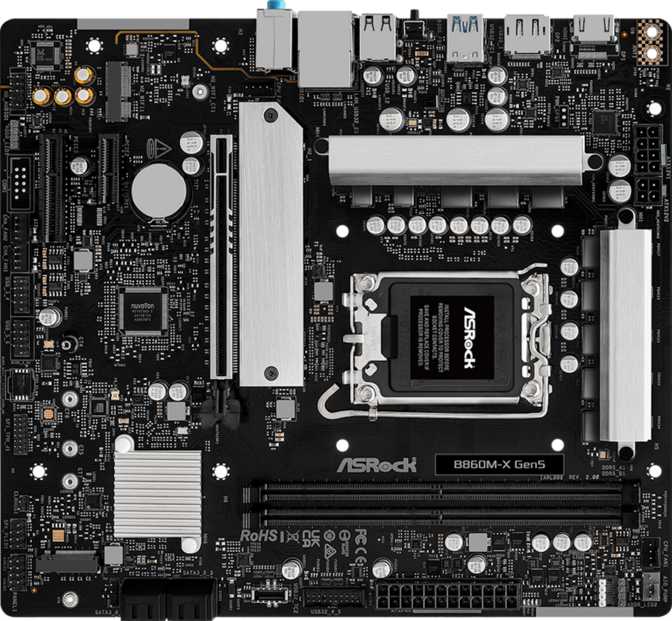
ASRock B860M-X Gen5 Review: An Honest Look at This mATX Board
MotherboardsThe budget-to-midrange motherboard segment is where most PC builds live or die. Pay too little and you're locked out of meaningful upgrades. Overspend and you're funding features that exist only on a spec sheet. The ASRock B860M-X Gen5 lands in that contested middle ground: a Micro-ATX board built on Intel's B860 chipset and the current LGA 1851 platform, targeting builders who want genuine forward-looking capability without the premium tax of a flagship board. What makes it interesting isn't one standout feature — it's the combination of PCIe 5.0 graphics support, high-headroom memory tuning, and a compact footprint that fits cases most mainstream builders actually use.
Key Highlights at a Glance
PCIe 5.0 GPU Slot
Future-ready GPU bandwidth
High-OC DDR5
Extreme memory tuning headroom
Dual M.2 + 4x SATA
Flexible, multi-drive storage
USB-C at 20Gbps
Fast rear-panel connectivity
Micro-ATX Form Factor
Wide case compatibility
3-Year Warranty
Full ASRock coverage
Design, Build Quality, and Physical Experience
Form Factor and Physical Footprint
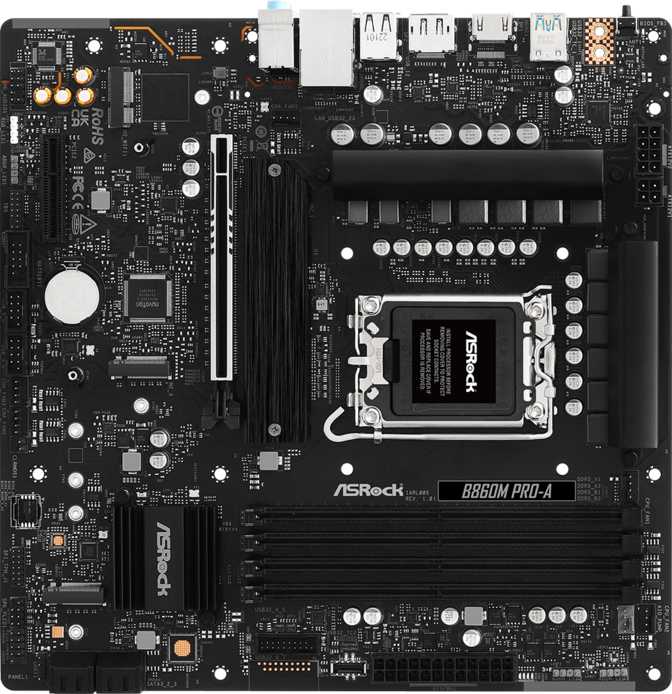
At roughly 218 mm tall by 244 mm wide, this is a proper Micro-ATX board — fitting in almost any mid-tower or compact case that accepts standard mATX sizing, while still leaving room for a discrete GPU and adequate airflow. Builders moving from full ATX who are worried about feeling cramped will find the layout sensible rather than compromised.
The board includes RGB lighting — a deliberate inclusion at this price tier rather than an afterthought — and it connects into whatever addressable ecosystem you're running without requiring a dedicated header workaround. The overall aesthetic leans functional over flashy, which suits a build focused on price-per-performance.
What's Not Here: Honest Build Omissions
Two absences worth knowing before you commit
- There is no dedicated clear-CMOS button on the rear I/O panel. Recovering from a bad BIOS setting requires opening the case and using the onboard jumper — a minor inconvenience during initial setup, but more significant for builders pushing aggressive memory OC profiles.
- There is no dual BIOS chip, meaning no automatic firmware recovery if a BIOS update fails. Neither omission is unusual at this price point, but on a board aimed at memory tuners who will actively stress BIOS limits, a backup chip would have been a meaningful addition.
The board ships with a three-year warranty from ASRock — standard for this segment and adequate coverage through most of a typical build's active lifespan.
Platform and Chipset: What B860 Means for Your Build
The B860 chipset occupies a deliberate position in Intel's current lineup. It supports the LGA 1851 socket — Intel's current mainstream desktop platform — and accepts the latest-generation processors. What it does not allow is CPU core frequency overclocking. That capability is reserved for Z890 boards. If pushing processor clocks beyond factory settings is part of your plan, this is not the right foundation.
No CPU Overclocking
B860 is a hard platform limit. No BIOS update or third-party tool changes this. Z890 is required if CPU frequency tuning is your goal.
GPU Required at Boot
This board does not expose integrated graphics to its display outputs. A discrete GPU must be installed before anything appears on screen.
Memory OC Fully Supported
B860 supports DDR5 memory overclocking — and the B860M-X Gen5 takes that headroom to a genuinely impressive ceiling for this price tier.
Where B860 Sits in Intel's Current Lineup
Previous Generation
B760
LGA 1700 platform — does not accept current-generation Intel processors
This Board
B860
LGA 1851 — current platform. Memory OC supported. CPU OC not supported.
Premium Tier
Z890
LGA 1851 — current platform. Full CPU and memory overclocking supported.
Memory Performance: The Board's Strongest Argument
DDR5 Headroom That Outpaces the Price
The memory subsystem is where the B860M-X Gen5 makes its most compelling case. It runs DDR5 — the current generation of system memory — with overclocking support reaching speeds that would have been exotic on high-end platforms just a couple of generations ago. Entry-level DDR5 typically ships at 4800–5600 MHz. The ceiling available here pushes well past double that baseline, giving enthusiasts meaningful room to tune for both latency and bandwidth without spending on a premium chipset.
DDR5
Memory Standard
Current-gen only — no DDR4 compatibility
2
Memory Slots
Install matched pairs for dual-channel
128 GB
Max Capacity
Far beyond everyday workloads
2-Ch
Dual Channel
Meaningful real-world bandwidth gain
Slot Count and Practical Planning
Two memory slots rather than four is a standard Micro-ATX trade-off. It simplifies PCB routing and keeps cost down, but means buying your final memory configuration from day one rather than starting small and expanding later. The practical recommendation: install two matched sticks immediately to run in dual-channel mode, which delivers a meaningful real-world performance improvement over a single-stick setup.
The maximum capacity ceiling is overkill for gaming and daily productivity; it becomes genuinely useful for content creators handling large video timelines, virtual machines, or professional workstation applications. ECC memory — the error-correcting type used in servers and high-reliability systems — is not supported, which is expected on a consumer B860 platform.
Storage Configuration
M.2 and SATA: A Practical Split
Two M.2 slots handle the compact, high-speed NVMe drives that have become standard for primary storage — for the OS drive and main application or game library. Having two available means running a dedicated OS drive and a high-speed secondary drive without ever touching the SATA ports.
Four SATA 3 connectors handle conventional 2.5-inch SSDs and 3.5-inch hard drives, providing capacity for a small media library or a multi-drive storage array. All storage connections reflect current standards; there are no SATA 2 ports or legacy mSATA connectors anywhere on this board.
RAID Support
All four major RAID configurations are supported across the SATA array:
- RAID 0 — Stripe across drives for maximum throughput
- RAID 1 — Mirror drives for data redundancy
- RAID 5 — Distributed parity for a balance of speed and redundancy
- RAID 10 — Mirrored stripe array combining speed with protection
- RAID 0+1 — Not available
Full RAID support — including RAID 5 — is rare at this price tier and makes the B860M-X Gen5 a legitimate option for compact home server and NAS-adjacent builds.
Expansion and Connectivity
PCIe 5.0: The Headline Slot
The primary graphics slot runs PCIe 5.0 at full x16 electrical bandwidth — the current leading standard for GPU connectivity. Today's graphics cards do not fully saturate PCIe 4.0 bandwidth, so the value here is longevity: as next-generation GPUs begin leveraging higher bus bandwidth, this board won't become the bottleneck. A PCIe x1 slot handles sound cards, capture cards, and network adapters. A PCIe x4 slot adds bandwidth for devices that need more than x1 can provide — a secondary NVMe adapter, for example.
Rear I/O Port Breakdown
| Port Type | Count | Speed and Notes |
|---|---|---|
| USB-A (Standard) | 3 | 5Gbps each — handles keyboards, mice, and standard peripherals without bottleneck |
| USB-C | 1 | 20Gbps USB 3.2 Gen 2x2 — fast enough for high-speed external SSDs and modern docks |
| USB 2.0 (USB-A) | 2 | Legacy speed — suitable for keyboards, mice, wireless receivers, and dongles |
| HDMI Output | 1 | HDMI 2.1 — supports 4K at 120Hz or 8K output when routed through a compatible GPU |
| DisplayPort Output | 1 | Secondary monitor connectivity via discrete GPU |
| Ethernet (RJ45) | 1 | Full-speed wired network — the recommended connection for gaming and intensive work |
| Audio Jacks | 3 | Front, rear, and microphone channels supporting 7.1 surround sound output |
Internal Headers and Thermal Control
Internally, two USB 3.2 Gen 1 headers serve front-panel USB-A ports, plus four USB 2.0 headers — giving multi-port case fronts plenty to work with. Five fan and pump headers allow flexible thermal management: CPU cooler, case fans, and an AIO liquid cooler pump without a separate hub. A TPM header supports hardware security including Windows 11's TPM 2.0 requirement.
Networking: Wired Only
No Built-in Wi-Fi or Bluetooth
For desktop builds on Ethernet — the recommended setup for gaming and intensive work — this is a non-issue. Builders who need wireless will need a PCIe Wi-Fi card (using the x1 slot) or a USB adapter. A single PCIe card can add both Wi-Fi and Bluetooth simultaneously without competing with the primary GPU slot.
Audio
The onboard audio delivers 7.1 surround channel support through three rear audio jacks, accommodating standard headphones, speakers, and microphones. There is no optical (S/PDIF) output — relevant only to builders connecting to AV receivers or external DACs via optical cable.
For the majority of users — analog headsets, 2.0/2.1 speakers, and standard desktop setups — the onboard audio is fully adequate for gaming and casual listening. Dedicated audiophiles building for high-fidelity monitoring will add a PCIe or USB DAC regardless of what the motherboard provides, so the absence of optical is rarely a deciding factor at this price tier.
Who This Board Is Built For
- Builders assembling a compact mid-range gaming PC who want PCIe 5.0 readiness without Z890 pricing
- Memory tuning enthusiasts who want a genuinely high DDR5 OC ceiling in a smaller board footprint
- Home server and NAS-adjacent builders who want full RAID support plus M.2 speed in a compact mATX design
- Content creators on a moderate budget who need DDR5 headroom for memory-intensive workflows
- Builders stepping onto the current Intel LGA 1851 platform without wanting to overpay for chipset features they won't use
- CPU overclocking — B860 does not support it at the platform level, and no BIOS setting changes that
- Built-in Wi-Fi or Bluetooth — wireless requires a separately purchased PCIe card or USB adapter
- A system that runs without a dedicated graphics card — no display output is available from processor graphics
- Dual BIOS protection or a rear clear-CMOS button for aggressive BIOS tuning sessions
- Enterprise-grade storage reliability — ECC memory is not supported on this consumer platform
Competitive Positioning
Understanding where the B860M-X Gen5 sits relative to logical alternatives clarifies whether it's the right choice for your specific build. The comparisons below cover the categories a buyer considering this board would actually evaluate.
| Feature | ASRock B860M-X Gen5 This Board | Typical B760 mATX | Typical Z890 mATX |
|---|---|---|---|
| CPU Overclocking | |||
| Memory OC Ceiling | Very High | Moderate | Very High |
| GPU Slot Standard | PCIe 5.0 | PCIe 5.0 | PCIe 5.0 |
| M.2 Slots | 2 | 2–3 | 3–4 |
| Built-in Wi-Fi | Often Yes | Often Yes | |
| Dual BIOS | Varies | Often Yes | |
| CPU Platform | LGA 1851 — Current | LGA 1700 — Previous | LGA 1851 — Current |
| Price Tier | Budget-Mid | Budget | Premium |
The comparison against B760 boards is particularly telling. B760 runs on the previous LGA 1700 platform, meaning it won't accept current-generation Intel processors. Building new today on B860 is simply the rational current-platform choice. Against Z890 mATX options, the trade is clear: you're giving up CPU overclocking capability and typically additional M.2 slots in exchange for a substantially lower price. Unless processor frequency tuning is specifically planned, that trade is often worth making.
Honest Assessment: Strengths and Weaknesses
Where It Delivers
- PCIe 5.0 GPU support on a budget-tier board isn't marketing noise — it positions the system against GPU generations not yet released
- Memory overclocking headroom rivals what premium boards offered in prior generations — impressive at this price point
- Micro-ATX footprint opens a wide range of compatible cases without the layout compromises inherent to Mini-ITX designs
- Full RAID suite including RAID 5 is rare at this price and makes compact home server configurations genuinely viable
- The rear USB-C port at 20Gbps outpaces what many competing boards at this tier provide — a practical advantage for external storage
- HDMI 2.1 output keeps display connectivity current alongside the rest of the platform
Where It Falls Short
- No clear-CMOS button and no dual BIOS means recovery from a failed flash or bad OC profile is slower and more hands-on
- Rear USB-A ports top out at 5Gbps — serviceable but one generation behind the 10Gbps standard some competing boards offer
- No Wi-Fi or Bluetooth means an additional purchase for any wireless-dependent build
- Only two memory slots removes the ability to start small and expand — your day-one configuration is likely your permanent configuration
- No optical audio limits connectivity options for certain AV receivers and dedicated external DACs
- Requires a discrete GPU before any display output is possible — no fallback for initial debugging without a graphics card installed
Common Buyer Questions Answered
Final Verdict
The ASRock B860M-X Gen5 makes a genuinely coherent argument for its existence. PCIe 5.0 GPU support on a budget-tier board matters for longevity. The memory overclocking ceiling is high enough that enthusiasts who care about tuning won't feel constrained. The mATX footprint opens a wider range of compatible cases than full ATX without the compromises of Mini-ITX. Full RAID support across all major configurations gives home server builders options they'd normally have to pay significantly more to access.
The trade-offs are consistent and honest: no CPU overclocking, no built-in wireless, no dual BIOS safety net. These aren't surprises — they're the natural shape of a B860 board designed to prioritize value per dollar. None are dealbreakers for the right buyer. All matter if your needs brush against any of these edges.
Recommended For
- Compact gaming builds on Intel's current platform
- Budget-conscious enthusiasts who prioritize memory tuning
- Home server and NAS-adjacent builds
- Builders moving to LGA 1851 without overspending
Skip It If You Need
- CPU overclocking support
- Built-in Wi-Fi and Bluetooth
- Dual BIOS or a rear clear-CMOS button
- Display output without a discrete GPU
For what it costs and what it delivers, the B860M-X Gen5 earns a confident recommendation within its defined use case. It doesn't try to be everything — and because it doesn't, it succeeds at what it is.