At a Glance
Core specifications that define this build platform
LGA 1851
Intel B860 Chipset
Micro-ATX
244 × 218 mm
DDR5 / 128 GB
2 Slots, Dual-Channel
Wi-Fi 6E
Bluetooth 5.3
2× M.2 + 4× SATA
PCIe 5.0 NVMe Ready
3-Year Warranty
Above Category Norm
Not every builder needs a flagship motherboard. The chase for the highest-tier board often ends with paying for features that never get used — extra PCIe lanes, overclocking headroom for processors that will never be pushed, and RGB arrays that light up an otherwise closed case. The ASRock B860M Rock Wi-Fi makes a different argument: give the serious builder exactly what a modern Intel platform demands, cut what genuinely doesn't matter, and price accordingly.
This is a Micro-ATX board built on Intel's B860 chipset for the LGA 1851 socket — the same socket that hosts Intel's current Core Ultra 200 series processors. That combination makes it a relevant foundation for anyone assembling a compact-but-capable system. Whether it earns its place on your shortlist depends on what you actually need from a platform, and that's exactly what this review will tell you.
Design and Build: Functional, Deliberate, Unapologetic
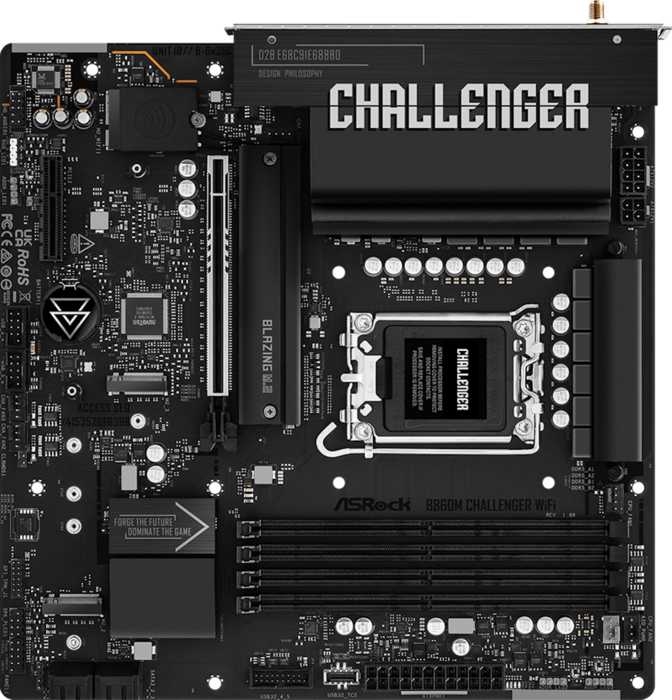
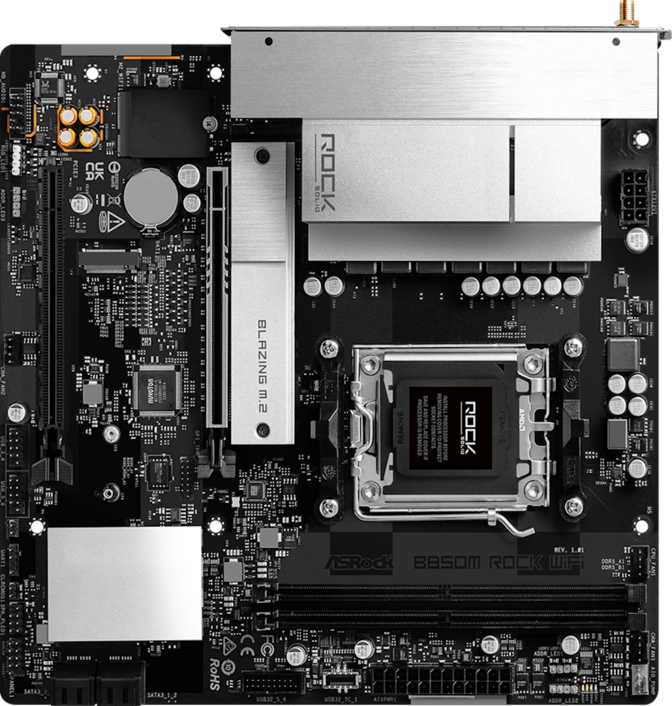
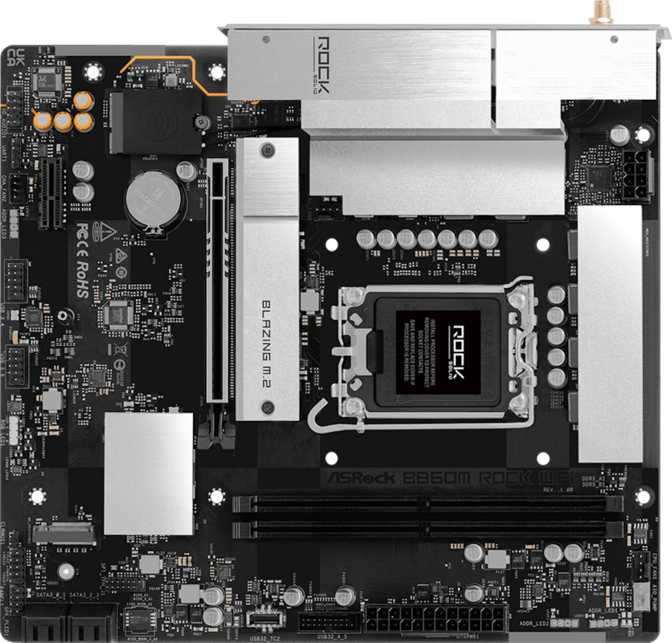
At 244mm wide and 218mm tall, the B860M Rock Wi-Fi fits the standard Micro-ATX footprint — small enough for compact mid-tower and cube cases, but not quite the ultra-small territory of Mini-ITX. For anyone moving from a full ATX board, this format saves meaningful space without requiring the extreme compromises a Mini-ITX build demands.
The board ships without RGB lighting of any kind. That's a deliberate choice, and it signals clearly who ASRock built this for. If you want your system to glow, this is the wrong board. If you want your build to look professional, run quietly, and draw as little unnecessary power as possible, the absence of decorative lighting is a feature, not a missing item.
There is no dual-BIOS chip and no dedicated physical BIOS reset button. Both of those absences matter to enthusiasts building experimental rigs. For a B860 platform — where the chipset itself limits the most aggressive forms of overclocking — these omissions are less consequential than they would be on a flagship Z890 board. This board isn't designed for people who plan to flash experimental firmware regularly. Build quality on ASRock's Rock series skews workmanlike: reinforced PCIe slots, reasonable VRM heat dissipation for the expected load range of non-K processors, and a layout that prioritizes cable routing logic over aesthetic drama.
- Form FactorMicro-ATX
- Board Width244 mm
- Board Height218 mm
- RGB LightingNone
- Dual BIOSNo
- BIOS Reset ButtonNo
Platform Compatibility: Understanding the LGA 1851 Ecosystem
The LGA 1851 socket is Intel's current-generation platform, and the B860 chipset sits at the practical midpoint of the lineup — above the entry-level H810, below the fully unlocked Z890. For builders who aren't planning to run a processor with an unlocked multiplier, B860 represents the performance ceiling that actually matters.
This board supports the full range of compatible Intel Core Ultra 200 series desktop processors. One important note: neither this board nor the B860 chipset supports integrated graphics independently. If your processor does not include Intel's integrated graphics solution, you will need a discrete GPU to get a display output — even for initial setup. Buyers coming from platforms where every CPU included functional onboard graphics should be aware of this requirement before purchasing.
The three-year warranty ASRock provides is above the industry norm for this price category. That kind of coverage on a platform component matters — motherboard failures are rare but expensive to diagnose and replace.
Display Output Dependency
This board's HDMI 2.1 and DisplayPort outputs only function when using a processor that includes Intel integrated graphics. If your CPU has no integrated GPU, a discrete graphics card is required from day one — including initial BIOS setup. Verify your processor's graphics specifications before purchasing.
- CPU SocketLGA 1851
- ChipsetIntel B860
- CPU Sockets1
- XMP OverclockingSupported
- K-Series CPU OCNot Supported
- Warranty Period3 Years
Memory Performance: DDR5 Done Right for This Tier
The board runs DDR5 exclusively — there is no DDR4 compatibility, which reflects where the Intel platform stands today. Two physical memory slots support a combined maximum of 128GB, more than enough for gaming, content creation, and general productivity workloads. The two-slot configuration means buying a matched pair from the start, which is the preferred approach for maximizing dual-channel bandwidth regardless.
What makes this board stand out in its class is the memory overclocking ceiling. Using XMP profiles — the memory industry's standardized speed-boost presets that activate automatically once enabled in the BIOS — this board can run memory at speeds representing the upper range of what DDR5 kits currently ship with commercially. Enthusiasts chasing the highest memory bandwidth for CPU-sensitive workloads or competitive gaming will find genuine headroom here.
Dual-channel operation is active by default when both slots are populated. In practical terms, the processor sees roughly double the memory bandwidth compared to a single-stick configuration — relevant for integrated graphics use cases, CPU-bound applications, and latency-sensitive software. ECC memory — the error-correcting type used in servers and professional workstations — is not supported, which is expected at the B860 tier and won't affect the vast majority of users.
- Memory TypeDDR5 Only
- Physical Slots2 (Dual-Channel)
- Maximum Capacity128 GB
- XMP SupportYes
- Max OC Speed8333 MHz
- ECC SupportNo
What 8333 MHz Means in Practice
Standard DDR5 kits ship at 4800–6400 MHz from the factory. This board's XMP ceiling sits well above that range — and enabling it takes a single BIOS toggle during initial setup. Most competing boards at this price point cannot match this headroom.
Storage: Generous and Future-Ready
Two M.2 slots handle primary fast storage. These accept the NVMe SSDs that are now the standard choice for operating system drives and primary application storage — smaller than a credit card, faster than any spinning hard drive, and installed directly onto the board without cables. One slot connects at PCIe 5.0 speeds, which represents the current cutting edge for consumer NVMe drives and delivers sequential read speeds that effectively eliminate storage as a bottleneck in any workload.
Four SATA 3 connectors expand storage capacity with traditional 2.5-inch SSDs or 3.5-inch hard drives. For builders with existing drives from a previous system, this means no forced migration — old storage carries forward. For those building media libraries, video archives, or NAS-adjacent setups, four SATA ports allow meaningful bulk storage alongside fast primary drives.
The board supports all four major RAID configurations: striping for maximum speed, mirroring for redundancy, and combinations thereof. RAID 5 support — which provides both redundancy and usable capacity across three or more drives — is notable at this price point and useful for anyone treating this as a hybrid workstation and storage system.
- M.2 NVMe Slot × 2 1 at PCIe 5.0
- SATA 3 Connectors × 4
- Up to 6 drives simultaneously
- RAID 0 — Striping (Speed)
- RAID 1 — Mirroring (Redundancy)
- RAID 5 — Parity (Speed + Safety)
- RAID 10 — Striped Mirror
Connectivity: The Rear Panel in Detail
Every port and wireless feature, translated from spec into practical meaning.
Wireless
Wi-Fi 6E opens access to the 6GHz radio band — a frequency range with significantly less interference than the crowded 2.4GHz and 5GHz bands most home devices compete on. In households with many connected devices, 6GHz connections are noticeably more stable. Older routers work without issue through full backward compatibility.
Bluetooth 5.3 handles short-range wireless for controllers, headsets, keyboards, and mice. Version 5.3 delivers improved connection stability and lower energy consumption compared to older releases — meaningful when running multiple peripherals simultaneously.
Video Output
Two display outputs sit on the rear panel: an HDMI 2.1 port and a DisplayPort output. HDMI 2.1 is the current-generation standard capable of driving 4K displays at high refresh rates and 8K displays at standard refresh rates. Both outputs are tied to the CPU's integrated graphics — not a standalone chip on the board.
If your processor includes integrated graphics, you can run a display from the board without a discrete GPU. If it does not, these ports are non-functional until a graphics card is installed.
- HDMI 2.1 (4K/8K capable)
- 1× DisplayPort output
USB Rear Panel
The standout port is a single USB-C connector delivering 20Gbps of transfer bandwidth — the fastest USB connection on this board. Connect a high-speed external NVMe enclosure or a modern USB hub here and you'll genuinely saturate it.
Three USB Type-A ports handle drives, flash storage, and most peripherals at solid speeds. Two additional USB 2.0 ports cover lower-bandwidth devices: keyboards, mice, webcams, and phone chargers.
- 1× USB-C Gen 2×2 — 20 Gbps
- 3× USB-A Gen 1 — 5 Gbps
- 2× USB 2.0 — 480 Mbps
- 1× RJ45 Ethernet
Front Panel Expansion via Internal Headers
The board's internal headers allow a compatible case front panel to add more USB ports, increasing the total available without a USB hub.
| Header Type | Ports Added | Typical Use |
|---|---|---|
| USB 3.2 Gen 1 Header | +2 USB-A (5 Gbps) | Case front panel USB 3.0 |
| USB 2.0 Headers | +4 USB-A (480 Mbps) | Front panel USB 2.0 / internal hubs |
Expansion Slots: One Lane That Matters, One That Helps
A single PCIe 5.0 x16 slot handles the discrete graphics card. PCIe 5.0 doubles the bandwidth of the previous generation — and while current GPU architectures don't fully saturate even PCIe 4.0 in most gaming scenarios, the headroom is meaningful for data-intensive workloads and the next generation of graphics cards that will use it fully.
A single PCIe x1 slot provides space for one add-in card — a dedicated audio card, a 10GbE network adapter, a capture card, or a Wi-Fi upgrade. The presence of only one x1 slot is the natural consequence of the Micro-ATX footprint. Two-slot GPU configurations are the practical limit on this board; anyone planning multiple high-bandwidth expansion cards should look at an ATX form factor instead.
- PCIe 5.0 x16 1 slot
- PCIe x1 1 slot
- PCIe 4.0 x16 None
- Legacy PCI None
Audio: Capable but Not Audiophile
The onboard audio supports 7.1 surround channel output through three 3.5mm jacks at the rear panel — covering the standard front/center, rear, and side configurations that a surround speaker system requires. There is no optical S/PDIF output, which matters only to users connecting to external DACs or A/V receivers that require it specifically. For headphone users and standard stereo or surround speaker setups, the three analog jacks are sufficient.
The audio solution is appropriate for gaming, general media consumption, and even casual music production. Dedicated audio professionals or anyone with an existing external USB or PCIe audio interface should route their output through that device instead — as they likely already plan to.
- Audio Channels7.1 Surround
- Rear Audio Jacks3 × 3.5mm
- Optical S/PDIFNot Included
- Bluetooth aptXNot Supported
Thermal Management: Four Headers, Reasonable Scope
Four fan headers give the board direct control over cooling within the case — typically covering a CPU fan, a CPU cooler pump header if using a liquid cooler, and one or two case exhaust fans. For a Micro-ATX build with a single GPU and a mainstream CPU cooler, four headers is generally adequate. The BIOS fan control curves allow you to tune each header's response independently based on temperature thresholds.
Builders constructing elaborate multi-fan configurations with separate intake and exhaust zones may find themselves wanting more. Fan splitters or a dedicated PWM fan controller address that limitation without meaningful complexity. This is an edge case rather than a typical concern for the board's intended audience.
4 Fan Headers
CPU Fan · Pump Header · 2× Case Fan
Who This Board Is — and Isn't — For
Match your actual use case before committing to this platform
Ideal Buyers
The Compact Professional
Video editors, software developers, and data analysts who need serious computing power in a small footprint. Wi-Fi 6E enables flexible desk placement without running cables; fast M.2 storage eliminates bottlenecks; a clean layout eases cable management in tight cases.
The Smart Gaming Builder
Someone whose budget is going into the CPU and GPU rather than the motherboard. PCIe 5.0 support protects your graphics investment for the next hardware cycle, and DDR5 overclocking headroom means buying a fast memory kit actually pays off in measurable ways.
The Storage-Heavy Builder
Anyone migrating drives from a previous system or building a media archive alongside a fast primary drive. Four SATA ports plus two M.2 slots mean existing storage carries forward — no forced spending on new drives at build time.
Look Elsewhere If...
You're Overclocking a K-Series CPU
The B860 chipset does not support CPU frequency overclocking. If you're buying an unlocked Intel processor specifically to push clock speeds beyond stock, you need a Z890 board. This board cannot accommodate that use case — full stop.
You Need Multiple PCIe Cards
With one x16 slot and one x1 slot, this board cannot accommodate multi-GPU setups or builders running several high-bandwidth expansion cards simultaneously. An ATX form-factor board with wider expansion is the correct tool here.
aptX Bluetooth Audio Is Critical
The board does not support the aptX Bluetooth codec. If your wireless headset or speakers rely on aptX for high-quality audio, you'll need a board or a USB Bluetooth adapter that explicitly supports it.
Competitive Positioning: How It Compares
Two alternatives will appear on most buyers' shortlists alongside this board. Here's how the meaningful differences break down.
| Feature | ASRock B860M Rock Wi-Fi This Board | B860 ATX Competition | Z890 Micro-ATX Boards |
|---|---|---|---|
| Form Factor | Micro-ATX | ATX (larger case required) | Micro-ATX |
| CPU Overclocking | Memory XMP only | Memory XMP only | Full (K-series CPUs) |
| Max Memory Speed | Up to 8333 MHz | Varies by model | High |
| GPU PCIe Slot | PCIe 5.0 x16 | PCIe 5.0 x16 | PCIe 5.0 x16 |
| Wi-Fi Standard | 6E (Built-in) | 6E (varies by model) | 6E (Built-in) |
| USB Gen 2×2 Ports | 1 port | Often 1–2 ports | Often 2+ ports |
| RGB Lighting | None (by design) | Usually present | Usually present |
| Price Tier | Mid | Mid | Premium |
ATX alternatives in the B860 range offer more expansion slots and fan headers — sensible if you're building in a larger case. The Z890 step-up makes sense only with an unlocked K-series processor; without one, you're paying for overclocking headroom you cannot use.
Strengths and Where It Falls Short
An honest look at what this board delivers and where it doesn't
-
PCIe 5.0 GPU Slot
Current-generation standard that protects your graphics investment for the next hardware cycle. Whatever GPU you buy today, and the one after it, will use this slot.
-
Wi-Fi 6E with True 6GHz Access
Not a checkbox feature — 6GHz band access makes a real and measurable difference in congested wireless environments. The interference reduction is immediate.
-
High DDR5 Overclocking Ceiling
Better XMP headroom than many competitors at this price tier. Buying a fast DDR5 kit actually pays off — the board can run it at its advertised speed.
-
Generous 6-Drive Storage Configuration
Two M.2 NVMe slots plus four SATA connectors accommodate most builders without compromise or the need for additional controllers.
-
Three-Year Warranty
Longer than most competing boards in this price category. On a platform component you're unlikely to replace for years, that coverage matters.
-
No RGB Waste
An honest design choice that skips decorative lighting, saves power, and looks professional in any build — open or closed.
-
Only Two Memory Slots
No expansion path. You're buying your full memory kit from the start — no room to add more sticks later without replacing what's already installed.
-
No BIOS Reset Button or Dual-BIOS
A bad firmware flash requires physical CMOS battery contact to recover. Inconvenient rather than catastrophic, but worth understanding before flashing anything.
-
Just Four Fan Headers
Complex multi-fan configurations will require splitters. Fine for most builds, limiting for thermal enthusiasts who want independent control over every fan.
-
No USB 3.2 Gen 2 Type-A on Rear
The fastest rear Type-A ports run at Gen 1 speeds. Only the single Type-C port reaches the faster Gen 2×2 tier — limiting for users with multiple fast USB-A devices.
-
Display Output Requires iGPU CPU
The board's video outputs are non-functional without a CPU that includes Intel integrated graphics. Know your processor before purchasing — this trips up first-time builders.
-
No aptX Bluetooth Codec
Bluetooth audio users dependent on aptX for high-quality wireless sound will need a separate USB adapter to get it. The built-in Bluetooth does not support the codec.
Questions Real Buyers Ask
Direct answers to the searches that led you here
Editorial Score
Based on full specification analysis
The Right Board for the Right Builder
The ASRock B860M Rock Wi-Fi earns its recommendation for a specific kind of builder — one who has thought carefully about what they need and isn't interested in paying for what they don't. It delivers a genuinely current platform with Wi-Fi 6E, PCIe 5.0, high-ceiling DDR5 support, and honest storage capacity in a compact Micro-ATX footprint. The three-year warranty backs it with better long-term confidence than most of its competition at this price tier.
It is not the board for overclockers chasing maximum CPU clock frequencies, builders who need more than one expansion slot, or those who want RGB as part of their build aesthetic. Those buyers have better options — they just cost more for specific reasons.
Best For
Compact professional workstations, smart gaming builds on a CPU-and-GPU budget, and storage-heavy configurations that need both fast NVMe and bulk SATA capacity. If your use case matches any of these, this board is a well-considered choice that doesn't ask you to compromise where it actually counts.