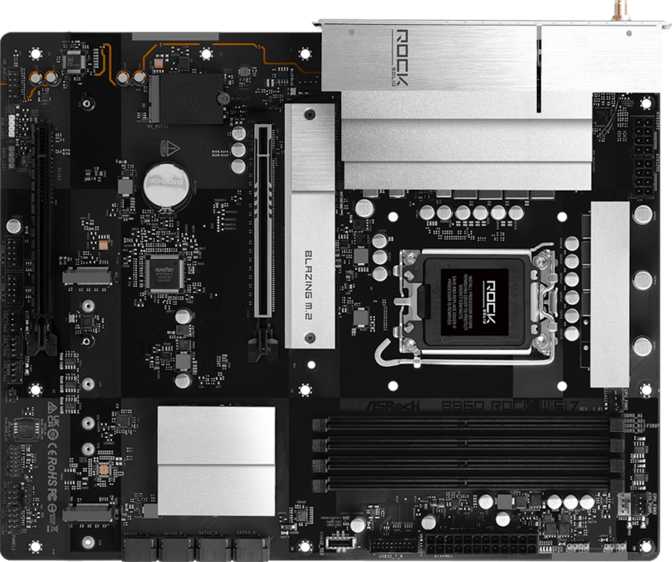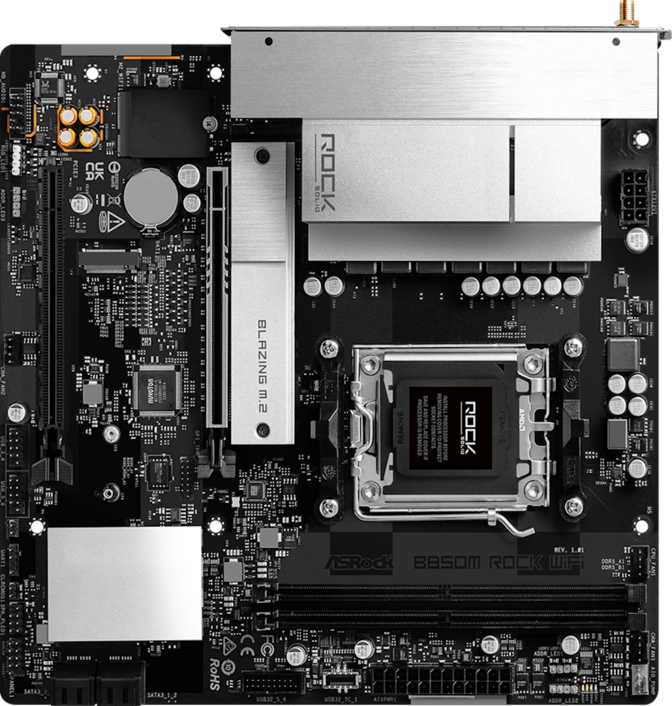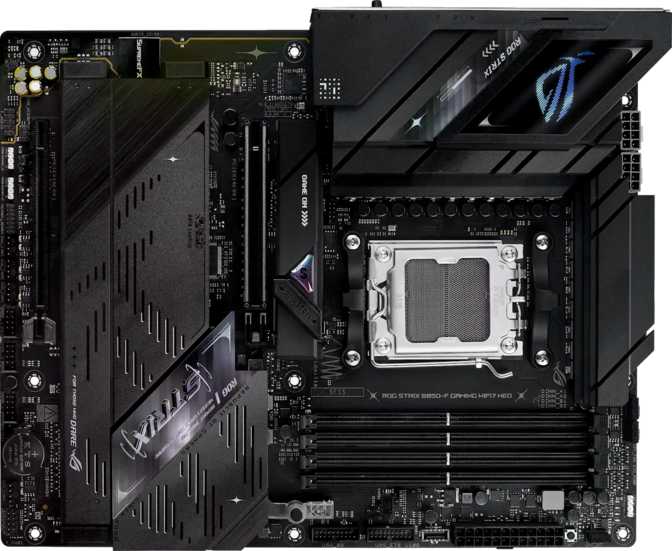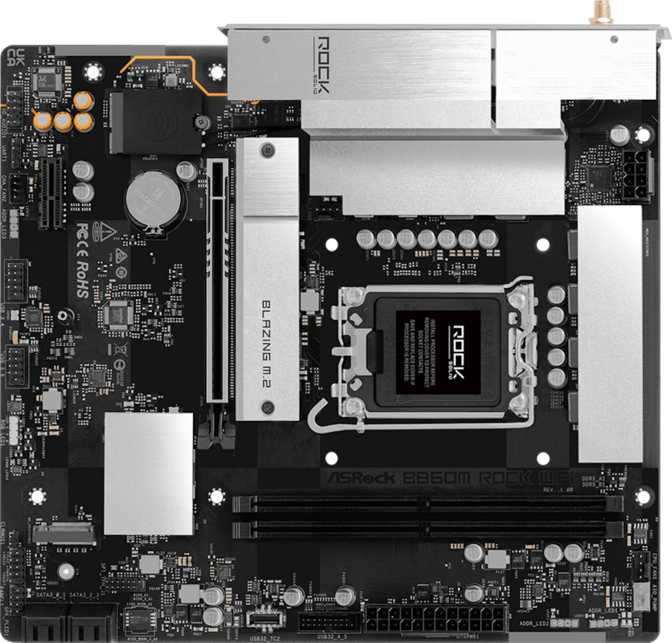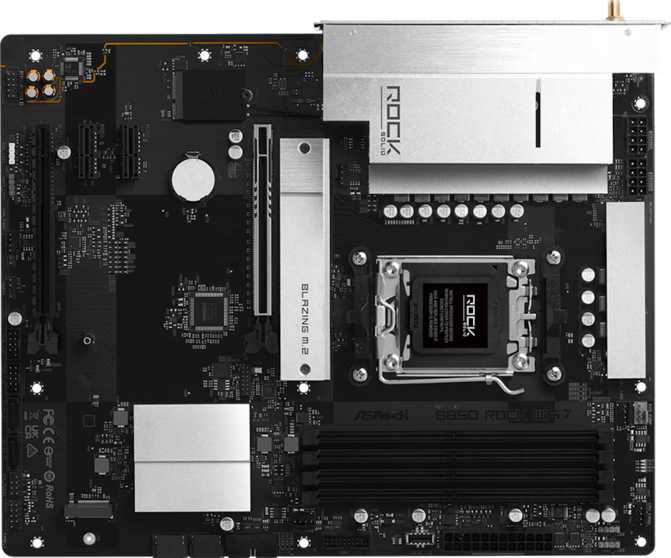
ASRock B850 Rock Wi-Fi 7 Review: A Capable AM5 Mid-Range Board
MotherboardsQuick Verdict
Wi-Fi 7, PCIe 5.0 GPU support, and dual BIOS protection on AMD's AM5 platform — without the premium price tag. A well-calibrated mid-range motherboard with a few meaningful trade-offs.
Socket
AM5
Form Factor
ATX
Memory
DDR5
Wireless
Wi-Fi 7
M.2 Slots
Gen 5 + Gen 4
BIOS Safety
Dual BIOS
Design and Build Quality
The B850 Rock Wi-Fi 7 arrives in the full-size ATX format — 305mm wide by 244mm tall — a practical choice that fits any standard mid-tower or full-tower case without compromise. The layout is clean and builder-friendly, with clear spacing between the primary PCIe slot, M.2 sockets, and DRAM slots.
Physical Highlights
- Full ATX footprint
305 × 244mm fits all standard mid- and full-tower cases with comfortable cable routing clearance. - Integrated RGB lighting
Adds visual personality for open-chassis builds. Completely inconsequential in solid-panel cases. - 3-year manufacturer warranty
A confident warranty window for a motherboard at this price tier. - Easy overclock support
ASRock's UEFI provides auto-tuning profiles alongside full manual voltage and frequency controls for builders at every experience level.
Dual BIOS Protection
The board carries two BIOS chips. If a firmware update fails mid-flash — a power cut, a corrupted file — the board recovers automatically from the backup chip. For enthusiasts who regularly update firmware, this is meaningful protection. For first-time builders, it is quiet insurance that most competing boards at this price do not include.
No manual intervention needed. Recovery is fully automatic and transparent to the user.
CPU Platform and Memory
AM5 Platform — Built for Longevity
The AM5 socket supports AMD's current Ryzen processor generation, and AMD's public commitment to AM5 longevity means buying into this platform today is a genuine upgrade path rather than a dead-end purchase. Future CPU generations will slot in without replacing the motherboard.
The B850 chipset sits above the entry-level B650 while stopping short of the flagship X870E. In practical terms, that means full PCIe 5.0 access for your graphics card, PCIe 4.0 bandwidth for secondary expansion, and a feature set calibrated for gaming and enthusiast workloads without the cost premium of the top tier.
DDR5 Memory — Speed and Scale
4
DIMM Slots
256GB
Max Capacity
8000MHz
OC Ceiling
Four DDR5 slots in dual-channel configuration lets you start with two sticks today and expand later without replacing your existing kit. The 8000MHz overclocking ceiling supports the fastest consumer DDR5 kits available; real-world performance gains above 6000–6400MHz are application-dependent and most noticeable in content creation and memory-sensitive workloads rather than gaming.
Storage Configuration
| Slot | Generation | Best For |
|---|---|---|
| Primary | PCIe 5.0 | Latest-gen NVMe drives |
| Secondary | PCIe 4.0 | Current mainstream NVMe |
The PCIe 5.0 primary slot is ready for the fastest NVMe drives available now and in the next generation. PCIe Gen 3 and Gen 4 drives install into either slot at their native rated speeds — your existing drive is not wasted.
Four SATA 3 ports accommodate traditional 2.5-inch SSDs and 3.5-inch hard drives — enough to build a meaningful storage array alongside an NVMe primary drive.
RAID Support
RAID 0 for performance striping, RAID 1 for mirrored redundancy, and RAID 10 for both are all available. RAID 5 — the three-drive parity configuration — is a known B850 chipset limitation and is absent across the tier.
Connectivity and Wireless
The board's name signals its headline feature. Here is what the wireless and wired connectivity specifications actually deliver in practice.
Wi-Fi 7
The latest wireless standard (802.11be) introduces Multi-Link Operation — simultaneous transmission across multiple frequency bands. In congested wireless environments this delivers more consistent throughput and lower latency, not merely a higher theoretical ceiling.
Fully backward-compatible with Wi-Fi 4, 5, 6, and 6E. Your current router works today; a Wi-Fi 7 access point unlocks the full capability.
Bluetooth 5.4
Current-generation Bluetooth brings improved connection reliability, better coexistence with 2.4GHz Wi-Fi traffic, and reduced power draw from connected peripherals — keyboards, mice, headsets, and controllers all connect cleanly.
Wired Ethernet
A single RJ45 Ethernet port handles wired network connectivity. For most home broadband connections this is invisible in daily use.
Rear I/O Ports and Expansion Slots
Rear Panel USB
| Port Type | Count | Speed | Connector |
|---|---|---|---|
| USB 3.2 Gen 2 | 1 | 10 Gbps | USB-A |
| USB 3.2 Gen 2 | 1 | 10 Gbps | USB-C |
| USB 3.2 Gen 1 | 2 | 5 Gbps | USB-A |
| USB 2.0 | 4 | 480 Mbps | USB-A |
Internal headers add 4 × USB 3.2 Gen 1 and 4 × USB 2.0 for front-panel case connections.
PCIe Expansion Slots
| Slot | Generation | Wired Lanes | Typical Use |
|---|---|---|---|
| Primary x16 | PCIe 5.0 | x16 | Discrete GPU |
| Secondary x16 | PCIe 4.0 | x4 (wired) | Capture / NVMe adapter |
| x1 slots ×2 | PCIe | x1 | Network, sound, USB |
The primary slot delivers full PCIe 5.0 × 16 bandwidth with no bottleneck for current or next-generation graphics cards. The secondary x16-sized slot runs fewer electrical lanes — standard practice at the B850 tier — making it suitable for expansion cards but not for a second full-bandwidth GPU.
The HDMI 2.1 output on the rear panel only activates with a Ryzen CPU that includes integrated graphics. With a discrete GPU and an iGPU-less processor, the motherboard HDMI port will not output a signal.
Audio
Onboard audio supports a 7.1-channel surround configuration through three analog jacks on the rear panel — the standard implementation that delivers multi-channel output without a dedicated sound card. For headphones and 2.0 desktop speaker setups, the onboard solution is fully functional.
Running a true discrete multi-speaker system with separate amplification per channel will call for a dedicated sound card or an external DAC/amp combination.
Cooling and Fan Control
Six fan headers are distributed across the board, providing the control points needed for a well-cooled mid-tower ATX build.
Total Fan Headers
Covers CPU cooler, optional pump header for all-in-one liquid coolers, and case fan positions. Sufficient for most ATX mid-tower configurations without additional hardware.
Elaborate multi-fan setups beyond six zones may benefit from a separate fan controller hub. All headers support full speed curve customization via the UEFI.
Who Should Buy the B850 Rock Wi-Fi 7?
This board was built with a specific builder in mind. Whether that builder is you depends on your actual requirements.
- PC builders entering or upgrading the AM5 platform who want future CPU headroom without paying X870 premium pricing
- Gamers who prioritize wireless and want Wi-Fi 7 built in for lower-latency wireless gaming
- Home office builds pairing a Ryzen CPU with integrated graphics for a clean, single-display setup without a discrete card
- Enthusiasts who want PCIe 5.0 GPU and Gen 5 NVMe storage readiness at a sensible price point
- Builders who value dual BIOS protection for safe firmware experimentation and update-heavy use
- Professionals who need ECC memory for data-critical computational or archival work
- Users with USB4 or Thunderbolt 4 device ecosystems who need those protocols natively on the motherboard
- Builders who want a dedicated rear-panel Clear CMOS button for frequent overclocking experimentation
- Anyone planning a multi-GPU rendering or compute configuration
- Users who need built-in 2.5G Ethernet for high-bandwidth NAS or home server file transfers
How It Compares to Alternatives
Measured against logical alternatives within the AMD AM5 ecosystem at adjacent price tiers.
| Feature | ASRock B850 Rock Wi-Fi 7 | Typical B650 Wi-Fi Board | Typical X870 Board |
|---|---|---|---|
| Primary GPU Slot | PCIe 5.0 | PCIe 4.0 | PCIe 5.0 |
| M.2 Gen 5 Slot | Yes — 1 slot | No | Yes — often 2+ |
| Wi-Fi Standard | Wi-Fi 7 | Often Wi-Fi 6E | Wi-Fi 7 |
| Memory Slots | 4 × DDR5 | 4 × DDR5 | 4 × DDR5 |
| Max Memory OC | 8000 MHz | Often lower | Higher ceiling |
| Dual BIOS | Yes | Varies | Yes |
| USB4 / Thunderbolt | No | No | Often yes |
| 2.5G Ethernet | No | Varies | Usually yes |
| Price Tier | Mid-range | Entry to mid | Premium |
The B850 closes the most critical gap versus the B650 generation — PCIe 5.0 GPU support and Gen 5 NVMe — while matching the X870's wireless capability at a meaningfully lower cost. The X870 tier adds USB4 and often dual 2.5G LAN, but charges a premium that most builders won't recoup in practice.
Strengths and Weaknesses
Where It Excels
The board's strongest case is platform readiness that resists obsolescence. Wi-Fi 7 built in from the factory, PCIe 5.0 for both the GPU slot and primary NVMe storage, DDR5 support with headroom for high-frequency kits, and AM5's forward CPU compatibility combine to create a board that is unlikely to feel outdated quickly.
Dual BIOS protection is a genuine differentiator at this price. For enthusiasts who experiment with firmware updates, it removes a significant risk with no user-facing downside. For cautious builders, it delivers invisible peace of mind that most competing boards in the tier do not match.
The full ATX layout provides comfortable cable routing, clear component spacing, and six fan headers that handle cooling demands in most builds without requiring additional fan controller hardware.
Where It Falls Short
The gaps are concentrated in connectivity. No USB4 limits integration with the expanding ecosystem of high-speed docks and next-generation peripherals. This is a feature gap that some competing boards at similar price points close, so it warrants a direct comparison before committing.
The single gigabit LAN port is adequate for most home broadband users but noticeably limiting for NAS-heavy content workflows. Adding a 2.5G PCIe network card solves it, but that card occupies one of only two available x1 slots.
Only two M.2 slots limits expandability for storage-intensive setups. And the absence of a physical Clear CMOS button — a small convenience that costs manufacturers almost nothing — becomes a more pressing inconvenience during active overclocking sessions with repeated failed boots.
Frequently Asked Questions
Answers to the real questions buyers search for before purchasing.
A Purposeful Mid-Range AM5 Board That Earns Its Keep
8.2 / 10 — Recommended
Editor's Rating
The ASRock B850 Rock Wi-Fi 7 makes a logical case for builders targeting the AM5 platform without paying flagship prices. Wi-Fi 7 from the factory, PCIe 5.0 GPU readiness, high-frequency DDR5 support, and dual BIOS protection together create a board that is genuinely future-resistant rather than merely claiming to be.
The real gaps — no USB4, single gigabit LAN, only two M.2 slots, no physical Clear CMOS button — are honest trade-offs that matter to specific workflows. For a gaming-primary build, a high-performance home office rig, or a capable content creation setup where wireless connectivity is central, those trade-offs are manageable. For users who need USB4 docking, multi-drive NVMe arrays, or high-bandwidth wired networking as core requirements, a direct comparison against X870 boards is the right next step.
Best For
Gaming builds, AM5 adopters, and Wi-Fi 7 priority buyers
Skip If You Need
USB4 devices, NAS-heavy workflows, or 3+ NVMe drives
Warranty
3-year manufacturer warranty with dual BIOS firmware protection