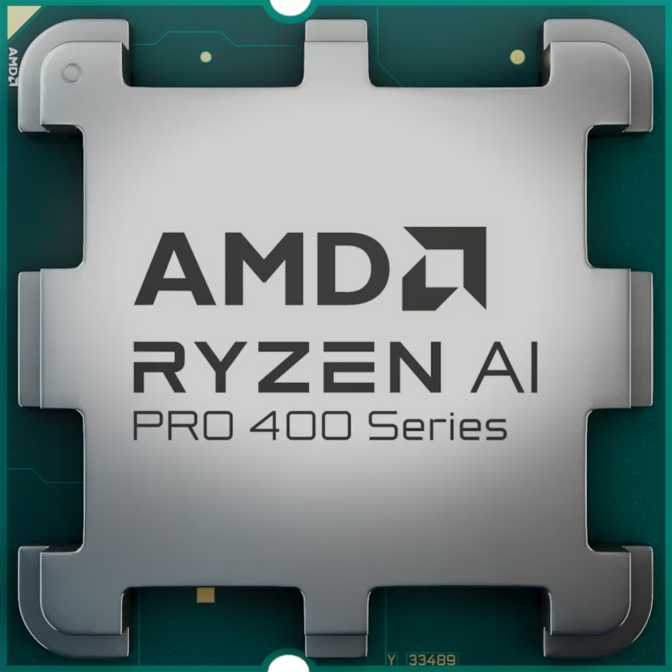
AMD Ryzen AI 7 Pro 450GE: Full Review of a 35W Efficiency Desktop CPU
CPUsProcessor Overview
AMD Ryzen AI 7 Pro 450GE at a Glance
Introduction
The Case for Going Low-Power Without Going Low-Performance
There is a persistent myth in desktop computing: that power efficiency is the enemy of performance. The AMD Ryzen AI 7 Pro 450GE is built specifically to challenge that assumption. This is a processor that slots into a standard desktop AM5 motherboard, yet operates within a thermal envelope most people associate with mid-range laptops.
For anyone building a compact home office machine, an always-on workstation, or a business deployment where electricity costs and cooling noise actually matter, this CPU deserves serious consideration.
The "GE" suffix is the key to understanding everything about this chip. It signals AMD's efficiency-optimized binning — a version of the underlying architecture tuned for sustained low-watt operation rather than peak burst performance. The "Pro" designation adds enterprise-grade reliability on top. Put them together, and you have a processor that is almost certainly not the right choice for a gaming rig or content creation powerhouse — but could be exactly right for a surprisingly wide range of real-world workloads.
Positioning Summary
Desktop Expandability. Near-Laptop Power Draw.
Think of this chip less as a scaled-down performance CPU and more as a scaled-up efficiency chip. Full AM5 platform access — PCIe 4.0, DDR5, wide chipset compatibility — at a power level that keeps systems silent, cool, and affordable to run continuously.
- AM5 socket — a platform with longevity ahead of it
- 35W for near-silent, low-heat operation
- Pro suffix unlocks ECC memory eligibility
- Radeon 860M removes the need for a discrete GPU
Product Category
Understanding What Kind of Processor This Actually Is
Before evaluating raw numbers, it helps to understand what category this processor occupies — because it is a genuinely unusual product. The Ryzen AI 7 Pro 450GE is a desktop CPU that uses the AM5 socket, fitting the same motherboards as AMD's high-performance desktop lineup. But it is not trying to compete with those chips on their own terms.
Instead, it targets a specific but underserved segment: users who want a capable, multi-core desktop processor that runs quietly, stays cool without elaborate cooling, and draws very little power around the clock.
The "Ryzen AI" product line name signals something meaningful beyond marketing. AMD uses this branding for processors that incorporate dedicated AI acceleration hardware alongside the main CPU cores. The AI designation on desktop processors in this family strongly implies the presence of an integrated neural processing block — relevant for workloads involving real-time AI inference, on-device machine learning pipelines, or software that explicitly targets AMD's AI acceleration stack.
- Ryzen AI
- Indicates integrated AI acceleration hardware (NPU) alongside the CPU and GPU cores, targeting on-device inference workloads.
- 7 (Tier)
- Sits below the flagship 9 series but well above entry-level 5 and 3 series parts — a capable mid-to-upper product tier.
- Pro
- Enterprise-grade validation: ECC memory support, extended platform testing, and suitability for commercial deployment environments.
- GE Suffix
- Efficiency-optimized binning. The 35W sustained TDP versus a standard 65W chip is the defining characteristic — lower heat, less noise, lower ongoing power cost.
Core Performance
Eight Cores, 35 Watts, and Why That Ratio Matters
Core Count and Threading Capability
Eight physical cores with sixteen processing threads is the foundation here. That thread count comfortably handles modern multi-threaded software — video conferencing with background processing, parallel compilation tasks, database queries, browser-heavy multitasking — without breaking a sweat.
The processor does not use a split big/small core design. All eight cores are uniform, which simplifies scheduling and means workloads behave predictably across all cores. There is no performance-core versus efficiency-core hierarchy to manage, and no risk of a critical single-threaded task landing on a weaker core at the wrong moment.
Clock Speeds: The Full Story
The power-saving floor. Active during light loads and idle periods, this frequency is what keeps the system whisper-quiet when full performance is not demanded.
Competitive with far more power-hungry chips. The processor accelerates sharply when active cores demand it, then retreats immediately when the demand drops.
Cache Architecture: Keeping the Processor Well-Fed
The memory hierarchy is well-balanced for this power class. A generous per-core L2 allocation ensures each core has fast local storage for working data, while the larger shared L3 cache acts as a staging area for bigger datasets — reducing how often the processor must wait on slower main RAM. For latency-sensitive workloads like financial modeling, real-time data processing, and interactive database applications, this cache configuration keeps throughput steady.
Built-In Graphics
Radeon 860M — More Than a Placeholder
Most integrated graphics solutions are an afterthought — a fallback for when no discrete GPU is present. The Radeon 860M inside the 450GE is a different class of integrated graphics and deserves to be evaluated on its own terms.
With 512 shader processors operating at up to 3,100 MHz — a substantial frequency for integrated silicon — the Radeon 860M delivers iGPU performance that crosses into territory previously requiring a separate graphics card. It supports DirectX 12 Ultimate, the same API tier as discrete gaming cards, meaning it is not locked out of modern rendering features or software compatibility requirements.
What the Radeon 860M Can Do in Practice
Radeon 860M Specifications
| Graphics Metric | Specification |
|---|---|
| GPU Architecture | Radeon 860M |
| Shader Processors | 512 Units |
| Texture Mapping Units | 32 TMUs |
| Render Output Units | 16 ROPs |
| Peak GPU Frequency | 3,100 MHz |
| Base GPU Frequency | 600 MHz |
| DirectX Support | DirectX 12 Ultimate |
| OpenGL Version | 4.6 |
| OpenCL Version | 2.1 |
Memory System
DDR5 at Its Practical Best
Speed, Capacity, and Why Dual-Channel Is Non-Negotiable
The Ryzen AI 7 Pro 450GE supports DDR5 memory exclusively — a meaningful detail both for future-proofing and raw bandwidth. At up to 5,600 MHz in dual-channel configuration, the processor can feed its integrated GPU and all eight cores with enough memory bandwidth to avoid the bottlenecks that plagued older iGPU platforms.
Dual-channel memory is particularly important here. Running two matched sticks of RAM rather than a single module effectively doubles available memory bandwidth for the Radeon 860M, which translates to noticeably smoother graphics in practice. Anyone configuring this system should treat dual-channel as a requirement, not an option.
The maximum supported capacity of 256 GB is exceptional for a desktop chip at this power level. For most users this ceiling is academic — 16 GB or 32 GB will cover standard workloads. But for workstation deployments running large in-memory datasets, virtual machines, or memory-hungry professional applications, knowing that headroom exists matters.
What it does: Detects and silently corrects single-bit memory errors before they cause data corruption or crashes — without any user interaction.
Who needs it: Financial records, medical data, database servers, code repositories, or any deployment where silent data corruption is unacceptable.
Who doesn't: General home computing with no mission-critical data. ECC adds no perceivable benefit in that context.
Platform & Compatibility
The AM5 Advantage
The AM5 socket is AMD's current-generation desktop platform, and building on it rather than an older socket matters for longevity. Compatible chipsets span a broad range — from value-oriented mainstream boards to full enthusiast-class platforms with maximum connectivity.
Cost-efficient builds without sacrificing the core features this processor needs. Provide all necessary connectivity for typical office, home, and HTPC deployments.
Expanded PCIe lanes, multiple NVMe slots, Thunderbolt, and premium I/O. A legitimate pairing even with an efficiency CPU when maximum platform expandability is the priority.
PCIe 4.0 Connectivity
PCIe 4.0 support means high-performance NVMe storage is fully accessible. Current-generation drives at PCIe 4.0 speeds deliver perceptible improvements in application load times, large file transfers, and boot speed. The processor imposes no storage bottleneck.
Hardware Instruction Sets
Extensions that unlock optimized code paths in security, scientific, and AI workloads — operating invisibly for most users, meaningfully for power users:
AES: Near-zero-overhead encryption for drives and VPNs. AVX2: Faster scientific, signal-processing, and AI workloads. F16C: Half-precision float operations for inference tasks.
Power & Cooling
What 35 Watts Means in Daily Operation
The 35-watt Thermal Design Power is the most operationally significant number on this processor's specification sheet. It represents the sustained heat the cooling system needs to handle under realistic workloads — and at 35W, the Ryzen AI 7 Pro 450GE generates roughly half the heat of a standard 65W desktop processor, and less than a third of a high-performance 105W chip.
The maximum operating temperature ceiling of 95°C provides significant headroom above what this chip reaches under normal conditions. Components running consistently well below their thermal limits age more slowly — a tangible benefit for always-on deployments.
One deliberate limitation: the clock multiplier is locked, which means overclocking is not an option here. For a chip designed around efficiency and thermal discipline, this is the expected and appropriate design choice. Those seeking overclocking headroom should look at an entirely different product category.
- A quality stock cooler or compact low-profile aftermarket unit is fully sufficient — no tower cooler or liquid cooling required.
- System fans run at low speeds even under sustained load, keeping noise levels near-silent in typical home and office environments.
- Small form factor and thin mini-ITX cases become genuinely viable — heat dissipation is not a constraint for enclosure choice.
- For always-on deployments, electricity savings versus a 65W or 105W chip compound meaningfully over months and years of operation.
Buyer Guidance
Who Should — and Should Not — Buy This Processor
- Home Office & Hybrid WorkersHandles video calls, office software, browser-heavy workflows, and light creative tasks without fan noise interruption.
- Small Business IT DeploymentsReliability, ECC capability, low heat output, and long-term AM5 platform support matter more than peak benchmark scores.
- Media Center & HTPC BuildersSmooth 4K video playback, light gaming, and multi-display output from a silent chassis — no discrete GPU needed.
- Developers & Technical UsersConsistent multi-core availability for compilation, containerized environments, and lightweight virtualization within a sensible power budget.
- Mini-ITX & Compact Build EnthusiastsWhere thermal constraints make 65W+ processors genuinely problematic, this chip thrives in small enclosures.
- Dedicated GamersThe Radeon 860M handles light gaming, but maximum frame rates in demanding titles need a discrete GPU and a higher-TDP processor.
- Video Production ProfessionalsFrequent exports, heavy color grading, and 3D rendering sustain all-core loads — exactly where the 35W ceiling becomes a throughput constraint.
- Overclockers & Performance ChasersThe locked multiplier and efficiency-first design philosophy rule this out immediately. There is no overclocking headroom here.
- Budget-First Builders with a Discrete GPUIf you plan to install a discrete GPU and don't need ECC, the Pro and efficiency features here may not justify the premium over a standard-TDP alternative.
Competitive Landscape
How It Stacks Up Against Alternatives
The Ryzen AI 7 Pro 450GE occupies a genuinely niche position. Few processors combine eight cores, a 35W TDP, capable integrated graphics, DDR5 support, ECC capability, and a current-generation upgradeable socket in one package. Here is how it compares to the logical alternatives a buyer would consider:
| Feature | Ryzen AI 7 Pro 450GE | Typical 65W Desktop CPU | Typical NUC / Mini PC CPU |
|---|---|---|---|
| Socket | AM5 (Upgradeable) | AM5 (Upgradeable) | Soldered — No Upgrade |
| TDP | 35W | 65W | 15–28W |
| ECC Memory | Yes | Rarely | No |
| Integrated GPU Tier | Radeon 860M | Radeon 760M or lower | Comparable |
| Overclockable | No | Some models | No |
| Max RAM | 256 GB | 192 GB typical | 64–96 GB typical |
| Platform Upgradeable | Yes (AM5) | Yes (AM5) | No |
Editorial Assessment
Honest Strengths and Real Limitations
Where It Genuinely Excels
The Ryzen AI 7 Pro 450GE is a genuine engineering achievement within its stated constraints. Building a processor that reaches 5.1 GHz peak frequency, integrates a capable Radeon 860M GPU, supports DDR5 and ECC memory, and does all of this within a 35-watt power budget on a 4nm process represents real progress in efficiency-focused design.
Its strengths are meaningful for the right buyer. The near-silence, the thermal discipline, the platform longevity of AM5, the ECC capability, and the Radeon 860M iGPU all combine into a processor that overdelivers relative to what its power consumption would suggest is possible.
The instruction set breadth, AES acceleration, and AI-oriented platform branding also position this chip well for workloads that increasingly run local inference and encrypted compute — a forward-looking advantage that may appreciate as those workloads mature.
Where It Falls Short
Its limitations are equally real and should not be minimized. The locked multiplier, the thermal ceiling that constrains sustained heavy workloads, and the Pro-tier positioning mean this chip's trade-offs only make sense for specific use cases.
Approached as a general-purpose performance CPU, it will disappoint. A standard-TDP chip at a similar or lower price point will complete heavy workloads meaningfully faster. The value proposition here is not raw throughput — it is the combination of efficiency, reliability, platform longevity, and a capable iGPU that eliminates additional hardware costs.
Whether those benefits justify the cost over a non-Pro, standard-TDP alternative depends entirely on which features you actually need. If ECC memory is a requirement, the choice makes itself. If it is not, the calculus requires more deliberate thought.
Common Questions
Answers to What Real Buyers Ask Before Purchasing
Final Recommendation
Our Verdict on the AMD Ryzen AI 7 Pro 450GE
A precision instrument built for a specific job — and it excels at that job.
If you are building a compact, quiet, professional-grade desktop system where power consumption, thermal output, reliability, and platform longevity matter more than raw throughput numbers, this processor rewards your investment decisively.
For the home office builder who wants silence, the small business deploying reliable workstations, the developer running persistent local services, or the HTPC enthusiast who wants capable iGPU output without a discrete card — the Ryzen AI 7 Pro 450GE is one of the most coherent and well-executed options available on the current AM5 platform. Buy with confidence if your use case fits. Look elsewhere if it does not.
- 5.1 GHz peak frequency from a 35W efficiency-class design
- Radeon 860M removes the need for discrete graphics in most builds
- ECC memory support — rare in a consumer-oriented desktop CPU
- AM5 socket ensures a long and legitimate upgrade path ahead
- 4nm process keeps thermals and power draw exceptionally controlled
- Sustained all-core workloads are throttled by the 35W power ceiling
- Locked multiplier means zero overclocking potential
- Pro-tier pricing adds cost over non-Pro GE-suffix alternatives
- Requires DDR5 — factor RAM cost into the complete build budget