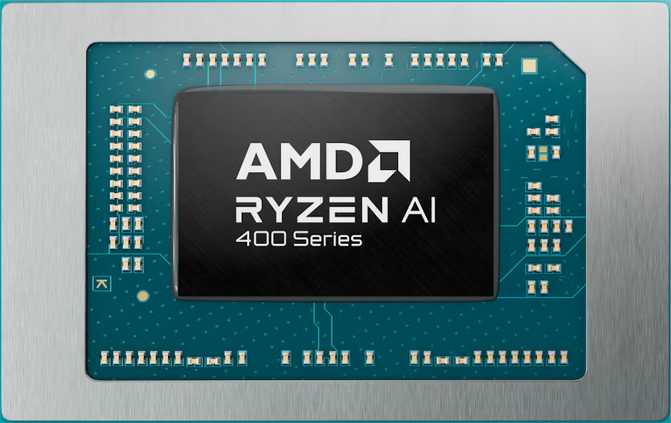
AMD Ryzen AI 7 445: Full Review of a 4nm Productivity Chip
CPUsThe AMD Ryzen AI 7 445 rewards those who look past the marketing badge. Built on a 4-nanometer manufacturing process — one of the most advanced nodes available in mobile silicon today — this chip pairs a genuine hybrid core architecture with an integrated Radeon 840M GPU and a DDR5 memory platform that runs at speeds that push the boundaries of its category. It occupies an interesting middle ground: efficient enough for slim, quiet laptops and capable enough for serious professional workloads without a discrete graphics card in sight. Whether it belongs in your next machine depends entirely on how you plan to use it.
Editor's Score
Physical Profile and Thermal Envelope
The Ryzen AI 7 445 is designed primarily for thin-and-light laptops — the kind of machines people carry to meetings, coffee shops, and airports. Its 28-watt thermal budget sits in the middle of the mobile processor spectrum, giving laptop manufacturers meaningful flexibility in how they implement it. At that level, the chip does not demand a thick chassis with loud fans to stay operational. It is thermally sensible enough to live in a slim laptop without constant fan activity, yet capable enough to accelerate when you actually need it.
The variable factor is how each laptop maker decides to configure the chip. Some run it conservatively — quieter, cooler, slightly slower. Others push it closer to its ceiling for better peak throughput at the cost of increased fan activity. This is a normal characteristic of the mobile processor market, not a flaw specific to this chip, but it is worth understanding before selecting a specific laptop model.
Why the 4nm Process Node Matters
Smaller transistors waste less energy as heat, meaning the chip accomplishes more work per milliwatt consumed. In everyday terms, this translates directly to better battery endurance and cooler operation compared to physically larger processors that look similar on paper. The 4nm foundation is one of the primary reasons this chip competes above its thermal budget.
The chip carries a maximum safe operating temperature of 100°C — an industry-standard ceiling for modern AMD silicon. Under normal conditions with adequate laptop cooling, the chip will never approach this limit. Its presence confirms the design is built to handle real sustained workloads, not just short bursts.
Quick Specs Reference
- Architecture
- Hybrid (big.LITTLE)
- CPU Threads
- 12
- L2 Cache
- 6 MB
- L3 Cache
- 8 MB
- Max Temperature
- 100 °C
- PCIe Version
- 4.0
Inside the Hybrid Core Architecture
The Ryzen AI 7 445 uses a hybrid core layout — the same fundamental design philosophy now found across premium mobile processors. Rather than relying on a single type of processing core, the chip contains two distinct core clusters: higher-performance cores designed for demanding workloads and efficiency-focused cores optimized for lighter background activity. The processor's scheduler routes tasks between these clusters automatically and invisibly to the user.
In everyday use, this architecture is what makes the chip feel consistently responsive. Light tasks like browsing, email, and document editing route to the efficient cores at low power states. Opening a heavy application, running an export job, or compiling code hands the work to the performance cores, which boost all the way to 4.6 GHz before stepping back down once the burst is complete.
The processor delivers twelve threads in total. Threads are the individual streams of work a processor handles simultaneously — twelve means the chip can juggle a video export, a screen recording, background cloud sync, and an active browser session without visibly struggling. This sits comfortably in the professional multitasking range without reaching flagship workstation territory.
A combined 14 megabytes of cache — 6 MB at the L2 level and 8 MB at L3 — keeps frequently used data close to the processing cores. Cache functions as ultra-fast scratch memory, reducing how often the processor must reach out to slower system RAM. This allocation is well-matched for this performance tier and supports the responsive multitasking behavior the architecture promises.
Performance at a Glance
Locked Multiplier
The Ryzen AI 7 445 does not support overclocking. Core clock speeds cannot be pushed beyond the chip's rated limits. This matters only to a small audience of performance enthusiasts — for all other buyers, it has no bearing on daily use.
Radeon 840M: More Than Just Video Output
Integrated graphics are the feature most often dismissed as useful only for plugging in a monitor. The Radeon 840M deserves considerably more credit than that reputation allows. Peaking at 2,900 MHz, it is built on AMD's RDNA graphics architecture — the same design lineage that powers AMD's discrete gaming cards, scaled and embedded alongside the processor cores. That shared foundation matters for real-world capability well beyond simple display output.
Gaming Capability
Esports titles — competitive shooters, MOBAs, and racing games — run comfortably at moderate settings and resolutions. Lighter indie games and older titles present no issues. Demanding modern AAA games at high settings exceed the 840M's natural territory. If gaming is a primary activity rather than an occasional bonus, a laptop with a discrete GPU is the appropriate tool.
Creative Acceleration
GPU-accelerated workflows — video exports, AI-assisted image processing, and light 3D rendering — benefit meaningfully from the 840M's RDNA architecture. Tasks that once required a discrete card are handled with confidence here, closing a gap that integrated graphics from earlier generations simply could not bridge.
Multi-Monitor Support
The 840M supports up to four independent displays simultaneously. For office users connecting to docking stations, this means a full multi-monitor productivity setup without a discrete graphics card. This is a genuinely useful capability, not a paper specification, and it covers most professional desk setups with headroom to spare.
API Compatibility
Full DirectX 12 support at the highest feature level, alongside OpenGL 4.6 and OpenCL 2.1, ensures compatibility with every modern application, game, and GPU-compute workload. There are no meaningful compatibility gaps at this API coverage level — professional software, creative tools, and hardware-accelerated compute all work without exceptions.
DDR5 Memory: Why the Speed Numbers Matter Here
The Ryzen AI 7 445 is DDR5-only, and its validated support ceiling — 8,000 MHz — lands at the high end of the market even by enthusiast standards. For most users, the significance of this is indirect but real: integrated graphics share system memory rather than drawing from dedicated video RAM. The faster the memory, the more bandwidth the Radeon 840M has available, and GPU performance scales with that bandwidth in a measurable, consistent way.
A laptop with this chip running faster DDR5 will show noticeably better integrated graphics performance than the same chip paired with slower memory — particularly in GPU-adjacent tasks like video processing, AI-accelerated workflows, and light gaming. When evaluating specific laptops, always check the memory speed specification alongside the processor badge. It matters more on this platform than on chips with a dedicated GPU.
Dual-Channel Bandwidth
Two memory channels working in parallel doubles the available bandwidth compared to a single-channel setup. This configuration is essential for integrated GPU performance. Always confirm that a specific laptop runs its memory in dual-channel mode — some budget configurations do not.
256 GB Ceiling
Maximum memory support reaches 256 gigabytes — a figure that sits firmly in workstation territory. For everyday users, this means the platform has no practical RAM ceiling. Virtual machines, massive datasets, and memory-intensive creative projects will never exhaust this platform's capacity.
No ECC Support
Error-correcting memory is not supported. This matters in enterprise environments — database servers, financial computation systems — where data integrity under sustained load is a formal requirement. For creative professionals and productivity users, ECC absence is entirely irrelevant.
Hardware Security and Instruction Set Depth
Beneath the performance specifications, the Ryzen AI 7 445 carries a set of hardware-level features with direct implications for both security posture and application performance. These are capabilities built into the silicon itself — not software features that can be patched away or removed.
AES Hardware Acceleration
Encryption and decryption — VPN connections, disk encryption, secure file transfers — are handled by dedicated hardware rather than consuming CPU cycles. Full-disk encryption causes no measurable performance penalty. This makes comprehensive security configurations essentially free in terms of throughput cost.
AVX2 and FMA3 Support
Scientific computing, machine learning inference, audio processing, and video codec acceleration all benefit from these instruction set extensions. Applications compiled to target AVX2 — which most modern professional software is — run faster without any user configuration. The benefit is silent and automatic.
NX Bit Security
The No-Execute bit marks memory regions as non-executable at the hardware level, blocking a foundational class of malware attacks before they can run. Its presence is a baseline requirement for any machine evaluated for sensitive professional or enterprise use.
Power Draw and What to Expect on Battery
A 28-watt TDP represents the chip's maximum sustained power draw under a full-load scenario. In practice, the hybrid architecture means the processor spends most of its operating time drawing considerably less — sometimes only a few watts during casual use or idle periods. This variable power behavior is the mechanism behind the efficiency advantage, and it has a direct positive impact on how long a laptop running this chip lasts between charges.
For a typical user — writing, browsing, video calls, and email — the processor contributes very modestly to overall battery drain. Demanding workloads pull it to full power briefly before the scheduler steps back down once the burst completes. This dynamic management is handled automatically at the hardware and operating system level, requiring no user input.
Battery Life Depends on More Than the Chip
Actual laptop battery endurance depends overwhelmingly on the battery capacity the manufacturer chose to include, the display's power draw, and the thermal tuning applied to this chip's power limits. The Ryzen AI 7 445 gives laptop makers the right tools to build efficient machines — but outcomes vary significantly by specific product. Evaluate the whole system, not just the processor specification.
Who This Chip Is Built For
This Is a Good Fit If You...
- Work primarily in productivity applications — documents, spreadsheets, video calls, email — and want a fast, consistently responsive machine.
- Need light creative capability: photo editing, casual timeline-based video editing, or light vector work that benefits from GPU acceleration.
- Want occasional light gaming capability — esports titles and indie games — without paying for a discrete GPU.
- Run virtualization workloads, juggle many applications simultaneously, or need reliable multitasking headroom across 12 threads.
- Value a thin, relatively quiet laptop that handles real professional demands without thermal compromise.
Consider Something Else If You...
- Render 3D scenes, process long-form video in heavy codecs, or run sustained machine learning training — discrete GPU hardware will deliver significantly more throughput.
- Game seriously and expect smooth performance in demanding AAA titles at high settings — the integrated GPU is not the appropriate tool for that workload.
- Need overclocking headroom for CPU performance tuning — the multiplier is locked with no exceptions.
- Require ECC memory for database, financial computation, or scientific environments where data integrity under sustained load is non-negotiable.
How It Compares to the Alternatives
The Ryzen AI 7 445 competes in a well-established field. Here is how it positions against two logical reference points: a comparable Intel platform and a previous-generation AMD mobile chip.
| Feature | Ryzen AI 7 445 | Intel Core Ultra 5 (comparable) | Ryzen 5 7530U (prev. gen AMD) |
|---|---|---|---|
| Process Node | 4 nm | 4 nm (Intel 4) | 6 nm |
| TDP | 28 W | 15–28 W (configurable) | 15 W |
| Integrated GPU | Radeon 840M (RDNA) | Intel Arc (varies by SKU) | Radeon 680M |
| Max Memory Speed | 8,000 MHz DDR5 | ~6,400 MHz DDR5 | 4,800 MHz DDR4/DDR5 |
| Max Memory Capacity | 256 GB | 64–96 GB (typical) | 64 GB |
| Hybrid Architecture | Yes | Yes | No |
| Overclocking | Locked | Locked | Locked |
Intel and Ryzen 5 7530U figures are representative of their respective platforms. Specific SKU configurations may vary.
Where It Excels and Where It Falls Short
Genuine Strengths
The 4-nanometer manufacturing foundation gives the Ryzen AI 7 445 an efficiency advantage that older designs cannot replicate. More work accomplished per watt means quieter operation, better battery endurance, and a chip that does not require aggressive cooling to perform well. This is not incremental progress — it is a generational step that has tangible, everyday consequences.
The Radeon 840M integrated GPU closes a real and meaningful gap between discrete-GPU and no-GPU laptop configurations. For users who do not need serious gaming or sustained GPU compute, the 840M delivers enough graphics capability to make a discrete card genuinely unnecessary — not just technically adequate.
The DDR5 platform, validated to 8,000 MHz in dual-channel configuration, is among the most capable memory setups available in this product tier. The 256 GB maximum capacity ceiling is essentially unlimited for any consumer or prosumer workload imaginable.
Honest Weaknesses
The locked multiplier eliminates any overclocking potential. This affects only the enthusiast segment specifically seeking performance tuning headroom — for everyone else, it is a non-issue — but it deserves acknowledgement for buyers who want that flexibility.
ECC memory support is absent. Professional environments where data integrity under sustained load is a formal operational requirement will need a platform with explicit error-correction support. The Ryzen AI 7 445 is not that platform.
Perhaps the most practical weakness is the implementation gap. Real-world performance varies significantly depending on how laptop manufacturers configure this chip across memory speed, thermal budget, and power limits. The chip itself is capable — but buying it without understanding the laptop around it means buying only half the picture.
Common Questions Answered
Final Verdict
The AMD Ryzen AI 7 445 is a well-executed mobile processor for the audience it is clearly designed for. Professionals who want an efficient, capable thin laptop — one that handles serious productivity workloads, provides useful GPU capability without a discrete card, and does not demand a noisy cooling system to perform — will find this chip delivers on its promises.
The 4nm manufacturing foundation, capable Radeon 840M graphics, and industry-leading DDR5 memory support make this a genuinely modern chip. The weaknesses — a locked multiplier, no ECC support, and performance that varies with implementation quality — are real but clearly bounded. They affect specific, well-defined use cases and are irrelevant to the majority of prospective buyers.
One Important Caveat Before You Buy
The chip's real-world performance depends significantly on the laptop around it. Prioritize configurations with dual-channel DDR5 at the higher end of the supported speed range, and understand how the manufacturer has tuned the thermal limits. A well-configured machine with this chip is a confident buy. An under-specced or thermally constrained implementation leaves meaningful performance on the table — and that gap comes from the laptop, not the chip.