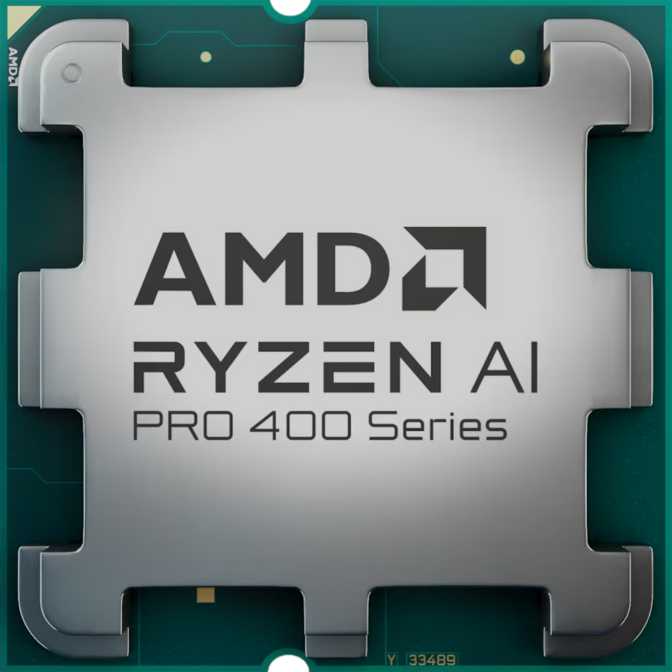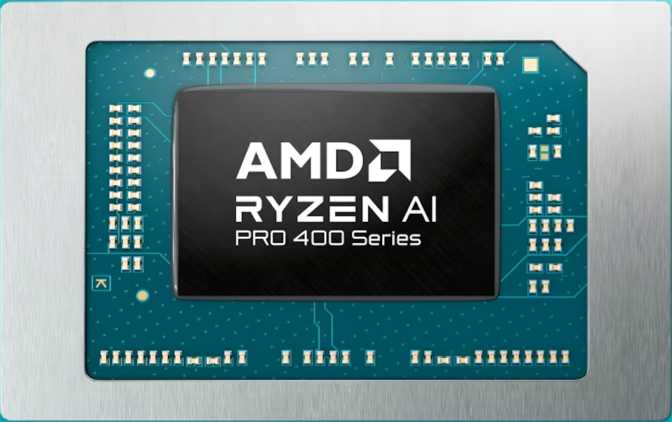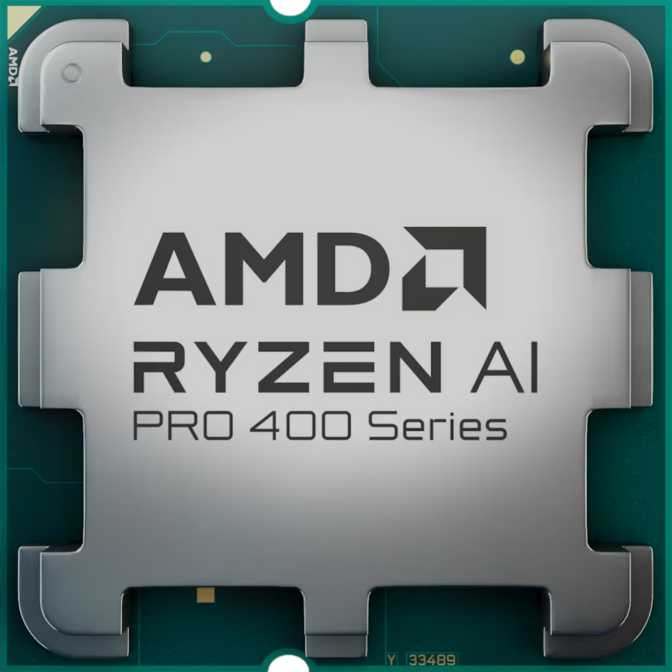
AMD Ryzen AI 5 Pro 435GE Review: An Efficiency-First Desktop Processor
CPUsMost desktop processors compete on raw speed and core counts. The AMD Ryzen AI 5 Pro 435GE competes on a different axis entirely — efficiency, reliability, and professional-grade capabilities packed into a power envelope that most desktop chips wouldn't dare attempt. At 35 watts, this is a six-core desktop processor built for builders who care about what a machine costs to run over its lifetime, not just what it costs to buy.
That "Pro" designation is doing real work here. This is not a rebranded mainstream chip — it carries ECC memory support and a focus on sustained, predictable performance that positions it squarely in professional workstations, compact business desktops, always-on systems, and low-noise builds. If you need a chip that disappears into a small case, sips power quietly, and gets the job done without drama, the Ryzen AI 5 Pro 435GE deserves your full attention.
Key Specifications at a Glance
Six defining numbers that tell the real story of this processor.
Design Philosophy: Efficiency as a Feature, Not a Compromise
The 35W Power Draw — What It Actually Means Day to Day
The thermal design power of a processor tells you how much heat it produces under sustained load, which in turn dictates how aggressive your cooling and chassis need to be. Most mainstream desktop processors operate between 65W and 125W. The Ryzen AI 5 Pro 435GE operates at 35 watts.
To put that in human terms: a standard incandescent bulb draws more power than this chip does under full load. That has cascading effects. You can cool it with a modest low-profile heatsink, opening the door to slim mini-ITX cases and small-form-factor builds without cramming in a tower cooler. It produces less heat, meaning less fan noise — which matters enormously in office environments, recording setups, or any space where a loud workstation would be disruptive.
The thermal ceiling is rated at 95°C, giving the chip headroom to boost aggressively when needed without triggering emergency throttling. With a 35W budget, you are unlikely to push it anywhere close to that ceiling under typical use.
Fabricated on 4-Nanometer Silicon
This processor is built on a 4-nanometer manufacturing process. The nanometer figure describes how tightly transistors are packed on the die — smaller numbers mean more transistors per square millimeter, which translates directly to better performance per watt.
Manufacturing at 4nm is a modern, high-efficiency process that allows AMD to deliver competitive performance at this remarkably low power budget. This is not old silicon being underclocked to hit a watt target — it is a contemporary architecture doing what modern silicon is designed to do efficiently.
The combination of a modern process node and a conservative power budget means the chip can sustain peak boost clocks more consistently than higher-TDP chips fighting thermal limits.
Core Performance: Six Cores That Work Smart, Not Just Hard
Clock Speed Architecture
The Ryzen AI 5 Pro 435GE runs six cores with a conservative base frequency, but that base figure is somewhat misleading on its own. The processor boosts up to 4.5GHz when workloads demand it — and because the chip operates well within its thermal limits most of the time, that boost headroom is readily available and sustained, not a brief spike that collapses under real load.
A chip fighting heat cannot sustain its peak speed for long. This chip runs cool, which means it reaches and holds its maximum clock more consistently and for longer periods. In practice, lightly threaded applications — which includes the vast majority of everyday software — benefit from that 4.5GHz ceiling regularly.
Six Cores, Twelve Threads
The six-core, twelve-thread configuration delivers genuine multitasking capability without the complexity and cost of higher core-count chips. Twelve simultaneous processing threads give the operating system and applications substantial resources to divide tasks across, keeping everything responsive even when multiple demanding applications run concurrently.
This configuration handles video calls, browser-based work, document processing, light video encoding, development environments, and data analysis comfortably. It is not optimized for heavily parallelized rendering or simulation workloads where sixteen or more cores would pull ahead — the target is professional productivity, not production at maximum scale.
Cache Hierarchy: Speed Where It Counts
The processor carries a three-tier cache structure: a fast 480KB first layer at the core level, a mid-tier 6MB second-level cache (1MB per core), and an 8MB third-level cache shared across all cores. Cache is essentially ultra-fast on-chip memory that keeps frequently accessed data immediately available without round trips to slower system RAM.
The 8MB L3 is modest by enthusiast standards, but for the workloads this chip targets it is appropriately sized. Business applications, web-based tools, and office productivity software generally have working sets that fit comfortably within this cache, keeping latency low during sustained use.
The Integrated Graphics: A Fully Capable Display Engine
The Ryzen AI 5 Pro 435GE includes integrated graphics with a boost clock reaching 2,800MHz. This is not a token display output — it is a capable graphics engine designed to drive real work environments.
The most telling specification here is multi-display support: up to four simultaneous outputs. For a professional workstation processor, that is substantial. Analysts, developers, traders, and creative professionals who rely on wide desktop real estate can run a four-monitor setup directly from this processor without touching a discrete graphics card.
Combined with the chip's low power draw, a four-display workstation built around the 435GE can have a very modest total system power footprint compared to configurations requiring a separate GPU. For general productivity, web browsing, video playback, and light image editing, the integrated graphics perform without issue.
iGPU Capability Summary
- Boosts to 2,800MHz — capable for all productivity and media tasks
- Drives up to 4 simultaneous displays without a discrete GPU
- 4K video playback and light image editing handled natively
- Not suited for 3D gaming or GPU-accelerated professional production
Memory Capabilities: DDR5 with a Professional Twist
Modern Memory at High Speed
Support for DDR5 at up to 5,600MHz in dual-channel configuration delivers significantly higher bandwidth than the previous generation. This benefits spreadsheet models with large datasets, databases, software development with sizeable codebases, and multitasking across memory-hungry applications. Install RAM in matched pairs to activate dual-channel and fully leverage the available bandwidth.
256GB Maximum Capacity
The ceiling for addressable memory is 256 gigabytes — a number most consumer laptops and small desktops never approach. This headroom matters for virtual machine hosts running multiple simultaneous operating systems, database servers, workstations processing large scientific datasets, and developers keeping extensive environments loaded in parallel.
ECC Memory Support
Error-correcting code memory automatically detects and corrects single-bit memory errors before they can cause data corruption, system crashes, or silent data integrity failures. Most consumer desktop processors do not support ECC. The 435GE does.
For financial services, medical informatics, engineering simulations, legal document management, or any environment running unattended — ECC is the difference between a system you can trust and one you have to babysit.
Platform Compatibility: The AM5 Ecosystem
Compatible Chipsets
The processor uses AMD's AM5 socket with a broad base of compatible motherboards across price tiers. Supported chipsets include B650, B840, and B850 on the mainstream side, as well as X670 and X870 for those who want additional connectivity — more USB ports, additional PCIe lanes, or advanced features for specialized configurations.
For a professional workstation build, the B650 chipset represents a strong value entry point with solid feature sets at moderate cost. Higher-end chipsets add expandability valuable in workstation configurations requiring multiple NVMe drives, Thunderbolt, or specialized peripherals.
PCIe Generation 4 Connectivity
The processor interfaces with the platform via PCIe Gen 4, which provides the bandwidth backbone for storage, graphics cards, and expansion cards. PCIe 4 NVMe SSDs deliver sequential speeds exceeding 7,000MB/s, making storage no longer a bottleneck in data-intensive professional workflows.
Locked Multiplier — And Why That Is Fine Here
The multiplier on this chip is locked, meaning clock speeds cannot be pushed beyond rated values through manual tuning. For an efficiency-focused professional chip, this is entirely consistent with the design intent. The system is configured for predictable, stable, certified behavior — not experimental performance headroom.
Platform Snapshot
- Socket
- AM5
- PCIe Version
- Generation 4
- Overclocking
- Locked Multiplier
- 64-bit Support
- Yes
- Max Junction Temp
- 95°C
Instruction Set Support: AI and Cryptographic Workloads
The supported instruction sets carry meaningful real-world implications for software developers, data scientists, and IT professionals — not just spec-sheet bullet points.
AVX2 + FMA3
Enables highly parallelized mathematical operations that accelerate machine learning inference, scientific computation, and signal processing. FMA3 extends this to fused multiply-add operations for maximum arithmetic throughput per clock cycle.
AES Hardware Acceleration
Encryption and decryption — VPN tunnels, encrypted drives, secure communications — are handled in dedicated silicon rather than general compute cycles. Fast and efficient, without taxing the processing cores at all.
F16C Half-Precision Float
Enables CPU-side AI inference at reduced precision — the method by which many AI workloads achieve speed on a processor without a dedicated neural processing unit. Useful for on-device AI tooling and lightweight model inference tasks.
NX Bit Security
Hardware-level execution prevention blocks a common class of memory-based malware attacks at the silicon level. In professional or business deployment contexts, this baseline security capability is a standard expectation — and it is handled here in hardware, not software.
Full instruction set support: MMX, F16C, FMA3, AES, AVX, AVX2, SSE 4.1, SSE 4.2
Real-World Scenarios: Who This Chip Serves Best
The Ryzen AI 5 Pro 435GE is a processor with a sharply defined purpose. Understanding where it thrives — and where it doesn't — is the most honest guide to whether it belongs in your build.
- Compact Professional WorkstationsA small-form-factor build delivering ECC memory, four-display output, and DDR5 performance in a chassis that fits under a monitor or in a desk drawer.
- Always-On Servers and NASAt 35 watts, running this processor around the clock costs a fraction of what a full-power desktop chip would in electricity over a year. A practical choice for home lab servers, NAS boxes, and always-on media systems.
- Multi-Monitor Business DesktopsDriving four displays from integrated graphics without a discrete GPU keeps system cost and power draw low while delivering the real estate that analysts, traders, and operations teams depend on.
- Low-Noise Sensitive EnvironmentsRecording studios, medical offices, libraries, and home offices where a loud workstation is disruptive benefit directly from the dramatically reduced cooling requirements a 35W chip enables.
- You Are Building a Gaming PCThe integrated graphics will not deliver satisfying frame rates in modern 3D games. Gamers who also need processing power for content creation should look at unlocked, higher-TDP chips with a discrete GPU option.
- You Are a Video Production ProfessionalColor grading 4K or 8K footage, running multi-stream effects in real-time, and encoding large projects benefit substantially from more cores and higher sustained power budgets than 35 watts can support.
- You Want to OverclockThe locked multiplier removes that avenue entirely. This chip is configured for predictable, certified behavior. Enthusiast overclockers seeking manual tuning headroom should look elsewhere.
Competitive Positioning: How It Stacks Up
The Ryzen AI 5 Pro 435GE occupies a distinct niche that mainstream desktop comparisons don't fully capture. This table shows where the separation lies.
| Factor | Ryzen AI 5 Pro 435GE | Typical 65W Desktop Six-Core | Higher-Core Workstation |
|---|---|---|---|
| Power Draw | 35W | 65–125W | 65–170W+ |
| ECC Memory | Yes | Rarely | Often |
| Max Displays (iGPU) | 4 | 2 | Varies |
| Max RAM | 256GB | 64–128GB | 256GB+ |
| Overclocking | No | Sometimes | Rarely |
| Best For | Efficiency workstations | Mainstream desktops | Heavy parallel workloads |
Comparison reflects typical category characteristics. Exact figures vary by specific model.
Honest Assessment: Strengths and Where to Temper Expectations
ECC memory on a mainstream-socket desktop processor at this power level is rare. The four-display integrated graphics capability without a discrete GPU is practically unique in this TDP class. DDR5 support and a 256GB memory ceiling deliver genuine workstation-grade headroom. And the AM5 socket ensures platform longevity — AMD has committed to AM5 for an extended period, meaning meaningful upgrade paths remain open.
The performance-per-watt story is the real headline. This chip achieves professional-grade capability at a power level that makes sustained, quiet, efficient operation genuinely practical. For the right builder, those are not compromises — they are exactly the point.
The base clock is on the conservative side, and in sustained, heavily threaded workloads, chips with higher TDP budgets will pull ahead. The locked multiplier limits flexibility for those who prefer to tune their system manually.
The integrated graphics, while capable for productivity, are a hard ceiling for graphically intensive work. This is not a slow chip — it is one that achieves professional-grade results at a power level where maximum raw throughput was never the primary objective. If your workloads genuinely demand more than 35 watts can support, higher-TDP options are the honest recommendation.
Answers to Questions Real Buyers Are Asking
The questions that appear in search results before most purchase decisions — answered directly here.
Final Verdict
The AMD Ryzen AI 5 Pro 435GE is a processor with a sharply defined purpose, and it executes that purpose with genuine competence. It is built for professionals, IT managers, and thoughtful builders who prioritize total cost of ownership, system reliability, and configuration flexibility over maximum benchmark scores.
If you are building a compact business workstation, an always-on server, a quiet multi-monitor productivity machine, or any environment where ECC memory and controlled power consumption are requirements rather than nice-to-haves, this processor belongs on your shortlist — and it may simply be the best option in its class for exactly those needs.
If you are building a gaming rig, a video production powerhouse, or any system where maximum throughput across all cores is the primary objective, look at higher-TDP options with unlocked multipliers. This chip was not designed to win those races, and it does not pretend otherwise. Buy it if the profile fits — knowing precisely what you are choosing and why.
Quick Verdict Summary
- Compact professional workstations
- Always-on and low-power systems
- Multi-monitor productivity desktops
- ECC-required business environments
- Gaming builds
- High-throughput video production
- Overclocking enthusiasts