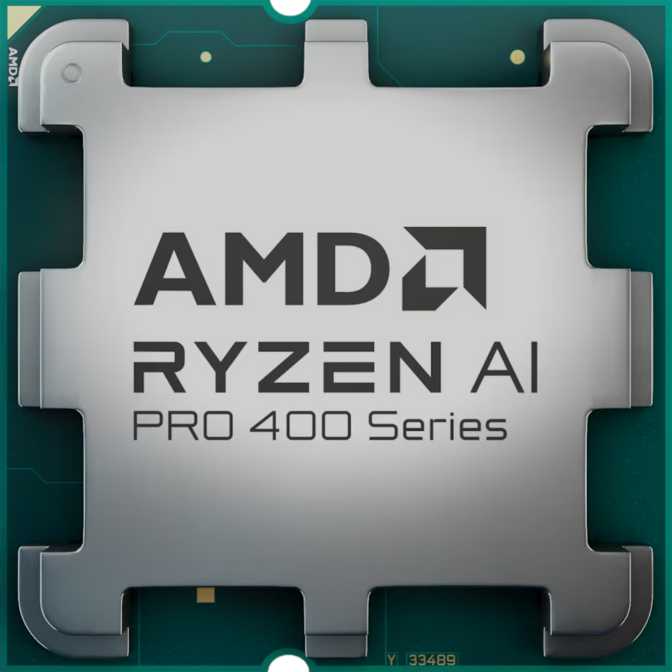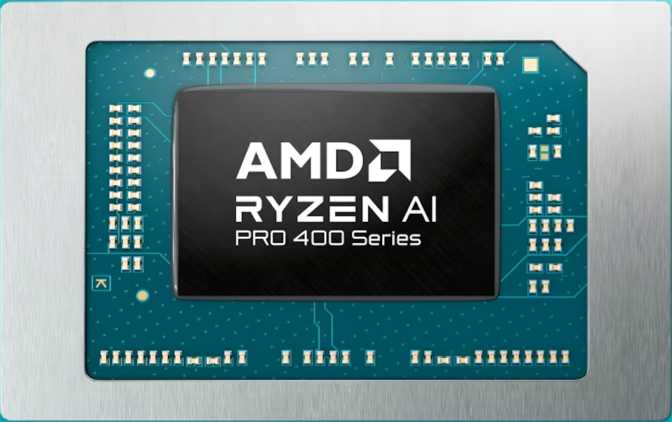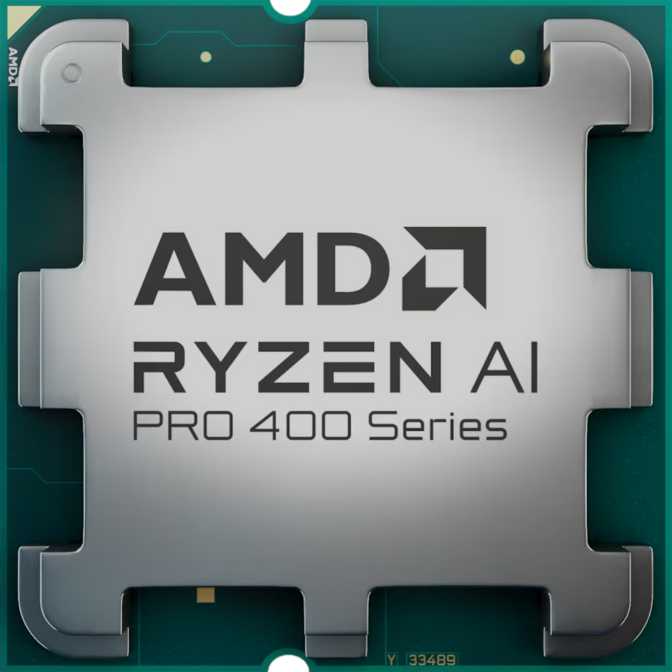
AMD Ryzen AI 5 Pro 435G – Full Review for Professional Builders
CPUsAMD's Ryzen AI 5 Pro 435G sits at an unusual crossroads in the desktop processor market. It is not a performance flagship, and it is not a budget chip either. Instead, it occupies a thoughtfully defined middle ground: a six-core, business-class desktop processor with integrated graphics capable enough to drive a fully functional workstation without a dedicated GPU. For anyone building a compact office system, a media PC, or a professional workstation where reliability and total cost of ownership matter more than raw benchmark dominance, this chip deserves serious attention.
The "Pro" designation is not cosmetic. It signals a set of enterprise-grade features — including ECC memory support — that are absent from AMD's consumer lineup at this tier. If your use case includes financial data, medical records, or any application where silent data corruption is unacceptable, that distinction alone changes the conversation.
Design and Platform: Built for the Long Haul
AM5 Socket and Chipset Compatibility
The 435G uses AMD's AM5 socket — the company's current-generation platform with a documented support roadmap extending several years forward. That matters for system builders who plan to upgrade their processor without replacing the entire motherboard. Compatibility spans five chipset families, from entry-level to enthusiast-grade, giving builders genuine flexibility. A modest mid-range board serves a lean office build just as well as a feature-rich flagship board for workstations demanding extensive I/O.
Purple = enthusiast-grade | Grey = mainstream and value chipsets
This is a desktop processor designed to sit in a standard ATX, Micro-ATX, or Mini-ITX case. It does not belong in a laptop or passively cooled small form factor device — factor that into your planning if chassis size is a constraint.
Power Envelope and Thermal Behavior
At 65 watts, the 435G is positioned as an efficient mainstream desktop chip rather than a power-hungry workstation part. A quality air cooler in the moderate price range is entirely sufficient — liquid cooling is unnecessary. AMD specifies a maximum operating temperature of 95°C, which is a ceiling rather than a cruising altitude. Under typical office workloads, a well-cooled system runs significantly below that threshold.
The 65W power draw translates to manageable electricity costs over a multi-year deployment — a practical consideration for small business environments running machines throughout the working day.
Core Performance: What Six Cores and Twelve Threads Mean in Practice
Clock Speed and Real-World Responsiveness
The 435G runs six physical cores, each capable of handling two simultaneous processing threads through AMD's simultaneous multithreading — giving the operating system twelve logical processors to work with. For the vast majority of office and professional tasks, twelve threads is more than sufficient. Word processors, spreadsheets, browsers, video conferencing, and accounting software rarely saturate even four cores, meaning day-to-day use will feel fluid and unhesitating.
The chip dynamically boosts individual cores up to 4.5 GHz when workloads demand it and the thermal budget allows. Think of the base frequency as the chip's idle whisper and 4.5 GHz as its working pace when you need it. For thread-intensive workloads — compiling code, batch document processing, running multiple virtual machines simultaneously — the six-core, twelve-thread configuration holds up well without becoming a bottleneck.
Cache Architecture: Speed Where It Counts
Cache memory is ultra-fast storage that lives on the chip itself. When frequently used data fits within cache — which it does for most business applications — the processor retrieves it in nanoseconds rather than waiting on slower system RAM. The 435G uses a three-tier structure.
Fastest tier — immediate instruction and data access, smallest footprint per core
1 MB dedicated per core — quick access to each core's active working data
Shared across all cores — larger working pool for multi-threaded workloads
The 8 MB shared L3 is modest by enthusiast standards but appropriate for this chip's intended workloads. Highly cache-sensitive tasks like large-scale database queries may approach the ceiling in prolonged sessions, but for professional productivity use it is a non-issue.
No Overclocking: A Deliberate Choice
The multiplier on this processor is locked — clock speeds cannot be pushed beyond AMD's factory settings. For business deployments and managed workstations, this is entirely appropriate. Overclocking introduces thermal unpredictability and can void warranties. The "Pro" designation implies a stable, validated platform, not a tuner's canvas.
Integrated Graphics: The Radeon 840M Explained
The integrated Radeon 840M is arguably the most compelling differentiator for this chip in its price class. This is not the bare-minimum display circuitry found on older processor generations. The 840M is a capable integrated GPU that drives modern displays at high resolutions, handles hardware video decoding, and manages light creative workloads — all without a dedicated graphics card.
The GPU reaches up to 2,800 MHz at peak — a meaningful clock speed for integrated graphics. Here is what the 435G can handle through the 840M alone:
Where the Radeon 840M hits its limits
The 840M will not replace a dedicated graphics card for 3D rendering, modern AAA gaming, machine learning inference, or GPU-accelerated video encoding at professional speeds. If those tasks are central to your workflow, a discrete card remains necessary. The chip supports discrete GPU addition via PCIe 4.0, so upgrading later is straightforward without replacing the processor.
The practical value for most buyers is eliminating the GPU from the initial build cost entirely. An office workstation, reception desk terminal, developer machine, or home office PC can run fully and indefinitely on integrated graphics alone.
Memory: DDR5 With Professional-Grade Options
Speed and Capacity
The 435G is a DDR5-only platform. DDR5 offers meaningfully higher bandwidth than the DDR4 standard it replaces — particularly relevant here, since the integrated GPU shares system RAM rather than having its own dedicated memory pool. Faster system memory directly improves integrated graphics performance.
Support extends up to 5,600 MHz in dual-channel configuration. Running two matched memory sticks — rather than a single stick — roughly doubles available memory bandwidth. For integrated graphics, this is not optional advice; it is effectively required for smooth performance. A single-channel setup will noticeably constrain what the Radeon 840M can do.
ECC Memory Support
This is where the "Pro" designation carries real weight.
ECC — Error Correcting Code — memory automatically detects and corrects single-bit data errors before they propagate into system state or stored files. Consumer processors at this tier typically do not support ECC. The 435G does.
For a small accounting firm, a medical practice, a scientific research lab, or any deployment where data integrity is non-negotiable, ECC support is a baseline procurement requirement — not a luxury. The fact that this chip includes it at the mainstream desktop tier, without requiring a premium workstation chipset, is a genuine differentiator.
Instruction Sets and PCIe 4.0: Silent Performance Multipliers
What the Instruction Set Support Actually Does
The 435G supports a broad range of processor instruction extensions. These are not features you configure — they operate transparently in the background when software takes advantage of them. The performance benefit is real and automatic.
Encryption and decryption — VPNs, secure storage, HTTPS — run at near-zero CPU overhead. Essential for any security-conscious deployment.
Allows compatible applications to process larger data chunks per clock cycle. Video editors, scientific tools, and modern databases benefit automatically.
Enables addressing large amounts of RAM and running modern operating systems without limitation — essential to confirm for enterprise deployments.
All supported instruction extensions — active automatically in compatible software, no user configuration required
PCIe 4.0: Future-Proofing Storage and Expansion
PCIe 4.0 support enables the fastest NVMe SSDs available — drives that deliver several times the throughput of older SATA storage. Applications launch faster, the operating system boots more quickly, and large file transfers complete in a fraction of the time. The same interface supports a discrete GPU if you add one, and future expansion cards at their rated speeds. For a workstation that opens and closes large files throughout the day, the cumulative difference is meaningful over months and years of use.
Who This Processor Is For — and Who Should Look Elsewhere
An Excellent Fit If You Are...
- Building a business workstation where integrated graphics handle day-to-day display duties without a separate GPU budget
- Deploying multiple machines in an office environment where total cost of ownership matters
- A developer who needs a reliable, multi-threaded CPU for compiling and running local environments
- Running a home lab or small server where ECC memory and stable platform longevity matter
- Building a capable media PC or home office machine without a dedicated graphics card in the budget
- Working in a field where data integrity is non-negotiable and ECC is a procurement requirement
Not the Right Chip If You Are...
- A gamer expecting smooth performance in modern, graphically demanding titles — the Radeon 840M has clear limits
- A content creator doing heavy 3D rendering or professional GPU-accelerated video encoding
- An enthusiast who overclocks — the locked multiplier makes this a firm non-option
- A buyer who already owns a discrete GPU and has no practical use case for integrated graphics
- Running software that specifically demands more than 8 MB of L3 cache at scale
Competitive Positioning: How It Stacks Up
The 435G competes most directly with Intel's Core i5 and i7 desktop processors that include integrated graphics, as well as AMD's own consumer Ryzen lineup at comparable core counts. Here is how the key differentiators compare:
| Feature | AMD Ryzen AI 5 Pro 435G | Consumer Ryzen (AM5) | Intel Core i5 Competitor |
|---|---|---|---|
| ECC Memory Support | Yes | No | Varies by model |
| Integrated GPU Tier | Radeon 840M (strong) | Varies by SKU | Intel Xe (competitive) |
| DDR5 Support | Yes | Yes (AM5) | Yes (recent platforms) |
| Overclocking | Locked | Often unlocked | Locked on most i5 |
| Platform Longevity | AM5 (long roadmap) | AM5 | LGA 1700 (aging) |
| Max RAM Support | 256 GB | Typically 128 GB | 192 GB (varies) |
The 435G's clear advantage is the combination of capable integrated graphics, ECC support, and the AM5 platform's upgrade runway in a single 65W chip. Its trade-off is the locked multiplier and a six-core configuration that trails eight-core alternatives in heavily threaded workloads.
Honest Assessment: Strengths and Where It Falls Short
What This Chip Gets Right
The strengths of the 435G form a coherent package rather than a scattered feature list. The Radeon 840M is among the stronger integrated graphics solutions available in desktop chips at this wattage, and pairing it with DDR5 memory bandwidth brings out genuine capability — capability that is underappreciated by buyers who evaluate integrated graphics only in single-channel memory configurations.
The ECC support is a legitimate differentiator that elevates this chip above equivalent consumer parts for professional deployments. Very few six-core desktop processors at this power level offer ECC, and its inclusion here without requiring a premium chipset makes it genuinely accessible to small businesses and pro users alike.
The AM5 platform means the investment in a compatible motherboard carries forward into future processor upgrades — buyers are not locked into a dead-end socket the moment they purchase.
Where Buyers Should Be Realistic
Six cores is sufficient but not future-proof for compute-heavy workloads as software increasingly leverages parallelism. Users with long hardware refresh cycles who anticipate running more demanding parallel workloads should weigh whether eight cores might serve them better at a modest price premium.
The shared L3 cache is on the lean side for data-intensive applications. Users running large-scale database queries or cache-sensitive scientific workloads may notice this ceiling during prolonged sessions.
The locked multiplier removes all tuning headroom, and the chip's boost performance depends on adequate cooling to sustain. A system with poor thermal management will see the processor throttle back from its peak — ensure cooling matches the workload environment.
Common Buyer Questions Answered
AMD Ryzen AI 5 Pro 435G: Our Recommendation
The AMD Ryzen AI 5 Pro 435G is a well-considered processor for a specific but meaningful category of buyer. If you are building a professional desktop workstation that needs to run reliably, handle everyday multi-tasking and professional software without a graphics card, support data-integrity-critical workloads, and benefit from a platform with genuine long-term upgrade potential — this chip delivers on all of those fronts in a single, efficient package.
It is not the chip for a gamer, a content creation powerhouse builder, or an enthusiast who values clock-speed tunability. Those buyers have better-suited options.
For the system builder equipping an office, a developer workstation, a reception terminal, or a reliability-first home PC — the 435G earns a clear recommendation. Its combination of capable integrated graphics, ECC memory support, DDR5 bandwidth, and the long-runway AM5 platform represents a coherent, professionally oriented value proposition that is difficult to match at its power envelope.
Best for professional workstations, office deployments, and ECC-required environments