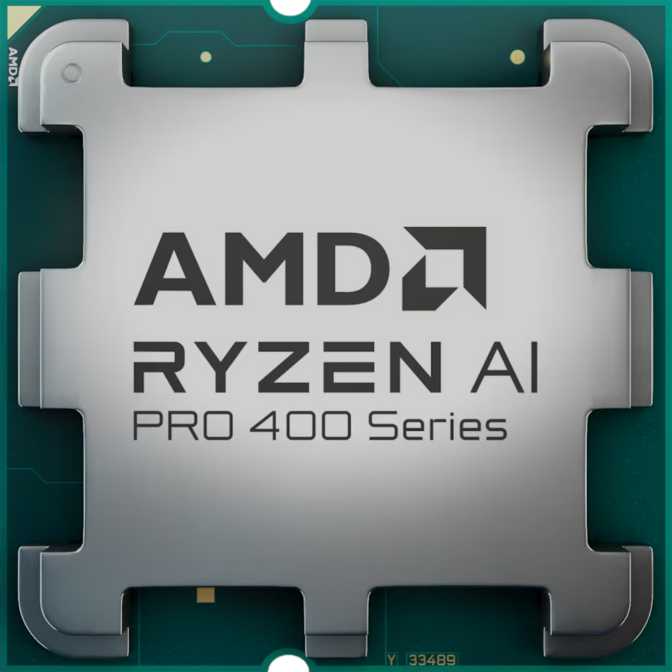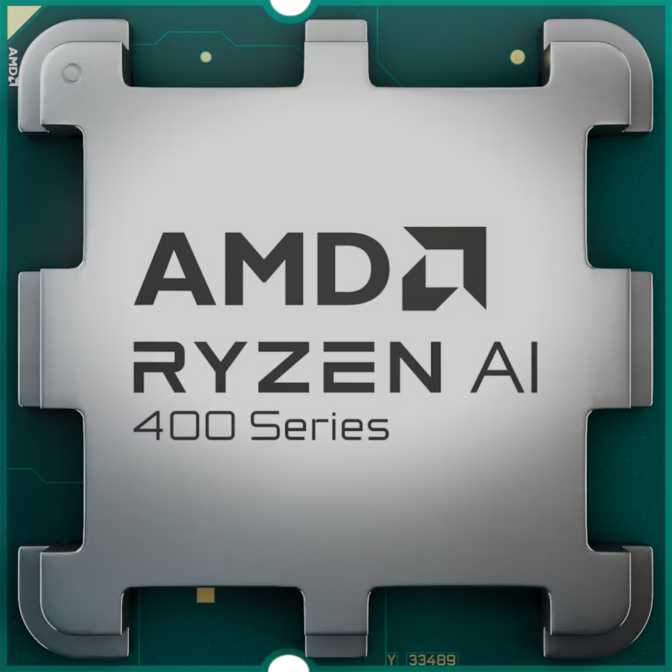
AMD Ryzen AI 5 440GE Review: A Genuinely Efficient Desktop CPU
CPUsMost desktop processors chase maximum performance at any power cost. The AMD Ryzen AI 5 440GE takes a deliberate detour: a six-core chip governed by a strict 35-watt ceiling that still boosts past 4.8GHz when workloads demand it. Pair that efficiency with Radeon 840M integrated graphics, ECC memory support, and an AM5 platform carrying genuine upgrade longevity — and the case for this processor in compact, quiet, and energy-conscious builds becomes difficult to argue against. The GE suffix is the key detail, signalling AMD's efficiency-tuned variant where sustained intelligent performance within tight thermal constraints takes priority over uncapped peak wattage.
AM5 Platform and the Case for Efficiency
Socket compatibility, chipset choices, and what 35 watts actually means for your build
AM5: A Long-Term Platform Investment
The Ryzen AI 5 440GE sits on AMD's AM5 socket — the same foundation shared across AMD's entire current desktop lineup from budget to flagship. The motherboard you buy today has a realistic path to future processor upgrades without requiring a full platform replacement.
Compatible chipsets span a deliberate range: value-focused B650 and B840 boards suit mainstream builds, X670 and X870 unlock maximum connectivity and overclocking headroom, and B850 balances features against cost in the middle. The platform runs PCIe 4.0 throughout, ensuring NVMe storage performs at its rated speed.
What 35 Watts Actually Means
Most mid-range desktop chips run between 65W and 105W at stock settings. This chip operates at roughly half that. The result is less heat, slower and quieter fans, and measurably lower electricity draw — not because performance was sacrificed, but because AMD tuned the voltage-frequency curve specifically for this power envelope.
AMD specifies a safe operating ceiling of 95°C. Under normal loads with any reasonable cooler, this chip stays comfortably below that limit. A modest air cooler — even a low-profile unit for compact cases — handles thermals without compromise. For always-on systems, the cumulative electricity savings versus a 65W or higher chip over a full year of operation are genuinely meaningful.
4nm Fabrication: Efficient by Design
Built on a 4-nanometer manufacturing process, the transistors inside this chip are physically smaller and more power-efficient than those in older desktop processors — the same fabrication class used in premium laptop and mobile silicon , brought to a socketed AM5 desktop form factor.
Smaller transistors mean less current leakage and lower heat per unit of computation. This is not a budget fabrication compromise. It is the reason a 35W ceiling is achievable without gutting clock speeds or core counts.
Performance: Six Cores, Twelve Threads, and When That Is Enough
Clock architecture, cache hierarchy, and multi-core threading in context
Core Count and Multithreading
Six physical cores running simultaneous multithreading gives the operating system twelve logical processors for scheduling workloads. For everyday computing — web browsing, video calls, document editing, spreadsheets, media playback, light photo editing — this configuration handles everything with zero friction and no perceptible lag even under multitasking pressure.
Where the thread count becomes genuinely interesting is in lightly-threaded professional applications: code compilation, batch file conversion, video export, and background service hosting all benefit from spreading work across twelve logical threads. Having forty browser tabs alongside a video call and an active background download does not rattle this chip.
Clock Architecture: From Floor to Ceiling
The base clock is intentionally modest — cores run economically when the workload is light. Performance lives in the boost frequency, which reaches 4.8GHz on active cores when the workload justifies it and thermal and power headroom remain available. The gap between base and boost is deliberately wide: idle economically, surge for demanding tasks.
The unlocked multiplier is a genuinely notable inclusion for an efficiency-class chip. Most GE or low-TDP desktop parts ship with fixed multipliers. Here, users on compatible motherboards can adjust the frequency-voltage curve — not to chase raw overclocking peaks, but to fine-tune the performance-per-watt relationship beyond AMD's defaults. Enthusiasts will appreciate the flexibility.
Cache Architecture: The Hidden Performance Multiplier
Cache memory operates at a fundamentally different speed tier than system RAM. Data that fits in cache is processed with far lower latency — no waiting for the memory controller to fetch it from your DDR5 modules. The Ryzen AI 5 440GE provides 1MB of L2 per core (6MB total) and a 16MB shared L3 pool, a generous allocation relative to its core count.
For everyday applications and gaming workloads in particular, a well-stocked cache reduces the frequency at which the processor stalls waiting on data. Gaming titles benefit meaningfully from L3 capacity — 16MB is a respectable figure for a chip operating in this power class. The chip will frequently feel faster in real use than a raw clock speed comparison might predict.
Cache Hierarchy Breakdown
| Cache Level | Total Capacity | Per-Core Allocation | Role |
|---|---|---|---|
| L1 | 480 KB | 80 KB / core | Fastest tier; holds most frequently used instructions and data for near-instant access |
| L2 | 6 MB | 1 MB / core | Per-core dedicated buffer; bridges L1 speed and L3 capacity — generous for an efficiency chip |
| L3 | 16 MB | ~2.67 MB / core | Shared across all cores; the key latency buffer for gaming and multi-application workloads |
Radeon 840M Integrated Graphics: Honest Analysis
What RDNA architecture inside a desktop processor actually delivers in daily use
The Radeon 840M is not the token display-output silicon that many desktop processors ship with. It is AMD's current-generation RDNA architecture running at a peak clock approaching 2900MHz, housed in a desktop thermal envelope that gives it slightly more headroom than a laptop-class equivalent.
- Smooth playback of high-resolution, high-frame-rate, and HDR video content
- Driving multiple monitors simultaneously for wide productivity setups
- Playable frame rates in less demanding and older game libraries at reduced settings
- GPU-accelerated media encode and decode in compatible editing software
- Enabling full discrete-GPU-free builds in compact and HTPC form factors
- Competitive gaming at high frame rates in demanding modern titles
- GPU-accelerated 3D rendering at professional or production scale
- Deep learning inference tasks that require dedicated, large VRAM pools
- Recent AAA releases at high-quality settings and target frame rates
- Workloads requiring GPU memory isolation from system RAM
Why Integrated Graphics Matter Beyond Gaming
For a small form factor build, an HTPC, or a compact workstation, eliminating a discrete GPU removes one of the most significant cost line items, allows the use of a smaller case, reduces overall system noise, and lowers total power draw. The Radeon 840M's value here is architectural as much as it is graphical — it is what makes a genuinely capable discrete-GPU-free desktop possible.
Memory: DDR5, ECC Support, and 256GB Headroom
Why the memory subsystem makes this chip interesting beyond the consumer market
DDR5 Up to 5600MHz — Build It in Dual Channel
The AM5 platform operates exclusively with DDR5, and the Ryzen AI 5 440GE validates speeds up to 5600MHz in dual-channel configuration. DDR5 has reached mainstream pricing and no longer commands a significant premium over DDR4 at equivalent capacities — the platform cost concern that existed at AM5's launch has largely dissolved.
Dual-channel operation — two sticks rather than one — effectively doubles available memory bandwidth to both the processor and the Radeon 840M. Because integrated graphics share system memory rather than drawing from dedicated VRAM, memory bandwidth is a direct determinant of GPU performance. A dual-channel kit is not a luxury here; it is functionally required to get the iGPU performing at its rated capability.
The theoretical maximum memory capacity of 256GB signals something beyond consumer positioning: this platform is taken seriously for small workstation, NAS, and server-adjacent deployments where memory density matters over longer hardware lifecycles.
ECC Memory Support
ECC — Error-Correcting Code — memory detects and silently corrects single-bit memory errors in real time, preventing the random data corruption that can cause crashes, corrupted files, or incorrect calculations in critical applications.
Finding ECC support in a consumer desktop processor at this price tier is genuinely uncommon. It transforms the Ryzen AI 5 440GE from a consumer efficiency chip into a legitimately professional platform option for:
- Network-attached storage systems
- Local home or small business servers
- Financial or database workstations
- Any workload where silent data corruption is unacceptable
Instruction Sets and AI Branding: What Is Real
Separating meaningful hardware capabilities from marketing nomenclature
AES Hardware Acceleration
Encryption and decryption operations — VPN tunnels, encrypted storage volumes, secure HTTPS connections — execute at hardware speed with negligible CPU overhead. Security does not cost performance cycles here.
AVX2 Wide Data Processing
Software built to leverage AVX2 — video editors, scientific applications, certain game engines — can process wider data sets per clock cycle. Applications that support it see real throughput improvements with no frequency increase required.
FMA3 for Floating-Point Work
Fused Multiply-Add operations in FMA3 accelerate floating-point-heavy calculations common in engineering software, audio processing applications, and machine learning inference running on the CPU rather than a discrete accelerator.
On the "AI" Branding
The Ryzen AI name aligns this chip with AMD's neural processing unit architecture, where a dedicated NPU die supplements the CPU and GPU for AI inference tasks. AMD's Ryzen AI lineup incorporates NPU hardware at the silicon level. NPU performance characteristics vary across the lineup, so users with specific AI workload requirements should verify the 440GE's NPU specifications directly against AMD's official technical documentation rather than relying on the family branding alone.
Real-World Use Cases: Who This CPU Is Built For
Matching the hardware profile to the builder's actual needs — honestly
- Compact and SFF Builders
The 35W envelope means Mini-ITX builds with limited airflow and low-profile coolers are fully viable. No thermal compromise required to keep the enclosure small and quiet.
- Quiet Home Office Setups
Low power means less heat. Less heat means slower fans. If silence matters during calls or focused work sessions, this chip's thermal profile enables near-inaudible operation.
- Always-On and 24/7 Systems
Home servers, NAS enclosures, and media boxes that run continuously benefit directly from a low TDP. The electricity delta versus a 65W or 125W processor compounds meaningfully over continuous operation.
- GPU-Free Builds for Moderate Gaming
If your gaming library leans toward older titles, indie games, or emulation rather than current AAA releases, the Radeon 840M is a complete, cost-eliminating graphics solution.
- Light Workstations With ECC Needs
Small businesses or power users handling databases, financial records, or file serving who need memory error correction without buying full workstation-class hardware.
- High-Frame-Rate Gaming Enthusiasts
Even the fastest DDR5 kits cannot push the Radeon 840M to competitive frame rates in demanding modern titles. A discrete GPU is needed — at which point the power savings value proposition shifts, and a higher-TDP processor may suit better.
- Heavy Creative Professionals
Video producers rendering complex timelines, 3D artists, and photographers processing thousands of RAW files in batch will feel the six-core sustained ceiling under prolonged all-core loads. Eight or more cores serve these use cases better.
- Overclocking Enthusiasts
The unlocked multiplier is a welcome tool for efficiency tuning. It is not a path to meaningful raw frequency gains — the 35W TDP physically constrains how far clocks can be pushed before power and thermal limits intervene.
Competitive Positioning: How It Compares
How the Ryzen AI 5 440GE sits against the most common alternatives buyers consider
| Consideration | Ryzen AI 5 440GE | Standard 65W Ryzen 5 | Intel Core Ultra 5 (Low Power) |
|---|---|---|---|
| Power Draw | 35W | 65W | 28–45W range |
| Core / Thread Count | 6C / 12T | 6–8C / 12–16T | 6–14C (hybrid architecture) |
| Integrated Graphics | Radeon 840M (RDNA) | Radeon 760M or similar | Intel Arc (variable by SKU) |
| Memory Platform | AM5 — DDR5 only | AM5 — DDR5 only | LGA1851 — DDR5 |
| ECC Support | Yes | Limited / SKU-dependent | Limited |
| Unlocked Multiplier | Yes | Depends on SKU suffix | Platform-restricted |
| Core Architecture | Uniform cores, no hybrid | Uniform cores, no hybrid | Hybrid P+E core design |
| SFF / Compact Viability | Excellent | Moderate | Good |
| Platform Upgrade Path | Strong (AM5 longevity) | Strong (AM5 longevity) | Newer platform, uncertain |
vs. 65W Ryzen 5: The higher-wattage chip maintains elevated all-core frequencies for longer under sustained loads. If your workload regularly maximizes every core simultaneously, the 65W variant delivers more sustained throughput. For everything else, the 440GE's efficiency profile wins on noise, heat, and operating cost.
vs. Intel Core Ultra 5: Intel's hybrid architecture schedules workloads across performance and efficiency cores, adding OS-level scheduling complexity. The 440GE uses uniform cores with consistent per-core behavior — a simpler, more predictable performance profile for workloads that do not benefit from Intel's scheduler optimizations.
Honest Assessment: Where It Excels and Where It Does Not
Genuine Strengths
The Ryzen AI 5 440GE's most compelling characteristic is internal coherence. Every specification points in the same direction — a chip designed for users who know precisely what they need and who refuse to pay, in electricity, heat, or money, for performance they will never use.
The ECC memory support is the single most surprising inclusion and genuinely sets this processor apart from consumer-class alternatives at comparable power levels. Pair it with a compatible board and ECC DDR5, and you have workstation-class memory reliability in a 35W desktop form factor — a combination that practically did not exist in this market segment previously.
The Radeon 840M exceeds what most buyers expect from integrated desktop graphics. The AM5 platform provides real upgrade longevity. The unlocked multiplier rewards users who understand power-frequency tuning. These are not marketing bullet points — they are hardware decisions that benefit specific builders in concrete, measurable ways.
Real Limitations
The 35W TDP ceiling is both the chip's defining feature and its hard constraint. Under sustained all-core workloads — every core loaded simultaneously for extended periods — the processor must manage its frequency to remain within that power budget. The result is lower sustained throughput compared to higher-wattage alternatives in prolonged parallel tasks.
The base clock is modest. In workloads where all cores are already active and the chip is running warm, single-core boost availability diminishes. This is not a flaw in the design; it is the physics of operating within a low TDP. Users whose workloads regularly maximize all cores should weigh this honestly against alternative options.
Six cores will not be the right answer for every builder. The cases where more cores deliver meaningful real-world benefit — production video rendering, software compilation at scale, virtualization hosting multiple concurrent VMs — are legitimate, and this chip does not pretend otherwise.
Common Questions Before You Buy
The questions real buyers search for — answered directly
The Right Processor for the Right Builder
The AMD Ryzen AI 5 440GE is a chip built around a coherent philosophy: deliver genuine computing capability, integrated graphics, and professional memory reliability within a 35W thermal envelope that opens the door to builds that most processors cannot support.
For compact system builders, silent home office setups, always-on servers and NAS systems, energy-conscious workstations, and users who can game competently without a discrete GPU, this processor is not a compromise. It is the correct choice — a chip where every specification exists in deliberate service of the same goal.
The ECC memory support alone distinguishes it from consumer competition at this power level. The Radeon 840M goes beyond token display output. The AM5 platform provides a genuine upgrade runway. The unlocked multiplier rewards users who understand efficiency tuning.
- Your priority is quiet, efficient, compact computing
- You need ECC reliability without workstation pricing
- You run a 24/7 system where operating costs accumulate
- The Radeon 840M covers your graphics requirements
- Sustained all-core performance is your primary metric
- You need competitive gaming frame rates without a dGPU
- Heavy rendering or encoding workloads dominate your use
- You prioritize maximum overclocking headroom above all else
The 35W ceiling is both the defining feature and the honest constraint. Know your workload, and the purchase decision answers itself.