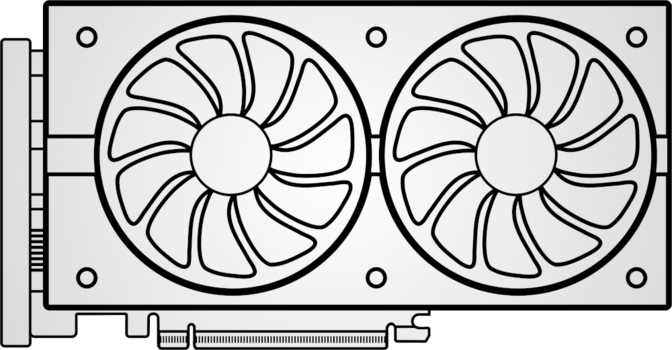
AMD Radeon RX 7400 Review: A Budget GPU That Plays by Different Rules
Graphics CardsThe entry-level graphics card market is largely defined by compromise, and buyers at this tier usually accept that as an unavoidable fact. What makes the AMD Radeon RX 7400 a genuinely interesting case study is which compromises it chooses. Rather than trimming VRAM or stripping out modern API support to hit a low price point, this card arrives with a full current-generation feature set, a memory buffer that embarrasses many competing options, and power consumption so low it fundamentally changes which systems can accommodate it.
None of that makes it a performance powerhouse. This is not a card for high-refresh 1440p gaming or anything approaching 4K. But for the specific buyer this card is targeting — and there are more of them than you might expect — it delivers a combination of capabilities that alternatives in this tier struggle to match.
Key Specifications at a Glance
Power Draw
Ultra-Low 55W
VRAM
8GB GDDR6
Architecture
RDNA 3 / 6nm
Max Displays
4 Screens
Upscaling
FSR 4 Ready
Ray Tracing
Hardware RT
Build and Physical Footprint
A Card That Fits Where Others Won't
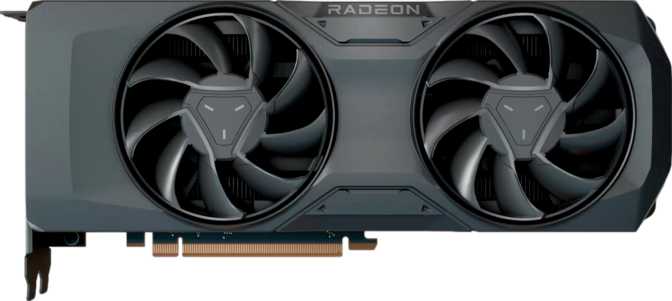
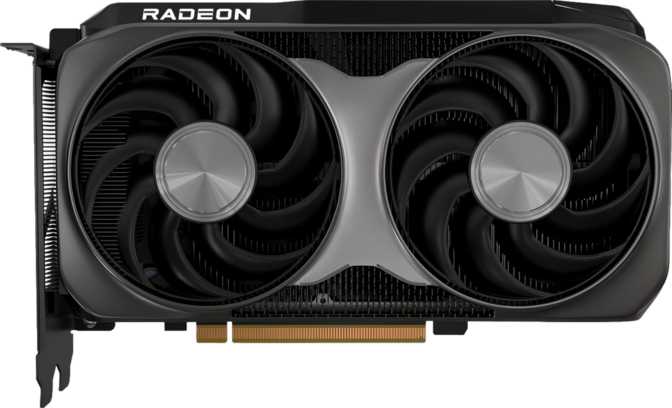
At roughly 167mm in length — comparable to the span of an adult hand — the RX 7400 is noticeably shorter than the majority of discrete graphics cards, including many in the mid-range tier. This compact profile is not an aesthetic choice; it is a capability. Small form factor cases, MicroATX and Mini-ITX builds, slimline chassis designs, and systems with restricted internal clearance can all accommodate this card where a standard-length GPU simply would not fit.
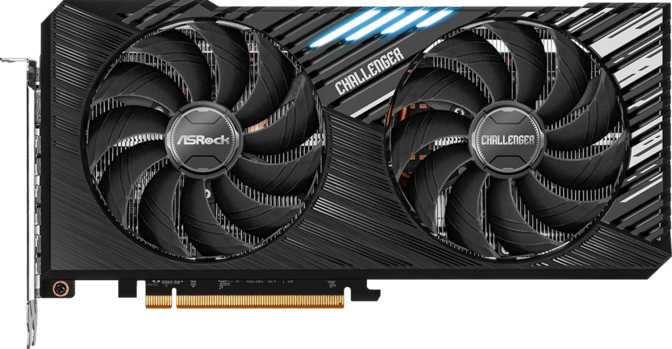
The card carries no RGB lighting, which will either disappoint or reassure depending on your priorities. For anyone building a quiet workstation, an HTPC, or a no-nonsense productivity system, the understated appearance is precisely right.
Power Without an External Cable
Its total power draw at full load sits at just 55 watts — low enough that the card can, in most board partner implementations, receive all the power it needs directly from the motherboard's PCIe slot, with no separate power cable from the PSU required.
Why This Matters
Tens of millions of pre-built desktop PCs have modest power supplies with no supplementary GPU connectors. The RX 7400 removes that barrier entirely, enabling a meaningful graphics upgrade on systems that could not support anything more power-hungry.
Cooling is handled by a conventional air-based solution — exactly appropriate for a card at this thermal level. The heat generated is modest, and a well-designed heatsink manages it without drama or excessive noise.
Core Performance: What the Architecture Delivers
Built on a Modern Foundation
The RX 7400 is built on AMD's RDNA 3 architecture, manufactured on a 6-nanometer process — the same fabrication generation used across AMD's broader Radeon 7000 family. Despite its low power and modest price, this card is not running on recycled or aging silicon. The transistor count — over 13 billion — reflects genuine architectural density, and the efficiency gains of the 6nm process are precisely what allow 55-watt gaming performance to exist at all. The GPU's clock behavior follows modern design norms: a conservative base frequency and an aggressive boost frequency pursued under sustained gaming loads.
1080p Gaming: The Intended Target
Within 1080p, the card handles popular online titles, indie games, and moderately demanding single-player releases well at medium to high settings. At 1440p, performance becomes selective and unreliable for graphically intensive modern releases.
- 1080p Medium–High Settings: Comfortable
- 1440p: Selective — rely on upscaling
- 4K: Outside this card's design scope
What the Compute Numbers Mean
The RX 7400 delivers approximately 16.5 TFLOPS of single-precision compute throughput — a measure of raw processing capability in trillions of operations per second. This places the card firmly in the entry tier: behind mid-range hardware, but ahead of older budget GPUs still in widespread use.
The card also carries hardware support for double-precision floating-point computation — an uncommon feature at this tier that broadens its utility for technical and scientific compute workloads beyond gaming.
Memory and Bandwidth: The 8GB GDDR6 Story
A Meaningful Advantage at This Tier
The RX 7400 ships with 8 gigabytes of GDDR6 memory, and that figure deserves more attention than it typically receives in budget GPU conversations. The entry-level market has a long history of shipping 4GB or 6GB configurations — which were serviceable a few years ago but increasingly create serious problems with current titles.
Modern games can push VRAM usage at 1080p past what 4GB or 6GB can hold. When a GPU exhausts its local memory and begins pulling data from system RAM instead, performance collapses — frame rates plummet and stuttering becomes severe. The 8GB buffer on the RX 7400 keeps that threshold comfortably out of reach for 1080p gaming at medium-to-high settings. For buyers who hold onto hardware for three to five years, this is a more meaningful spec than it appears at purchase time.
The Bus Width Context
The memory operates on a 128-bit data bus — narrower than the 192-bit or 256-bit widths found in higher-tier hardware. The resulting bandwidth is appropriate for 1080p workloads, where raw memory throughput is rarely the primary bottleneck. Compute capacity tends to be the limiting factor first at this resolution.
At higher resolutions, the narrower bus becomes a meaningful constraint — one of the consistent architectural reasons this card belongs at 1080p.
ECC Support: Error Correcting Code memory is present, adding a reliability layer for compute workloads and data-sensitive applications beyond gaming.
Features That Matter Beyond Frame Rate
FSR 4 Upscaling
FSR 4 renders the game at a reduced internal resolution and reconstructs a higher-quality output image. The result: substantially more frames per second with minimal perceptible quality loss. For a card at this tier, it is not a nice-to-have — it is a core part of the performance strategy. Running demanding titles at 1080p with FSR 4 Quality mode can transform a game from marginal to genuinely smooth.
Hardware Ray Tracing
Hardware-accelerated ray tracing computes lighting, shadows, and reflections with greater physical accuracy than traditional rasterization. The RX 7400 has dedicated hardware to handle it — but realistic expectations apply.
Ray tracing is resource-intensive at this tier. Pairing it with FSR 4 delivers the best quality-to-performance balance.
DirectX 12 Ultimate
Full implementation of DirectX 12 Ultimate confirms hardware support for ray tracing, variable rate shading, mesh shaders, and sampler feedback — features increasingly present in current and future game releases. There is no API compatibility ceiling on this card for the foreseeable software future.
Also includes OpenGL 4.6 and OpenCL 2.2 for GPU-accelerated creative and compute workflows.
AMD Smart Access Memory
AMD Smart Access Memory (SAM) allows a compatible AMD Ryzen processor to access the full VRAM pool directly rather than in limited segments. When paired with a recent Ryzen CPU and a supporting motherboard, this delivers measurable frame rate improvements in certain titles — activated with nothing more than a BIOS toggle. It is a free performance gain for AMD platform builders.
No DLSS Support
DLSS is exclusive to NVIDIA hardware and unavailable on any AMD GPU — no software update changes that. FSR 4 is the functional equivalent here and is broadly competitive, but they are distinct implementations with different per-game support.
If DLSS is a firm requirement for your setup or workflow, this card cannot accommodate it.
Four-Display Support
Three DisplayPort outputs and one HDMI 2.1 port allow up to four simultaneous displays — an unusually generous configuration for entry-level hardware. This makes the RX 7400 a practical choice for multi-monitor productivity setups and media centers where screen count matters more than maximum gaming muscle.
Display Output and Multi-Monitor Capability
The RX 7400 offers a notably complete display configuration for its price class — one that stands well above entry-level norms.
Four Screens on an Entry-Level Card
Three DisplayPort outputs sit alongside a single HDMI port, giving you four total simultaneous display connections. Multi-monitor setups of up to four screens are fully supported — a figure typically associated with professional-class hardware rather than budget gaming cards.
The HDMI port implements version 2.1 — the current standard — which supports 4K at high refresh rates and 8K output. For a living room PC or HTPC connected to a modern television, this is the right connector without adapter compromise. The three DisplayPort outputs match the same capability tier and suit any modern monitor.
No USB-C, DVI, or Mini DisplayPort outputs are present. Older DVI-only monitors will require an adapter.
Output Configuration
-
HDMI 2.1 1 Port
4K/8K capable — ideal for TVs and modern monitors
-
DisplayPort 3 Ports
Current standard — compatible with all modern monitors
-
USB-C / DVI / Mini DP
Not present — adapter required for legacy DVI monitors
-
Max Simultaneous Displays
Up to 4 screens at once
Who This Card Is For — and Who It Isn't
Buyers Who Benefit Most
-
The Pre-Built PC Upgrader
Tens of millions of OEM desktops run on modest power supplies with no supplementary GPU connectors. At 55W with no external power requirement, the RX 7400 enables upgrades that are simply not possible with any higher-power alternative.
-
The Small Form Factor Builder
When a case imposes hard length restrictions, physical compatibility is the first filter — and most cards do not pass. Under 170mm, the RX 7400 fits in ITX and compact chassis where longer cards are categorically excluded.
-
The 1080p Budget Gamer
For popular online titles, indie games, and moderately demanding single-player releases at 1080p — especially with FSR 4 as a tool — this card delivers a smooth, capable experience on a tight budget.
-
The HTPC / Media Center Builder
HDMI 2.1, four display outputs, near-silent operation, and a compact footprint make this an excellent fit for living room PCs and home theater systems that also handle light gaming.
-
Light Compute and GPU-Accelerated Users
OpenCL 2.2 and ECC memory support make this a modestly functional choice for GPU-accelerated workflows where a professional card is overkill and integrated graphics are insufficient.
Who Should Look Elsewhere
-
1440p and 4K Gamers
The architectural ceiling here is firmly 1080p for demanding titles. Anyone prioritizing higher resolutions should be shopping in a different performance tier without exception.
-
High-Refresh Competitive Gamers
Consistently achieving 144Hz or above in graphically demanding multiplayer games requires more compute headroom than this card carries. Cards with meaningfully more shading capacity serve this use case better.
-
Professionals with Heavy GPU Workloads
4K video editing, complex 3D rendering, and AI-based creative tools benefit enormously from more VRAM headroom and compute throughput. The RX 7400 can participate in these tasks, but professionals with heavy workloads will find the pace frustrating.
-
Anyone Who Requires DLSS
If your pipeline is built around DLSS — for games or creative software — this card cannot provide it. It is a hardware requirement exclusive to NVIDIA, and no update will change that.
How the RX 7400 Stacks Up Against the Alternatives
| Comparison Factor | AMD Radeon RX 7400 | Mid-Range Step-Up (RX 7600 Class) |
NVIDIA Budget Equivalent |
Intel Arc Entry-Level |
|---|---|---|---|---|
| Target Resolution | 1080p | 1080p–1440p | 1080p | 1080p |
| Power Draw | Very Low ~55W | Moderate to High | Moderate | Moderate |
| External Power Connector | Typically Not Required | Required | Required | Varies |
| Upscaling Technology | FSR 4 | FSR 4 | DLSS + FSR | XeSS + FSR |
| VRAM | 8GB GDDR6 | 8GB | 8GB (varies) | 8–16GB |
| Hardware Ray Tracing | Yes | Yes | Yes | Yes |
| SFF / Compact Build Suitability | Excellent | Average | Average | Varies |
| Best Suited For | Low-power / SFF builds | 1080p–1440p gaming | DLSS-dependent users | Value-focused builds |
Competitor entries represent general market tiers. Individual models vary. The RX 7400's advantage lies in power efficiency and form factor, not outright performance.
Honest Assessment: Strengths and Limitations
What the RX 7400 Gets Right
The power efficiency story here is genuinely impressive. Building a modern, feature-complete GPU that consumes less power than a household light bulb under load — while still supporting the full DirectX 12 Ultimate feature set, hardware ray tracing, and the latest upscaling technology — reflects meaningful engineering achievement. At this thermal envelope, the RX 7400 opens upgrade and build scenarios that simply do not exist for less efficient competitors.
The 8GB of GDDR6 memory deserves credit in context. Entry-level cards have a persistent history of shipping with inadequate VRAM, creating a performance cliff that arrives faster than buyers expect. The RX 7400 avoids that cliff, and for buyers keeping this card for several years, that future-proofing is worth considerably more than it appears today.
FSR 4 support on entry-level hardware is also notable. The performance headroom it creates — particularly in Quality mode — extends the card's practical gaming capability well beyond what its raw throughput numbers suggest.
Where It Falls Short
The 128-bit memory bus is the main architectural constraint, and it is fixed. It keeps this card at 1080p and limits what is possible as content and workloads scale up. There is no workaround — it is a permanent hardware characteristic that consistently reasserts itself the moment you push beyond the card's intended resolution.
The absence of DLSS will matter to some buyers. For gaming ecosystems or creative workflows built around NVIDIA's upscaling pipeline, this is a hard limitation with no software remedy.
Raw performance headroom is limited. Buyers who consistently want maximum quality settings at native resolution without upscaling assistance will bump into the RX 7400's limits regularly. This card rewards those who work with FSR 4 intelligently — not those seeking brute-force rendering power without compromise.
Common Buyer Questions Answered
The Right Card for the Right Buyer
The AMD Radeon RX 7400 is a card that asks you to know exactly who you are as a buyer before reaching for your wallet.
If you are upgrading an underpowered pre-built, building in a compact chassis, or assembling a living room media PC that also runs games, this card is the right answer in ways that a more powerful alternative simply cannot be. Its power efficiency, compact footprint, modern feature support, and healthy VRAM allocation make it uniquely suited for constrained scenarios.
If you are building a standard desktop gaming rig with a proper power supply and a mid-tower case, the incremental cost to step up to a significantly more powerful card is money well spent — because the constraints that make the RX 7400 valuable do not apply to you.
Purchase Verdict: Strongly recommended for low-power and SFF builds, pre-built PC upgrades, and HTPC applications. For a standard gaming rig with no power or space constraints, prioritize stepping up to a higher-performance tier instead.