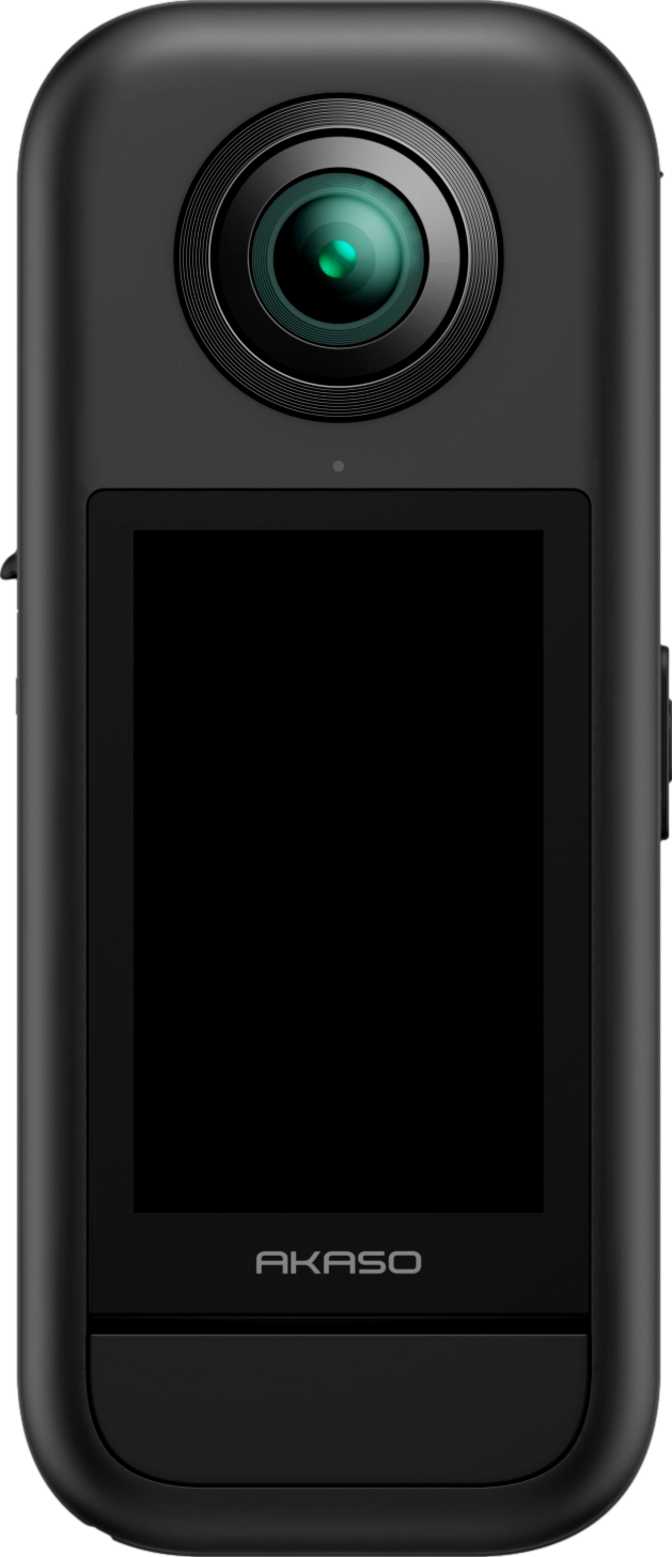
Akaso 360 Review: Impressive Features, Real-World Limitations
Action CamerasAt a Glance
Overall Score / 10
Creative features that outpace the price — with battery life and no waterproofing as firm limits.
Category Ratings
Design and Build Quality
Compact and pocket-friendly, with a distinctive flip-out display — and important physical limitations to understand before buying.
Physical Dimensions
Key Physical Features
-
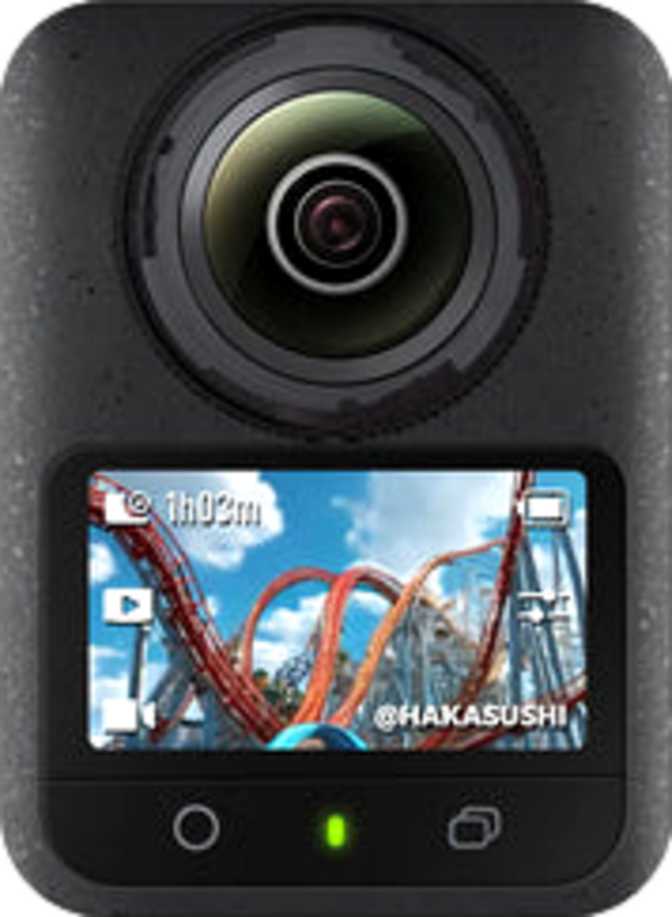
2.29-Inch Flip-Out ScreenRotates out for selfie-mode framing, overhead monitoring, and ground-level review — a practical edge over cameras with fixed or absent displays. Navigation runs through physical buttons, not touch.
-
External Memory Card RequiredZero internal storage means a microSD card is mandatory before first use. Budget for a fast, high-capacity card — spherical video files are considerably larger than standard footage.
-
Standard Tripod MountA universal tripod thread opens up full compatibility with tripods, selfie sticks, and table-top rigs. No dedicated bike mount is included; cyclists need a separate clamp adapter.
-
USB-C ChargingThe modern connector standard means one cable handles this camera alongside most other devices in your bag — no proprietary charger required.
The Dual-Lens System and Image Quality
Two lenses, a back-illuminated sensor, and 72 megapixels — here is what those numbers actually mean for your shots.
How the Dual-Lens Architecture Works
A 360-degree camera pairs two ultra-wide lenses — each covering slightly more than a hemisphere — and stitches their output into a single spherical image or video. Both lenses on the Akaso 360 draw from back-illuminated CMOS sensors, often called BSI sensors, which are engineered so the light-gathering layer sits closer to incoming light rather than behind the circuitry.
In practical terms, this design tends to improve low-light performance compared to older front-illuminated sensor designs. For a camera that captures all directions simultaneously — including shaded or dimly lit areas — this sensor architecture matters more than it might on a single-lens camera.
What 72 Megapixels Actually Gives You
In a 360 camera, this resolution is spread across a full spherical capture — not concentrated on a flat frame. The practical benefit is resolution headroom: you can crop into specific areas of the sphere in post-production and still retain usable, print-worthy detail.
For creators who shoot 360 footage and then reframe it — selecting precisely where the viewer looks — this headroom is genuinely valuable. The f/2.25 aperture on the main lenses allows a reasonable amount of light in mixed indoor-outdoor settings, though extreme low-light performance is not where this camera excels.
Video Performance
Mid-tier resolution with strong stabilization and autofocus — but a hard ceiling on slow-motion recording.
Resolution and Frame Rate
The camera records at a native width of 2880 pixels at 30 frames per second. In the 360-degree camera category, this is a mid-tier specification — sufficient for comfortable playback in a VR headset or 360-degree video player, and capable of producing reframed clips that hold up at standard HD dimensions.
The 30fps maximum handles most everyday scenarios smoothly — walking footage, social events, travel, moderate-paced activities. There is no slow-motion recording mode available at any frame rate.
Video Feature Breakdown
Keeps the horizon flat even when the camera tilts or rolls — the foundational requirement for watchable 360 footage on a moving body or vehicle mount.
Faster and more decisive focus locking than contrast-detect systems, operating continuously while recording — reliable for moving subjects in all directions.
Keeps a moving subject in continuous focus across the frame — ideal for vlogging, follow-cam footage, and any scenario with subject movement.
Footage captured on a monopod is processed to remove the stick from the final stitched image — a significant quality-of-life feature for solo creators shooting handheld.
Records at the theatrical 24-frame standard, giving travel vlogs and narrative content a more cinematic quality without additional post-processing adjustments.
Condenses long sequences — sunsets, clouds, construction, crowds — into short watchable clips. A core creative mode for documentary-style and environmental content.
Audio Recording
Stereo capture from two built-in microphones — with no pathway for external audio input of any kind.
What the Built-In Stereo Pair Provides
Two microphones positioned on the body capture stereo audio — sound recorded from two distinct points, preserving a sense of spatial direction that mono audio cannot replicate. For 360 video, where viewers can look in any direction, this spatial quality noticeably enhances the sense of presence and immersion.
For social content, vlogging, event documentation, and personal travel recording, the built-in stereo pair performs adequately. It is not a substitute for a dedicated recording setup in professional or broadcast contexts.
Audio Limitations
-
No 3.5mm Audio JackThere is no headphone or microphone port. External lavalier and boom microphones have no connection path to this camera.
-
No Dedicated Microphone InputBroadcast-quality audio workflows are not possible. Journalists, interviewers, and filmmakers dependent on external audio equipment should look elsewhere.
-
Dual Stereo MicrophonesTwo mics capture directional stereo audio, providing improved spatial context versus a single mono mic — practical for immersive 360-degree playback.
Battery Life and Power
One hour of continuous recording is the honest ceiling — but the removable design offers a workable solution.
Continuous recording on a single full charge
Lowest-rated category: 4.0 / 10Context and Practical Workarounds
360 cameras are power-intensive by design — they are processing two simultaneous video streams, stitching them together, applying stabilization, and sometimes streaming live at the same time. Even premium 360 cameras routinely fall in the 60-to-90-minute range, which provides useful context for this figure.
The Akaso 360 partially addresses this through a removable, rechargeable battery design. Spare batteries can be carried in a jacket pocket and swapped in seconds without touching a computer or wall outlet. For full-day shoots, this is a workable approach — but it demands deliberate preparation before every outing.
Charging is handled via USB-C, so one cable type serves both the camera and most other devices you carry. A live battery level indicator on the display ensures you are never caught off-guard mid-recording.
Connectivity
Smartphone-first wireless control with built-in live streaming — no HDMI, no GPS, and no NFC.
Who Is This Camera For?
The Akaso 360 has a clearly defined sweet spot — and equally clear situations where it will consistently disappoint.
Strong Match — Buy It If You Are:
-
A travel documentarian or storyteller360 capture records full environmental context — the scale of a landscape, the energy of a crowd — without requiring precise framing decisions in the moment.
-
A solo content creator or vloggerInvisible selfie stick removal, the flip-out self-monitor screen, and smartphone remote control make solo shooting genuinely manageable without an assistant.
-
An event documentarianBirthday parties, family gatherings, local festivals — the compact size, easy mounting, and 360-degree coverage suit "set it and forget it" recording perfectly.
-
A first-time 360 camera buyerSmartphone remote control and always-on spherical capture remove the pressure of precise framing, significantly lowering the learning curve.
-
A live streamer wanting a 360 perspectiveFirst-party live streaming is built in — no computer relay required to broadcast events, travel, or demonstrations in real time.
Poor Match — Skip It If You Need:
-
Waterproof performanceNo rating, no housing included. Surfing, kayaking, snowboarding in wet conditions, and any activity where the camera may get wet are ruled out entirely.
-
Slow-motion videoThere is no high-frame-rate mode at any resolution. Sports, motorsports, dance, and wildlife photography that depends on slow-motion replay is simply not supported.
-
External audio integrationJournalists, interviewers, and filmmakers who depend on lavalier or boom microphones have no connection path. The built-in mics are the only audio option.
-
Cold-weather shootingThe minimum rated operating temperature is 0°C. Winter landscapes, ski resort coverage, and sub-freezing environments require a camera built for those conditions.
-
Uninterrupted full-day recordingOne hour of runtime demands active planning. Without spare batteries on hand, multi-hour shoots will require repeated stops at inconvenient moments.
How It Compares
Where the Akaso 360 sits relative to entry-level and mid-range alternatives in the 360-camera category.
| Feature | Akaso 360 | Entry-Level Competitor | Mid-Range 360 Camera |
|---|---|---|---|
| Resolution | 72MP / 2880-wide video | 30–64MP / lower-res video | 72–108MP / 5.7K–8K video |
| Waterproofing | None | Often IPX4–IP67 | IP68 or dedicated housing |
| Display | 2.29" Flip-Out | Fixed touchscreen or none | Fixed touchscreen |
| Battery | ~1 hr, removable | ~1–1.5 hr, often sealed | 1.5–2 hr, proprietary |
| GPS | Occasionally | Often included | |
| Slow Motion | Occasionally | ||
| Live Streaming | Sometimes | ||
| RAW Photo Capture | Rarely | ||
| Selfie Stick Removal | Sometimes |
Honest Assessment
Where the Akaso 360 earns genuine praise — and where it falls short without qualification.
What It Gets Right
- The flip-out display is a thoughtful inclusion that meaningfully improves self-directed shooting. It sounds minor until you have tried to monitor a 360 frame from a fixed or absent screen.
- RAW image capture, phase-detection autofocus with tracking, and invisible selfie stick removal all appear at a price tier where they are typically absent from competing cameras.
- The removable battery design is more practical than a sealed unit on a power-hungry 360 camera. Carrying spares in a pocket and swapping in seconds is a workable long-day strategy.
- Gyroscope stabilization with horizon leveling produces steady, level footage even on a moving body or vehicle — the baseline requirement for watchable 360-degree video.
- Live streaming and 24p cinema mode add real creative flexibility without requiring additional hardware, software, or subscription services.
- USB-C charging keeps the accessory footprint minimal — one cable, no proprietary hardware, works alongside everything else already in your bag.
Where It Falls Short
- One hour of battery life is a planning burden regardless of the removable design — a constraint that competitors at comparable prices are beginning to address more effectively.
- The absence of waterproofing is not a minor inconvenience. It is a hard restriction that fundamentally limits where this camera can be used without serious risk to the hardware.
- No slow-motion recording is a creative ceiling that cameras at this size and price are beginning to clear. Action-focused shooters will feel this limitation immediately.
- Physical button navigation on a 2.29-inch display is slower and less intuitive than a touchscreen. The non-touch interface on a camera this capable is an unnecessary friction point.
- No GPS, no HDMI out, and no audio input each represent individually acceptable trade-offs — but together they define a camera with a deliberately narrow intended use case.
- Zero internal storage means every shoot requires a pre-loaded memory card. Forgetting it means no recording at all — a small but genuinely frustrating day-ruiner in the field.
Common Questions Answered
The questions real buyers search for before purchasing — answered directly and without ambiguity.
Final Verdict
The Akaso 360 is a capable and feature-rich camera for a specific, well-defined user: someone creating 360-degree content for social media, travel documentation, or live streaming, who shoots in controlled or fair-weather conditions and is prepared to manage battery life proactively.
Its flip-out screen, RAW image capture, phase-detection autofocus tracking, and live streaming support make it a more complete creative tool than its price suggests. For a first 360 camera, the smartphone remote control and always-on spherical capture meaningfully reduce the learning curve.
- A content creator shooting fair-weather travel or events
- A solo vlogger who needs a self-monitoring screen
- A first-time 360 buyer on a tighter budget
- A live streamer wanting a compact 360 source
- Waterproofing for water sports or wet weather
- Slow-motion video at any resolution
- External microphone connectivity
- Sub-freezing or cold-weather operation