GoPro Max2 Review: A Complete 360-Degree Action Camera Test
Action CamerasThe action camera market has never been more crowded, yet the demand for true 360-degree capture has remained a niche that very few manufacturers handle well. Most 360 cameras sacrifice either image quality, usability, or durability in pursuit of the format. The GoPro Max2 enters this space with a clear thesis: you should not have to compromise any of those three things. Whether that thesis holds up under scrutiny is exactly what this review answers.
Design and Build Quality
Physical Form Factor
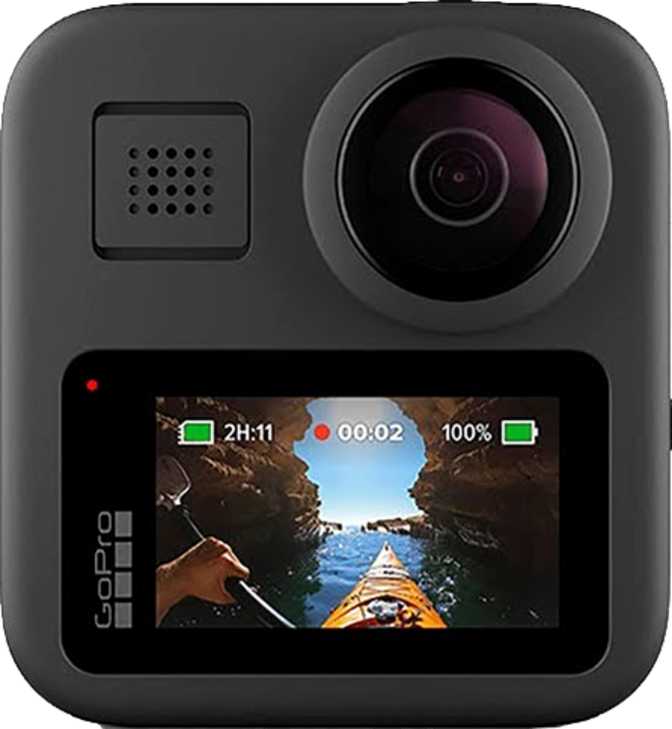
At roughly 195 grams and with a body nearly 5 centimeters thick, the Max2 is noticeably denser than a standard action camera. That extra mass is the price of admission for the dual-lens 360 system inside. Both lenses protrude from opposite faces of the body, which means the camera requires mindful handling — you cannot stuff it in a pocket without risking the glass. The footprint remains modest: it fits comfortably in a palm, and the dimensions keep it compatible with almost any standard action cam accessory. GoPro ships it with a dedicated bike mount included, which signals clearly who one of the primary audiences is.
Screen and Controls
The 1.82-inch touchscreen handles all primary navigation in a single-screen design — there is no secondary display on the opposite face, and the screen does not flip out. For creators accustomed to flipping a display around to frame selfies, this is a real consideration. The workaround is the GoPro companion app, which turns your phone into a live viewfinder. It works, but it adds a step.
The touch interface responds well to gloved or wet fingers, which matters given where this camera goes. Voice commands are also supported, letting you trigger recording, capture photos, and change modes without touching the camera at all — genuinely useful when it is mounted on a helmet or a pole.
| Weight | 195 g |
|---|---|
| Height | 69.7 mm |
| Width | 64 mm |
| Thickness | 48.7 mm |
| Touchscreen | 1.82 inches |
| Waterproofing | 5 meters (no housing) |
| Temp. Range | -10°C to 40°C |
| Storage | MicroSD required |
Durability and Environmental Range
The Max2 carries an IPX8 waterproof rating, which in practical terms means it handles submersion to 5 meters without any housing required. That covers snorkeling, whitewater kayaking, and heavy surf confidently. The operating temperature range spans from -10°C to 40°C — handling hard winter sessions on the slopes and summer beach use without issue, though battery performance compresses in colder conditions, as is standard with lithium-ion cells. There is no internal storage onboard. Every shoot requires a memory card in the external slot — a fast, high-capacity card is not optional; it is foundational to using this camera.
Optics and Image Quality
The Dual-Lens System
The core of the Max2 is its pair of cameras working in tandem to stitch together a complete spherical image. Each lens uses a back-illuminated CMOS sensor — a technology that improves light-gathering efficiency compared to older sensor architectures, particularly in shadowy or mixed-light environments. The combined resolution of 29 megapixels is substantial for a 360-degree capture format where the full image sphere is later cropped, panned, and reframed in post-production.
The f/1.8 aperture is relatively wide for an action cam, helping the sensor gather more light without pushing ISO sensitivity unnecessarily. The ISO ceiling reaches 6400 — adequate for dusk shooting, though low-light stitching challenges are a category-wide issue for all 360 cameras, not a Max2-specific flaw.
Manual Control Options
What separates the Max2 from point-and-shoot 360 cameras is genuine manual control. Shutter speed, white balance, and exposure can all be adjusted manually. The camera shoots RAW files, meaning photographers who plan serious color work in post are not locked into processed JPEGs. The field of view is also adjustable, so you are not permanently committed to the full fisheye look — narrower fields produce more natural-looking footage, particularly useful when shooting in traditional flat mode rather than full 360.
Video Capabilities
Resolution and Frame Rates
At its ceiling, the Max2 records 4K video at 30 frames per second — the standard for high-quality action footage that handles large-screen playback comfortably. Slow-motion recording is supported, allowing creators to capture fast-moving subjects — a skate trick, a mountain bike descent, breaking waves — and replay them at a cinematic pace. A 24fps cinema mode produces footage with the motion cadence audiences associate with film, and combined with RAW capture and manual settings, this puts the Max2 in a more serious creative bracket than typical action cams.
Stabilization: The Electronic Approach
The Max2 does not use optical image stabilization — there is no lens-shifting hardware inside. Instead, GoPro uses accelerometer data and electronic processing to smooth footage. The 360-degree capture method actually aids this significantly: because the full sphere is recorded, the software has enormous flexibility to re-frame and stabilize in post, which is a genuine structural advantage of the format. The result is smooth footage, though creators should understand the mechanism is computational rather than mechanical.
Horizon leveling is built in, meaning even when the camera tilts dramatically during mountain biking, surfing, or skiing, the horizon line in the final edit stays flat. This is one of the most practically useful features for active sports footage.
Standout Video Features
Audio Performance
Six microphones arranged around the body capture spatial audio that matches the 360-degree video. The stereo microphone system can be directionally focused in post to match whichever direction the video is pointed — if you reframe the edit to look forward, the audio perspective shifts to match. This is a level of audio-visual coherence that standard action cameras with fixed forward-facing mics simply cannot offer. For athletes narrating their footage, wildlife recorders, or anyone who cares about immersive sound, this system changes the calculus entirely.
Connectivity
Wireless Ecosystem
The Max2 uses Wi-Fi 6 as its primary wireless standard — the fastest widely deployed Wi-Fi generation. Transfers to a phone or computer are quicker than older Wi-Fi standards allowed, and the connection holds more reliably in high-congestion environments like events, races, or crowded public spaces. Bluetooth 5.3 handles the persistent low-energy connection to the GoPro app for remote control and camera management without draining the battery at the rate a full Wi-Fi connection would.
GPS is integrated, embedding location, speed, and altitude data into video files. Athletes who want to overlay telemetry on their footage — pace, elevation change, route mapping — can pull this data directly without a separate external sensor. USB-C with USB 3 speeds handles wired transfers and charging, future-proofing the camera for high-speed wired offloading.
Connection Features at a Glance
-
Wi-Fi 6 (802.11ax) — faster, more reliable wireless transfers in congested areas
-
Bluetooth 5.3 — persistent low-energy link to the GoPro companion app
-
GPS — location, speed, and altitude embedded automatically in every recording
-
USB-C (USB 3) — high-speed wired transfer and charging via current-standard connector
-
Voice Commands — hands-free control for recording, photo capture, and mode switching
-
Live Streaming — first-party support for streaming directly from the camera
-
No NFC — no tap-to-pair functionality
-
No HDMI Output — not suited for live production display setups
-
No Dedicated Remote — smartphone app replaces the physical remote
Battery and Charging
Real-World Endurance
The Max2 uses a removable battery that delivers several hours of mixed recording before needing a swap. Active 360-degree processing and continuous Wi-Fi use will shorten individual sessions; cold weather compresses capacity further. The removable design is the critical feature here — carrying a spare battery effectively doubles or triples the day's shooting potential without needing to find a power source. For all-day events, multi-leg adventure shoots, or heavy travel days, this is a fundamental workflow advantage over cameras with sealed batteries.
Fast charging support means the battery recovers quickly when you do have access to power. There is no wireless charging, so a USB-C cable is required. A battery level indicator is present on-screen at all times, so you are never guessing at remaining capacity mid-session.
Battery Overview
- Removable and swappable
- Fast charging supported
- On-screen level indicator
- No wireless charging
Who the GoPro Max2 Is For
- Shoot action sports or outdoor adventures and want flexible reframing options in the edit — the 360-degree footage lets you decide the story after the fact, not on location.
- Create solo content and need a camera that removes the selfie stick, shoots wide enough to frame yourself without a tripod, and tracks focus automatically.
- Need serious weather and water resistance without purchasing or assembling a separate housing before every session.
- Want a camera that doubles as both a traditional wide-angle action cam and a full 360-degree system without carrying two bodies.
- Care about audio quality and want directional audio that automatically matches your video reframe in post-production.
- Plan to do manual exposure work and RAW photography alongside video — not just auto-shoot and upload.
- Primarily shoot traditional flat footage — a standard GoPro Hero model delivers higher flat-video resolution at a lower price point without the 360 overhead.
- Need HDMI output for live production setups or displaying footage on external monitors on location.
- Record heavily in extreme low-light environments, where 360 stitching and the format's inherent wide exposure challenges work against you most.
- Depend on external audio sources through a 3.5mm connection — no adapter-free option exists on this body.
- Want a flip-out screen for self-shooting without relying on a paired smartphone as a viewfinder every time.
Competitive Positioning
The Max2 occupies a specific position: more expensive and capable than entry-level 360 cameras, and more versatile but heavier and more complex than a standard Hero-series cam. Competing 360 cameras from other manufacturers match or exceed the Max2 in specific areas — some offer higher resolution spherical video, others prioritize livestreaming infrastructure — but few match the complete package of GoPro's ecosystem, software polish, and accessory compatibility.
| Feature | GoPro Max2 | Typical Action Cam | Rival 360 Camera |
|---|---|---|---|
| 360-Degree Capture | |||
| Native Waterproofing | 5 meters | Varies (often needs housing) | Usually less depth |
| Audio Microphones | 6 (spatial) | 2–3 (stereo) | 4–6 |
| RAW Photo Support | Sometimes | Rarely | |
| Wi-Fi Standard | Wi-Fi 6 | Wi-Fi 5 typically | Wi-Fi 5 typically |
| Removable Battery | Varies | Varies | |
| Invisible Selfie Stick | Some models | ||
| Full Manual Controls | Limited on many |
Honest Assessment: Strengths and Weaknesses
The GoPro Max2's greatest strength is its flexibility. The 360-degree format stops being a gimmick the moment you realize you can reframe an entire shoot in post — repositioning the camera angle, adjusting the horizon, and telling a completely different visual story from the same recording. For solo creators and sports athletes especially, this workflow fundamentally changes how you think about shooting.
The audio system is genuinely impressive. Six microphones producing spatial audio that follows the video reframe is a feature that most people do not think to ask about but immediately appreciate when they experience it. No other camera format can replicate this at all.
The durability is credible. Five meters of native waterproofing means you grab the camera and go, rather than assembling housing in a parking lot before a surf session. The wide operating temperature range reinforces this grab-and-go reliability across seasons and climates.
No secondary screen and no flip-out display creates real friction for self-framing. Seasoned GoPro users will manage this instinctively, but newcomers to the format may find themselves frequently reaching for the app to check composition. The no-storage-onboard situation is a minor but real annoyance — remembering the memory card is non-negotiable.
The body's depth makes it less pocketable than a Hero-series camera, and the protruding lenses on both faces require mindful transport. Anyone who has cracked an action camera lens knows the anxiety of unprotected glass at the bottom of a bag.
For shooters who rely on external microphones, the absence of a 3.5mm input requires adapter workarounds. And those whose primary workflow is traditional flat video will find the 360 format adds complexity and file size overhead without clear benefit to their work.
Common Questions Before You Buy
Final Verdict
The GoPro Max2 is the most capable all-in-one 360 action camera for creators who need genuine performance across image quality, audio, durability, and creative flexibility. It does not ask you to choose between being a 360 camera and a conventional action camera — it functions as both, and does so at a level that justifies its position in the market.
The missing secondary screen, absent 3.5mm jack, and protruding lens design are real constraints. If any of those represent deal-breakers for your specific workflow, the Max2 is not the right tool. But for the athlete, solo creator, or adventure documenter who wants a single camera that can handle anything and be reshaped in the edit room, this camera removes more obstacles than it creates.
360-degree flexibility, native waterproofing, and professional spatial audio are all priorities in a single, versatile body.
You primarily shoot traditional flat footage — a dedicated action camera delivers better flat-video specs at a lower price without the 360 trade-offs.