DJI Osmo 360 Full Review: The 360 Camera Built for Adventure
Action CamerasPerformance at a Glance
Most 360-degree cameras force a trade-off: you can have durability, or you can have image quality, or you can have ease of use — but rarely all three at once. The DJI Osmo 360 arrives as a direct challenge to that assumption. It pairs professional-grade video capabilities with a body built for genuine outdoor punishment, then wraps it in an interface approachable enough that you don't need a manual to start shooting. Whether you're strapping it to a helmet for a mountain descent or pulling it out at a family event, this camera is engineered to disappear into the activity rather than become the activity.
Design and Build Quality
A Body Built for the Real World
The Osmo 360 carries an IP68 rating — the highest standard for consumer dust and water protection. In practical terms, this means the camera can be fully submerged without any external housing or protective case. You can mount it to a surfboard, take it into a rainstorm, or drop it in a shallow river without a second thought. For a camera built for action and adventure, this isn't a luxury feature — it's a prerequisite.
The operating temperature range stretches from -20°C at the cold end to 45°C at the top, which covers everything from ski slopes in deep winter to desert trail riding in summer heat. Very few consumer cameras can make that claim honestly.
The Screen and Interface
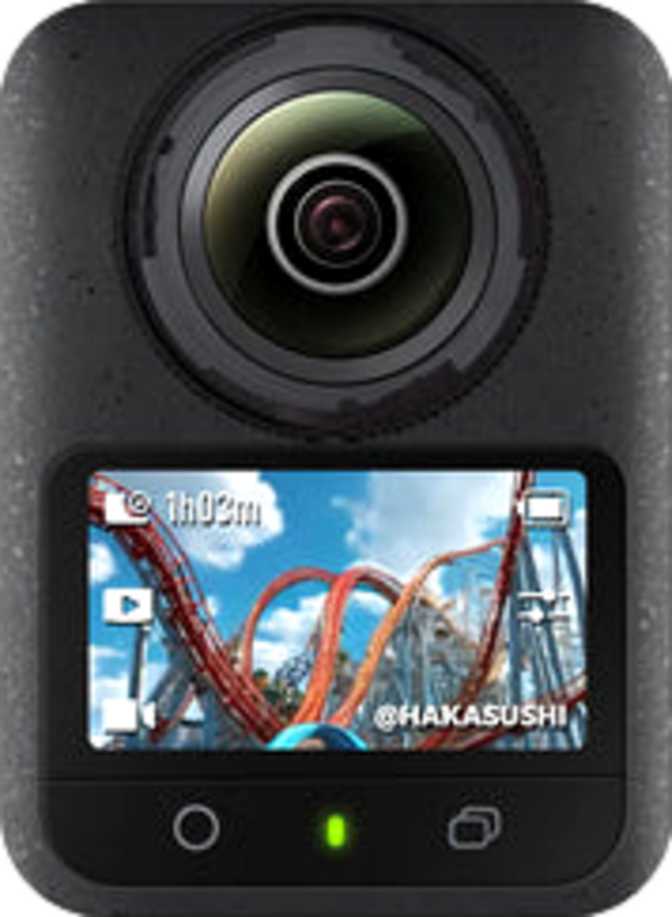
The front-facing 2-inch touch display is the primary interaction point. It's entirely functional for composing shots, reviewing footage, and navigating menus in the field — a screen designed for quick decisions, not detailed color grading, and it excels at that narrower purpose.
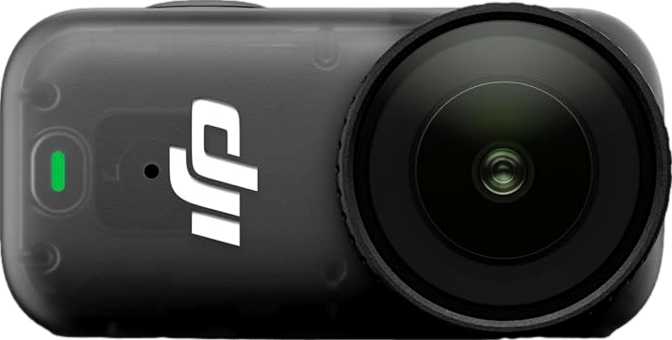
Voice commands compensate for situations where touching the screen isn't practical — when your hands are wet, gloved, or occupied. There is no secondary screen or flip-out display, which keeps the design clean and the body sealed against water ingress. The dual-lens configuration enables the camera's 360-degree capability, with DJI engineering the chassis to protect both lenses during aggressive use while keeping the stitching zone as unobtrusive as possible.
Imaging Performance
Stills: 120 Megapixels Across the Full Sphere
The combined output of the dual-lens system reaches 120 megapixels — and in a 360 context, that resolution is spread across an entire spherical image. More pixels mean that when you crop into equirectangular footage for reframing in editing or exporting a flat photo from a 360 capture, you retain usable image quality rather than ending up with a muddy result.
The f/1.9 maximum aperture is genuinely wide for an action camera in this category. Wider apertures gather more light, which translates directly to better performance in low-light conditions: indoor events, dawn and dusk shooting, or shaded forest trails where compact cameras typically struggle. Backing the optics is a back-side illuminated CMOS sensor — a design that places light-gathering elements closer to the lens, reducing the noise that typically degrades images in dim environments.
Manual shutter speed and manual white balance controls give users who want predictable, repeatable results the levers to achieve them. Beginners can ignore both and rely entirely on automatic modes without sacrificing usable output.
The Osmo 360 does not shoot RAW files. All still images are processed and compressed in-camera before you ever touch them in editing software. For casual shooters and content creators, this is a non-issue. For professional photographers or anyone planning heavy post-production color work, the absence of RAW output is a genuine ceiling on what's achievable in editing.
Video Capabilities
4K at 120 Frames Per Second
The headline video specification is extraordinary for the category: 4K resolution at up to 120 frames per second. Most action cameras top out at 4K 60fps, and many 360 cameras still hover around 4K 30fps as their best mode. The Osmo 360's ability to capture full 4K at 120fps means you can produce smooth, detailed slow-motion footage at four times normal speed without dropping below broadcast-standard resolution.
The maximum data rate of 170 Mbps is the other half of that equation. At this bitrate, the camera stores footage with a level of detail that holds up under aggressive color grading and demanding resolution exports. The 170-degree field of view captures an expansive perspective — wide enough to record an entire environment in a single shot, ensuring nothing significant falls outside the frame during fast-moving activities.
Stabilization and Focus
The built-in gyroscope works with horizon leveling to keep footage aligned regardless of camera orientation — critical for mounting scenarios where constant tilt and rotation would otherwise make footage unwatchable. Phase-detection autofocus, with continuous focus and subject tracking both active during recording, handles focus acquisition with the speed and reliability you'd expect from a dedicated camera rather than a compact action device.
Cinema and Creative Modes
The 24p cinema mode records at the frame rate of theatrical film, giving footage a distinct motion character that looks cinematic rather than broadcast. Timelapse and slow-motion modes cover the full spectrum of temporal manipulation — from condensing hours of cloud movement into a few dramatic seconds, to stretching split-second action into detail the eye couldn't process in real time.
Invisible Selfie Stick
The invisible selfie stick feature automatically removes the pole mount from final footage using the 360-degree overlap information. The result is video that appears to float through space without any visible support structure — a signature aesthetic of immersive 360 content that requires zero additional editing work from the creator.
Key Video Specifications
| Specification | Value | What It Means for You |
|---|---|---|
| Maximum Resolution | 4K / 120fps | Broadcast quality with true 5x slow-motion capability |
| Maximum Bitrate | 170 Mbps | High data density that supports demanding post-production |
| Field of View | 170° | Full environmental capture in a single uncut shot |
| Cinema Mode | 24p | Cinematic motion character for travel and narrative content |
| Autofocus System | Phase-Detection + Tracking | Fast, reliable focus on subjects moving toward the camera |
| Stabilization | Gyro + Horizon Leveling | Usable footage from any mount orientation |
Audio
Four-Microphone Spatial Array
The Osmo 360 uses four microphones to capture stereo audio from the full environmental surround. In a 360-degree camera, directional audio that corresponds to the visual field matters: when a viewer rotates their perspective in a VR headset or 360 player, the sound should rotate with it. Four microphones arranged across the body provide the spatial information to achieve this.
- Outdoor action and environmental capture
- 360-degree spatial audio in VR experiences
- Moderate ambient noise environments
- Immersive environmental sound that matches the footage
- Controlled interview or vocal recording
- High-noise environments with wind or water
- Workflows requiring external microphone input
- Vlogging with close-up narration in loud surroundings
There is no 3.5mm audio jack and no external microphone input. For precise vocal recording, this is a real constraint — not a dealbreaker for action and environmental use cases, but a hard stop for any workflow that requires controlled, clean audio.
Battery Life and Power
The Honest Reality of 1.6 Hours
The 1950mAh battery provides approximately 1.6 hours of continuous operation. That figure deserves honest treatment: it's short by the standards of most action cameras, and if you're planning a full day of activity without access to charging, you need a strategy.
The saving grace is that the battery is removable. Unlike competitors that require the entire camera to sit connected to a power bank during charging, the Osmo 360 allows you to swap a depleted battery for a fresh one in seconds and keep shooting. Carrying two or three spare batteries weighs very little and transforms the power situation from a limitation into a manageable workflow.
Two or three spare batteries kept charged and ready means you can shoot continuously through a full day of activity without tethering the camera to a power source. Fast charging support ensures that when you do have access to power, you're back to a functional charge significantly faster than a standard charge rate would allow.
Connectivity and Smart Features
Wi-Fi 6 and Bluetooth 5.1
Wi-Fi 6 matters primarily for file transfer speed. Large 4K 120fps files accumulate fast, and Wi-Fi 6's bandwidth means transferring them takes seconds rather than minutes. Bluetooth 5.1 handles low-energy background tasks — remote control connectivity, basic pairing, and status communication with the companion smartphone app.
The camera pairs with both Android and iOS devices, enabling smartphone remote control from a distance — useful for tripod setups, selfie scenarios, or any situation where you can't reach the shutter button. Live streaming is supported natively, without requiring external hardware or workarounds.
Storage and Expansion
The 128GB of internal storage is substantial — at 170 Mbps bitrate, you get well over an hour of continuous high-bitrate 4K footage before storage fills. The external memory slot provides expansion for longer shoots or multi-day archiving directly in the field.
Route tracking requires a separate device with footage synced in post-production — a meaningful omission for adventure sports documentation.
Who Is the DJI Osmo 360 For?
- You're an action sports enthusiast who wants immersive 360 footage from helmet, chest, or pole mounts without worrying about water, dust, or temperature extremes
- You're a travel creator who wants one camera that covers wide environmental shots, invisible selfie stick footage, and cinematic 360 content in a single compact body
- You create content for 360-degree platforms — social media, VR experiences, or real estate walkthroughs where immersive footage is a clear differentiator
- You want intelligent stabilization and automatic tracking without manually configuring complex settings before every shot
- You need a camera that works reliably from deep winter cold to peak summer heat without modifications or additional protective housing
- You're a professional photographer who requires RAW file output for extensive post-production — the Osmo 360's processed-only output is a hard ceiling for that workflow
- You need external audio input for controlled interview or vocal recording — there is no microphone jack of any kind on this body
- You want GPS tracks logged directly in-camera for route-embedded adventure sports documentation without a separate device
- You expect a full day of shooting on a single charge — the 1.6-hour runtime makes spare batteries non-negotiable standard kit
- You want a traditional fixed-perspective hybrid — this is a dedicated 360 device, not a conventional action camera with a bonus wide mode
How It Compares
The DJI Osmo 360 stacked against two representative competitors in the same category
| Feature | DJI Osmo 360 | Competitor A | Competitor B |
|---|---|---|---|
| Max Video | 4K / 120fps | 4K / 60fps | 5.7K / 30fps |
| Waterproofing | IP68 (no case) | IP68 (no case) | IP54 (case required) |
| Battery Design | Removable + Fast Charge | Fixed, Standard Charge | Removable, Standard |
| Microphones | 4-mic Spatial Array | 2-mic Stereo | 4-mic Spatial Array |
| Wi-Fi Generation | Wi-Fi 6 | Wi-Fi 5 | Wi-Fi 5 |
| Internal Storage | 128GB | 64GB | 32GB |
| GPS | |||
| RAW Photo Output |
Competitor specifications represent typical category alternatives for comparative purposes.
Honest Strengths and Weaknesses
Where It Excels
The 4K 120fps video ceiling is a genuine differentiator — smooth slow motion at full resolution is something only a handful of cameras in any category can claim. The IP68 rating without requiring a case is a practical win that simplifies packing and removes the mental overhead of protecting your gear in wet or dusty conditions.
The removable battery, while limited in duration, turns a potential frustration into a manageable field workflow. Wi-Fi 6 transfer speeds mean moving large files from camera to computer no longer becomes the tedious end-of-day ritual it is on older hardware. The 128GB of onboard storage — expandable via external memory — means most users won't run out of space during a typical shooting day.
Voice commands, smartphone remote control, invisible selfie stick removal, and in-camera panoramas add genuine practical value without requiring technical expertise to use.
Where It Falls Short
The 1.6-hour battery runtime is genuinely short, and while the removable design mitigates this, it doesn't eliminate the need to plan around it. The absence of GPS integration is a clear omission on a camera marketed toward active outdoor use — users who want route-embedded footage will need a separate solution.
No RAW photo output constrains the ceiling for still photography, and no external microphone input is a hard stop for any workflow requiring controlled vocal or interview audio. The lack of a secondary screen limits feedback when the primary display faces away during mounted shooting.
None of these weaknesses undermine the product's core purpose, but each one will be a dealbreaker for a specific type of user — and knowing which type you are matters before committing.
Questions Real Buyers Ask
Final Verdict
The DJI Osmo 360 is a high-capability 360 camera that earns its position in the market through a combination of video performance and physical resilience that few direct competitors match simultaneously. The 4K 120fps video, IP68 waterproofing, Wi-Fi 6 connectivity, and removable fast-charging battery make it a serious tool for action and adventure content creators who want maximum quality without babying their gear.
It is not the right camera for every buyer. If GPS tracking, external audio control, or RAW photo output are essential to your workflow, the Osmo 360 will require compromises that may not be acceptable. If your shooting involves extended sessions without access to charging, spare batteries are non-negotiable kit.
For the creator who wants immersive, high-resolution footage from an adventure camera that can take the same punishment the adventure dishes out — and who values the invisible selfie stick aesthetic, intelligent stabilization, and the flexibility of a removable battery — the DJI Osmo 360 makes a compelling, well-rounded case for itself. It is best-in-class at what it sets out to do.
- Action and adventure videographers
- Travel and immersive content creators
- VR and 360-degree platform creators
- Professional RAW photographers
- Controlled audio recording workflows
- Single-charge all-day shooting needs