Zebronics Zeb-Vita Bar 200: Full Review of a Budget Soundbar
SoundbarsBudget soundbars are a crowded, often disappointing category. Most promise much and deliver mediocre results — tinny highs, no real bass, and Bluetooth that drops whenever your phone gets a notification. The Zebronics Zeb-Vita Bar 200 takes a different approach: strip away every premium feature that drives up cost, nail the fundamentals, and price it where it makes sense for someone upgrading from laptop speakers or a basic TV audio setup. Whether that trade-off is the right one for you depends entirely on what you're walking in expecting.
24W
Total Output
BT 5.3
Bluetooth
410mm
Bar Width
857g
Weight
Design and Build Quality
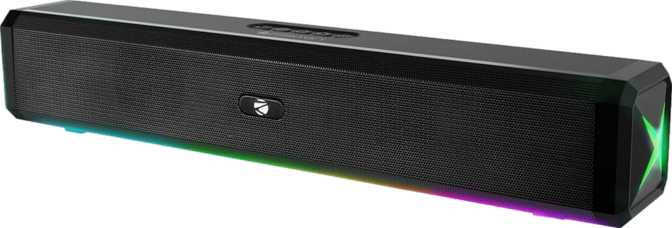
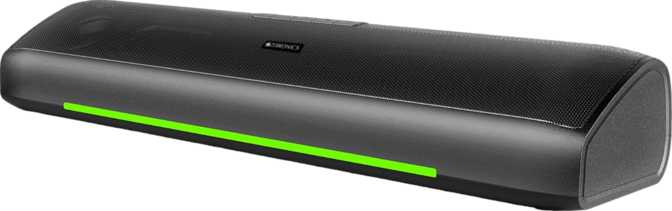
The Zeb-Vita Bar 200 measures 410mm across — roughly the width of a 32–40 inch television — which makes it a natural companion for smaller bedroom TVs or desktop monitor setups rather than a living room centrepiece. At 68mm tall and 85mm deep, it sits low and flat, slipping easily in front of a TV stand without blocking the screen.
The weight comes in just under 900 grams, light enough that placement is effortless and mounting on a wall (with the right hardware) is not an ordeal. The form factor is honest: this is not a unit trying to look like a premium speaker. It is compact, functional, and built to do one job without taking up physical or visual real estate.
Audio Performance
24 Watts of Focused Stereo Sound
Power and Output
The Zeb-Vita Bar 200 houses two 2.2-inch drivers, each powered by 12 watts, for a combined output of 24 watts. To put that in perspective: 24 watts from a stereo soundbar is enough to comfortably fill a small to medium-sized room — a bedroom, a home office, or a study — without the audio sounding strained at moderate listening volumes. It is not built to anchor a living room of 250+ square feet or to compete with the ambient noise of a party.
The dual drivers produce a stereo soundstage — left and right channels are separated — which is a meaningful improvement over the mono or pseudo-stereo output common in the cheapest TV speakers. Dialogue, music, and sound effects each occupy distinct space in the mix rather than collapsing into a single point of sound.
Frequency Range and Tonal Character
The unit covers the full audible spectrum from 20Hz to 20,000Hz — the theoretical range of human hearing. The presence of 20Hz indicates the drivers are tuned to attempt low-frequency reproduction, but two 2.2-inch drivers in a compact enclosure will not move air the way a dedicated subwoofer does. Expect the low-end to be present and functional — enough to give music and movie dialogue some warmth — rather than deep, chest-filling bass.
The high-frequency ceiling at 20kHz means treble detail is well-handled. Cymbal shimmer, vocal clarity, and the edge of acoustic instruments should all come through cleanly.
Low End
20 Hz
Floor
Full Audible Range
20 Hz – 20,000 Hz
High End
20 kHz
Ceiling
For everyday use — streaming music, Netflix dialogue, YouTube videos, casual gaming — this tonal profile works well. For audiophiles who listen critically or for content where bass impact matters (action films, EDM, gaming), the limitations are real.
Connectivity
Bluetooth-First, With a Wired Backup
Bluetooth 5.3 and Audio Codec Support
The Zeb-Vita Bar 200 uses Bluetooth 5.3, bringing more stable connections, lower latency, and better energy efficiency compared to older versions. More meaningfully, the soundbar supports three audio transmission codecs — each delivering higher wireless audio quality than the default standard used by most budget soundbars.
For Apple Users
The native codec for iPhones and iPads. Pairing with an Apple device delivers audio at a noticeably higher quality level than standard Bluetooth SBC, reducing compression artifacts in music playback.
For Android & Windows
Qualcomm's benchmark for Android devices and many Windows laptops. It delivers near-CD-quality audio over Bluetooth — a meaningful step up from what most budget soundbars offer at this price.
The Real Differentiator
A variable-bitrate codec that adjusts dynamically between 279kbps and 420kbps. It protects the connection automatically when interference increases — rather than dropping out. In a home full of wireless devices, this matters in daily use.
AUX Input
A 3.5mm auxiliary input provides a wired fallback for older TVs without Bluetooth output, desktop computers, gaming consoles, or any source where you want zero latency and no wireless variables. It also means the soundbar works in environments where Bluetooth is disabled or restricted.
What Is Not Included
These omissions are not an oversight — they are deliberate decisions that keep the unit's price where it is. Understanding what is absent is as important as understanding what is present.
Real-World Usage: Who This Soundbar Serves
The Right Fit
- Small bedroom TV setups — A 32–40 inch TV paired with this soundbar will see an immediate improvement over built-in TV speakers, which typically max out at 8–12W with no stereo separation.
- Desktop monitor audio — Anyone using a monitor without built-in speakers will find 24W of stereo output a meaningful upgrade for music, video calls, and content consumption.
- Home office listening — aptX Adaptive codec support makes this a capable wireless speaker for streaming from a compatible Android phone or laptop throughout the workday.
- Students and renters — The compact footprint, low weight, and no-fuss setup make this easy to move and use without commitment or configuration overhead.
- First-time soundbar buyers — Those upgrading from TV speakers or a basic Bluetooth speaker will notice an immediate improvement without any complex audio ecosystem to navigate.
Not the Right Fit
- Primary living room audio — The 24W output and compact drivers are not built for larger spaces. Sound will degrade at high volumes in rooms above 150–200 square feet.
- Home theater enthusiasts — No HDMI ARC means no volume synchronization with the TV remote, no auto-on behavior, and no source switching. TV integration is simply absent.
- Anyone who needs a remote — The absence of a remote is a hard constraint if the soundbar will not be within easy arm's reach of the listening position.
- Dolby Atmos content — The bar does not decode spatial audio formats. Atmos-encoded content plays as standard stereo with no height or surround processing applied.
- Deep bass seekers — There is no wireless subwoofer pairing. If bass performance is a primary concern, this soundbar's driver configuration physically cannot deliver it.
Competitive Positioning
At this price tier, most soundbars offer basic Bluetooth and little else. Here is how the Zeb-Vita Bar 200 stacks up against what a typical entry-level alternative delivers.
| Feature | Zeb-Vita Bar 200 | Typical Entry Competitor |
|---|---|---|
| Total Power Output | 24W (2 × 12W) | 16–20W (2 × 8–10W) |
| Bluetooth Version | 5.3 | 5.0–5.1 |
| aptX Adaptive | Yes | Rarely at this price |
| HDMI ARC | No | Occasionally |
| Remote Control | No | Sometimes |
| Wi-Fi / Streaming Apps | No | No (at this tier) |
| AUX Input | Yes | Usually yes |
| Weight | ~857g | Varies |
The Zeb-Vita Bar 200's strongest competitive differentiator is its codec support. aptX Adaptive at this price tier is unusual — the clearest signal that the audio engineering here is more thoughtful than the price tag implies. The trade-off is the complete absence of a remote and any meaningful TV-integration features.
Strengths and Honest Weaknesses
Where It Earns Its Place
The Zeb-Vita Bar 200 earns its place through a specific set of genuine strengths. The Bluetooth codec support — AAC, aptX, and aptX Adaptive together — gives this soundbar better wireless audio fidelity than most products near it in price. The 24W combined output provides enough headroom for small rooms without distortion becoming a problem at comfortable listening volumes.
The compact, lightweight build means setup takes minutes and placement options are broad. There is no app to install, no account to create, and no learning curve to climb. For the specific use case it targets, it delivers without pretense.
Where the Limitations Are Real
The lack of a remote control is the most immediate friction point for a significant portion of potential buyers. Any scenario where the soundbar is not within easy arm's reach becomes inconvenient in daily use. The absence of HDMI ARC removes volume synchronization with the TV remote, auto-on behavior, and source switching all at once.
The driver configuration, while capable in its range, cannot produce meaningful sub-bass. At high volumes, the small enclosure becomes audible as a limiting factor. There is no ecosystem depth here either — no app, no voice control, no multi-room expansion. If you want a soundbar that grows with a smart home setup, this is a dead end.
Questions Buyers Ask Before Purchasing
Final Verdict
Recommended for Its NicheThe Zebronics Zeb-Vita Bar 200 is a carefully scoped product that does exactly what it promises without pretending to be something it is not. For a user buying their first soundbar to replace poor TV speakers, equipping a small bedroom setup, or looking for a capable desktop audio upgrade with quality Bluetooth, it punches meaningfully above what the price would suggest — particularly because of its codec support.
The decision against buying comes down to three questions. Do you need a remote? Do you need HDMI ARC? Do you need strong bass? If any of those three answers is yes, look elsewhere. If your setup is small, your source is Bluetooth-capable, and you want clean stereo sound without an ecosystem of features you will never use, the Zeb-Vita Bar 200 is a focused, honest product that delivers its core promise well.