Zebronics Zeb-Juke Bar 2601 Review: A No-Frills Soundbar with Surprisingly Smart Wireless Audio
SoundbarsThe Indian audio market is crowded with soundbars that promise the world and deliver mediocrity. The Zebronics Zeb-Juke Bar 2601 takes a different approach: a straightforward 2.0-channel soundbar built for buyers who want a clean, no-nonsense TV audio upgrade without the complexity of satellite speakers, wireless subwoofers, or subscription-dependent smart features. Whether that philosophy suits you depends entirely on what you're walking away from — and what you're walking toward.
Overall Rating
Design and Build: Compact, TV-Ready, and Understated
Physical dimensions, build quality & usability
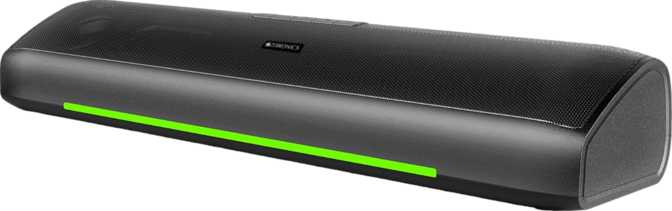
At 581mm wide, 108mm tall, and just 68mm deep, the Zeb-Juke Bar 2601 is built to sit unobtrusively beneath a mid-sized television — typically a 43- to 55-inch panel — without overhanging the TV stand or cluttering the viewing area. The slim 68mm depth means it won't conflict with most TV cabinet arrangements, and the moderate height ensures it rarely blocks the bottom edge of the screen even when placed flat on a console.
The physical footprint is deliberate. Zebronics hasn't tried to fill the bar with excessive bulk, which keeps the unit light enough to wall-mount without specialist hardware for most users. The overall volume of the enclosure — roughly the size of a large hardcover atlas laid flat — suggests a cabinet that prioritizes front-facing driver placement over bass-reflex chamber depth.
The control panel is located directly on the device, so basic operations like volume adjustment and input switching are accessible without hunting for the remote. A traditional remote control is included — battery-powered rather than rechargeable, which is standard at this price category. Keep spare batteries nearby.
Physical Specifications
- Width 581 mm
- Height 108 mm
- Depth 68 mm
- Total Volume 4,266 cm³
- On-device Controls Yes
- Remote Included Yes (battery)
No dedicated smartphone app, no touch surface, no LED display panel. Interaction stays simple and physical.
Core Audio Performance: 2.0 Channel Explained
What stereo-only audio means in practical terms
The Zeb-Juke Bar 2601 is a 2.0-channel system — two audio channels, left and right, with no dedicated low-frequency driver in the package. For a buyer coming from built-in TV speakers, this will be a noticeable and welcome improvement in stereo separation and vocal clarity. For a buyer expecting cinematic bass impact or surround-like immersion, the expectation needs to be recalibrated before purchase.
The frequency response spans the full 20Hz to 20,000Hz range — the theoretical limits of human hearing. How much of that low end is reproduced with genuine body depends on the physical drivers and cabinet tuning. What can be said confidently: a 2.0 soundbar of this physical size will handle dialogue, music, and mid-range content well, but deep bass in action films or bass-heavy electronic music will feel restrained compared to systems with a dedicated subwoofer. This is not a flaw unique to this product — it is a category truth.
Where It Shines: Dialogue & Music
The 2.0 configuration is, counterintuitively, excellent for spoken content — news, sports commentary, talk shows, podcasts streamed through the TV, and dialogue-heavy dramas.
Stereo soundbars without a subwoofer often render vocals with more precision than budget 2.1 systems that over-EQ the low end to justify the subwoofer's presence. For music listeners, the clean two-channel Bluetooth output is entirely usable — particularly given the high-quality wireless codec support.
Frequency Range at a Glance
Relative performance inference based on 2.0 cabinet configuration and frequency spec. Not a lab measurement.
Bluetooth Connectivity: A Genuine Highlight
aptX Adaptive, aptX & AAC codec support explained
This is where the Zeb-Juke Bar 2601 meaningfully overdelivers for its category. The soundbar carries Bluetooth 5.0 alongside support for three distinct audio codecs. Here is what each one means in plain terms:
Standard SBC Not used
Most budget soundbars rely on this compressed codec, resulting in flat, digital-sounding wireless audio. The Zeb-Juke Bar 2601 goes well beyond this baseline.
AAC Included
The preferred codec for Apple devices. iPhones, iPads, and Macs automatically use AAC when pairing, delivering meaningfully better audio than SBC — tighter stereo, cleaner highs.
aptX Included
Qualcomm's codec favoured by Android flagship and mid-range devices. Lower latency and better quality than SBC — lip-sync stays tight when watching video via Bluetooth.
aptX Adaptive — The Standout Feature
The most advanced of the three: a variable bitrate codec that adjusts quality dynamically based on connection conditions, providing the cleanest wireless audio when both the source device and the soundbar support it. It also further reduces latency, making it genuinely suitable for gaming over Bluetooth. For a soundbar at this price point to include aptX Adaptive is unusual — most competitors in this segment stop at standard aptX or AAC.
Bluetooth 5.0 also provides a more stable connection at greater distances compared to older versions — practical for users in larger rooms or who frequently move the source device around.
Wired Connections: HDMI ARC and Auxiliary Input
How to connect and what each input delivers
HDMI ARC — The Right Way to Connect
The soundbar includes a single HDMI port operating in ARC (Audio Return Channel) mode. This is the most convenient way to connect to a modern television: one cable carries audio from the TV to the soundbar and allows the TV's remote to control the soundbar's volume through the HDMI CEC protocol.
In practical terms: once connected via HDMI ARC, switching TV channels, adjusting volume, and changing inputs all work through the single cable without juggling two remotes. The soundbar effectively becomes an extension of the TV's audio system.
ARC vs eARC: This is HDMI ARC, not eARC. eARC supports lossless formats like Dolby TrueHD. Since the Zeb-Juke Bar 2601 is a 2.0 system without Dolby Atmos processing, the absence of eARC has zero practical impact on its actual output.
AUX Input — Broad Legacy Compatibility
A 3.5mm auxiliary input broadens compatibility considerably. Older televisions, desktop computers, gaming consoles, portable audio players, and any device with a headphone-out or line-out jack can connect directly without Bluetooth.
This is a small but practical inclusion that adds genuine flexibility — especially useful when Bluetooth pairing isn't convenient or when the source device has no wireless output.
Full Connectivity Overview
- HDMI ARC (1 port)
- 3.5mm AUX Input
- Bluetooth 5.0 (aptX Adaptive / aptX / AAC)
- Wi-Fi — Not available
- Optical (S/PDIF) — Not available
- NFC Pairing — Not available
What Is Missing — And Whether It Matters
A transparent look at absent features and their real impact
Real-World Usage Scenarios
Who should buy this soundbar — and who should look elsewhere
- TV upgraders in smaller living rooms or bedrooms where the priority is clearer dialogue and better stereo audio over built-in TV speakers, without the bulk of a multi-piece system.
- Music listeners who want a Bluetooth speaker capable of receiving high-quality wireless audio from Android or iOS devices using aptX, aptX Adaptive, or AAC.
- Clean desk or console setups where a single slim bar replaces mediocre monitor or TV speakers without adding cable complexity.
- Buyers prioritising simplicity — no app to install, no account to create, no firmware subscription model to manage.
- Low-latency wireless gaming on compatible devices, where aptX Adaptive's reduced wireless delay keeps audio in sync with on-screen action.
- Home theatre enthusiasts who want genuine surround sound, deep bass extension, or Dolby Atmos processing — a 2.1 or 5.1 system serves this far better.
- Smart home households built around voice assistant ecosystems who expect seamless device integration and hands-free control.
- Users with only an optical output on their TV — without Toslink support, connection options are limited to AUX or Bluetooth.
- Large living rooms where audio needs to fill a wide, reverberant space — the 2.0 configuration and physical size suggest optimisation for rooms up to roughly 200–250 square feet.
How It Compares to the Alternatives
Competitive positioning against logical alternatives in the same price range
| Feature | Zebronics Zeb-Juke Bar 2601 | Typical Budget 2.1 Soundbar | Entry Smart Soundbar |
|---|---|---|---|
| Audio Channels | 2.0 (stereo) | 2.1 (with subwoofer) | 2.0 or 2.1 |
| Bluetooth Codec | aptX Adaptive + aptX + AAC | Usually SBC or AAC only | SBC / AAC |
| Bass Performance | Moderate, balanced | More impact, less precise | Varies |
| HDMI ARC | Sometimes | ||
| Wi-Fi / Smart Features | |||
| Voice Assistant | |||
| Setup Complexity | Very simple | Moderate | Complex |
| App Dependency | None | None | Required |
The comparison surfaces a clear value case: the Zeb-Juke Bar 2601's Bluetooth codec suite outclasses most soundbars at a similar or even higher price. Where it concedes ground is bass output and smart features. Buyers who prioritise wireless audio quality over bass impact win clearly here.
Honest Assessment: Strengths and Limitations
A balanced view of what this soundbar does well and where it falls short
Where It Excels
The Zeb-Juke Bar 2601's strongest argument is its wireless audio capability. The combination of aptX Adaptive, aptX, and AAC within what is fundamentally a no-frills TV soundbar is a genuine differentiator. Most competing products at this price tier treat Bluetooth as a checkbox feature and implement it with the cheapest codec available. Buyers who use their phone as a primary audio source will notice the difference immediately when pairing a compatible device.
The HDMI ARC implementation is correct and complete for a 2.0 system. Volume synchronisation with the TV remote, straightforward CEC integration, and a single-cable setup represent the expected standard — and the Zeb-Juke Bar 2601 meets it without complication.
Where It Falls Short
The honest limitation — and this applies to any 2.0 soundbar of this physical size — is that it cannot replicate the physical sensation of low-frequency sound. Explosions in films, kick drums in dance music, and the low rumble of cinematic scores require physical air movement that a single slim enclosure with no subwoofer cannot produce with authority. Buyers expecting otherwise will be disappointed not because this product is defective, but because physics imposes real constraints.
The absence of Wi-Fi is pragmatic rather than a flaw — for a TV soundbar, network connectivity is only necessary if the user wants the bar to stream independently of the TV. The non-rechargeable remote is a minor quality-of-life note. At this price point, it is an expected compromise — keep spare batteries nearby.
Answers to Questions Buyers Search For
Common pre-purchase questions answered clearly
Final Verdict
Buy It — With Clear Eyes
The Zebronics Zeb-Juke Bar 2601 is a well-targeted product that knows exactly what it is. It is not trying to be a home theatre system or a smart speaker. It is a clean, uncomplicated 2.0 stereo soundbar with better-than-expected wireless audio credentials, solid HDMI ARC integration, and a form factor designed to complement rather than dominate a TV setup.
The aptX Adaptive codec support is the most compelling reason to choose this over alternatives in its class. For Bluetooth-first users who want wireless audio to sound as close to wired as current technology allows, this soundbar punches beyond its category on that specific metric.
Buy this if you want:
A simple, honest TV audio upgrade that handles dialogue clearly, pairs effortlessly with modern smartphones at high quality, and disappears beneath your TV without fuss.
Pass on it if you need:
Deep bass, smart home integration, voice control, or large-room audio coverage. Your requirements call for a different category of product entirely.
Overall Score