Sony Inzone H6 Air Review: When Open-Back Gaming Audio Gets It Right
PC and Gaming HeadsetsAt a Glance
Best suited to quiet, dedicated setups
Performance by Category
Design and Build: Deliberately Understated
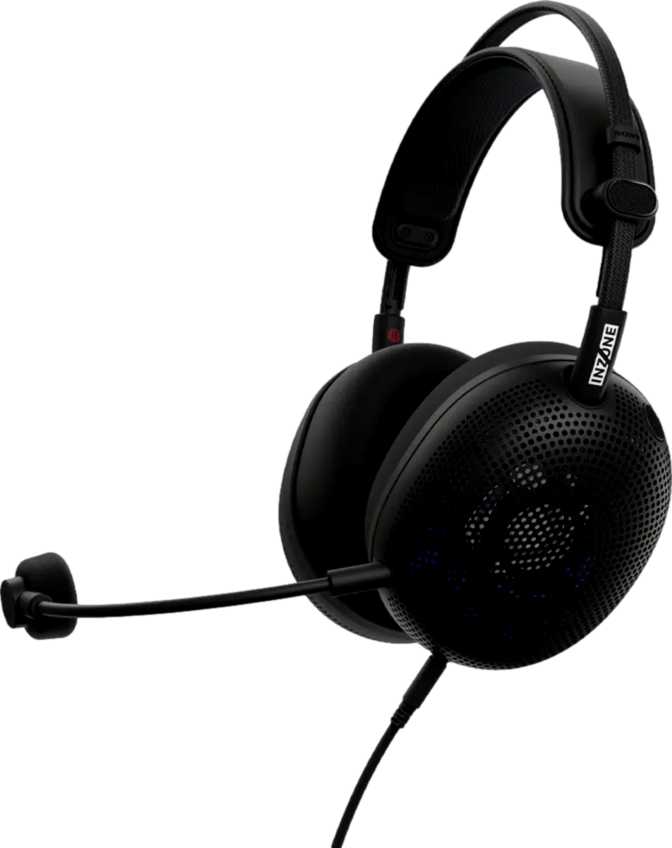
The H6 Air makes no attempt to look like gaming hardware. There is no RGB lighting, no aggressive angular styling, no indicator lights pulsing in the dark. What you get instead is a clean, mature aesthetic that would not look out of place in a recording studio — which is largely the point.
At just 199 grams, this is one of the lightest over-ear headsets Sony has produced under the Inzone brand. Most full-size gaming headsets land somewhere between 270g and 350g. That difference becomes meaningful after hour two of a long session — the H6 Air simply stops registering on your head in a way heavier headsets never quite manage.
The build prioritizes low mass over premium heft. Nothing here feels cheap, but there is a conscious trade-off. Buyers who associate weight with build quality should recalibrate expectations before picking this up — the lightness is an achievement, not a corner cut.
The detachable cable runs two meters, is tangle-resistant, and is fully replaceable if damaged. All volume and mute controls live on the earcup itself, keeping the cable clean and snag-free during play.
Physical Specifications at a Glance
-
Over-ear fit
Full cushioning around the ear, not on it -
199g weight
Roughly 40–60% lighter than most gaming headsets -
Detachable, tangle-free cable
2m length, fully replaceable if worn or damaged -
Travel bag included
Protective storage, though not built for commuting -
No RGB lighting
Performance over aesthetics — saves weight, reduces clutter -
Does not fold
Desk-first design — not intended for portability
The Open-Back Decision: Everything Flows From Here
Understanding the H6 Air requires understanding what open-back means — it is not a feature buried in a spec sheet, it is the foundational design philosophy.
In a closed-back headset, the earcup is sealed. Sound stays contained, outside noise is partially blocked, and the acoustic environment is a small sealed chamber. That works for isolation, but it creates a sense of audio coming from inside your head rather than around you.
An open-back design vents the rear of each earcup. Sound passes through freely. The result is a dramatically more natural, spacious presentation — game audio seems to exist in a room rather than pressing against your eardrums. Competitive FPS players describe it as hearing positional cues in genuine three-dimensional space.
The H6 Air has no active noise cancellation and no passive noise isolation — by deliberate design. You will hear your environment. Your environment will hear you.
This headset belongs in quiet rooms: a dedicated home office, a private gaming setup, a studio. Take it to a coffee shop, use it on a commute, or bring it into a shared household with ambient noise, and the entire premise collapses. This is not a flaw — it is the product’s defining constraint.
Open-Back vs. Closed-Back: Key Differences
| Characteristic | Closed-Back | Open-Back (H6 Air) |
|---|---|---|
| Sound Presentation | Inside the head | Room-like, expansive |
| Soundstage Width | Narrow to moderate | Wide and natural |
| Noise Isolation | Moderate passive block | None |
| Sound Leakage | Minimal | Yes — audible to others nearby |
| Best Environment | Anywhere | Quiet rooms only |
| Competitive Edge | Good | Superior positional audio |
Sound Quality: What the Drivers Actually Deliver
Frequency Range and Driver Performance
The H6 Air’s drivers extend down to the very lowest registers of human hearing — capturing sub-bass texture and rumble in games and music that most consumer headsets simply cannot resolve. The upper range reaches the full ceiling of audible frequency, meaning no detail in any recording is discarded before it arrives at your ears. Every layer of a complex soundtrack is present and accounted for.
The 40mm drivers operate at high efficiency, producing strong output from modest power input. Any device with a standard audio output — a laptop headphone jack, a PlayStation controller, a USB port — can drive the H6 Air to full potential without strain. No external amplifier is required, though pairing it with a quality DAC will reveal additional nuance in well-recorded material.
The impedance rating deserves specific attention. At 28 Ohms, these drivers are designed to be driven by consumer electronics rather than studio equipment. You will not find yourself underpowering the H6 Air from any mainstream source device.
Spatial Audio Support
On compatible PlayStation titles and PC software, the H6 Air’s spatial audio processing places directional cues above, behind, and around the listener — well beyond standard stereo left-right separation. Combined with the naturally expansive soundstage the open-back design already provides, the positional precision here is exceptional for a two-driver headset.
To be direct about what spatial audio is: it is digital signal processing that approximates multi-speaker surround. The open-back acoustic design does more real acoustic work than any algorithm. The two working together, however, produce results that closed-back headsets with virtual surround rarely replicate.
- Frequency Range: 10 Hz – 20,000 Hz
- Covers the entire audible spectrum plus sub-bass felt as physical vibration. Nothing in any recording is filtered out before reaching your ears.
- Driver Size: 40mm
- A high-performance size balancing bass extension with midrange clarity. Larger and more capable than entry-level headset drivers.
- Sensitivity: 99 dB/mW
- Highly efficient. These drivers produce substantial output from minimal power — sufficient volume from any standard source without amplification.
- Impedance: 28 Ohms
- Consumer-friendly load. Phones, laptops, and gaming controllers all drive these drivers to full potential with no output compromise.
Microphone: Clear Communication Without Compromise
The H6 Air ships with a removable boom microphone — not a fixed arm, not a pinhole buried in the cable. The boom detaches entirely when unused, restoring the visual profile to something much closer to a music listening headset than a gaming peripheral. It is a clean solution for those who switch between gaming sessions and focused listening.
Microphone noise processing handles background sounds — mechanical keyboards, HVAC systems, ambient room tone — before your voice reaches teammates. A physical mute control is built directly into the earcup, providing a fast, tactile way to cut the signal mid-conversation without opening a software menu or fumbling for a keyboard shortcut.
With a single microphone capsule, noise reduction here relies on signal processing rather than multi-microphone beam-forming — a technique that uses multiple mics to isolate voice directionally, found on some competing headsets. In quiet-to-moderate environments, which is where this headset belongs anyway, the single-capsule approach performs well. The microphone’s capabilities are well matched to the H6 Air’s intended context.
Connectivity: Wired, But Versatile
The H6 Air is a wired headset — no wireless option, no Bluetooth, no USB dongle. For some buyers that ends the conversation. For others, it is the feature that closes the sale.
The primary connection unlocks the complete feature set: spatial audio processing, microphone noise cancellation, and the Inzone Hub software equalizer on PC. This is the recommended connection method for both PC and PlayStation.
Wired connections introduce zero latency between source and ear. For competitive gaming, where positional audio triggers real-time reactions, wired remains the technically superior path — even as wireless options have improved substantially in recent years.
The analog path works anywhere there is a headphone jack: older PCs, the DualSense controller in your hands, a console without USB-C audio routing. Universal compatibility, no drivers required.
This connection bypasses the digital signal processor. Spatial audio and microphone noise cancellation are unavailable in this mode. You receive clean, high-quality analog audio — but without the software feature set the USB-C path enables.
Who the Sony Inzone H6 Air Is For — And Who It Isn’t
- A PC or PlayStation gamer with a quiet, dedicated gaming space
- Someone who values natural, spacious sound over bass-heavy gaming audio
- A competitive FPS player who actively uses positional audio cues during play
- A gamer who also listens seriously to music and wants one headset for both
- Anyone who experiences fatigue from heavy headsets during extended sessions
- Gaming in a shared living space, apartment, or noisy open-plan room
- Looking for a wireless or Bluetooth gaming headset
- An Xbox or Nintendo Switch primary user
- Someone who prefers the aggressive, bass-heavy sound signature typical of gaming headsets
- A commuter or traveler who needs a portable, all-purpose headset
Competitive Positioning: How the H6 Air Compares
The open-back wired gaming headset is a narrow category. The H6 Air’s real competition comes from closed-back gaming headsets on one side and audiophile open-back headphones on the other — not direct category equivalents.
| Feature | Sony Inzone H6 Air | Typical Closed-Back Gaming Headset | Audiophile Open-Back Headphone |
|---|---|---|---|
| Soundstage Width | Wide, natural | Narrow to moderate | Wide to very wide |
| Noise Isolation | None | Moderate | None to minimal |
| Gaming Microphone | Yes, removable | Yes, typically fixed | No |
| Console Integration | PlayStation native | Varies by model | No |
| Spatial Audio | Yes | Often | No |
| Weight | Very light — 199g | Moderate to heavy | Varies widely |
| Wireless Option | No | Often available | Rarely |
| Use Case Flexibility | Quiet gaming & listening | Gaming, travel, mixed use | Music listening only |
Honest Assessment: Strengths and Weaknesses
The soundstage is the headline achievement and it is difficult to replicate at this price point. Open-back construction does something that no digital processing can fully fake inside a closed headset. This headset competes purely on audio quality — and wins on those terms.
The weight advantage compounds across long sessions. The difference between 199g and 330g is not felt in the first hour — it accumulates across three, four, five hours of continuous wear. The H6 Air simply disappears on your head in a way heavier headsets never quite do.
The PlayStation and PC ecosystem integration is tight and well-executed. Spatial audio works with platform-native systems without workaround configuration, and the Inzone Hub software gives PC users meaningful equalizer control. For the platforms it supports, the H6 Air behaves exactly like the first-party Sony product it is.
Wired-only connectivity is a deliberate design choice, not an oversight — but in a market where wireless gaming headsets have become genuinely excellent, this limits versatility for buyers who game from a distance or move between setups regularly.
The complete absence of noise isolation is absolute. In a perfect acoustic environment, this is irrelevant. In a busy household, the headset’s strongest quality — openness — becomes its biggest liability.
The single-capsule microphone handles quiet rooms well but is outpaced by multi-mic array implementations on competing headsets when background noise is present. It performs adequately within the H6 Air’s intended context, but it is not the microphone you reach for in challenging acoustic conditions.
Questions Buyers Ask Before Purchasing
Final Verdict
Sony Inzone H6 Air
The Sony Inzone H6 Air is a specialized tool made for a specific kind of gamer — one with a quiet space, a desk setup, and an appreciation for audio accuracy over acoustic isolation. For that buyer, it delivers a soundstage and listening experience that closed-back competitors at the same tier genuinely cannot replicate.
It makes no apologies for what it is not. No wireless, no noise cancellation, no isolation, no folding. What it offers in exchange is a headset that sounds like a step above its category, weighs less than almost any comparable alternative, and integrates cleanly into the PlayStation and PC ecosystems it was built for.
If your environment matches what this headset demands — a quiet room, a stationary setup — the H6 Air earns a strong recommendation. If you need isolation, wireless freedom, or multi-platform flexibility, a closed-back alternative will serve you better. The H6 Air does not compromise on its core promise. For the right buyer, that is exactly what makes it worth buying.