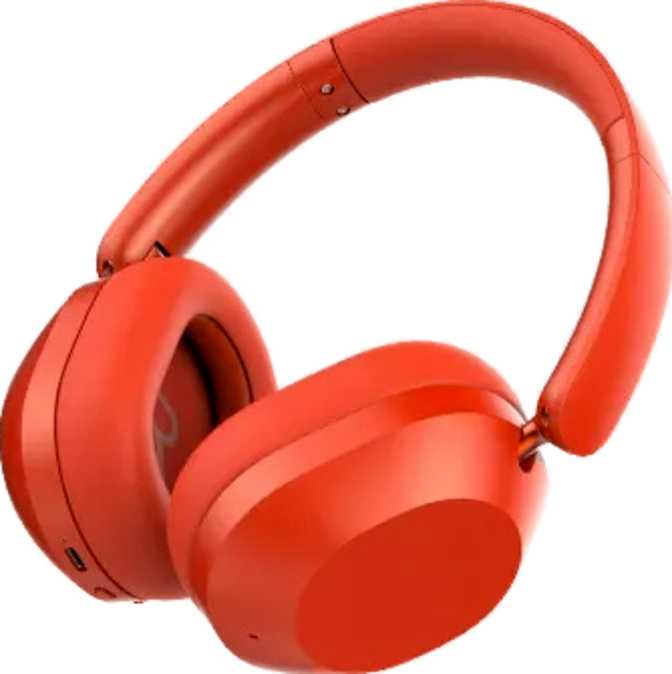
Realme TechLife Studio H1 Review: 70-Hour ANC Headphones Tested
HeadphonesMost wireless ANC headphones ask you to compromise somewhere — great sound but mediocre battery, strong noise cancellation but a charging routine that feels like a part-time job. The Realme TechLife Studio H1 stakes its entire pitch on solving the one complaint that frustrates over-ear headphone owners more than almost anything else: running out of juice mid-week. Pair that with active noise cancellation, hi-res audio streaming, and a foldable design built for life on the move, and you have a headphone clearly engineered around real daily friction points rather than spec-sheet bragging rights.
This review breaks down exactly where the Studio H1 earns that confidence — and where it asks you to make trade-offs you should know about before you buy.
Design, Comfort, and Build Quality
Fit, Weight, and All-Day Wearability
At 256 grams, the Studio H1 sits on the lighter side of the over-ear ANC category, where headphones commonly creep toward 280–320 grams once you factor in noise-cancellation hardware and larger ear cushions. That weight difference matters more than it sounds — over a four-hour work session or a long-haul flight, even an extra 30–40 grams clamped around your head becomes noticeable fatigue. The over-ear fit fully encloses the ear rather than resting on it, which generally means better comfort for extended wear and significantly better passive sound isolation than on-ear designs.
This is a closed-back headphone, meaning the ear cups are sealed rather than vented. Closed-back designs trap sound and block outside noise more effectively, making them better suited to offices, commutes, and shared spaces. Open-back headphones often deliver a more spacious, natural soundstage but leak sound in both directions. Realme has clearly prioritized isolation and portability over that open, airy listening character — the right call for a headphone built around all-day, on-the-go use.
No water or sweat resistance rating. Treat this as an indoor, commute, and travel companion rather than a workout partner or outdoor headphone.
Cable, Backup Listening, and Everyday Practicality
One detail that deserves more attention than it usually gets: the Studio H1 ships with a detachable, tangle-free cable. When the battery eventually runs flat, you're not stuck with a useless headphone — plug in the cable and keep listening, no Bluetooth required. This also opens up wired use with audio sources that don't support Bluetooth at all, like airplane seatback entertainment systems or certain studio equipment.
The tangle-resistant coating is a small but genuinely useful touch for anyone who's wrestled a knotted cable out of a bag pocket. Charging happens over USB-C — the modern reversible standard that's increasingly the only cable most people carry anyway.
- Folds flat for compact travel and bag storage
- USB-C charging — reversible and universally carried
- Detachable cable for battery-free wired listening
- Tangle-free cable coating for hassle-free storage
Sound Quality: Driver Performance and Audio Character
What the 40mm Driver Delivers in Practice
The Studio H1 uses a 40mm driver — the moving component inside each ear cup that physically produces sound. This is a common and well-proven size for over-ear headphones, large enough to move real air and deliver punchy, room-filling bass without the muddiness that can plague oversized drivers in poorly tuned headphones. Expect a sound signature that leans toward fun and energetic rather than flat and reference-neutral, which is exactly what most listeners outside professional audio mixing actually want from a daily-use headphone.
One detail worth flagging for the more technical reader: Realme hasn't listed a neodymium magnet in the driver assembly. Neodymium magnets allow for stronger magnetic fields in a smaller, lighter package, often translating to tighter bass control and better efficiency. Its absence here doesn't mean the Studio H1 sounds bad — most listeners will never notice the difference in casual use — but audiophiles directly comparing driver technology against pricier alternatives should factor this in.
Closed-back over-ear design tuned for immersive, full-bodied listening in real-world environments
Frequency Range and Hi-Res Audio Tuning
The Studio H1 is tuned across a frequency range spanning from the very bottom of what human hearing can detect all the way to 40,000Hz — more than double the ceiling of typical human hearing. The extended upper limit isn't about perceiving sounds you couldn't otherwise hear. It's about hi-res audio certification and headroom: drivers tuned beyond the audible range tend to render the audible spectrum with cleaner detail and less distortion, particularly when paired with a high-bitrate codec capable of delivering that resolution.
In short: the extended frequency range is meaningful for justifying the hi-res audio claim, even if no human will physically perceive 40kHz.
Spatial Audio and Stereo Imaging
Spatial audio support means the Studio H1 can process compatible content to simulate a wider, more immersive soundstage — useful for movies, certain music mixes, and content specifically mastered for spatial playback.
Combined with true stereo drivers — one dedicated driver per ear cup delivering independent left and right channels — the result is accurate channel separation and a believable sense of width, even within the more intimate soundstage that closed-back designs naturally produce.
Noise Cancellation and Ambient Awareness
Two independent noise-blocking layers working together — more effective across more noise types than ANC alone.
Active Noise Cancellation
Uses onboard microphones and electronics to generate an inverse sound wave that cancels consistent, low-frequency noise — engine drone, HVAC hum, the steady roar of a train or airplane cabin.
Passive Isolation
The physical seal of the closed-back ear cups against your head naturally blocks higher-frequency sounds — nearby conversation, clattering dishes, keyboard clatter — without requiring any electronics.
Ambient Sound Mode
Lets outside noise back in through the microphones without removing the headphones — handy for hearing a gate announcement, a colleague's question, or staying safe during an outdoor commute.
The noise-canceling microphone works to isolate your voice from background noise on the other end of the line — meaningful for calls from a busy café or a shared coworking space, where a standard microphone would pick up everything around you.
Battery Life and Charging: The Headline Feature
This is where the Studio H1 genuinely separates itself from the mid-range ANC field.
A rated 70-hour battery, drawn from a comparatively modest internal cell, is a strong figure for the category — it implies efficient power management rather than simply throwing a larger battery at the problem. At two hours of daily listening, that's roughly five weeks between charges. Even heavy users at three to four hours a day are looking at over two weeks per charge.
One honest caveat: manufacturer battery figures are measured under specific conditions, and continuous ANC use will reduce that figure somewhat compared to ANC-off listening. Even accounting for that, the headroom over headphones rated at 20–40 hours remains enormous. A visible battery level indicator means you'll always know your charge state, rather than getting caught off guard mid-commute.
Connectivity, Codecs, and Real-World Compatibility
Codec support is the most critical compatibility check before buying — it determines whether you get standard Bluetooth audio or genuine hi-res streaming.
Codec Support: Who This Headphone Is Really Optimized For
Codecs determine how audio data is compressed and transmitted over Bluetooth, with a direct, audible impact on sound quality depending on your phone's support.
| Codec | Supported | Best For |
|---|---|---|
| AAC | iPhone and all Apple devices | |
| LDAC | Android — genuine hi-res Bluetooth audio at significantly higher bitrates than standard streaming | |
| aptX | Not supported | |
| aptX HD | Not supported | |
| aptX Adaptive | Not supported | |
| aptX Low Latency | Not supported | |
| Bluetooth LE Audio | Not supported |
If your phone defaults to aptX rather than LDAC — common on many Samsung Galaxy devices — you won't get hi-res streaming and will fall back to standard AAC or SBC. Check your specific phone's audio codec output before buying.
Bluetooth 5.4 in Practice
The current-generation Bluetooth standard brings improved power efficiency and more stable connections compared to older versions — a sensible pairing with a headphone built around long battery life.
- 10-metre rated wireless range — in line with category norms; walls and interference will reduce this
- No NFC pairing — manual Bluetooth settings menu required
- No fast-pair — no automatic pop-up prompt on Android
Latency: What 80ms Means for You
Audio latency of 80 milliseconds is the delay between on-screen action and the sound reaching your ears. Its real-world impact depends entirely on what you are doing.
- Music — completely imperceptible, no impact
- Video — borderline; casual viewing usually fine, sensitive viewers may catch slight lip-sync drift
- Competitive gaming — noticeable input delay; not recommended for twitch-reflex play
Everyday Controls and Call Quality
Controls live directly on the ear cup itself rather than on an in-line remote — sensible for a primarily wireless headphone where an in-line panel would only be useful in wired mode. Playback, volume, and ANC toggling are accessible directly on the device without reaching for your phone.
The Studio H1 is fully confirmed for use as a headset, supporting calls, video meetings, and voice assistant access, backed by a noise-canceling microphone for clearer voice pickup in noisy environments.
Coverage comes with a standard one-year manufacturer warranty, in line with typical industry terms for this product category.
Missing Controls to Know About
-
No dedicated mute buttonSilencing your microphone mid-call requires reaching for your phone's controls
-
No in/on-ear detectionMusic won't auto-pause when you remove the headphones — manual pause only
Who Should Buy the Realme TechLife Studio H1
-
Commuters and Remote WorkersGenuinely long battery, reliable call quality, and dual-layer ANC that handles transit and office noise effectively over full working days.
-
Frequent TravelersFoldable design, detachable cable for in-flight entertainment, and fast 1.5-hour recharge make it well-suited for long-haul travel.
-
Android Users with LDAC-SupportGet genuine hi-res Bluetooth audio without paying flagship prices — the LDAC codec delivers a real upgrade over standard Bluetooth quality.
-
Value-Focused BuyersPrioritizing battery life and ANC over premium codec breadth or rugged durability — this headphone delivers where it matters most for daily use.
-
Gym-Goers and RunnersNo water or sweat resistance at all. One sweaty session could void the warranty and damage the headphone entirely.
-
Competitive Gamers and Video EditorsThe 80ms latency with no dedicated low-latency codec will create perceptible input delay in gaming and precision video work.
-
Samsung and aptX Ecosystem UsersWithout aptX, you'll lose the hi-res codec advantage on many Galaxy devices and fall back to standard audio quality.
-
Audiophiles Chasing Reference SoundOpen-back soundstage and neodymium-driver efficiency aren't part of this headphone's design brief. It's a fun, real-world tuned listener.
How the Studio H1 Stacks Up Against the Category
Measured against typical mid-range ANC over-ear headphones in the same price tier.
| Feature Category | Typical Mid-Range ANC | Realme TechLife Studio H1 |
|---|---|---|
| Battery Life (rated) | 20–40 hours | 70 hours |
| Charge Time | 2–3 hours | 1.5 hours |
| Hi-Res Codec Support | Often AAC/SBC only | AAC + LDAC |
| aptX Family Support | Common on Android models | Not supported |
| Water Resistance | Rare in this category | None |
| Wired Backup Option | Inconsistent | Detachable cable included |
| Weight | 280–320 g | 256 g |
The Studio H1 wins decisively on endurance, charging speed, and comfort, while accepting trade-offs on codec breadth, durability, and gaming-grade latency.
Honest Strengths and Weaknesses
Where It Earns Its Price
The case for the Studio H1 is built on genuine, daily-life advantages rather than spec-sheet theater. The 70-hour battery rating, backed by a fast 1.5-hour recharge and a visible battery indicator, removes one of the most persistent annoyances in wireless headphone ownership. The dual-layer noise reduction handles a broader range of real-world noise types than ANC alone typically manages.
Add LDAC support for Android hi-res streaming, a comfortably light 256g build, and a fully foldable design built for travel, and you have a headphone clearly designed around how people actually use headphones in real life — not just how they look on a comparison chart. The detachable cable means a dead battery never becomes a useless headphone.
Where It Asks for Compromise
The complete absence of any aptX codec variant is a real limitation for a meaningful slice of the Android market, and the 80ms latency with no dedicated low-latency mode makes this a poor fit for gaming or latency-critical video work. There's no water or sweat resistance at all, ruling out workout use.
The lack of NFC or fast-pair support means pairing takes more manual steps compared to tap-and-go competitors. Small daily frictions — no auto-pause when removed, no dedicated mute button — won't break the experience, but they're the kind of details a more premium headphone would have polished away. None of these weaknesses are dealbreakers alone; together, they simply confirm this is a headphone built to excel in specific, well-defined ways.
Real Buyer Questions, Answered
The questions people actually search before spending money on a wireless ANC headphone.
Should You Buy the Realme TechLife Studio H1?
If your priority is a wireless ANC headphone that genuinely disappears into the background of your week — one you charge occasionally rather than nightly, that switches to wired in seconds when needed, and that delivers real hi-res sound on supported Android phones — the Realme TechLife Studio H1 earns a confident recommendation.
It's built around the problems that actually annoy people in daily use, not the ones that look good in a spec comparison. Where it asks for compromise is equally clear: no water resistance rules out workout use, the missing aptX codec family will matter to a specific slice of Android owners, and the latency makes it the wrong choice for gaming or precision video work. If none of those apply to you, this is a genuinely well-judged, value-focused over-ear ANC headphone.