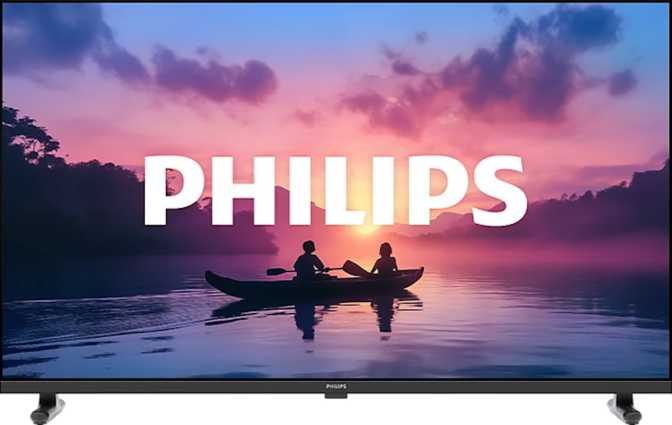
Philips 40PFS6050/12 – An Honest Review of a 40-Inch Full HD Smart TV
TVsAt a Glance
Key facts before you read further
Editor's Rating
Display
40" Full HD 1080p
HDR10 & HLG, 60 Hz
Ports
3× HDMI · 2× USB
Ethernet + 3.5 mm jack
Broadcast
DVB-T2 / C / S2
Fully satellite-ready
Voice Control
Google + Alexa
No Siri / HomeKit
USB Recording
Built-in PVR
No extra box needed
Running Cost
~33 kWh / year
0.5 W on standby
This TV has no Bluetooth, a Wi-Fi 4 wireless adapter, a 60 Hz panel with no variable refresh rate, and a Full HD — not 4K — resolution. If any of those constraints matter to your setup, the detailed sections below explain exactly how much.
Design and Build Quality
The PFS6050 doesn't try to make a visual statement. Its proportions are sensible for the size class — just under 90 cm wide and about 52 cm tall — and at roughly 5 kg it's light enough to mount or reposition without needing a second pair of hands. The depth of just under 80 mm is standard for an LED LCD panel with a conventional chassis; don't expect the wafer-thin profile of a premium OLED, but it won't jut aggressively from a wall either.
The TV supports VESA wall mounting, which is a practical consideration for bedrooms, kitchens, or any space where a floor stand would be inconvenient. Wall-mounting hardware is sold separately, so factor that into your budget if you plan to go that route.
The anti-reflection coating on the panel is a genuinely useful inclusion — not a checkbox feature. In rooms with windows or overhead lighting, an untreated panel becomes a mirror before noon. The coating meaningfully reduces glare without washing out the image, making the PFS6050 more usable in real-world domestic environments than its price tier might suggest.
The built-in ambient light sensor works alongside the display to adjust brightness automatically as room conditions change. It's a subtle feature that most users set and forget, but it contributes to comfortable extended viewing and helps manage power draw without requiring manual adjustments throughout the day.
Physical Specifications
- Width
- 893 mm
- Height
- 516 mm
- Depth
- 79.5 mm
- Weight
- ~5 kg (4,940 g)
- VESA Mount
- Supported
- Anti-Glare
- Coated
- Ambient Sensor
- Built-in
- Operating Temp.
- 5 °C – 35 °C
Display Performance
Resolution and Sharpness at This Size
Full HD — 1,920 by 1,080 pixels — at 40 inches produces a pixel density of around 55 pixels per inch. At typical TV viewing distances of 1.5 to 2.5 metres, this is comfortably sharp. You won't see individual pixels, and everyday content — broadcast TV, streaming at standard quality, DVDs — looks clean and detailed.
Where the resolution limitation becomes noticeable is with 4K source material. The TV scales 4K content down to 1,080p, meaning you're not seeing the full detail of a 4K Blu-ray or 4K streaming tier. For most users at this room size and viewing distance that's a reasonable trade-off. For buyers specifically purchasing a 4K source player or console and expecting the full visual step-up, it's worth flagging.
HDR Support: What You Get and What You Don't
The PFS6050 supports HDR10 and HLG — the two most widely used HDR standards in broadcast and streaming. HDR10 covers the majority of streaming platforms, and HLG is the standard used in HDR broadcasts across Europe. Content encoded in unsupported formats will still play — it falls back to standard HDR10 or SDR depending on the source.
| HDR Format | Supported | Where You'll Find It |
|---|---|---|
| HDR10 | Yes | Netflix, Disney+, most streaming platforms |
| HLG | Yes | European digital broadcast (DVB) |
| HDR10+ | No | Amazon Prime Video, Samsung devices |
| Dolby Vision | No | Netflix, Disney+, Apple TV+ |
Panel Technology and Colour
The LED-backlit LCD panel reproduces a palette of 16.7 million colours via an 8-bit colour depth — the baseline for modern HD displays and entirely standard at this tier. The result is accurate, natural colour rendering for everyday content. This is not a wide-colour-gamut display targeting content creators or colour-critical professionals.
The refresh rate is 60 Hz — the standard cadence for broadcast and streaming content. Live sport, news, and standard drama all look natural. Fast-paced gaming or high-frame-rate content won't benefit from smooth motion interpolation, and there is no adaptive sync technology for variable frame rate gaming. The PFS6050 is a TV first; its gaming credentials are limited to basic functionality.
Viewing Angles
The 178-degree horizontal and vertical viewing angles are among the widest available in any flat-panel technology. These figures suggest a display that maintains consistent colour and contrast whether you're sitting directly in front of it or off to one side — a practical advantage for shared rooms where viewers aren't always centred on the screen.
Connectivity
HDMI, ARC, and USB
Three HDMI ports is a comfortable allocation for a 40-inch TV in this class. You can connect a streaming stick, a games console, and a Blu-ray player simultaneously without needing a switch. These ports are rated at HDMI 2.1, which technically supports bandwidth for higher-resolution signals — though the display's 1,080p / 60 Hz ceiling means you won't be using that headroom. The practical benefit is strong signal compatibility with modern devices.
One HDMI port includes ARC (Audio Return Channel), allowing a soundbar or AV receiver connected via HDMI to receive audio from the TV's smart platform without a separate optical cable. This is standard ARC rather than the newer eARC standard, so very high-bandwidth lossless audio formats won't pass through — but for most soundbars at this level, standard ARC is entirely sufficient.
Two USB ports allow for media playback from a flash drive or external hard drive and — notably — USB recording of broadcast television. The USB recording feature lets you connect a USB storage device and record live TV directly, functioning as a basic personal video recorder without a separate box.
3
HDMI 2.1 Ports
2
USB Ports
1
Ethernet Port
3.5 mm
Audio Jack
No Bluetooth on this TV.
There is no Bluetooth radio built into the PFS6050. Wireless headphones, Bluetooth speakers, and Bluetooth keyboards cannot pair directly with it. The 3.5 mm jack provides a wired listening option, but this is a hard limitation buyers expecting wireless audio should weigh carefully.
Network: Wired and Wireless
The TV connects to your home network either via a built-in wired Ethernet port or over Wi-Fi. The wireless standard is Wi-Fi 4 (802.11n), which operates on the 2.4 GHz band. This is functional for streaming at 1,080p on a stable home network, but won't offer the throughput or interference resistance of newer Wi-Fi standards. If your router is nearby, the Ethernet port is worth using for a more reliable streaming experience.
Miracast support allows direct wireless screen mirroring from compatible Android devices and Windows PCs — no network required, just a direct device-to-device connection. Useful for sharing content from a phone to a larger screen without opening a streaming app.
Broadcast Tuners
The PFS6050 includes a comprehensive set of aerial and satellite tuner inputs: DVB-T, DVB-T2, DVB-C, DVB-S, and DVB-S2. This means the TV can receive terrestrial digital broadcasts, cable television, and satellite signals natively. No separate set-top box is required for standard broadcast viewing across all major delivery formats — a meaningful convenience for users who rely on free-to-air or subscription satellite services.
Smart TV Platform and Voice Control
The PFS6050 is a smart TV with an operating system and app store built in, allowing direct access to streaming services without any additional hardware. The presence of a built-in browser, voice command support, and smartphone remote capability reflects a reasonably modern smart platform.
Voice control is supported through both Google Assistant and Amazon Alexa — a practical dual-compatibility that covers the two dominant smart home ecosystems. Whether you're already invested in Google Home or Amazon Echo devices, the TV integrates without friction.
Smartphone remote support allows you to use a compatible phone as a controller, which is useful if you frequently misplace the physical remote or want more convenient text input for the smart platform. The included remote is battery-powered rather than rechargeable.
AirPlay — Apple's wireless streaming protocol — is not supported, and neither is Siri or Apple HomeKit. iPhone or iPad users who want to stream from their device to the TV will need a separate Apple TV device or a third-party casting solution.
Smart Feature Compatibility
Google Assistant
Native built-in support
Amazon Alexa
Native built-in support
Miracast
Android & Windows mirroring
Smartphone Remote
App-based TV control
Apple AirPlay
Not supported
Siri / Apple HomeKit
Not supported
Audio: Adequate for Casual Use, Limited for Critical Listening
The built-in speaker system delivers 12 watts of total stereo output — 6 watts per channel — with Dolby Audio processing applied. Dolby Audio is a signal processing suite that adjusts dialogue clarity, manages dynamics, and compensates for the physical limitations of small built-in speakers.
Frankly stated: this is TV-speaker audio. It handles dialogue well at moderate volumes in a small-to-medium room. It will not deliver meaningful bass, it will compress at higher volumes, and it is not a substitute for a soundbar or any form of dedicated audio system. There is no subwoofer, no Dolby Atmos spatial processing, and no DTS decoding.
The HDMI ARC port and digital audio output (optical) both provide clean paths for routing sound to an external system. If you're considering this TV for a living room setup where sound quality matters, plan for a soundbar from the outset — the connections are there and ready, even if the built-in speakers can't replace one.
Audio Specifications
- Total output: 12 W (2 × 6 W stereo)
- Dolby Audio processing: Included
- HDMI ARC output: Standard ARC
- Digital optical output: Included
- Dolby Atmos: Not supported
- DTS (all formats): Not supported
- Subwoofer: Not included
Plan a soundbar from day one
If audio quality matters at all to your viewing experience, budget for a soundbar when you purchase the TV. The PFS6050 connects cleanly to one via HDMI ARC or optical output — it simply can't replace one with its built-in speakers. A modest soundbar transforms the experience for everyday use.
Power Consumption and Running Costs
The PFS6050's annual energy consumption is modest — roughly 33 kilowatt-hours per year under standard EU test conditions. For context, that's approximately equivalent to leaving a single LED light bulb on continuously for around four months. In practice, actual consumption varies with brightness settings, content type, and usage hours, but this figure reflects a genuinely economical screen to run day-to-day.
Standby power draw is negligible — half a watt — which is the baseline you'd expect from a modern TV meeting current efficiency standards. The EU energy label classification is E, which is the expected rating for a display of this type and brightness level under the current European regulatory framework.
The ambient light sensor, when active, contributes to real-world efficiency by reducing backlight intensity in darker rooms — the kind of incremental saving that adds up over years of use.
33 kWh
Annual energy use
0.5 W
Standby power draw
EU: E
Energy label rating
Who This TV Is For — and Who It Is Not
-
Bedroom or secondary room use
At 40 inches, this is the ideal size for a bedroom where viewing distance is shorter and a 55-inch panel would feel excessive.
-
Kitchen or utility room installation
Light enough to wall-mount easily, comprehensive enough to handle broadcast TV and a streaming stick without fuss.
-
Replacing an older HD TV
Modern smart features and better connectivity without upgrading to 4K — if that's not a priority, this fits the brief precisely.
-
Free-to-air and satellite viewers
The full range of DVB tuners and USB recording make this genuinely self-contained for broadcast-first households.
-
Google or Amazon smart home setups
Native compatibility with both ecosystems — no hub or bridge device required.
-
4K content enthusiasts
If you've invested in a 4K media player or subscribe to 4K streaming tiers and want the full quality difference, this TV cannot deliver it.
-
Performance gamers
No variable refresh rate, no high frame rate support, and a 60 Hz panel make this unsuitable as a dedicated gaming display for modern consoles or PC use.
-
Dolby Vision or Atmos households
Netflix Dolby Vision content and immersive audio setups will not perform at their best on this television.
-
Apple ecosystem users
No AirPlay, no HomeKit, no Siri. The smart features are built entirely around Google and Amazon.
-
Bluetooth audio users
If you use wireless headphones or a Bluetooth speaker, the absence of Bluetooth is a hard limitation with no workaround at the TV level.
How It Compares to Logical Alternatives
The PFS6050 competes in a segment where a modest budget increase opens the door to 4K panels. Here's how the options stack up.
| Feature | Philips 40PFS6050/12 Our Pick |
Typical 43" 4K Smart TV | Typical 32" HD Set |
|---|---|---|---|
| Screen Size | 40" | 43" | 32" |
| Resolution | Full HD 1080p | 4K Ultra HD | 720p or 1080p |
| HDR Support | HDR10 + HLG | HDR10 + sometimes Dolby Vision | Rarely |
| HDMI Ports | 3 | 3–4 | 2 |
| Bluetooth | No | Often yes | Rarely |
| USB Recording | Yes | Sometimes | Rarely |
| DVB-S2 Satellite | Yes | Less common at this price | Rarely |
| Wi-Fi Standard | Wi-Fi 4 | Wi-Fi 5 more common | Wi-Fi 4 |
| Typical Weight | ~5 kg | ~7–9 kg | ~3 kg |
Figures for alternative categories represent typical market offerings at comparable price points, not a specific competing model.
Honest Assessment
Where It Earns Its Price
The PFS6050 earns its place through practicality and completeness rather than headline specifications. Three HDMI ports, a full complement of broadcast tuners, wired Ethernet, and native voice assistant integration make it a genuinely self-sufficient television for a secondary room.
The anti-reflection coating and wide viewing angles address real everyday problems — the kind of features that matter once you've lived with a TV for a few months. USB recording, rare at this tier, is a meaningful addition for broadcast-first viewers who want a personal video recorder without a separate device.
One practical note: a single year of manufacturer warranty is below the two-year standard now common with competitors. Extended warranty options from the retailer are worth considering at the point of purchase.
Where It Falls Short
The absence of Bluetooth is the most immediately frustrating gap for a modern television and will affect anyone expecting to pair wireless headphones. Wi-Fi 4 is functional but dated — in a dense wireless environment or a large home where the TV is far from the router, it can become a weak link for streaming reliability.
The 60 Hz panel and lack of adaptive sync close the door on this TV as a gaming display. Dolby Vision and HDR10+ are absent, which matters if you're paying for premium streaming tiers that carry those formats. The built-in speakers, while adequate for background viewing, are genuinely not up to the task of delivering satisfying audio in a proper viewing session.
The Full HD resolution is the defining trade-off. At 40 inches and typical viewing distances it's perfectly adequate — but buyers who later upgrade to a 4K source will see no benefit on this screen.
Common Buyer Questions
Answers to the questions real buyers search for before purchasing.
Final Verdict
The Philips 40PFS6050/12 is a focused, competent television for a specific type of buyer. It does not compete on cutting-edge display technology, gaming performance, or premium audio. What it offers is a genuinely complete feature set for broadcast-first and casual streaming households in a manageable 40-inch footprint.
With satellite tuner support across all major delivery standards, built-in USB recording, dual voice assistant compatibility, anti-reflection coating, and solid everyday display quality — it's a self-sufficient screen that handles broadcast TV natively, connects cleanly to modern devices, and integrates with a Google or Amazon smart home without requiring additional hardware.
If you're considering it for a main living room, plan to play 4K content, use Bluetooth audio devices, or want Dolby Vision from your streaming subscriptions, the specification gaps will matter and a different television deserves your attention. For the right use case — a bedroom, kitchen, or secondary room with broadcast TV at its heart — this one earns a straightforward recommendation.
Editor's Verdict