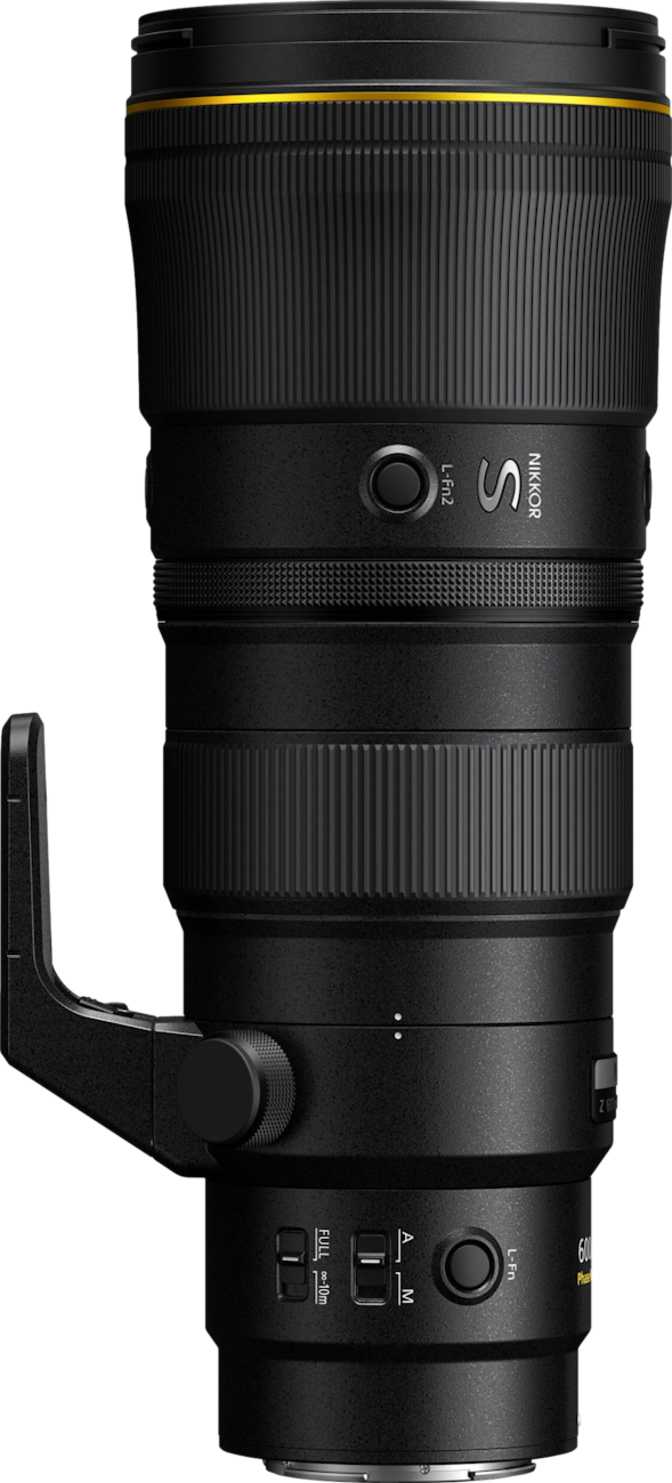
Nikon Nikkor Z 600mm f/6.3 VR S – Full Review & Real-World Analysis
Camera LensesA 600mm S-Line prime that reshapes what wildlife and sports photographers can carry into the field — without reshaping their spine doing it. The weight breakthrough is real. The f/6.3 aperture trade-off is equally real.
Editor's Rating
S-Line optical quality in a genuinely portable 600mm prime
What You Are Actually Getting With a 600mm Prime
Super-telephoto photography has always demanded a choice: carry something enormous and optically perfect, or accept compromises to make the kit manageable. For decades, the answer largely depended on the size of your budget and the strength of your back. The Nikon Nikkor Z 600mm f/6.3 VR S repositions that conversation. It is a 600mm prime lens built for Nikon's Z-mount mirrorless system, aimed squarely at photographers who need serious reach — wildlife, sport, aviation, nature — but who have grown tired of sacrificing portability to get it.
This is not a budget telephoto with soft edges and shaky autofocus. It carries Nikon's S-Line designation, which is the company's clearest signal that a lens meets its highest standards for optical and mechanical quality. Understanding what that means in practice — and whether the trade-offs suit your style of shooting — is exactly what this review is for.
Build Quality and Physical Design
Lighter Than You'd Expect, Tougher Than It Looks
At just under 1.4 kilograms, this lens defies what most photographers imagine when they picture a 600mm prime. Comparable telephoto primes from previous generations frequently crossed the 3kg threshold, which effectively ruled out handheld shooting for most people. This lens does not. For reference, 1390g is roughly the weight of a large water bottle — a modest ask for a lens that reaches this far.
The construction uses a metal mount — the connection point between lens and camera body — which matters more than most buyers realize. This is the interface under the most mechanical stress during long shooting sessions, handling switches between bodies, and the general wear of field use. A metal mount resists deformation and maintains accurate optical alignment over years of use in ways that plastic alternatives simply cannot match.
Weather sealing runs throughout the barrel. This is not a marketing promise about light rain; it reflects genuine protection against dust and moisture intrusion at multiple points along the lens. Wildlife photographers spending mornings in dewy grassland, or sports photographers caught in a stadium downpour, need protection like this to work confidently without babying their equipment.
Handling in the Field
The front element is fixed — it does not rotate when you focus. That matters practically because any circular polarizer or graduated filter you attach will stay exactly where you positioned it regardless of what the lens is doing. It is a small detail with real workflow consequences.
The included lens hood is reversible, meaning it can be flipped backward onto the barrel for transport, reducing the total footprint when the lens is in a bag. It is the kind of thoughtful detail that becomes genuinely appreciated on the tenth time you are packing a bag quickly at the end of a day.
Filter Cost Consideration
The filter thread diameter of 106.5mm is large. Filters at this size are a significant additional investment and are less available than standard sizes. Factor this into your total cost of ownership.
Build Specifications at a Glance
1,390g
Total Weight
106.5mm
Filter Thread
Full
Weather Sealing
Metal
Lens Mount
Optical Performance: What 600mm Actually Means
Understanding the Reach
600mm is an extreme focal length by any measure. To give that a real-world frame: where a standard portrait lens might isolate a face from across a room, a 600mm lens lets you fill the frame with a bird perched 30 metres away, or capture a cyclist in sharp detail from the far side of a sports field. The angle of view is just 4.2 degrees — an extraordinarily narrow slice of the scene in front of you.
That narrowness is precisely the point. It compresses distance, isolates subjects from backgrounds, and allows you to work at ranges that would be physically impossible to bridge on foot. For wildlife photography especially, keeping distance from animals is not just a practical matter — it is an ethical one. A 600mm lens lets you photograph without disturbing.
The f/6.3 Aperture — Honest Assessment
The maximum aperture of f/6.3 deserves honest treatment rather than cheerful deflection. Compared to the f/4 and f/5.6 super-telephoto primes that have long been the professional standard, f/6.3 admits less light. On modern mirrorless cameras with strong high-ISO performance, this is less limiting than it would have been five years ago — pushing ISO higher to compensate for reduced light is a reasonable trade on current bodies — but it is a genuine consideration for photographers shooting in low light.
Where f/6.3 earns its place is in what it allows the lens to be: physically smaller and considerably lighter than its faster counterparts. This is a deliberate design choice, not a cost-cutting measure. The lens is built to S-Line standards, and the aperture choice enables that quality in a form factor that actually gets taken out of the bag and used.
Aperture Light Comparison
Relative light transmission based on aperture physics. Offset by modern high-ISO camera performance.
Bokeh Characteristics
Nine aperture blades, rounded, contribute to smooth and natural background blur. At 600mm, even at f/6.3, background separation is dramatic — the narrow angle of view and the physics of long focal lengths mean that anything behind your subject blurs into soft abstraction naturally. The nine-blade rounded diaphragm ensures that out-of-focus light sources render as soft circles rather than geometric polygons, which matters particularly in environmental portraits of wildlife with specular highlights in foliage or water behind the subject.
Image Stabilization: How VR Changes the Game at This Focal Length
Built-in Vibration Reduction (VR) is not optional at 600mm — it is essential. Without stabilization, the minimum shutter speed needed to reliably capture a sharp handheld shot at 600mm would be so high that it would strain even the best-lit conditions. With it, photographers can shoot at dramatically slower shutter speeds without the motion blur introduced by natural hand movement and breathing.
Nikon's VR system in this lens is not the basic stabilization found in consumer zooms. It works in coordination with in-body stabilization systems present in modern Z-series bodies for a combined effect that exceeds what either system achieves alone. This is particularly relevant for static subjects like perched birds, architectural details, or distant landscapes — scenarios where you want optical perfection rather than maximum action-freezing speed.
VR System Highlights
- Built into the lens barrel
- Cooperates with Z-body IBIS
- Enables genuine handheld use
- Critical for slow-shutter static subjects
Autofocus Performance
The Silent Motor Advantage
The focus motor built into this lens is designed to operate without audible sound. In wildlife photography, a noisy focusing mechanism can startle animals. In video work, mechanical noise bleeds into recordings. The silent motor addresses both concerns — you can track a subject through continuous autofocus without announcing the process to everything within earshot.
Full-time manual focus override means that at any point, on any autofocus setting, you can reach for the focus ring and take manual control without switching modes. For situations where autofocus locks onto the wrong element in a complex scene — branches in front of a bird, a fence post cutting through a subject — this is the practical escape hatch.
Minimum Focus Distance Considerations
The closest this lens can focus is 4 metres. At 600mm, this still produces meaningful magnification — the maximum reproduction ratio means a subject roughly 13 centimetres wide fills the entire frame at minimum focus distance. But if you anticipate needing to focus on subjects closer than 4 metres, that is a hard limit to plan around.
Silent
Focus Motor
Full-Time
Manual Override
4m
Min. Focus Distance
Infinity
Focus Capable
Who Should Buy This Lens
Ideal Users
-
Wildlife and Nature Photographers
The reach, weather sealing, silent motor, and manageable weight combine to address the specific demands of field work in unpredictable conditions with skittish subjects. Bird photographers in particular will find nearly every design decision maps onto what birding demands.
-
Sports and Action Photographers
Cycling, athletics, motorsport, equestrian — 600mm covers distances that shorter telephoto lenses cannot bridge, and S-Line optical quality holds up to large prints and professional publication.
-
Travel Photographers Covering Wildlife
The weight allows genuine handheld use across a long day — something simply not practical with heavier predecessors and critical for photographers travelling by air.
Who Should Look Elsewhere
-
Low-Light Indoor Shooters
Indoor sports arenas, dawn and dusk wildlife under heavy canopy — f/6.3 is challenging in these environments. A faster lens at shorter focal length, combined with a teleconverter if needed, may serve better.
-
Macro and Close-Up Photographers
Insects, small flowers, and close-up product work require focusing closer than 4 metres — a hard physical limit this lens cannot overcome regardless of technique.
-
Cinematic Videographers
Those requiring precise, smooth manual focus pulls for cinematic work should verify whether the focus ring behaviour meets their specific needs — this lens is engineered around photography-first use.
Competitive Positioning
Three categories compete for the same budget and photographic intent. Understanding where this lens genuinely wins — and where it does not — saves regret later.
| Characteristic | Nikkor Z 600mm f/6.3 VR S | Typical 600mm f/4 Alternative | Typical 150–600mm Zoom |
|---|---|---|---|
| Maximum Aperture | f/6.3 | f/4 | f/6.3 (at 600mm) |
| Approximate Weight | ~1.4 kg | ~3.0+ kg | ~2.0–2.5 kg |
| Build Designation | S-Line Prime | Professional Prime | Variable |
| Optical Consistency | Prime-optimised | Prime-optimised | Variable across range |
| Focal Flexibility | Fixed 600mm | Fixed 600mm | Versatile zoom range |
| Weather Sealing | Varies | ||
| Handheld Viability | Excellent | Challenging | Good |
The 600mm f/4 lenses remain the choice for photographers where maximum light-gathering justifies the weight and cost — the difference between f/4 and f/6.3 is real, roughly 1.3 stops, translating to approximately 2.5x the ISO needed to match a given exposure. Super-telephoto zooms offer versatility this prime cannot match, but sacrifice the optical consistency and peak sharpness that a single focal length prime achieves. The Nikkor Z 600mm f/6.3 VR S occupies a clear and deliberate position in this market.
Strengths and Honest Limitations
Where It Excels
The weight story is the most compelling thing about this lens. Super-telephoto photography has historically required enormous physical strength, a heavy tripod, or significant compromise. At its weight, this lens opens the focal length to photographers who would otherwise be excluded — those with physical limitations, those travelling by air, those working in conditions where a full tripod setup is impractical or impossible.
The S-Line build quality delivers exactly what it promises. Weather sealing, metal mount, non-rotating front element — these are functional requirements for the shooting environments where a 600mm lens spends its life, not premium features added to justify a price point.
The silent, fast focus system paired with full-time manual override creates a highly capable tracking and shooting experience. The silent motor is a genuine field advantage that photographers who have startled subjects with noisy lenses will deeply appreciate.
The Honest Limitations
The aperture is the honest limitation, and it would be doing readers a disservice to minimise it. f/6.3 is not fast. On the newest generation of mirrorless bodies with strong noise performance at high ISO, it is workable — even excellent — in good light and into subdued daylight. But photographers who regularly face difficult lighting should weigh this carefully, and those who require consistent f/4 or f/5.6 performance will find that this lens cannot deliver it, by design.
The 4-metre minimum focus distance is appropriate for the focal length but remains a constraint. Subjects closer than roughly 4 metres are simply out of reach, and unlike a zoom, you cannot pull back to change the framing.
The 106.5mm filter thread means that any filtration work — polarisers, neutral density filters — comes with a premium price and limited availability. Budget for this separately if filtration is part of your regular workflow.
Frequently Asked Questions
4.5/5
Editor's Verdict
Recommended for wildlife, sport & nature photographers
Final Verdict
The Nikon Nikkor Z 600mm f/6.3 VR S makes a clear and defensible case for itself: it brings 600mm prime performance into a weight class that makes it genuinely usable across the conditions where it will actually be deployed.
The f/6.3 aperture is a real trade-off, not a minor asterisk. Anyone prioritising low-light performance or photographing under difficult conditions regularly should be honest with themselves about what f/4 access is worth — both optically and in terms of the weight they are willing to carry to get it.
For wildlife and bird photographers, outdoor sports shooters, and serious nature photographers who work primarily in reasonable light and value a lens that does not become a physical burden over a full day, this lens is an excellent match. The S-Line optical standard, the considered build quality, the silent and reliable autofocus system, and the weight that makes handheld shooting sustainable — taken together, these make a compelling argument.