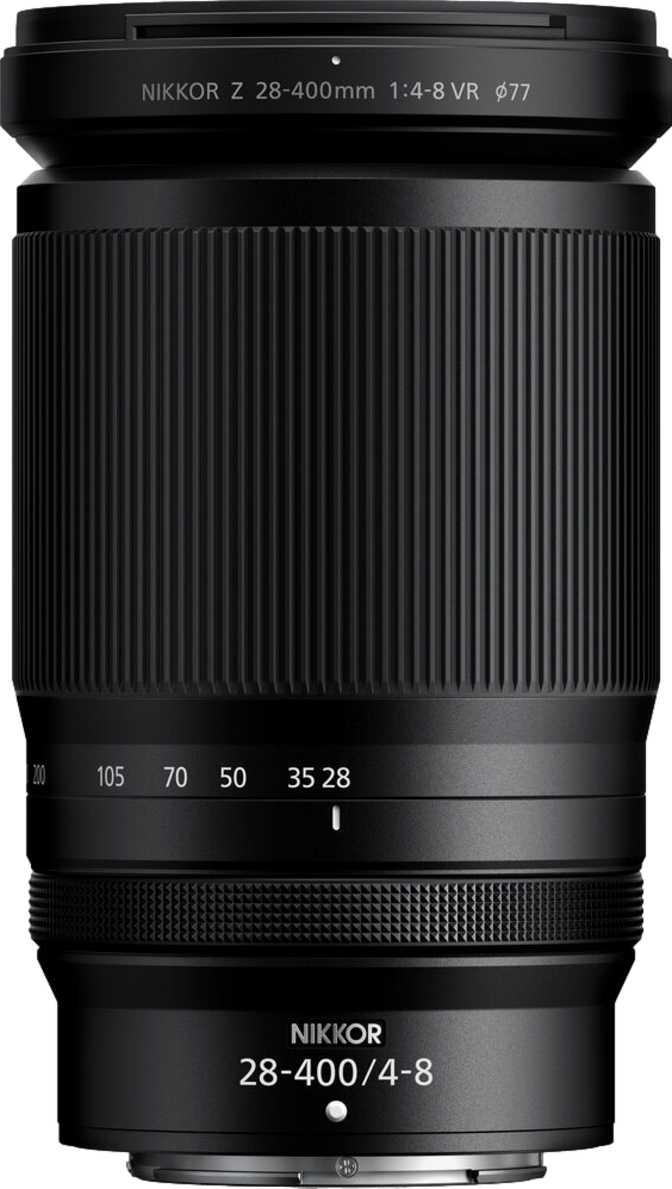
Nikon Nikkor Z 28-400mm f/4-8 VR: Full Review for Real-World Shooters
Camera LensesThere is a moment every traveling photographer dreads: the one where the subject you have been waiting for appears — a bird landing in perfect light, a street performer mid-leap, a mountain suddenly revealed through parting clouds — and you are holding the wrong lens. You either shoot it badly or miss it entirely. The Nikon Nikkor Z 28-400mm f/4-8 VR is an argument that this moment never has to happen again. It spans from wide-angle to powerful telephoto in a single barrel, asking one central question: how much versatility can a single piece of glass responsibly deliver?
The honest answer is more than most people expect, with trade-offs that matter more in some situations than others. This review examines what this lens actually delivers, where it performs with confidence, and where it will ask you to accept a compromise.
At a Glance
Key specifications translated into what they mean for you
Focal Range
28–400mm
Wide-angle to super-telephoto
Aperture Range
f/4 – f/8
Variable, widest at 28mm
Stabilization
Built-in VR
Works with in-body IS
Lens Mount
Nikon Z
Native mirrorless system
Carry Weight
725 g
Lighter than a two-lens kit
Close Focus
20 cm
Near-macro detail capability
Filter Thread
77 mm
Standard, widely available size
Weather Sealing
None
Not splash or dust resistant
Performance Ratings
Assessed from real-world implications of the lens specifications and design
Overall Score
4.0
out of 5
Design and Build: What You Are Handling Day to Day
At 725 grams, this lens occupies an interesting middle ground. It is heavier than any single prime or short zoom you would normally carry, but lighter than the combined weight of the two or three lenses it replaces. After a full day walking through a city or across a wildlife reserve, the distinction is meaningful — not in a trivial convenience sense, but in terms of whether your shoulder survives the trip and whether you are inclined to keep shooting by late afternoon. In practical terms, it is the weight of a large smartphone and a half: substantial enough to feel solid, not so heavy that it changes the nature of the day.
The front element accepts 77mm filters — a well-established diameter in the photography accessories world. Circular polarizers, neutral density filters, and UV protectors in this size are widely available across every price point. You are not locked into a proprietary thread or forced to buy brand-specific glass to protect your investment.
Two omissions require attention before purchase:
No Lens Hood Included
A hood reduces flare in backlit conditions and protects the front element from stray impacts. This is not a luxury item for casual use — budget for a compatible hood immediately and treat it as part of the total package cost before comparing prices.
No Weather Sealing
This lens is not splash-proof or moisture-resistant. A weather-sealed camera body with an unsealed lens offers limited protection. Rain, sea spray, and dusty environments are real operational risks. For outdoor photographers in variable conditions, this is the most significant constraint on the entire lens.
What the 28–400mm Range Actually Gives You
The focal range is the whole argument for this lens. It covers three distinct shooting zones that most photographers would otherwise address with separate pieces of glass.
A natural, slightly open view of the world. Wide enough for full room interiors, city skylines, and group portraits without distortion becoming conspicuous. The setting you reach for on a street corner, inside a building, or when you want to show context and environment alongside your subject.
Classic portrait territory, moderate telephoto for candid street photography, and the compressed mid-range distances ideal for travel scenes. Wildlife at accessible distances, architectural facade details, and performers viewed from the audience all land in this zone — all without a lens change.
Serious telephoto reach. A bird perched in a distant tree fills the frame. A player on a sports field becomes a subject, not a figure in a crowd. A mountain peak kilometers away reveals its texture and detail. This is reach that was once the exclusive domain of large, dedicated telephoto glass.
For travel photography specifically, this range is compelling. You can photograph a cathedral interior and then — without switching lenses or pausing — photograph wildlife or a distant coastline detail from the same spot. Covering this range with separate glass would require two or three pieces of equipment and all the logistics that involves.
The Variable Aperture: What You Are Trading for That Range
f/4
At 28mm
Wider opening, more light
Narrows as
you zoom in
f/8
At 400mm
Narrower opening, less light
At the wide end, the maximum available opening admits a generous amount of light relative to what superzooms typically offer. It is enough to shoot in indoor ambient light, achieve meaningful subject-to-background separation in portraits, and use shutter speeds that freeze everyday motion without pushing ISO into uncomfortable territory.
As the focal length extends, that maximum aperture narrows progressively. By the time you reach the telephoto extreme, the widest opening has contracted significantly — and this is where the lens asks you to be realistic about your shooting conditions.
The Defining Trade-Off
In bright sun or open shade, f/8 at the telephoto end is entirely workable on a modern sensor. In anything less — wildlife at dusk, sports under stadium lighting, shooting into a shadowed forest interior — you will need high ISO values and may still find shutter speeds struggle to freeze motion. VR compensates for camera shake, not for a moving subject. This is the single most important factor to evaluate honestly before buying.
Vibration Reduction: Why It Matters More Here Than Almost Anywhere
At 400mm focal length, camera shake is not an inconvenience — it is the enemy of usable images. The magnification at the telephoto end amplifies the smallest tremors from breathing, heartbeat, and natural hand movement into visible blur. Without stabilization, handholding at these focal lengths requires shutter speeds that are extremely difficult to achieve in moderate light.
Optical Stabilization in the Lens
Working through optical elements that physically shift to counter movement, the built-in VR makes handholding at focal lengths that would otherwise demand a tripod genuinely practical. For travel shooters who do not carry a tripod, and wildlife photographers who cannot deploy one quickly enough for opportunistic shots, this is operationally essential rather than merely convenient.
Compound Stabilization with IBIS
On compatible Z-mount bodies that carry in-body image stabilization, the lens optics and the camera sensor-shift system cooperate. The result is stabilization performance that neither system could achieve independently — a meaningful compounding benefit for photographers whose body supports this pairing.
VR draws a small amount of current from the camera body while active. In normal use, this is not a significant contributor to battery drain — the electronic viewfinder and continuous autofocus have considerably more impact. Shooting with VR engaged is the correct default; toggling it off to manage battery is not a practical strategy.
The Focus System: Silent, Fast, and Closer Than You Would Expect
The autofocus motor operates without audible mechanical noise — not reduced-noise, but genuinely silent in practical use. Three features of this system stand out for real-world shooting.
Silent Operation
Video shooters recording with on-camera microphones will find that focus hunting and focus pulls do not bleed into audio tracks. Wildlife photographers stalking cautious subjects will appreciate that the lens does not announce itself to the scene.
Full-Time Manual Override
With autofocus active, you can reach for the focus ring at any moment and adjust without switching modes or navigating menus. For photographers who let autofocus acquire and then finesse manually, this is a genuinely useful and intuitive affordance.
20cm Close Focus
Twenty centimetres from the front element — roughly the length of a standard ruler. The lens reproduces subjects at over a third of their life size in the frame. Flowers, insects, food details, and textured surfaces become photographic subjects without reaching for a dedicated macro lens.
Bokeh and Background Rendering
The aperture diaphragm uses nine blades shaped to maintain a circular opening across a range of aperture sizes. When out-of-focus elements appear in the background — specular highlights from lights, reflections in water, bright points of colour against a soft background — the shape of those highlights takes on the shape of the aperture opening. With nine rounded blades, those highlights render as smooth circular discs rather than as geometric polygons.
At portrait focal lengths with adequate separation between subject and background, the rendering is pleasant and natural. At the telephoto extreme, the compression of perspective and the magnification of background blur create the conditions where this rounded diaphragm is most visually apparent. It is not a substitute for the bokeh of a fast prime, but for a zoom lens of this range, the nine-blade design produces consistently clean, circular results.
Who This Lens Is Built For
A clear breakdown of ideal users — and those who should look elsewhere before spending
Built for These Shooters
Travel Photographers
Moving from interior architecture to a bird in a distant tree without changing glass is exactly what extended travel photography demands. Combined with a mirrorless body that fits a modest bag, this becomes a capable system that goes wherever the itinerary leads.
Wildlife and Nature Enthusiasts
The telephoto reach covers birds, deer, and similar wildlife at typical encounter distances. The silent focus motor is directly suited to cautious subjects. The stabilization handles handholding at long focal lengths. Most effective for daylight shooting in open terrain.
Enthusiasts Who Want One Lens
Learning composition, light, and timing across a full focal range on a single lens is educationally valuable. The freedom to experiment without managing multiple pieces of gear allows photographers to focus on seeing rather than switching.
Documentary Video Shooters
Silent autofocus, optical stabilization, close-focus capability, and an extreme zoom range combine for single-operator documentary and event video. Zoom from a wide establishing shot to a tight close-up without cutting, handheld, without a sound crew cringing at focus motor noise.
Consider Looking Elsewhere If
Low-Light Events Are Your Core Work
Indoor event photography, low-light portraiture, and nighttime shooting will be persistently limited at longer focal lengths. A fast standard zoom paired with a moderate telephoto prime covers those scenarios with significantly more light-gathering capability.
Professional Sports Photographers
Fast-moving subjects under variable artificial lighting require maximum apertures this lens cannot offer at telephoto distances. Dedicated fast telephoto zooms or fixed-aperture long primes serve professional sports differently and better.
Maximum Optical Quality Is Non-Negotiable
Purpose-built glass for specific focal lengths will outperform a superzoom in raw resolution and edge performance. That is not a failure specific to this lens — it is physics. Pixel-peepers who regularly compare output against prime lenses will find the gap visible at the extremes.
You Regularly Shoot in Rain or Dust
Coastal environments, rain, sea spray, and fine dust are environments where this lens has no margin for error. If weather-resistant glass is a regular operational requirement, the absence of sealing here imposes a constraint that sealed alternatives do not.
Competitive Positioning: One Lens vs. The Alternatives
Within the Nikon Z ecosystem, the natural alternative is a two-lens approach. Across other mirrorless platforms, comparable superzoom lenses exist with similar design philosophies. Here is how the trade-offs map:
| Factor | Z 28-400mm f/4-8 VR | Two-Lens Kit Approach | Other Superzoom Platforms |
|---|---|---|---|
| Focal Coverage | Full wide-to-telephoto | Full wide-to-telephoto | Comparable ranges |
| Lens Changes Required | None | Yes, in the field | None |
| Max Aperture at Telephoto | Variable, narrows to f/8 | Often f/2.8–4 fixed | Variable, similar range |
| Carry Weight | Single lens (725g) | Two lenses, heavier combined | Comparable single-lens weight |
| Weather Protection | Not sealed | Depends on chosen lenses | Varies by model |
| Close-Focus Capability | 20cm minimum | Varies by lens pairing | Varies by design |
| Silent Autofocus | Yes, built in | Depends on chosen lenses | Varies by model |
| Bag Space Required | One lens slot | Two or more slots | One lens slot |
Honest Assessment: Strengths and Limitations
No lens is perfect — here is what this one genuinely gets right and where it falls short
Strengths
-
Extraordinary Focal Coverage
From a natural wide-angle to serious telephoto reach in a single barrel, with no compromise to the user during shooting. Covering this range with separate lenses requires two or three pieces of glass and all the bag space, weight, and moment-missing that involves.
-
Genuinely Silent Autofocus with Manual Override
Silent in practice, with the ability to override to manual focus at any moment without switching modes. A combination that serves video creators and wildlife photographers without asking either to compromise.
-
Unexpectedly Close Minimum Focus Distance
The 20cm close-focus limit adds genuine macro-adjacent utility that most photographers will not expect and many will regularly use. This is not a marginal feature — it meaningfully expands what you can photograph with a single lens.
-
Nine Rounded Aperture Blades
Out-of-focus highlights render as smooth circular discs across aperture settings. At portrait and telephoto focal lengths, the background rendering is consistent and clean — a noticeably better result than lenses with fewer or non-rounded blades.
-
Compound Stabilization Capability
On bodies with in-body IS, the dual system delivers performance that exceeds what either stabilization layer achieves independently. This is a meaningful engineering advantage that pays off most at the long telephoto end.
Limitations
-
Variable Aperture Narrows to f/8 at 400mm
At the telephoto extreme, the maximum opening contracts to f/8 — a genuine constraint in anything less than generous light. This is the single most important trade-off to evaluate before purchase. It is the price the lens charges for its convenience.
-
No Weather Sealing of Any Kind
A sealed camera body with this unsealed lens provides limited combined protection. Rain, dust, sea spray, and coastal environments represent real operational risk. For photographers who regularly encounter these conditions, this is a meaningful constraint rather than an edge case.
-
No Lens Hood Included
The omission of a hood places an immediate accessory cost on the buyer that should be factored into any price comparison. A hood is not optional for serious outdoor shooting — it reduces flare and provides basic physical protection to the front element.
-
Substantial Carry Weight
At 725g, this is not an ultralight travel lens. It earns its weight by replacing multiple heavier pieces of glass, but it remains a significant lens to carry over extended periods on foot.
-
Optical Compromises at the Extremes
Purpose-built prime lenses and dedicated telephoto zooms will outperform this lens in raw resolution and edge sharpness at their respective focal lengths. This is inherent to superzoom design — not a specific failing — but it is real, and visible on close inspection.
Questions Real Buyers Ask Before Purchasing
Direct answers to what matters most before spending money on this lens
The Nikon Nikkor Z 28-400mm f/4-8 VR
This is an honest lens — honest about what it is, honest about what it trades, and honest about who it serves. It does not position itself as the sharpest optic Nikon makes, the fastest aperture lens available for the Z mount, or a weather-resistant workhorse. It is a single piece of glass that covers a focal range most photographers would otherwise address with two or three separate lenses, pairing a genuinely capable focus system and dual stabilization with close-focus capability few will expect.
The operational freedom it provides translates directly into more shots made and fewer opportunities missed. For a specific kind of photographer, that is a meaningful value proposition.
Buy It If
You shoot primarily outdoors, travel with photography as a central activity, want one lens rather than three, and do most of your telephoto work in daylight conditions.
Reconsider If
Low-light telephoto work is a regular part of your shooting, weather sealing is a non-negotiable requirement, or you have optical quality expectations only dedicated glass can meet.
Look Elsewhere If
Maximum aperture at the telephoto end is essential to your core work. No amount of range or convenience compensates for an aperture that does not serve your most important shooting conditions.
For the photographer whose strongest need is to always have the right focal length available without the weight and complexity of multiple lenses — this is, without qualification, one of the most capable answers to that specific problem that the Z mount system currently offers.