Navee XT5 Ultra Review: High-Performance Scooter for Serious Riders
Electric ScootersBuilt for More Than the Average Commute
Most electric scooters make a quiet promise: get you from A to B without too much fuss. The Navee XT5 Ultra makes a different promise entirely. With dual high-output motors, a battery large enough to power a small apartment for an afternoon, and a top speed that would earn a fine in a school zone, this is not a scooter you buy because it was on sale. It is a machine engineered for riders who have outgrown the entry-level category and want something that genuinely performs — in rain, on hills, on longer journeys, and at speeds that demand real engineering behind them.
That ambition comes with real trade-offs worth examining closely. This review covers every one of them.
Expert Rating
Design and Build: Commanding Presence, Serious Weight
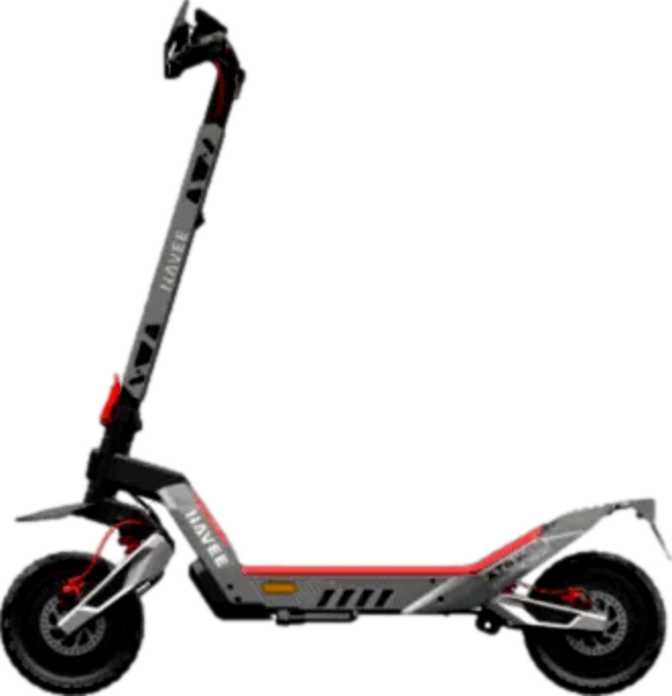
The Navee XT5 Ultra occupies a clear physical tier above most consumer scooters. Standing 1,400 mm tall with a handlebar spread of 1,360 mm, it has the wide, planted stance of a machine that prioritizes stability over compactness. This is not a scooter you squeeze between subway seats or carry on escalators without planning ahead.
Weight Reality Check
At 38.6 kg (approximately 85 lbs), the XT5 Ultra is foldable — but folding only changes its shape, not its mass. Carrying it up a flight of stairs is a two-person job most days. For riders with ground-floor access, private parking, or a garage, this is a non-issue. For anyone whose routine involves regular lifting, this weight demands honest consideration before purchasing.
What that weight buys you is a chassis with the rigidity and space to house premium components. The 12-inch air-filled (pneumatic) tires are noticeably larger than the 8- and 10-inch wheels found on lighter scooters. Air pressure inside the tire acts as a secondary suspension layer, cushioning vibration in a way solid rubber physically cannot replicate. Pair that with a dedicated suspension system and the difference over cracked pavement, uneven joints, and speed bumps is immediately apparent to anyone who has ridden a bare-deck alternative.
Performance: What Dual 2,200W Motors Actually Mean on the Road
Raw Power and What It Translates To
The combined motor output here is substantial. Two motors working in concert deliver the kind of acceleration and hill-climbing capability that single-motor scooters — even well-regarded ones — cannot match. Starting from a standstill on a steep gradient, which causes many scooters to struggle or require a manual push-off, is handled without hesitation.
The 50 km/h (approximately 31 mph) top speed places this firmly in the performance segment — most commuter scooters are electronically limited to 25–30 km/h. The real benefit of oversized motors is not only the top-end ceiling; it is the smooth, confident power delivery at every speed beneath it. Merging with traffic, clearing intersections decisively, and climbing multi-story parking garage ramps all improve measurably when the motor system has headroom to spare.
Operating at 50 km/h on public roads puts this scooter in territory where specific licensing, registration, or path restrictions may apply depending on your country, state, or city. Always verify local electric scooter regulations before riding at maximum speed in public spaces.
Braking and Control
Independent front and rear brakes are standard on the XT5 Ultra. At 50 km/h, this is not optional — it is a safety baseline. The ability to modulate both braking forces separately is critical during emergency stops, where a rider's weight shifts sharply forward and rear wheel lock-up becomes a genuine hazard with single-brake systems.
The 150 kg maximum load capacity is among the most generous in this segment — many competitors cap between 100 and 120 kg. Heavier riders will notice that performance characteristics (acceleration, range, hill handling) remain competent rather than degraded, which is not always the case when a scooter is loaded near its rated limit on rival machines.
Battery and Range: The Numbers Behind 90 Kilometres
Understanding the Battery Size
The onboard battery stores 899 Wh of energy — more than double what most mid-range commuter scooters carry (typically 250–400 Wh). This capacity is the foundational reason the XT5 Ultra can travel so far on a single charge, and it directly explains both the range advantage and the weight.
The 90 km maximum range is a best-case scenario: lighter rider, flat terrain, moderate speed, ideal temperature. In normal real-world urban use, most riders should plan for 55–75 km per charge. Even at the conservative end, that covers multiple days of typical commuting — the average urban round-trip is well under 20 km, meaning many riders will charge every three to four days under normal use patterns.
Battery Capacity vs. Segment Benchmarks
Charge Time: Surprisingly Practical
Despite the battery's large capacity, a full recharge takes approximately 3 hours. That is a fast turnaround relative to energy stored. For comparison: a scooter with a 400 Wh pack that takes 6 hours to charge is objectively slower at recovering usable range per hour plugged in. Overnight charging always produces a full battery by morning, and plugging in during a work shift or extended stop adds a substantial range boost.
Fixed Battery Note
The battery is not removable — charging requires the whole scooter to be near a power outlet. For riders with separate parking and no outdoor socket nearby, the scooter must physically come indoors to charge. This is a practical constraint worth planning around before purchasing.
Regenerative Braking
Each time you slow down, the XT5 Ultra's motors recover a fraction of kinetic energy and route it back into the battery — a process called regenerative braking. In city riding with frequent deceleration, this extends effective range by an estimated 5–15% depending on terrain and stop frequency. It also reduces wear on the physical brake components over the lifetime of the scooter. A built-in battery level indicator keeps remaining charge visible at all times, so you are never caught off-guard mid-commute.
Who This Scooter Is For — and Who It Is Not
Ideal Riders
- Long-distance commuters covering 30–60 km round-trips who have hit the limits of standard scooter range
- Heavier riders up to 150 kg who have found that lighter scooters underperform or exceed rated capacity limits
- Year-round all-weather commuters who ride regardless of rain and need a scooter that handles it reliably
- Hilly terrain riders where elevation change destroys range and confidence on single-motor alternatives
- Performance-oriented riders who want full capability — not a legally capped commuter with artificial limits
Not Ideal For
- Apartment dwellers without elevator access or ground-floor storage — 38.6 kg makes regular stair-carrying impractical
- Casual or occasional riders who cover short distances and can meet their needs with a lighter, less expensive option
- Riders in strict 25 km/h jurisdictions where much of the performance investment goes legally unused
- Anyone requiring a removable battery for charging at a desk or locker room separate from where the scooter is stored
How the Navee XT5 Ultra Compares to the Competition
The XT5 Ultra sits at the upper tier of the performance scooter segment. Its most distinctive advantages are charge speed relative to battery size, IPX6 protection, large pneumatic tires, and a category-leading load capacity. The primary trade-off versus similarly-specced rivals is the heavier chassis.
| Feature | Navee XT5 Ultra | Typical Performance Scooter | Typical Commuter Scooter |
|---|---|---|---|
| Motor Output | 2,200W dual | 1,000–1,600W dual | 350–500W single |
| Top Speed | 50 km/h | 40–45 km/h | 25 km/h |
| Range (Claimed) | 90 km | 50–70 km | 25–40 km |
| Battery Capacity | 899 Wh | 500–720 Wh | 250–400 Wh |
| Wheel Size | 12" pneumatic | 10" pneumatic | 8–10" pneumatic/solid |
| Scooter Weight | 38.6 kg | 22–30 kg | 10–15 kg |
| Water Resistance | IPX6 | IPX4–IPX5 | IPX4 or unrated |
| Charge Time | ~3 hours | 5–8 hours | 4–6 hours |
| Max Load | 150 kg | 120–130 kg | 100–120 kg |
Honest Assessment: Strengths and Weaknesses
Where It Excels
The case for the Navee XT5 Ultra is straightforward when the use case fits. Nothing in this class charges as fast relative to its battery size. Very few machines offer the combination of large pneumatic tires, full suspension, and IPX6 in the same package at a comparable specification level. The dual-motor system delivers the kind of real-world hill performance that specification tables alone undersell — it is one of those differences you feel immediately when you encounter a gradient that would have caused a previous scooter to noticeably lose pace. For a rider with a specific, demanding use case — long range, heavy load, wet weather, steep terrain — the XT5 Ultra resolves multiple problems at once without requiring a compromise on any single front.
Where to Manage Expectations
The weight is the honest limitation that cannot be argued away. At 38.6 kg, every capability this scooter has is a downstream result of engineering choices that happen to produce a heavy machine. Folding changes its profile — it does not change its mass. Anyone who needs to carry it regularly should account for this realistically, not optimistically.
The fixed battery simplifies the design and reduces potential failure points, but it ties charging access to wherever the scooter can physically be parked near a power outlet. For some riders this is irrelevant; for others it is the deciding factor that sends them elsewhere.
The 50 km/h speed capability is valuable only where local law permits it. In markets where electric scooters are capped at 25 km/h regardless of hardware, a significant portion of the performance engineering sits idle by legal obligation.
Frequently Asked Questions
Final Verdict
The Navee XT5 Ultra is a purpose-built performance scooter that does not apologize for its priorities. It is heavy, it is powerful, and it charges an unusually large battery in an unusually short time — all direct results of engineering choices made for a specific type of rider.
If your commute genuinely requires extended range, dual-motor performance, all-weather capability, and a high load limit, the XT5 Ultra delivers on each of those needs with fewer compromises than most rivals at a comparable specification level. The approximately 3-hour recharge window for a 899 Wh battery is a standout differentiator that meaningfully improves the day-to-day ownership experience.
If portability is a priority, if your typical ride is well under 30 km, or if your daily routine demands regular lifting and carrying, there are lighter, more practical options better matched to those needs. For the rider this machine was designed for, the Navee XT5 Ultra is among the most capable options available in its category.
Overall Score