Musnap Ocean C Review: A Seven-Inch E-Reader Built for Readers
E-readersMost e-readers make you choose: a compact device that fits in a jacket pocket, or a larger screen with proper reading real estate — but rarely both without compromise. The Musnap Ocean C positions itself firmly in the large-screen camp, built around a seven-inch e-paper display and hardware that signals serious reading intent rather than casual dabbling. Whether you are a first-time e-reader buyer stepping up from paperbacks or a long-term digital reader ready to leave an aging device behind, there is a lot happening here worth examining carefully before you commit.
Design and Build: Slim, Large, and Unassuming
The Ocean C is a wide device. At roughly 157mm tall and nearly 139mm across, it is closer in footprint to a standard paperback novel than to the palm-sized e-readers that dominate entry-level shelves. That width is intentional — it accommodates the seven-inch screen without forcing an unusually tall, narrow form factor that would feel awkward in the hand.
What makes the physical experience work is the thickness, or rather the lack of it. At 7mm, the Ocean C sits comfortably thin. Hold it alongside a typical smartphone and it will actually feel slimmer. The result is a device that looks large on a table but disappears quickly in your hands during a long reading session.
The build uses standard display glass rather than a branded damage-resistant glass. This is not unusual in the e-reader category, but worth acknowledging if you plan to carry the device loosely in a bag alongside keys or other hard objects. A protective case is a wise investment here — not just cosmetically, but practically.
Physical Dimensions
- Height
- 157.5 mm
- Width
- 138.7 mm
- Thickness
- 7 mm
- Volume
- 152.9 cm³
The Display: Where the Ocean C Earns Its Reputation
Resolution and Pixel Density
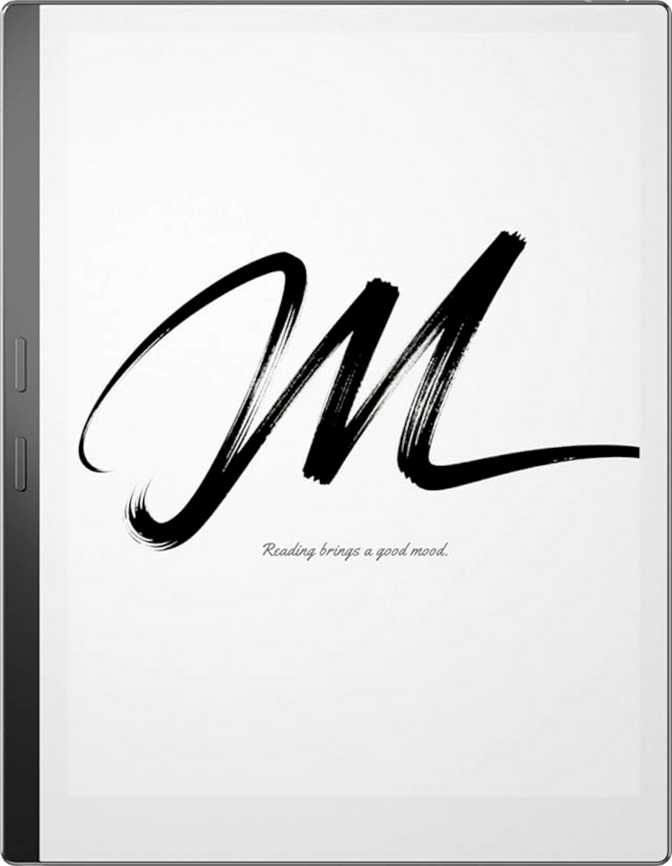
The screen is the centrepiece, and it delivers. At 300 pixels per inch across a 1264 × 1680 pixel canvas, text renders with a sharpness that print-trained eyes will genuinely appreciate. Three hundred ppi is the threshold typographers traditionally associate with print-quality reproduction — individual pixels become invisible to the naked eye at normal reading distances, and letterforms at smaller sizes look crisp rather than slightly fuzzy.
The larger seven-inch canvas changes the reading experience in practical ways. You can comfortably use a larger font size without constantly tapping to turn pages, or drop to a smaller size and fit more text per screen with legibility that a five- or six-inch display at the same setting simply cannot match.
E-Paper Technology and the Self-Lit Screen
E-paper reflects ambient light rather than projecting light at you — meaning the Ocean C's screen actually becomes easier to read in bright sunlight, not harder. Extended sessions of several hours cause far less eye fatigue than equivalent time spent on any conventional LCD or OLED screen.
The built-in front light casts illumination across the screen surface rather than shining through it from behind. This preserves the paper-like quality while making night reading entirely practical without a bedside lamp or separate light source.
The anti-reflection coating makes direct overhead lighting and bright windows substantially more manageable. Reading near a window without hunting for the correct seat angle is a small daily comfort that quietly adds up over time.
| Screen Size | 7 inches |
| Resolution | 1264 × 1680 px |
| Pixel Density | 300 ppi |
| Display Type | E-Paper |
| Touch Screen | Yes |
| Front Light | Yes |
| Anti-Reflection Coating | Yes |
| Damage-Resistant Glass | No |
Performance: More Processor Than Most E-Readers Carry
E-readers historically ran on modest processors designed around one low-demand task. The Ocean C takes a different approach. Its eight-core processor running at 2.2GHz per core places it comfortably into territory usually occupied by mid-range Android tablets — not because an e-reader needs that power to display a page of text, but because the implications stretch well beyond page-turning alone.
Instant Response
Eight cores at 2.2GHz eliminate the slight delay that older e-readers still exhibit when turning pages or navigating large libraries.
True Multitasking
4GB of RAM keeps multiple processes active simultaneously — switching between reading, audio, and browsing requires no visible reload each time.
Library Without Limits
Sixty-four gigabytes holds well over ten thousand standard e-books — enough for a lifetime collection, plus document archives and sideloaded files.
Connectivity: Wireless, Practical, and Focused
Wi-Fi Without a SIM
The Ocean C connects via Wi-Fi 4 and Wi-Fi 5, covering both older 2.4GHz home networks and the faster 5GHz bands on newer routers. Downloading an entire novel takes seconds; syncing a large library or firmware update over a modern home network moves quickly. There is no cellular radio — the device cannot accept a SIM card or connect to mobile data independently.
For home use, office environments, cafés, or libraries, the Wi-Fi-only approach is no limitation at all. Travellers who want to download books spontaneously in locations without Wi-Fi will need to plan ahead rather than downloading on the fly.
Bluetooth and the Missing Headphone Jack
Bluetooth is present, but there is no 3.5mm headphone socket. Wired headphones or earbuds with a traditional jack plug will not connect here without an adapter. Bluetooth headphones and earbuds work natively without compromise. For the vast majority of users, this is a non-issue. Those who specifically prefer wired listening should note it as a concrete consideration.
NFC is absent, which has no meaningful impact on e-reader use. HDMI output is similarly missing, which matters only in the unlikely scenario of mirroring the display to an external screen.
Battery Life: Measured in Days, Not Hours
The 3,000mAh battery powering the Ocean C is sized for this category's consumption patterns, not for a streaming device or phone. E-paper screens draw power almost exclusively when a page turns — displaying a static image requires essentially no ongoing energy. The front light and processor activity contribute more to overall drain than the display itself.
A reader spending one to two hours reading daily at moderate brightness can expect to charge the device roughly once a week, possibly less. More intensive users — those who leave the front light at maximum, use text-to-speech extensively, or run the stereo speakers for long periods — will charge more frequently, but multi-day battery life remains the reliable baseline.
Charging uses a USB-C port, sharing the same cable standard as most modern phones and laptops — a small but appreciated convenience. Fast charging and wireless charging are not supported, meaning a full top-up takes longer than a fast-charging smartphone. The practical consequence is minimal for a device charged overnight once a week, but worth knowing if you regularly leave charging until the last moment.
Estimated Battery Duration
- USB-C (universal cable standard)
- Battery level indicator included
- No fast charging
- No wireless charging
Features That Expand Beyond Reading
Stereo Speakers Built In
The presence of stereo speakers on an e-reader is genuinely noteworthy. Most e-readers either omit speakers entirely or include a single mono driver as an afterthought. The Ocean C pairs its stereo array with text-to-speech capability — any compatible text file can be read aloud, which is useful for commutes, exercise, or simply resting your eyes after a long reading session. The stereo configuration produces a noticeably wider sound stage than mono alternatives. Calibrate expectations appropriately — this is an e-reader, not a dedicated speaker — but for reading-adjacent listening the quality sits well above the category average.
24 Supported File Formats
Twenty-four supported file formats reflects genuine versatility beyond standard e-book types. Document formats common in professional and academic settings, and image-based files, are all covered — meaning sideloaded content from multiple sources is a practical expectation rather than a workaround. For readers who source content from different libraries, convert their own files, or regularly work with technical PDFs, this breadth of support removes the constant friction of conversion steps before every read.
Dictionary and Built-In Browser
A built-in dictionary allows word lookups without ever leaving the current page — a small but frequently used feature that removes the need to toggle to another device. For reading in a second language or encountering unfamiliar technical vocabulary, the immediacy of an embedded dictionary genuinely matters. The built-in browser handles reference lookups and light web tasks comfortably. Text-heavy pages, reference sites, and library portals work well; video and animation-heavy pages are best left to a separate device with a conventional screen.
Child Lock and Motion Sensors
The child lock feature makes the Ocean C a shared device that families can hand to younger readers with content controls active — a thoughtful inclusion that many competing devices omit. The accelerometer and gyroscope handle screen orientation automatically: rotate the device and the display follows, which is particularly relevant for PDF documents that benefit from a landscape layout, or for users who naturally alternate reading orientations depending on content type.
Who This Device Is For
The Ocean C suits you if…
- You read for extended periods and want to avoid screen fatigue from a tablet or phone.
- Your library spans multiple formats and sources — not a single ecosystem's store.
- You want a large, sharp screen with comfortable reading at any font size preference.
- Audio integration — speakers and text-to-speech — adds real value to your reading routine.
- You read primarily at home, in offices, or in Wi-Fi-accessible environments.
The Ocean C is not for you if…
- You want a device that connects independently to mobile data while travelling.
- You need water resistance for poolside, beach, or bathroom reading.
- You exclusively use wired headphones and find adapters a genuine inconvenience.
- You need expandable storage beyond the built-in 64GB ceiling.
How It Compares: Positioning Among Alternatives
Where the Musnap Ocean C stands relative to typical alternatives in its size class.
| Feature | Musnap Ocean C | Typical 6" Entry E-Reader | Typical 7–8" Premium E-Reader |
|---|---|---|---|
| Screen Size | 7 inches | 6 inches | 7–8 inches |
| Pixel Density | 300 ppi | 212–227 ppi | 300 ppi |
| Built-in Storage | 64 GB | 8–32 GB | 32 GB |
| RAM | 4 GB | 1–2 GB | 2–3 GB |
| Stereo Speakers | Varies | ||
| File Format Support | 24 types | 8–12 types | 10–15 types |
| Weather Resistance | Varies | Often IPX8 | |
| Cellular Option | Some models |
Comparison reflects general category specifications. Individual competing models may vary.
Honest Assessment: Strengths and Weaknesses
Where It Delivers
The Ocean C's genuine strengths are its display quality and its hardware headroom. Three hundred pixels per inch on a seven-inch screen is not universal in this category — some devices still compromise on pixel density to keep costs down, and the difference in real-world reading experience is immediately visible. The processing power and RAM make this a device you are unlikely to outgrow; it handles every task quickly and without the sluggishness that plagues underpowered e-readers running increasingly capable software.
The broad format support and stereo speakers reflect a philosophy of openness and versatility that distinguishes the Ocean C from devices more aggressively tied to a single content ecosystem. You are buying a reading tool, not a subscription gateway.
Where It Falls Short
The lack of weather resistance is the most significant limitation for active users. E-reading near water — even casual bathroom use — is off the table, whereas some competitors have made IPX8 waterproofing a standard feature at comparable price points.
The absence of fast charging is a minor inconvenience given the infrequent charging rhythm an e-reader demands, but noticeable if you run the battery down unexpectedly. No cellular connectivity restricts spontaneous downloading to Wi-Fi zones, and no expandable storage makes the built-in 64GB a ceiling rather than a starting point. None of these are dealbreakers for the majority of intended users — they simply define the product's context honestly, not catastrophically.
Frequently Asked Questions
Final Verdict
Our recommendation on the Musnap Ocean C
The Musnap Ocean C is a serious e-reader designed for readers who spend meaningful time with their devices and expect hardware that keeps up. Its 300 ppi seven-inch display is the core reason to consider it — combined with generous processing power and 4GB of RAM, it offers a reading experience that feels current rather than compromised by cost-cutting.
The trade-offs are clear: no water resistance, no cellular option, no expandable storage. If those limitations intersect with your specific habits, look carefully at alternatives that address them. If they do not — if you read indoors, plan ahead when travelling, and have no need to expose the device to moisture — the Ocean C earns a strong recommendation.
The combination of screen quality, format versatility, stereo audio capability, and processing power is difficult to match at this screen size without stepping into significantly more expensive territory. For committed readers who want a device that disappears into the act of reading rather than getting in the way of it, the Ocean C makes a compelling and well-considered case.