Minisforum N5 Air Review: A Compact PC That Thinks Like a Workstation
Mini PCsCPU
8 Cores / 16 Threads
Memory
64 GB DDR5-5600
Storage
1 TB PCIe 4 NVMe
Displays
4 Simultaneous
Ethernet
Dual Gigabit LAN
USB Speed
2× Thunderbolt 4
Mini PCs have spent years earning skepticism. For most of that time, the trade-off was obvious: you traded desk space for performance, and you lived with the consequences every time a task ran slow or a display would not connect. The Minisforum N5 Air is a direct argument against that narrative. Packing a legitimate workstation-class processor, enough memory to handle virtually any professional workflow, and a port selection that embarrasses many full-sized desktops into a chassis roughly the size of a hardback book, the N5 Air positions itself as a machine you choose because it is genuinely capable — not just because you are short on space.
29,752
PassMark Multi-Core
4
Simultaneous Displays
8.3
TFLOPS GPU Compute
Design and Build: Serious Hardware in a Small Box
Micro-ATX Form Factor • 252 × 202 × 199 mm • 4 kg
Physical Footprint
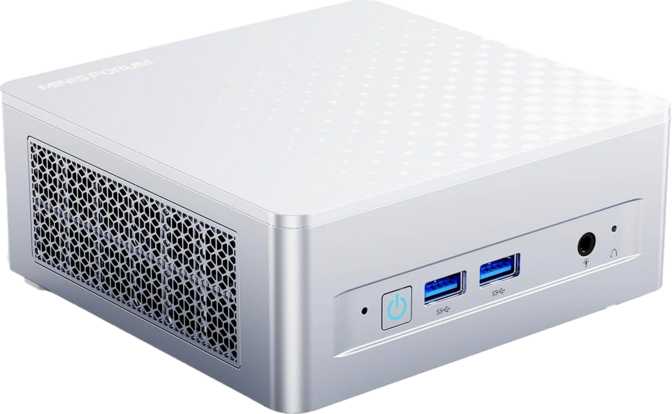
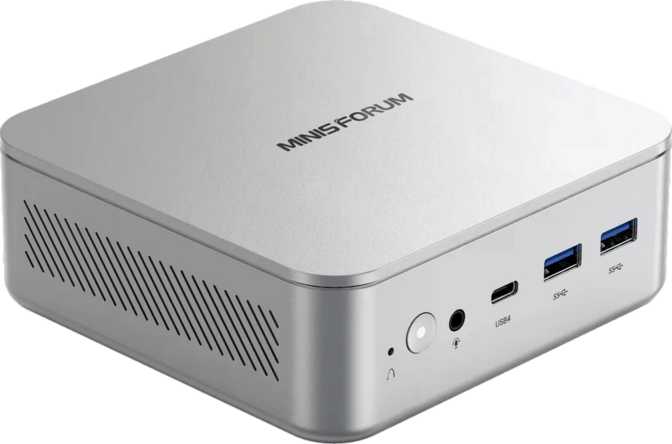
The N5 Air sits in a gray zone between true mini PC and compact desktop. At roughly 25 cm deep, 20 cm wide, and 20 cm tall, it occupies more volume than a palm-sized NUC-style box but far less than any tower. At 4 kg, it has substantial heft — this is not a machine you will slide behind a monitor on a flimsy mount and forget about. That weight signals internal density: real cooling infrastructure, real hardware, not a hollow shell around a single board.
What the Micro-ATX Form Factor Means
The Micro-ATX classification is worth unpacking for buyers unfamiliar with the form factor. This is not a barebones NUC or a repurposed laptop board shoved into a cube. It is a more generously proportioned platform that allows for better thermal headroom, more port real estate, and greater internal expandability than ultra-compact alternatives. Think of it as the middle ground between “tiny and limited” and “full desktop you would rather not own.”
The chassis communicates premium intent without theatrical flourishes. There are no RGB light strips or aggressive angular vents styled for a gaming aesthetic. The N5 Air presents as a professional device — appropriate on a home office desk, in a conference room AV rack, or mounted to the back of a display in a digital signage installation. For buyers who want power without spectacle, that restraint is a feature.
| Specification | Value |
|---|---|
| Form Factor | Micro-ATX |
| Width | 202 mm |
| Depth | 252 mm |
| Height | 199 mm |
| Weight | 4,000 g (4 kg) |
| Warranty | 1 Year |
CPU Performance That Does Not Apologize
4 nm Process • 8 Cores / 16 Threads • 45 W TDP • Up to 4.95 GHz Boost
Architecture and Processing Muscle
The processor inside the N5 Air is built on a 4-nanometer manufacturing process — the same cutting-edge node used in the finest mobile silicon available today. Eight cores with simultaneous multithreading give it sixteen logical threads of parallel processing, which means the machine does not hit a wall when you are running a browser with forty tabs, a video conference, a background file sync, and a spreadsheet update all at the same time. Most people never push hardware to that level — but the N5 Air handles it without visible strain.
The base clock speed is fast by any desktop standard, and the processor can boost considerably higher when a demanding burst task requires it. What makes this particularly meaningful in a compact chassis is that the architecture is built to extract maximum work from each watt. This is an efficient architecture, not just a fast one.
Real-World CPU Context
The PassMark multi-threaded score of nearly 30,000 places this processor firmly in the upper tier of workstation-class performance. Many traditional desktop processors used in corporate workstations from just two or three years ago score significantly below this threshold. The single-core score of 3,774 reflects a platform that handles single-threaded applications — legacy software, browser JavaScript, certain creative tools — without frustrating bottlenecks.
The 45-watt thermal envelope is notable. This is a processor designed to sustain high performance without requiring aggressive, noisy cooling. In practice, it means the N5 Air can run demanding workloads without becoming audibly disruptive — relevant for open-plan offices, bedroom setups, and any environment where fan noise matters.
Well above average for compact workstations
Strong single-thread for responsive everyday tasks
Boost
4.95 GHz
TDP
45 W
L3 Cache
16 MB
Instruction Set Support
Integrated Graphics: Far More Capable Than It Sounds
AMD Radeon 780M • RDNA 3.0 • 4 nm • 8.294 TFLOPS • DirectX 12 Ultimate
The Radeon 780M Explained
The phrase “integrated graphics” traditionally triggers an immediate downgrade in expectations. The AMD Radeon 780M — built on the RDNA 3.0 architecture, the same generational leap used in AMD’s dedicated mid-range desktop cards — rewrites that assumption entirely.
With 768 shading units running up to 2,600 MHz under load, and delivering over 8 teraflops of floating-point compute, the 780M is not a check-the-box graphics solution. It is genuinely capable integrated silicon, and it represents the strongest iGPU available in any mini PC platform at this performance tier.
To put 8+ teraflops in perspective: dedicated graphics cards from earlier generations sold specifically for gaming performed at similar or lower levels. The 780M supports DirectX 12 Ultimate, OpenGL 4.6, and OpenCL 2.1 — relevant for 3D modeling tools, video editors leveraging GPU acceleration, and developers running compute workloads. Hardware ray tracing support is present, though at this tier it is better suited to visualisation tasks than high-framerate gaming with full effects enabled.
| Specification | Value |
|---|---|
| Architecture | AMD RDNA 3.0 |
| Compute Performance | 8.294 TFLOPS |
| GPU Boost Clock | 2,600 MHz |
| Shading Units | 768 |
| TMUs / ROPs | 48 / 32 |
| Process Node | 4 nm |
| DirectX | 12 Ultimate |
| OpenGL / OpenCL | 4.6 / 2.1 |
| Ray Tracing | Supported |
| PCIe Version | PCIe 4.0 |
Display Capabilities: Four Screens, No Adapter Required
Four simultaneous display outputs set this machine apart from nearly every competitor in the compact PC space. The combination of two HDMI 2.1 ports and two DisplayPort outputs means you can run a proper four-monitor productivity array without a single adapter or hub. Each HDMI port supports the latest standard, capable of 4K at 120 Hz or 8K at lower refresh rates. For trading setups, video production multi-monitor workstations, or digital signage installations, this capability is rare at this price point and form factor.
2× HDMI 2.1
4K@120Hz capable
2× DisplayPort
High-refresh output
4 Independent
Simultaneous displays
Ray Tracing Ready
DX12 Ultimate support
Memory: Headroom Most Users Will Never Hit
64 GB DDR5-5600 Standard • 256 GB Maximum • Dual Channel
64 GB DDR5 as Standard
Shipping with 64 GB of DDR5 memory as the base configuration is not a minor specification note — it is a statement about who this machine is designed to serve. DDR5 at 5,600 MHz offers substantially higher bandwidth than the previous DDR4 standard, which directly benefits the integrated GPU. Unlike discrete graphics cards with dedicated video memory, the Radeon 780M draws from system RAM. Faster, larger RAM translates directly to better graphics performance, not just CPU responsiveness.
64 GB at the base level is more RAM than most users will need for the foreseeable future. Virtual machines, large dataset analysis, video editing timelines, heavy browser sessions, and cloud-native development environments all consume memory aggressively — and none of them will make the N5 Air sweat at this capacity.
The platform supports memory expansion to 256 GB maximum across two channels — a specification that moves this machine into territory typically occupied by workstation-class towers. For data scientists, software developers running memory-intensive build processes, or anyone managing large virtual machine environments, that ceiling provides genuine long-term headroom.
NVMe Storage
The included one-terabyte NVMe SSD operates over a PCIe 4.0 interface, delivering sequential read and write speeds that make even large file operations feel near-instant compared to older SATA SSDs. One terabyte handles most users’ primary operating system and application needs, with the expectation that external or networked storage handles bulk media archiving.
| Specification | Value |
|---|---|
| Installed RAM | 64 GB |
| DDR Standard | DDR5 |
| Speed (Installed) | 5,600 MHz |
| Speed (Max Support) | 7,500 MHz |
| Maximum Capacity | 256 GB |
| Memory Channels | Dual Channel |
| ECC Support | Not Supported |
| Specification | Value |
|---|---|
| Capacity | 1 TB (1,000 GB) |
| Interface | PCIe 4.0 NVMe |
| Form Factor | M.2 SSD |
| External Slot | Not Present |
Connectivity: A Port Selection That Embarrasses Larger Machines
USB 4 (40 Gbps) • Dual HDMI 2.1 • Dual DisplayPort • Dual Gigabit LAN • Wi-Fi 6E
USB 4 / Thunderbolt 4
2 ports • 40 Gbps each
USB 3.2 Gen 2
2 ports • 10 Gbps • Type-A
USB 2.0
1 port • Peripherals
HDMI 2.1
2 ports • 4K@120Hz
DisplayPort
2 ports • High-refresh
Gigabit Ethernet
2 ports • Dual LAN
Wi-Fi 6E
2.4 / 5 / 6 GHz bands
Bluetooth 5.2
Wireless peripherals & audio
Who Should Buy the Minisforum N5 Air
This machine is genuinely excellent for a specific audience — and wrong for another. Here is how to know which side you are on.
-
Home Office Power Users
Running multiple applications simultaneously without hitting a ceiling. Video conferencing, complex spreadsheets, creative work, and background tasks all fall within comfortable range. The 64 GB baseline gives multitasking headroom that entry-level mini PCs simply cannot match.
-
Multi-Monitor Productivity Setups
Four display outputs, natively, justifies this machine for traders, developers, video editors, and anyone working across multiple screens. No external GPU required, no USB display adapter compromises.
-
Home Lab and Network Builders
Dual Ethernet enables firewall appliance builds, NAS configurations with network interface separation, and dual-WAN setups. Add Thunderbolt 4 for high-speed peripheral connectivity and this becomes a remarkably capable home lab host.
-
Software Developers and Data Professionals
256 GB maximum RAM, 16 processing threads, fast NVMe storage, and strong single-core performance make this a legitimate development workstation. Multiple containers, large codebases, and several virtual machines simultaneously are all viable.
-
4K Media Center Builds
HDMI 2.1, hardware-accelerated 4K decode, and efficient idle power consumption make the N5 Air a capable, quiet living room media device — dramatically overpowered for the task, but silent and reliable.
-
A Dedicated Gamer
The Radeon 780M is the best integrated GPU at this tier, but modern AAA titles at 1080p high settings will challenge it. Older titles, esports-category games, and indie releases run well. Current-generation AAA games at high graphical fidelity do not.
-
Requiring a Discrete GPU From Day One
There is no PCIe slot for a graphics card. External GPU enclosures via Thunderbolt 4 are possible but add cost and bandwidth limitations. If a mid-range or high-end dedicated GPU is non-negotiable, a larger form factor is the correct choice.
-
On a Tight Budget
The N5 Air’s specification level positions it at the premium end of the mini PC market. If the workload does not genuinely require 64 GB of RAM, high-speed USB 4, or four display outputs, less expensive compact machines handle basic productivity tasks adequately.
Competitive Positioning
Where the N5 Air stands against the most logical alternatives in its purchase class.
| Against | Typical Competitor | N5 Air Has the Edge | N5 Air Falls Short |
|---|---|---|---|
| Ultra-compact mini PC | Intel NUC 13 Pro, Beelink SER7 | More RAM, 4 displays, dual LAN, USB 4 | Larger footprint, heavier |
| AMD APU mini PC | Minisforum UM790 Pro | Higher max RAM (256 GB), 4 displays | Similar GPU tier, price premium |
| Entry gaming mini PC | Minisforum HX100G | No discrete GPU dependency, quieter | Lower dedicated gaming ceiling |
| Mid-range laptop | Ryzen 9 laptop, 16 GB config | More RAM, better connectivity, upgradeable | No portability |
| Small form factor desktop | Intel Core i5/i7 SFF PC | Smaller, comparable multi-thread performance | No discrete GPU expansion |
The N5 Air’s combination of 256 GB max RAM, quadruple display output, dual Ethernet, and Thunderbolt 4 in a compact footprint has no direct equivalent at a comparable price point.
Honest Assessment: Strengths and Weaknesses
The memory situation — 64 GB standard, 256 GB supported — represents a forward-thinking approach to longevity. A machine you buy today and expect to use for four or five years benefits enormously from not hitting a memory ceiling in year two.
The four-display capability and dual Ethernet ports are not marketing bullets; they open real workflows that competing machines cannot support without additional hardware.
The Thunderbolt 4 implementation at 40 Gbps is the kind of connectivity that typically appears in business-class laptops and professional workstations, not mini PCs. Having two of those ports means external storage arrays, high-resolution display chains, and peripheral ecosystems that rival much larger systems.
The missing 3.5 mm audio jack will inconvenience users with wired headphone setups. The workaround — a USB audio adapter — costs money and desk space.
The integrated GPU ceiling is firm. The Radeon 780M punches well above its class, but anyone expecting current-generation gaming performance without a Thunderbolt-attached external GPU will be disappointed.
The one-year warranty is on the short end for a premium-priced machine; buyers expecting longer manufacturer coverage should factor in an extended warranty from the outset. The 4 kg weight is also worth acknowledging for anyone planning VESA mounting — confirm your mount’s load rating before committing to that installation approach.
Common Buyer Questions Answered
Straight answers to what real buyers search for before purchasing the Minisforum N5 Air.
Final Verdict
The Minisforum N5 Air is the answer to a specific and underserved question: what does a genuinely capable professional workstation look like when the brief is compact form factor, not desktop tower? The answer turns out to be impressively good. Four display outputs, dual Ethernet, Thunderbolt 4, 64 GB of fast DDR5, and a processor that scores near the top of its class in multi-threaded work — these are not compromised specifications dressed up in a small chassis. They are legitimate workstation credentials.
The limitations are clear: no discrete GPU pathway without external hardware, no audio jack, and a one-year warranty that asks you to trust the hardware early. For anyone whose workflow involves gaming at current-generation graphical settings, those limitations matter enough to redirect the purchase decision.
For everyone else — the developer managing containers, the creative professional editing 4K footage, the data analyst running large notebooks, the home lab builder who wants dual WAN with proper network separation, or the multi-monitor power user who has been told mini PCs cannot deliver four displays — the N5 Air makes a compelling, concrete case. It does not hedge. It commits to what it is, and what it is happens to be exactly right for a specific, large, and underserved audience.
Ideal For
Professional Workstation Users
Standout Feature
Quad Display + Dual LAN
Key Limitation
No Discrete GPU Slot
Also Note
No 3.5 mm Audio Jack