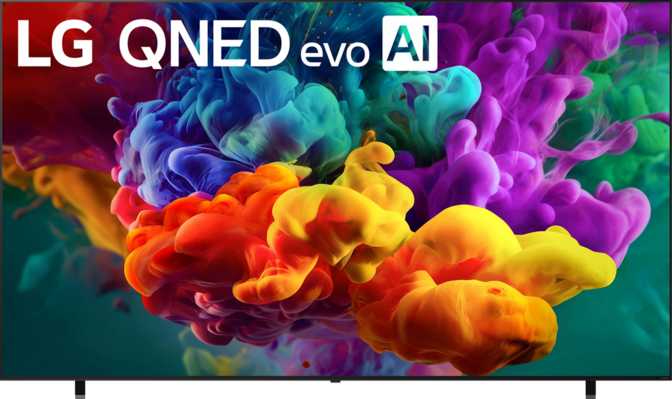
LG 100QNED84BU 100-Inch Mini-LED TV: Full Review and Honest Verdict
TVsExpert Score
There is a version of home cinema that does not require a projector, a blackout room, or a dedicated media space. The LG 100QNED84BU is that version — a 100-inch Mini-LED television that lands in a living room the way a statement piece of furniture does: it does not just occupy a wall, it redefines the entire room around it. At this screen size, the conversation shifts from "which TV should I buy" to "am I ready to commit to this scale of experience." This review answers that question honestly, for every type of buyer.
The 100QNED84BU sits at a technically demanding intersection: a panel large enough to rival a projection setup, backed by display and gaming specifications that go well beyond what most 100-inch alternatives offer. Whether those specifications justify the physical commitment this set demands is exactly what this review examines.
- 100-inch Mini-LED panel with 144Hz native refresh
- All four HDMI ports at version 2.1 standard
- Dolby Vision, HDR10, and HLG supported
- AMD FreeSync Premium across all HDMI ports
- Built-in subwoofer with Dolby Atmos support
- Google Assistant and Amazon Alexa native support
Key Specifications at a Glance
The numbers that define this television — and what each one means in practice
100"
Screen Size (99.5" viewable)
4K UHD
3840 × 2160 Resolution
144Hz
Native Refresh Rate
4× HDMI
All HDMI 2.1 Standard
10-bit
1.07 Billion Colors
Wi-Fi 5
+ Bluetooth 5.3
Atmos
Dolby Atmos + Subwoofer
68 kg
Pro Installation Required
Design and Physical Presence
Build quality, dimensions, and what owning a 100-inch television actually requires
Scale You Need to Plan For
The LG 100QNED84BU spans just over 2.2 meters wide and stands roughly 1.28 meters tall. It weighs approximately 68 kilograms — about the same as an average adult. This is not a television you rearrange on a whim, and it is not something two people can casually mount on a Sunday afternoon. Wall installation requires professional help and a structurally sound surface. If you are placing it on a stand, the furniture beneath it needs to be purpose-built for this footprint.
Shipping and delivery logistics are worth planning carefully before you order. Measure doorframes, hallways, and stairwells in advance. At 100 inches, this step is not just recommended — it is essential.
Build Quality and Profile
Despite its scale, the chassis sits at just under 51mm deep — trim for a panel generating this much light across such a large surface area. Mini-LED backlighting allows for tighter panel construction than you might expect, replacing the thicker light chambers used in older full-array LED designs.
The set supports VESA mounting, giving professional installers a standardized attachment point for custom wall brackets. The anti-reflection coating on the panel surface is a meaningful inclusion at this size — a 100-inch display catches ambient light from nearly every corner of a room, and without effective coating, bright windows or ceiling lights can wash out large portions of the image during daytime use.
The built-in ambient light sensor reads the room's conditions and adjusts the panel's output automatically, reducing eye fatigue without requiring manual intervention every time conditions change. It is a small feature that has an outsized practical impact at this screen size.
Display Performance: What Mini-LED Actually Delivers
Panel technology, color accuracy, motion handling, HDR support, and viewing angles — all translated into real-world meaning
The Technology Explained
Mini-LED is a backlighting architecture, not a panel type. The screen itself remains an LCD — liquid crystal layers controlling light passage — but the light source behind it has been upgraded from conventional full-array LEDs to thousands of much smaller LEDs grouped into independent dimming zones.
The practical result: darker blacks and brighter highlights can coexist on screen simultaneously, something standard LED-backlit LCD televisions struggle with. This matters most in high-contrast scenes — a candle flame against a dark room, stars against a night sky, a floodlit stadium against a black background. Where a conventional LED television would bloom and bleed light into surrounding dark areas, Mini-LED tightens that significantly.
Color Depth and Accuracy
The panel renders over one billion distinct color values. For context, standard displays work with approximately 16 million. The jump to 10-bit color processing means gradients — sunsets, skin tones, deep shadows — transition smoothly rather than stepping in visible banding.
For a screen this large, that smoothness is a genuine display requirement. At 100 inches, a color banding artifact that reads as a faint stripe on a 65-inch set becomes an obvious, distracting flaw. The 10-bit processing addresses this directly at scale, where it matters the most.
4K at 100 Inches: Pixel Density Reality
The native 3840 × 2160 resolution spread across 99.5 inches works out to 44 pixels per inch — significantly lower than the roughly 68 ppi on a 65-inch 4K set. This does not mean the image looks soft. It means your seating distance is non-negotiable.
Optimal Viewing Distance
3.5 to 4.5 meters from screen to seating. Sitting within 2 meters will reveal pixel structure in fine-detail content.
144Hz and AMD FreeSync Premium
The 144Hz refresh rate operates differently depending on your source. For broadcast and streaming content, it reduces the judder in panning camera shots that becomes particularly noticeable at this scale. For gaming, it enables high frame rate output that feels immediate rather than delayed.
AMD FreeSync Premium synchronizes the display's refresh to the source's output in real time, eliminating screen tearing even during demanding game sequences where frame rates fluctuate. At 100 inches, tearing artifacts that are mildly annoying on a monitor become impossible to ignore.
HDR Support
Three HDR formats are fully supported: HDR10 (the baseline standard found on all HDR content), Dolby Vision (dynamic, frame-by-frame HDR used by Netflix, Disney+, and Apple TV+), and HLG (broadcast and live sports content).
Viewing Angles
The panel is rated for 178 degrees of viewing angle in both horizontal and vertical planes — meaning the image holds its contrast and color accuracy almost to the physical edge of the screen's plane. LCD panels historically degrade when viewed off-axis, with colors shifting and contrast collapsing. For a screen this wide, where even centrally-seated viewers can be at an angular offset from the screen edges, maintaining image integrity across near-extreme angles is more than a cosmetic spec — it is a functional requirement.
Audio: Surprisingly Capable for an Integrated System
Built-in speakers, Dolby Atmos support, and external audio connection options
Built-In Sound at Scale
The speaker system includes a built-in subwoofer alongside stereo drivers — an arrangement that is less common than it should be at this price tier. At 100 inches, a thin, front-facing soundstage feels tonally mismatched with the visual scale. The subwoofer helps anchor low-frequency content so that action sequences and music do not feel hollow relative to what is happening on screen.
The system supports Dolby Atmos, the object-based surround format that places sounds in three-dimensional space rather than fixed channels. Whether a built-in speaker array can fully realize Atmos spatial audio is a fair question, and the honest answer is: partially. You will hear more directional dimensionality than a standard stereo setup provides, but a dedicated soundbar or home theater system will still outperform it meaningfully. For casual viewing, the included audio is genuinely adequate.
External Audio Options
The connection options for connecting a separate audio system are comprehensive. For those who want to match the audio ambition to the visual scale, every major connection method is covered:
- HDMI eARCLossless Dolby Atmos passthrough to soundbar or AV receiver — no compression, full fidelity
- HDMI ARCStandard audio return for compatible soundbars and receivers via existing HDMI cable
- Digital Audio OutputCompatible with legacy AV receivers that predate HDMI
- 3.5mm Headphone JackPrivate listening without additional hardware or wireless setup
Connectivity: A Well-Stocked Rear Panel
Ports, wireless standards, and what each connection option means for real-world device setup
HDMI 2.1 Across All Ports
All four HDMI ports run at version 2.1 — the current high-bandwidth standard required for 4K content at 120Hz or higher, uncompressed HDR, and Variable Refresh Rate gaming. Each port can handle a 4K/144Hz signal, meaning you can connect a gaming PC, a PS5, an Xbox Series X, and a streaming device simultaneously without any of them being limited by a lower-bandwidth port.
Wireless and Wired Networking
Wi-Fi 5 provides ample bandwidth for 4K HDR streaming — which requires roughly 25 Mbps at peak, well within Wi-Fi 5's practical ceiling. Wi-Fi 6 is absent, which matters only in heavily congested home networks with many competing devices. A wired ethernet port remains the most reliable option for a stationary installation of this kind and is present here.
USB Recording and Extras
Two USB ports cover external storage, and USB recording allows you to connect an external drive and record broadcast content directly to it — bypassing the need for a separate PVR device. Miracast wireless display mirroring is supported, allowing Android devices to cast their screen to the TV without sharing the same Wi-Fi network. No external memory card slot is present.
| Connection | Specification | Practical Use |
|---|---|---|
| HDMI | 4 ports — all HDMI 2.1 | 4K/144Hz, VRR, HDR from all sources simultaneously |
| Wi-Fi | Wi-Fi 4 (802.11n) + Wi-Fi 5 (802.11ac) | 4K streaming and smart TV services |
| Ethernet | 1 × RJ45 port | Wired network — most reliable for stationary use |
| Bluetooth | Version 5.3 | Wireless headphones, smartphone connectivity |
| USB | 2 × USB ports | External storage, USB recording to external drive |
| Audio Output | HDMI ARC, HDMI eARC, 3.5mm, Digital Out | Soundbar, AV receiver, headphones, legacy audio |
| Screen Mirroring | Miracast | Wireless Android device screen casting |
Smart TV Platform and Voice Control
LG webOS, voice assistant compatibility, and smart home ecosystem support
LG webOS
The built-in smart TV platform is LG's webOS — one of the more mature and consistently updated operating systems in the category. Navigation uses a point-and-click magic remote, and the platform covers all major streaming services. A built-in browser is present for open web access, and the sleep timer, child lock, and USB recording features are all available through the platform interface without requiring additional hardware.
Smartphone remote support is included, letting you control the set from an iOS or Android device when the physical remote is not at hand.
Voice Assistant and Ecosystem Compatibility
Voice control spans two of the three major platforms, and Apple device integration is partially covered through AirPlay:
- Google AssistantVoice search, content discovery, and Google smart home device management
- Amazon AlexaNative support for Alexa-based smart home ecosystems
- AirPlay 2iPhones, iPads, and Macs can stream or mirror content directly to the TV
- Apple HomeKit — Not SupportedThe TV cannot be added to HomeKit scenes or Siri automations. AirPlay content streaming still works fully.
Real-World Usage: Who This TV Is — and Is Not — For
An honest assessment of the buyers who will get maximum value from the 100QNED84BU, and those who will not
The Ideal Buyer
This television is built for spaces that can accommodate both its physical scale and its viewing distance requirements. A dedicated home cinema room, a large open-plan living area, or a commercial installation space — boardroom, lobby, sports bar — are natural fits.
- Upgrading from a projector or 75–85-inch TV and want a genuine step-change in immersion
- Households where gaming is a primary use — 144Hz, HDMI 2.1, and FreeSync Premium together at 100 inches is a rare combination
- Sports viewers who want a broadcast-scale perspective at home — football, basketball, and motorsport benefit enormously
- Movie enthusiasts with a room depth of 3.5 meters or more from screen to primary seating
- Commercial or semi-commercial installations requiring a large, reliable, feature-rich display
Who Should Look Elsewhere
If your room depth from screen to primary seating is less than three meters, this TV will work against you visually. At close range, the pixel density limitation becomes apparent and the sheer scale becomes fatiguing rather than immersive.
- Rooms with under 3 meters viewing distance — pixel structure becomes visible and close-range immersion turns to fatigue
- Brightly-lit rooms with large windows opposite the screen — anti-reflection coating helps but cannot eliminate the challenge at this surface area
- Apple HomeKit smart home users — the ecosystem integration gap here is real and not workaround-able
- Anyone wanting an easy-to-move, low-footprint setup — 68 kg and professional installation are part of the package
- Heavy Amazon Prime Video users who rely on HDR10+ — content will downgrade to standard HDR10 playback on this set
Competitive Positioning
How the LG 100QNED84BU sits against its closest alternatives in the large-format television market
The 100-inch segment is genuinely sparse. Alternatives fall into two categories: similarly-priced LED-backlit LCD sets from competing manufacturers, or significantly more expensive OLED and QLED panels at smaller sizes. Against standard LED LCD competitors at 100 inches, the Mini-LED backlighting and 144Hz panel are meaningful differentiators. Against OLED sets at 85 inches, the comparison is more nuanced — but a 15-inch screen difference represents roughly 40% more surface area, and the 100QNED84BU's price point typically undercuts OLED flagships considerably.
| Feature | LG 100QNED84BU | Typical 100" LED LCD | 85" OLED Alternative |
|---|---|---|---|
| Panel Technology | Mini-LED LCD | Standard Full-Array LED | OLED Self-Emissive |
| Refresh Rate | 144Hz | 60Hz – 120Hz typical | 120Hz typical |
| HDR Formats | HDR10 + Dolby Vision + HLG | HDR10, sometimes Dolby Vision | HDR10 + Dolby Vision + HLG |
| HDMI 2.1 Ports | 4 ports (all 2.1) | 2 – 4 (varies by model) | 4 ports |
| AMD FreeSync Premium | Rarely at this screen size | Varies by model | |
| Screen Size | 100" | 100" | 85" |
| Built-in Subwoofer | Rarely included | Rarely included |
Strengths and Honest Weaknesses
An unfiltered look at where the LG 100QNED84BU earns its price — and where it asks for compromise
What It Gets Right
The 100QNED84BU's primary strength is the combination of size, refresh rate, and panel technology at a price point that makes 100-inch television ownership feasible without a commercial AV budget. The four HDMI 2.1 ports are a practical luxury — you will not be juggling cables or input-switching as you add new devices, and every source gets full-bandwidth treatment.
The integrated subwoofer raises the out-of-the-box audio experience enough that casual viewers will not immediately feel the need for supplementary speakers. The anti-reflection coating and ambient light sensor reflect real-room deployment thinking rather than darkened showroom optimization.
The AMD FreeSync Premium implementation at 144Hz across all four HDMI 2.1 ports is the standout combination for gaming households. It is simply not a configuration available on many competing 100-inch panels at any price, making the 100QNED84BU a rare choice for buyers who want the largest possible screen with serious gaming credentials.
Where It Asks for Compromise
The 44 ppi pixel density is the number that defines this set's one non-negotiable requirement: seating distance. Ignore it and the viewing experience suffers. This is not exactly a flaw, but it is a hard constraint that cannot be engineered around after purchase — it must be planned for before the set arrives.
The one-year warranty is brief for a product at this price and physical complexity. Given that professional installation alone represents a meaningful sunk cost, extended protection plans are worth budgeting for alongside the television itself. The absence of HDR10+ is minor for most buyers but worth acknowledging for heavy Amazon Prime Video users.
Wi-Fi 6 would be appropriate at this price tier, particularly for buyers in dense network environments. Only two USB ports feels lean for a large-format installation where connecting multiple peripherals simultaneously is common. Apple HomeKit integration is absent, meaningfully limiting smart home options for iOS-first households.
Answers to Questions Buyers Actually Ask
Common concerns addressed before you commit to a 100-inch television
Recommended for the Right Room
The LG 100QNED84BU is not a television for every buyer, and it makes no attempt to be. It is a considered, technically capable choice for a specific type of owner: one with the room, the seating distance, and the intention to build a large-format viewing environment rather than simply replace an existing set.
What you get is a rare combination at 100 inches — Mini-LED contrast, 144Hz motion performance, full HDMI 2.1 across every port, and one of the most complete HDR format lineups available outside of flagship OLED sets. The smart platform is mature and well-supported. The audio is better than the category standard without needing supplementary equipment to function adequately.
What you accept is the viewing distance requirement, brief warranty coverage, and a physical installation that demands planning and professional help. These are not deal-breakers — they are simply the terms of 100-inch television ownership.
Buy if:
- Your room allows 3.5 meters or more viewing distance
- Gaming, sports, or large-screen cinema is your primary use
- You want 144Hz with VRR and FreeSync on all HDMI ports
- Upgrading from a projector or existing large-format display
Skip if:
- Your viewing distance is under 3 meters
- Your room receives significant direct natural light
- Apple HomeKit integration is important to your setup
- Amazon HDR10+ is your primary HDR format requirement