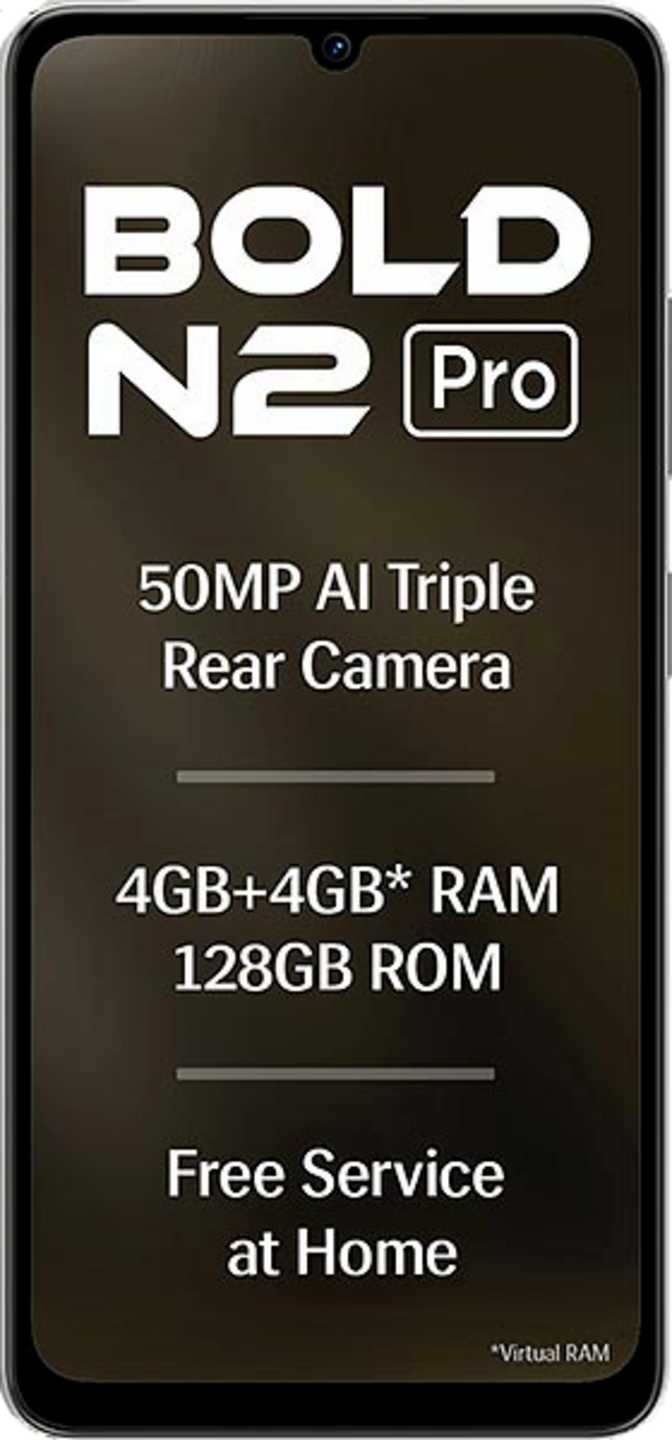
Lava Bold N2 Pro Review: The Budget Phone That Gets the Basics Right
SmartphonesQuick Verdict
The Bold N2 Pro earns its position through a deliberate bundle — 120Hz display, NFC, IP54 splash resistance, a retained headphone jack, 128GB storage, and Android 15 — accepting defined trade-offs in processing power and camera hardware that are honest for its price tier.
Design and Build Quality
Size, Weight, and First Impressions
At 201 grams, the Bold N2 Pro sits at the heavier end of the budget segment. That weight is a direct consequence of the large display footprint and the oversized battery packed inside. In hand, it feels substantial rather than premium — this is a plastic-bodied phone that doesn't pretend otherwise. The build is functional and sturdy without the glass or metal finishes found on phones costing significantly more.
What genuinely stands out is splash and dust resistance. An IP54 rating means the phone handles rain, sweat, dusty pockets, and kitchen counter splashes without incident. This isn't deep submersion protection, but for everyday life IP54 is a meaningful and frequently absent feature at this price point — delivering real-world peace of mind that many competing budget handsets simply don't offer.
Ports and Physical Controls
The USB-C port is a welcome choice that aligns the Bold N2 Pro with the current cable standard, making it compatible with most modern chargers. The 3.5mm headphone jack is present and remains a genuine differentiator as more budget phones quietly drop it. Wired audio users won't need adapters here.
-
IP54 Splash & Dust ResistanceRain, sweat, and dusty pockets — covered
-
201g WeightSubstantial feel — balanced for the screen size
-
USB-C Charging PortUniversal cable standard — no proprietary connector
-
3.5mm Headphone JackPlug any earphones in directly — no adapter needed
-
Physical Fingerprint ScannerFast, reliable biometric unlock
-
Dual SIM + MicroSD SlotTwo SIM cards and expandable storage simultaneously
Display: Big Screen, Budget Reality
6.75"
IPS LCD Panel
120Hz
Refresh Rate
260
Pixels Per Inch
HD+
720 × 1600px
What the Panel Delivers
IPS technology provides decent viewing angles and accurate enough color reproduction for everyday use — photos display without obvious distortion and streaming video is comfortable to watch. The panel reliably handles the core use cases most buyers bring to it.
The 120Hz refresh rate is a meaningful inclusion at this tier. Many competing phones still ship at 60Hz, where scrolling feels visibly slower and less immediate. The higher refresh makes everyday navigation feel more fluid and responsive. Once experienced, going back to a 60Hz screen feels like a clear regression.
The Resolution Trade-Off
Stretching HD+ resolution across 6.75 inches lands at roughly 260 pixels per inch. Text is sharp enough for comfortable reading and standard-definition video looks fine, but detail-rich images and fine text examined closely will reveal the limits — a 1080p phone of similar size is noticeably sharper.
No HDR Support
This display supports neither HDR10 nor Dolby Vision. Streaming services deliver standard dynamic range only. For casual viewing this is a non-issue; for a media-first phone, it is worth acknowledging.
Performance: Understanding the Unisoc T7250
What This Chip Actually Means
The Unisoc T7250 is an entry-level processor built on a 12-nanometer manufacturing process. It uses an eight-core design split between two faster cores for demanding tasks and six efficiency cores for lighter workloads — a configuration that balances processing headroom with power consumption.
In real-world terms, the benchmark numbers position this chip firmly in the budget tier. Single-core performance reflects responsiveness in individual app operations, while the multi-core result reflects overall system throughput. Both figures are sufficient for smooth daily use but sit well below the mid-range chips found in phones costing two to three times as much.
The graphics processor runs at 850MHz with 64 shader units — adequate for the display's resolution and for casual 2D gaming, but not designed for sustained demands of graphically intensive 3D titles.
Benchmark Context
Entry-level tier — adequate for app responsiveness
Handles multitasking and parallel workloads adequately
What You Can and Cannot Do Comfortably
- Messaging, calls, and email
- Social media and web browsing
- Music, podcasts, and video streaming
- Maps, navigation, and GPS apps
- Casual games, puzzles, and card titles
- Light 2D games and RPGs
- High-fidelity 3D mobile games
- Heavy simultaneous multitasking
- Large app installs take noticeably longer
- Background app reloads during frequent switching
- Extended gaming sessions risk thermal throttling
RAM, Storage, and Expandability
4GB
Physical RAM
Expandable to 12GB via virtual RAM
128GB
Internal Storage
Generous for photos, apps, and media
MicroSD
Expansion Slot
Add storage without removing a SIM
DDR4
RAM Standard
Reliable modern standard at 1866MHz
The virtual RAM feature uses a portion of internal storage to simulate additional working memory. It reduces how often apps reload when switching between them, though the benefit is modest compared to physically larger RAM configurations.
Camera System: Capable for the Category
Main Camera
The 50-megapixel primary sensor is the headline figure, but megapixel count alone tells you very little about real-world image quality. What matters is how the camera handles focus and light — and here the Bold N2 Pro makes reasonable, if unsurprising, choices for its tier.
Phase-detection autofocus enables quick, reliable subject locking in good light. Continuous autofocus during video recording keeps subjects sharp without manual adjustment. The manual controls available — ISO, white balance, exposure compensation, and focus — are unusually comprehensive for this price bracket, giving hands-on photographers genuine room to experiment.
Video recording tops out at 1080p at 30 frames per second — the standard expectation here. Adequate for sharing and everyday documentation, but not suited to high-quality video production.
Notable Absences
- No optical image stabilisation — hand-held video and low-light shots are more prone to blur
- No back-illuminated sensor — low-light performance falls off more quickly than BSI-equipped rivals
- No optical zoom — digital zoom degrades image quality as you pull in
Camera Feature Overview
- Main Camera 50MP
- Front Camera 8MP
- Phase-Detection Autofocus
- Continuous AF in Video
- Manual Controls (ISO, WB, EV)
- HDR Mode
- Panorama & Timelapse
- Burst Mode
- Optical Zoom
- Optical Image Stabilisation
- Max Video Quality 1080p / 30fps
Battery Life and Charging
5,000
mAh Capacity
Full day to day-and-a-half endurance for most users
10W
Wired Charging
Full charge in approximately two hours from empty
Included
Charger in Box
No need to purchase a separate charging adapter
Endurance
The large battery is one of the Bold N2 Pro's most practical strengths. A typical user — someone who browses, messages, takes photos, and watches occasional video — should reach the end of a full day without reaching for a charger. Light users may stretch to a day and a half comfortably.
The efficiency-oriented processor contributes here too. Entry-level chips draw less power under sustained load than more powerful alternatives, producing battery endurance that often pleasantly surprises users coming from older or cheaper handsets.
Charging Speed Reality
The 10W wired charging rate means a full recharge from empty takes around two hours — not fast by current standards, where many mid-range phones charge at 25W to 67W, but not frustratingly slow either. Overnight charging is the most natural usage pattern for most people, and 10W fits that routine without difficulty.
Not Available
- No wireless charging
- No reverse wireless charging (cannot top up accessories or other devices)
Software: Android 15 Clean Experience
What You Get Out of the Box
Running Android 15, the Bold N2 Pro ships with one of the most current Android versions available. This matters more than it might seem — newer Android versions include improved privacy architecture, better background process management, and updated security frameworks that older versions simply lack.
The interface feels clean rather than bloated. Dynamic theming adapts the system color scheme to the wallpaper, widgets are supported, dark mode is available system-wide, and split-screen multitasking and picture-in-picture playback work natively without third-party additions.
Privacy and Productivity Features
Connectivity and Features
What's Included
-
Bluetooth 5.2A current, stable version for wireless earphones, speakers, and accessories
-
NFCEnables tap-to-pay, quick device pairing, and card emulation — increasingly expected even at budget prices
-
GPS + Galileo NavigationEuropean satellite support improves positioning accuracy where GPS alone performs inconsistently
-
Wi-Fi 4 & Wi-Fi 5 (802.11n/ac)Connects efficiently to modern routers — handles streaming and downloads on typical home networks well
-
4G LTE — Up to 300Mbps DownloadMore than adequate for mobile browsing, streaming, and navigation in most real-world conditions
-
Dual SIM SupportCarry two numbers simultaneously — useful for work/personal separation or international travel
What's Not Here
-
No 5G SupportThis is a 4G-only phone. In regions where 5G is actively rolling out, this will limit peak mobile speeds and could age poorly over a long ownership period.
-
No GyroscopeAffects AR apps, gyro-controlled games, and 360-degree video. A niche limitation but a real one for specific use cases.
-
No Infrared SensorCannot be used as a TV or appliance remote — a minor omission that some users will notice.
-
No aptX or LDAC Audio CodecsWireless audio quality is limited to standard Bluetooth performance — no hi-res wireless audio support.
-
No Stereo SpeakersSingle speaker output — acceptable for calls and notifications, less immersive for media.
Who the Lava Bold N2 Pro Is For
- Want a large, smooth-scrolling screen for browsing and media without overspending
- Prioritise full-day battery endurance over fast charging
- Want NFC for contactless payments built in at a budget price
- Still use wired earphones and don't want to carry an adapter
- Take casual photos in good lighting and don't push camera limits
- Value a clean Android 15 experience with solid privacy controls
- Are buying a first smartphone, an upgrade from an older handset, or a reliable secondary device
- Play graphically intensive 3D mobile games and expect smooth, high-detail performance
- Regularly shoot in low light and expect clear, detailed photos
- Need 5G connectivity now — or will before you replace this phone
- Value display sharpness highly — a 1080p screen at this size is noticeably clearer
- Do heavy multitasking across demanding apps and can't tolerate background app reloads
- Rely on AR apps or gyroscope-dependent gaming controls regularly
Competitive Positioning
The Bold N2 Pro operates in a dense field. The table below reflects general category trends against typical budget Android alternatives — phones from Redmi, Realme, and Samsung's A-series competing in the same price bracket.
| Feature | Lava Bold N2 Pro | Typical Budget Competitor |
|---|---|---|
| Display Refresh Rate | 120Hz | 90Hz or 60Hz |
| NFC | Often absent | |
| 3.5mm Headphone Jack | Increasingly removed | |
| Base Internal Storage | 128GB | Often 64GB |
| 5G Support | Varies by model | |
| Splash / Dust Resistance | IP54 | Often absent |
| Android Version at Launch | Android 15 | Android 14 or older |
| Optical Image Stabilisation | Occasionally present | |
| Processor Tier | Entry-level | Varies — often mid-entry |
Competitors often gain ground in camera hardware, processor speed, and 5G availability. The Bold N2 Pro's edge is its combination of NFC, headphone jack, 128GB base storage, IP54, and Android 15 in a single package — few rivals deliver all five simultaneously at this tier.
Honest Assessment
Where It Genuinely Earns Its Keep
The Bold N2 Pro makes a credible everyday case through the combination of features it includes rather than any single standout specification. The 120Hz refresh rate creates a scrolling experience that feels more fluid than most phones at this price. The battery delivers on its promise of a full day without anxiety. NFC, the headphone jack, fingerprint scanner, USB-C, and expandable storage form a connectivity package that is deliberate rather than compromised.
The software position is a genuine positive. Android 15 out of the box — with a solid privacy toolkit, multi-user support, and a clean interface — is not a given at this tier. These are features that improve daily life quietly and consistently, without drawing attention to themselves.
Where the Compromises Show
The processor is firmly entry-level — it handles ordinary tasks without complaint but resists being pushed. Anyone upgrading from a mid-range device should recalibrate their expectations: app loading takes a beat longer and multitasking has a clear ceiling.
The camera performs in good light and disappoints in poor light — an expected outcome from a sensor without back-illumination or optical stabilisation. It suits casual photography but not users who treat their phone camera as a primary imaging tool.
The absence of 5G is a practical concern whose severity depends entirely on the buyer's geography and ownership timeline. In many markets, 4G remains the realistic daily experience for years ahead. In others, this decision will age poorly before the hardware does.