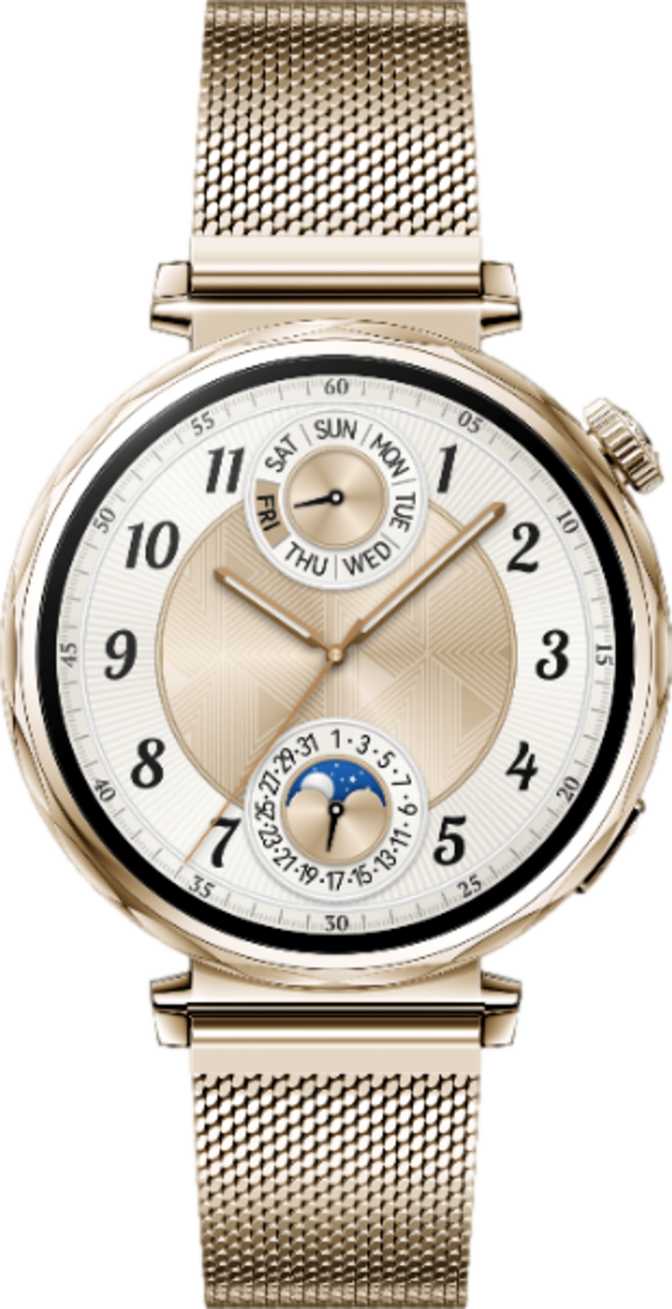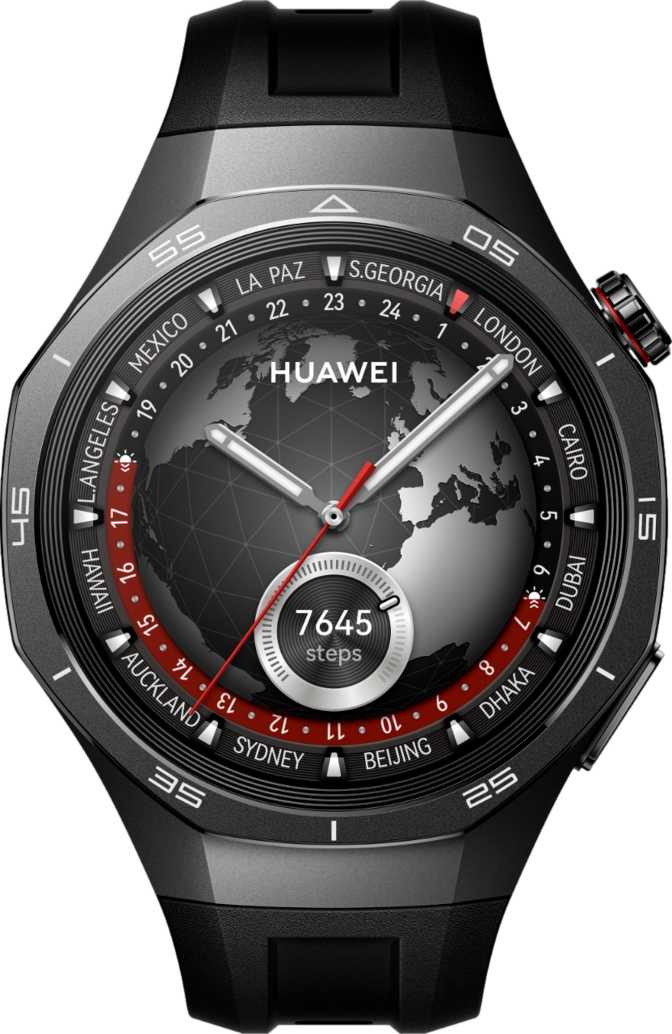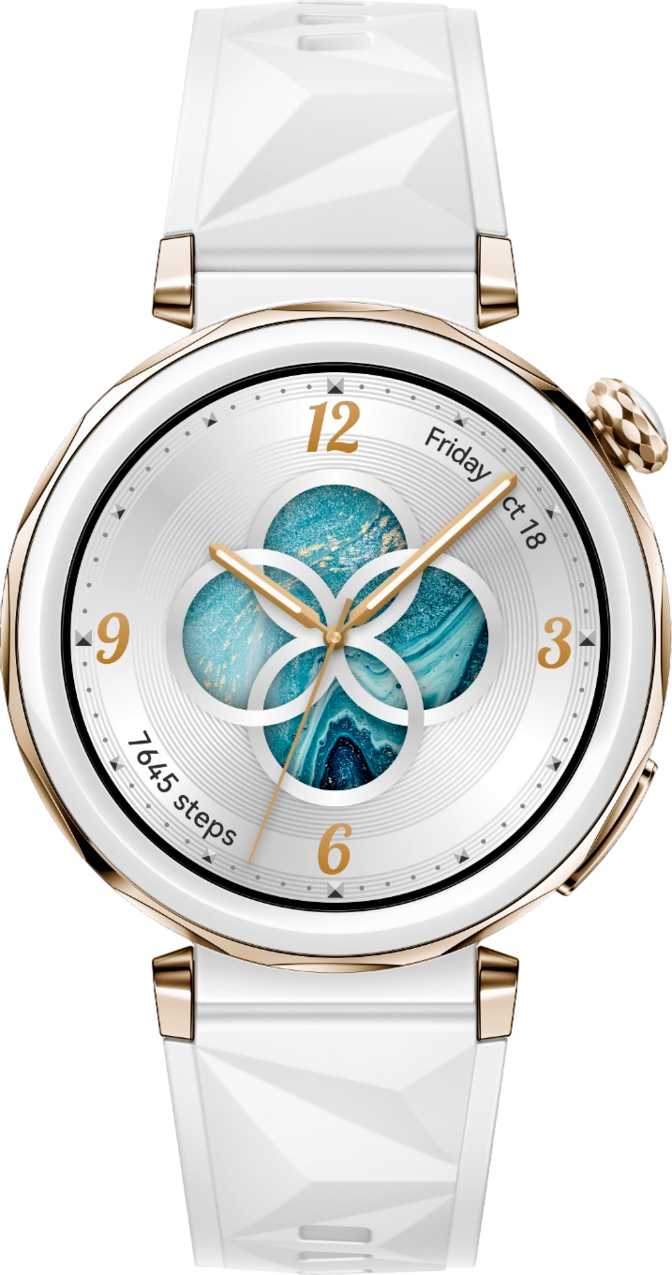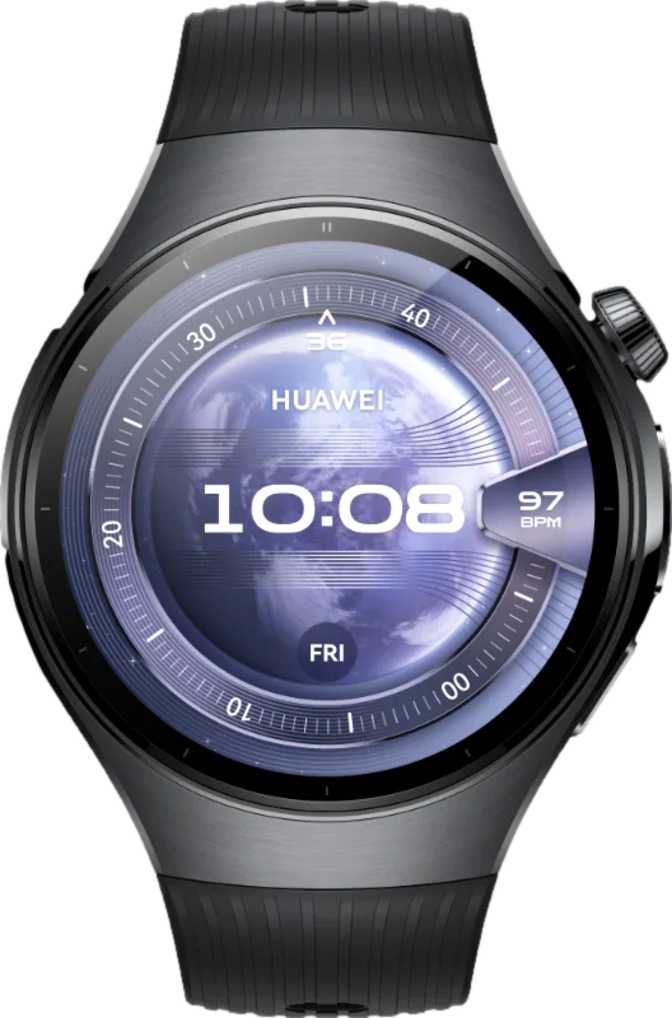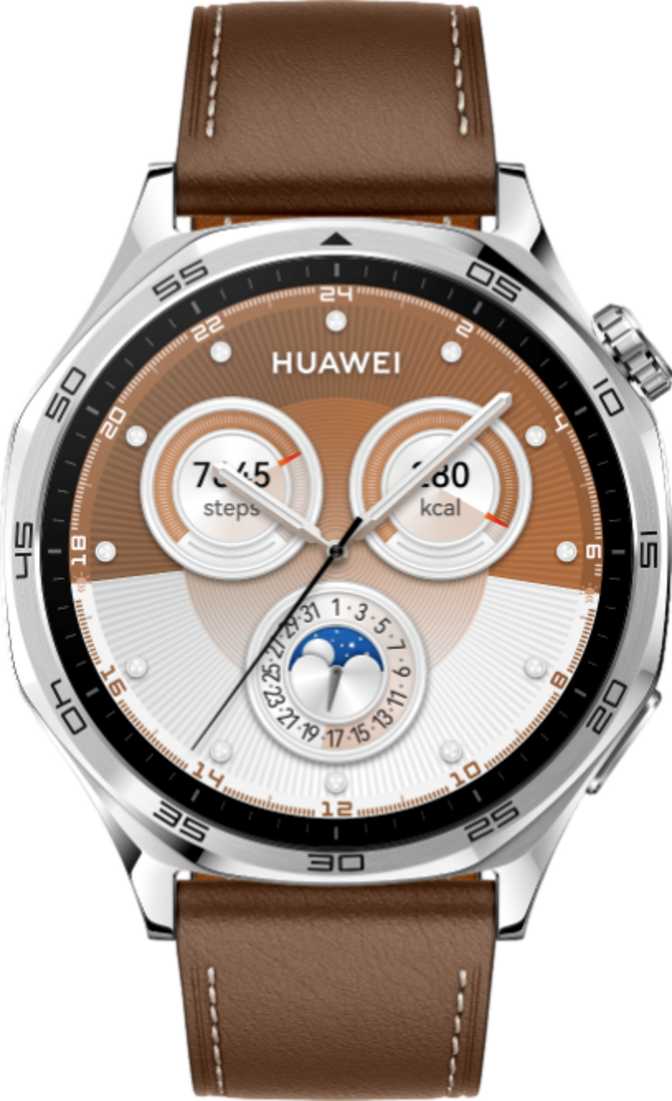
The Huawei Watch GT 5 is a focused health and fitness watch that prioritizes battery endurance and sensor depth over app ecosystem breadth. For the right buyer, it consistently outperforms its price class.
Overall Rating
Design and Build Quality
Physical experience, materials, and wearability assessed
Size and Fit
At 45.8mm across and 10.7mm thin, the GT 5 occupies a naturally comfortable position on most wrists. Many competing watches creep toward 12–13mm in thickness, creating awkward bulk under a shirt cuff. The GT 5 avoids that entirely.
Weighing just 48 grams with the band, this watch is light enough that sleep tracking feels effortless — most wearers genuinely forget it's there by the second night.
Display Quality
The 1.43-inch AMOLED panel runs at 326 pixels per inch — sharper than most laptop screens. Text is crisp, watch faces are detailed, and true AMOLED blacks make everything pop in a way LCD and MIP displays simply cannot match.
The always-on display mode keeps time visible without a wrist raise. AMOLED handles this efficiently — dark watch face backgrounds draw almost no power — so enabling it has minimal impact on battery endurance.
Durability and Climate Range
Dual-rated with IP68 and 5 ATM to 50 metres, pool swimming, rain, and accidental submersion are handled without concern. The operating range from -20°C to 45°C covers everything from skiing to working outdoors in summer heat.
Honest note: the GT 5 does not use sapphire crystal or branded scratch-resistant glass. Those who regularly work with their hands may want to add a screen protector for long-term peace of mind.
Band Compatibility: The 22mm band width is an industry standard. Because the band is user-replaceable, you can swap between a sport silicone strap and a dressier option without buying a second watch — and the aftermarket selection is extensive.
Performance and Sensor Suite
What the GT 5 measures, how it measures it, and what that means for you
Heart Health Monitoring
Continuous heart rate monitoring runs throughout the day and during every workout. Over weeks of use, the GT 5 tracks resting heart rate as a baseline — a figure that meaningfully reflects cardiovascular fitness improvements that step counts alone will never show.
The watch issues alerts for both abnormally high and low heart rates and flags irregular rhythm patterns when detected. What it does not include is an ECG function — the kind producing a medical-grade single-lead trace available on some competing devices.
Blood Oxygen and Body Temperature
The SpO2 sensor measures blood oxygen saturation — most relevant for altitude training, recovery awareness, and sleep quality monitoring. Paired with the onboard body temperature sensor, the Huawei Health app can identify meaningful patterns that heart rate data alone cannot surface.
A temperature deviation during sleep combined with a blood oxygen dip is a signal worth noticing. Having both sensors in the same device, rather than relying on heart rate alone, is a genuine advantage over many watches at this price tier.
GPS and Navigation Accuracy
The GT 5 pairs standard GPS with the Galileo satellite network — a constellation that adds coverage accuracy in urban canyons, dense forest cover, and challenging terrain where basic GPS can struggle. The result is more reliable route recording for outdoor runners, hikers, and cyclists.
There is no fast GPS lock feature, so the first satellite acquisition of the day may take a few extra seconds. Waiting at the watch face for the GPS signal to confirm before setting off is a minor but real habit to build into your pre-workout routine.
VO2 Max and Recovery Readiness
VO2 max estimation — a measure of aerobic fitness capacity derived from heart rate and movement data — is tracked across weeks and surfaced in the Huawei Health app. Improvements in this figure are among the clearest indicators that training is producing measurable results.
The readiness and recovery indicator uses recent sleep quality, heart rate variability patterns, and activity load to advise whether your body is prepared for a hard session. For anyone following a structured training plan, this changes how intelligently you can pace your weekly effort.
Battery Life: The GT 5's Strongest Card
Endurance figures explained in practical everyday terms
Typical daily use including notifications, sleep tracking, and several recorded workouts per week
With GPS actively recording — sufficient for a full back-to-back outdoor weekend without needing a charge
Wireless charging with no contacts to align — plug in during a morning routine and it's ready before you leave
A 14-day runtime is meaningful in a way that changes daily life. Most comparable smartwatches from competing brands land in the 2–5 day range, meaning a buyer upgrading goes from charging multiple times per week to roughly twice per month.
A user who wears the watch continuously, tracks sleep, and completes three or four recorded workouts per week can realistically expect 10 or more days per charge. That removes charging anxiety from the equation entirely — you stop managing the device and start simply wearing it.
With GPS actively recording, 48 hours of endurance means even a demanding outdoor weekend — two consecutive days of hiking or cycling — will not exhaust the battery. For a single training session, the GPS ceiling is simply not a concern.
The wireless charging design has no physical contacts to corrode or cable ports to push into. With a 14-day runtime, most users interact with the charger fewer than three times per month — easily managed during a shower or morning routine.
Key Features in Real-World Terms
What each capability actually means when you are wearing the watch
With 100 exercise modes covering running, cycling, swimming, HIIT, yoga, hiking, and dozens of others, the GT 5 handles the full range of activities most users will ever attempt. Automatic activity detection recognizes common movements and begins recording without requiring a manual start — no more missed sessions because you forgot to tap the screen.
Route tracking and elevation recording are both present. The maps feature in Huawei Health allows pre-loaded routes to be navigated from the wrist, which is genuinely useful on trails where pulling out a phone creates friction mid-effort.
One technical note: the GT 5 does not include dedicated cadence hardware. Cyclists who rely on precise pedaling cadence metrics should know these figures may be derived from accelerometer data rather than a dedicated sensor, or they may need to pair with an external accessory.
The GT 5 can answer and conduct phone calls directly from the wrist via its built-in microphone. Calls route through the paired phone's Bluetooth connection — the watch acts as a wrist-mounted speakerphone. This is practical for quick calls during a run or when your phone is across the room.
Voice commands allow hands-free control of watch functions. Call controls — accept, reject, and end — are all accessible on the wrist. A remote camera shutter and find-my-phone trigger complete the communication feature set.
Without a cellular module, all communication functions depend on the paired phone being within Bluetooth range. The GT 5 cannot make or receive calls independently — this is the deliberate trade-off that enables its exceptional battery endurance.
The Huawei Health app includes menstrual cycle tracking with period start-date predictions, fertile window notifications, and ovulation prediction. These features are substantive rather than token additions — the app uses body temperature data from the wrist sensor alongside cycle history to refine its predictions over time. This is a meaningful advantage over watches that track cycles using only manually entered calendar dates without any biometric input to support them.
Sleep monitoring runs automatically through the night, capturing sleep stages and generating a detailed morning report. The body temperature sensor contributes to sleep quality assessment in a way that heart-rate-only trackers cannot — temperature patterns during sleep add genuine signal around recovery quality and cycle phase.
The silent vibration alarm wakes you without disturbing a partner. There is no smart alarm function that adjusts wake timing based on sleep stage depth — a feature some competing watches offer at similar price points.
The Huawei Health app is free and ad-free, with no subscription required for any core feature. Goal setting, exercise diary, coaching, water and weight tracking, BMI monitoring, smart scale compatibility, and live tracking are all included at no additional cost.
The app runs on both Android and iOS. Android users receive the full feature set; iOS users experience some limitations due to Apple's system restrictions on third-party health apps. Both platforms are supported for everyday use.
The watch runs Huawei's proprietary OS. Third-party apps cannot be installed — if you rely on Spotify, real-time Strava, or other watch-native third-party apps as part of your daily workflow, those are not available here. This is the most significant software trade-off relative to Wear OS competitors.
Who Should Buy the Huawei Watch GT 5
Matching the watch to the right lifestyle before you commit
Strong Fit For
-
Users frustrated by constant charging. Going from a 2–3 day watch to one that lasts two full weeks changes how you relate to the device. You stop managing it and start simply wearing it.
-
Outdoor and endurance athletes. GPS accuracy with Galileo, elevation tracking, navigation, and 48-hour GPS endurance serve hikers, trail runners, and cyclists extremely well.
-
Health-conscious non-athletes. Continuous heart rate, SpO2, temperature, and sleep data build a meaningful wellness picture without any active effort beyond wearing the watch.
-
Women tracking reproductive health. The fertility and cycle tracking is substantive — sensor temperature data refines predictions rather than relying on manual calendar input alone.
-
Android users wanting deep integration. The full feature set opens up on Android, with additional options available on Huawei's own devices.
Look Elsewhere If
-
You need ECG functionality. Users who require medical-grade cardiac monitoring, or who have been advised by a physician to use ECG-capable wearables, need a different device.
-
You want cellular independence. Without a cellular module, the GT 5 depends entirely on phone proximity for calls and data. There is no way around this hardware limitation.
-
You live inside Apple or Google's ecosystem. The GT 5 works alongside those ecosystems through Huawei Health, but does not integrate natively with iCloud, Apple Health, Siri, or Google services.
-
You want third-party watch apps. Huawei's proprietary OS is closed — no Spotify, no real-time Strava, no third-party watch faces beyond what Huawei provides.
-
Fall detection is a safety priority. The GT 5 does not include fall detection. For older users or those with specific safety requirements, this absence is worth factoring in carefully.
Competitive Context: Where the GT 5 Stands
How the Huawei Watch GT 5 compares to logical alternatives in its class
| Feature | Huawei Watch GT 5 | Mid-Range Competitor | Premium Sport Watch |
|---|---|---|---|
| Battery Life | Up to 14 days | 2–5 days (typical) | 5–14 days (varies) |
| Display Type | AMOLED, 326 ppi | MIP or LCD (common) | AMOLED or MIP |
| ECG | Sometimes | Often yes | |
| Cellular | Sometimes | Often available | |
| GPS Accuracy | GPS + Galileo | GPS only (common) | Multi-band GNSS |
| Sleep Tracking | Yes + temp sensor | HR only (common) | Advanced (varies) |
| Women's Health | Full suite | Limited (varies) | Full (varies) |
| Charging Method | Wireless ~1 hour | Magnetic, 1–2 hrs | Varies |
| App Ecosystem | Huawei Health only | Wear OS or proprietary | Proprietary |
The GT 5 occupies a compelling position: battery endurance and sensor depth more commonly associated with dedicated sport watches, packaged in a case thin and light enough to wear as a daily lifestyle device. Its trade-offs — closed ecosystem, no ECG, no cellular — are directly responsible for the advantages it provides.
Honest Assessment
What the GT 5 genuinely gets right — and where it shows its edges
Where the GT 5 Excels
The battery performance will genuinely surprise buyers coming from a typical smartwatch. Going from a device that needs charging every few days to one that lasts two weeks is not a minor convenience — it changes the fundamental experience. You stop managing the watch and start simply wearing it.
The display earns its place too. At 326ppi on an AMOLED panel, image quality is better than most buyers expect at this price tier. The always-on mode is practically useful rather than a drain on the battery advantage, making quick time-checks natural without a wrist raise.
The sensor suite punches above its weight class. Combining continuous heart rate, SpO2, body temperature, and sleep staging gives Huawei Health enough inputs to build genuinely useful wellness trend data over time — not just workout logs, but real indicators of how your body is responding to training and recovery.
Where It Shows Its Limits
The closed software ecosystem is the most consistently felt limitation in daily use. No third-party apps on the watch face means no Spotify, no real-time Strava, no Uber — users deeply embedded in Google or Apple services feel like they are operating an outsider device. It functions, but it does not integrate in the way those platforms expect.
The absence of ECG is a growing gap rather than a historical one. A rising segment of health-conscious buyers — particularly those over 40 — now specifically want cardiac trace capability. The GT 5's irregular rhythm alerts cover everyday monitoring, but they do not replace an ECG output for users who want that clinical reference point.
No fall detection and no smart alarm are smaller omissions that will matter to specific buyers. The display glass without scratch resistance certification is a practical concern for hands-on users. None of these are deal-breakers for the target buyer — but they are worth naming clearly before purchase.
Questions Buyers Ask Before Purchasing
Straightforward answers to the searches that bring people here
Final Verdict
Recommended with a clear purpose
The Huawei Watch GT 5 earns its place in the market by doing a focused set of things with real care — and being honest about what it is not trying to be.
The GT 5 makes a clear and defensible argument for itself: exceptional battery endurance that removes charging from your mental overhead, a genuinely sharp AMOLED display, and a sensor package that takes daily wellness tracking seriously. For buyers who have been frustrated by the charging demands of popular smartwatches, or who find that complex app ecosystems add friction rather than value, the GT 5 addresses both complaints directly.
The recommendation is direct for the right buyer: if you want a watch that tracks your health intelligently, performs reliably outdoors, looks good on the wrist, and asks very little of you in return — the GT 5 earns its place. The bar it clears, especially on battery endurance and display quality, is higher than its segment typically delivers.
Those are real limitations, not minor footnotes. Know which column you are in before committing — the GT 5 will exceed expectations for one group and frustrate the other. For the majority of buyers reading this, it lands firmly in the first group.