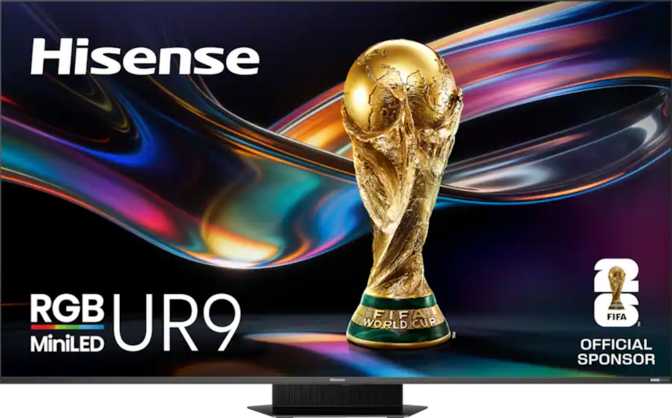
Hisense 85UR9SG 85-Inch TV: Full Review of a Serious Mini-LED Screen
TVsWhat the Hisense 85UR9SG Brings to the Table
The 85-inch TV market used to be a simple equation: pay a premium, get a premium picture. That math has shifted considerably, and the Hisense 85UR9SG sits right at the fault line where serious display technology starts becoming accessible to households that have not historically budgeted for flagship-tier screens. Packing Mini-LED backlighting, a full suite of HDR formats, and gaming-grade display features into a footprint that dominates any living room, this television makes a strong case — but it also asks you to think carefully about what you actually need from a screen this size.
Category Ratings
Design, Build Quality, and Physical Experience
Physical Footprint and Installation
At just over 189 centimetres wide and nearly 110 centimetres tall, the Hisense 85UR9SG is not a television you rearrange lightly. Its 52-kilogram chassis means installation genuinely requires two people — whether positioning it on a media unit or mounting it to a wall. The depth of just under 5 centimetres is respectable for a set housing a full Mini-LED backlight array: it will not sit flush against the wall like an OLED, but it will not jut out awkwardly either.
VESA mount compatibility is included, which is the right call for a screen this large. Many buyers in this size class ultimately opt for wall mounting, as furniture capable of supporting this weight and width is a significant purchase in itself. Given the dimensions and weight, professional installation is strongly advisable for any wall-mounting project.
Physical Specifications
- Width
- 189.5 cm
- Height
- 109.2 cm
- Depth
- 4.8 cm
- Weight
- 52 kg
- VESA Mount
- Supported
- Operating Temp.
- 5 °C – 35 °C
Anti-Reflection Coating
On a panel this wide, ambient light from windows and ceiling fixtures can wash out the picture across a substantial surface area. The anti-reflection coating reduces that glare without the image-softening haze that cheaper matte treatments produce — keeping the picture sharp and clear whether the room is bright or dim.
Ambient Light Sensor
The built-in light sensor monitors room brightness and adjusts screen output automatically. This means the television adapts as a day shifts from bright morning sunlight to dim evening lighting — you do not need to manually tune the brightness every time room conditions change.
The Mini-LED Panel: Picture Quality in Depth
The Backlight Advantage
Standard LED televisions illuminate the entire screen from behind using a relatively small number of light zones. Mini-LED technology deploys a significantly denser array of much smaller LEDs, allowing the TV to dim specific portions of the image independently and with far greater precision. The practical result: darker blacks in shadowed areas of a frame and brighter highlights where the content calls for them — both simultaneously, in the same scene.
This matters most with high-contrast content — space documentaries, night-time action sequences, and candlelit drama. The 85UR9SG can render bright stars against a genuinely dark sky in a way that conventional LED TVs struggle with. It will not match the pixel-perfect black levels of an OLED, but it closes that gap considerably while sustaining peak brightness levels that OLEDs typically cannot maintain for extended viewing periods.
Resolution and Pixel Density
The 3840 × 2160 pixel count across an 84.5-inch panel works out to approximately 52 pixels per inch. At the recommended viewing distance for a screen this large — somewhere between 2.5 and 3.5 metres — 4K resolution is more than sufficient for a sharp, detailed image. Individual pixels remain indistinguishable even from a closer comfortable position. Pixel density is not a limiting factor here.
Colour Depth and Viewing Angles
The 10-bit panel processes over one billion distinct colour values. That prevents the colour banding visible in gradients, sky shots, and skin tones on cheaper displays. Smooth, natural colour transitions are the consistent result across all content types.
The 178-degree horizontal and vertical viewing angle figures are unusually generous for an LCD panel. On a screen this large, family members seated at the sides of a room can easily be 30 or 40 degrees off-centre. Wide-angle consistency ensures the picture remains accurate for everyone in the room, not just viewers sitting directly in front.
HDR Format Coverage
HDR support is comprehensive — all four major formats are present, meaning no compatibility compromises regardless of the content source or streaming platform.
The baseline HDR standard, supported by virtually all 4K content across every platform and physical format. The universal entry point for HDR.
Adds dynamic metadata so brightness is optimised scene-by-scene rather than locked to one setting for the entire film. The preferred format on Amazon Prime Video.
The competing dynamic metadata standard favoured by Netflix and Apple TV+. Widely considered the most precisely mastered HDR format in streaming, and common on premium Blu-ray titles.
Hybrid Log-Gamma — the broadcast HDR standard for terrestrial and satellite sources. Essential for viewers who want HDR from live or recorded television channels.
Viewing Angle Summary
With 178° horizontal and 178° vertical viewing angles, colour accuracy and brightness hold steady for viewers positioned well off-centre — critical for large screens where an audience spans the full width of a room.
Gaming Performance
The gaming credentials here are not a secondary consideration. The 85UR9SG's specification set reads closer to a dedicated gaming monitor than a typical living room television.
Premium Pro
FreeSync Premium Pro: What It Means
AMD FreeSync Premium Pro is the highest tier of AMD's adaptive sync certification. The television's refresh rate synchronises dynamically with the frame output of a connected console or PC, eliminating screen tearing. The Premium Pro tier adds low framerate compensation — smooth performance even when framerates dip below the sync threshold — and mandates HDR support within the variable refresh rate window. The result is tear-free gaming without sacrificing high dynamic range, with no trade-offs between the two.
HDMI 2.1: Built for Current-Generation Consoles
All three HDMI ports operate to the 2.1 standard. This matters because HDMI 2.1 carries the bandwidth required for 4K at 120 frames per second — the maximum output of the PlayStation 5 and Xbox Series X in supported titles. Older HDMI 2.0 connections cap at 4K/60fps regardless of what the source device outputs. With three full-bandwidth ports, there is no need for an external HDMI switch to connect multiple current-generation devices.
Audio: More Than You Typically Expect
Built-in Speaker System
Most televisions rely on small drivers built into the chassis that produce thin, directional sound. The 85UR9SG includes a stereo speaker system with a dedicated subwoofer — a meaningful addition at this price tier. A subwoofer adds low-frequency reproduction that makes explosions, cinematic bass lines, and impactful sound design feel physical rather than flat. For casual viewers, this is a television that holds its own without requiring an immediate soundbar investment.
Dolby Atmos Built In
Dolby Atmos processing is built into the television — content mixed in the Atmos format is decoded and handled by the television itself rather than passed through to an external device. This matters because Atmos content is increasingly common on streaming platforms and Ultra HD Blu-rays.
For those adding an external soundbar or AV receiver, the HDMI eARC port enables full-bandwidth audio return — including lossless Dolby Atmos formats that the older ARC standard cannot carry. The flexibility to upgrade the audio setup later without losing quality is a genuine advantage.
Audio Connections
- HDMI eARCFull-bandwidth Dolby Atmos lossless passthrough to soundbars and AV receivers
- HDMI ARCBackward-compatible audio return for older soundbars and receivers
- Digital Optical OutputFor AV receivers and legacy audio equipment
- 3.5 mm Headphone JackDirect connection for headphones or stereo amplifiers
Supported Dolby Formats
Smart TV Platform and Ecosystem Integration
Voice Assistant Support
Both Google Assistant and Amazon Alexa are supported natively. You can control the television, search for content, adjust settings, and integrate it into a wider smart home setup using either ecosystem. The coverage across both major platforms means the 85UR9SG fits naturally into almost any existing smart home configuration.
Screen Casting and Mirroring
All three major wireless display standards are present. Chromecast built-in handles Android devices and Chrome browsers; AirPlay handles iPhones, iPads, and Macs; Miracast provides Windows device compatibility. Between the three standards, every major device platform is covered without additional hardware.
Broadcast Tuner and Smart Extras
The built-in tuner covers the full set of broadcast standards — terrestrial aerial, cable, and satellite. In most regions this means the television receives free-to-air and subscription broadcast channels without a separate set-top box. USB recording allows live broadcast content to be saved directly to an external drive. A sleep timer, child lock, full web browser, and smartphone remote control app complete the feature set.
Voice Assistant Compatibility
Wireless Display Standards
Full Connectivity Breakdown
Every port, wireless standard, and signal path on the Hisense 85UR9SG — with context for what each connection is used for.
| Connection Type | Specification | Key Use Case |
|---|---|---|
| HDMI | 3× HDMI 2.1 (incl. ARC & eARC) | 4K/120fps from PS5, Xbox Series X, gaming PC |
| USB | 2× USB ports | USB recording, external media playback |
| Ethernet | 1× RJ45 wired network port | Stable wired internet connection for streaming |
| Wi-Fi | Wi-Fi 5 (802.11ac) + Wi-Fi 4 (802.11n) | Wireless internet; Wi-Fi 5 is sufficient for 4K streaming |
| Bluetooth | Bluetooth 5.4 | Wireless headphones, keyboards, smart devices |
| Audio Output | 3.5 mm headphone jack + Digital optical | Headphones, stereo amplifiers, legacy receivers |
| Wireless Display | Chromecast + AirPlay + Miracast | Screen sharing from phones, tablets, and laptops |
| Broadcast Tuner | DVB-T, DVB-T2, DVB-C, DVB-S, DVB-S2 | Aerial, cable, and satellite broadcast reception |
| Memory Expansion | No card slot — USB drives only | Connect external USB storage for recordings |
On Wi-Fi 5: The television does not include Wi-Fi 6 (802.11ax). For 4K streaming, Wi-Fi 5 has more than adequate bandwidth. The practical impact for typical home streaming use is negligible.
On Power: Operating consumption sits at 400 watts — in line with expectations for an 85-inch Mini-LED display at competitive brightness. Standby draw is a responsible 0.5 watts.
Who Should Buy the Hisense 85UR9SG
Not every television suits every buyer. Here is an honest breakdown of who this 85-inch set genuinely serves — and where it falls short of specific needs.
This TV Is For You If...
You want 85 inches of screen and cannot justify the significantly higher cost of an OLED in this size class.
You own a PlayStation 5 or Xbox Series X and want to use the console at its maximum output — 4K at 120fps with HDR active.
Your room has variable lighting throughout the day — the anti-reflection coating and ambient light sensor handle it without manual adjustment.
You watch across multiple streaming platforms — every HDR format is covered, with no compatibility gaps on Netflix, Amazon, Apple TV+, or broadcast.
You want capable built-in audio without immediately budgeting for a soundbar — the subwoofer-equipped speaker system is above average for a TV.
Your smart home runs on Google or Amazon — both assistants are natively supported and integrate reliably.
Consider Alternatives If...
Absolute black level performance is your primary criterion. OLED remains the reference standard for perfect blacks, and no LCD-based display fully replicates it — the 85UR9SG offers a different, not inferior, image character.
You rely on Apple HomeKit automations or Siri for smart home device control. Apple ecosystem integration is absent from this television.
Your room is compact. The comfortable viewing distance for 85 inches starts at roughly 2.5 metres — in a tight space, this screen will feel overwhelming rather than immersive.
How It Compares to the Competition
The 85UR9SG positions itself between budget LED sets and premium OLED televisions. Here is how it stacks up across the features that matter most in this size class.
| Feature | Hisense 85UR9SG | Typical 85" OLED | Typical 85" Standard LED |
|---|---|---|---|
| Black Level Performance | Very Good Mini-LED local dimming |
Reference Per-pixel control |
Average Limited zone dimming |
| Peak Brightness | High Sustained output |
Moderate Brightness-limited |
Moderate Varies by model |
| 4K / 120fps Gaming | 3× HDMI 2.1 |
Varies by model | Often limited |
| FreeSync Premium Pro | Rarely included |
Rarely included |
|
| All-Format HDR | All 4 formats |
Yes (most models) |
Typically partial |
| Built-in Subwoofer | |||
| Relative Price | Mid-to-High | Premium | Budget – Mid |
The Mini-LED approach is increasingly the competitive answer to OLED in large formats. Where OLED cannot sustain brightness without risking long-term panel wear, Mini-LED can run at higher luminance for extended periods — better suited to bright-room viewing. The trade-off is that local dimming involves discrete zones rather than individual pixels, so very precise contrast boundaries may show slight blooming. For nearly all real-world content, this is a non-issue in daily viewing.
Honest Assessment
What It Does Well
The combination of Mini-LED backlighting with full HDR format coverage is coherent and genuinely well-executed. The picture holds up across every content type — streaming, broadcast, gaming, and physical media — without requiring workarounds or format compatibility compromises.
The gaming specification set is a clear design priority. Three HDMI 2.1 ports with FreeSync Premium Pro is a combination you associate with dedicated gaming monitors, not living room televisions. For households with current-generation consoles, this is the hardware already configured and waiting for you.
The built-in audio, with its dedicated subwoofer, is above average for a television and delivers a satisfying out-of-box experience. The smart TV integration covers both major ecosystems and all three major wireless display standards — platform coverage is essentially universal.
Where Expectations Need Managing
The remote control is not rechargeable — a minor but genuinely noticeable absence at this price level. Disposable batteries for a television remote in this tier feel like a step back.
Wi-Fi 6 would have been a more future-proof choice than Wi-Fi 5, though the practical streaming impact today remains marginal. Apple HomeKit support is absent entirely — not a consideration for most buyers, but a firm barrier for a specific set of users.
The 400-watt power draw is simply the physics of illuminating 85 inches of Mini-LED panel at competitive brightness. It should be factored into the total ownership cost honestly, particularly for households with high daily viewing hours. This is not a fault — it is an informed trade-off to make consciously.
Common Questions from Buyers
The questions real buyers search before purchasing — answered directly.
Final Verdict
The Hisense 85UR9SG earns its place in a competitive market by refusing to compromise on the specifications that matter most. The Mini-LED display delivers genuine picture quality improvements over standard LED competition. The HDMI 2.1 triple-port setup with FreeSync Premium Pro addresses gaming at the highest current standard. Comprehensive HDR format coverage makes the television ready for every content library without workarounds.
It is not an OLED. It was not designed to be one, and buyers expecting that specific image character will find a capable but different picture. What it offers instead is sustained brightness performance, wide viewing angles, and gaming-grade display features — packaged into a smart TV platform that integrates with both the Google and Amazon ecosystems cleanly.
For a household that wants the immersive scale of 85 inches, uses current-generation gaming hardware, watches across multiple streaming platforms, and wants to avoid the OLED price ceiling — the 85UR9SG is a considered, well-specified choice that delivers on its headline promises.