Aurzen Eazze D1 Air Review: A Complete Smart Projector With One Real Trade-Off
ProjectorsThe Aurzen Eazze D1 Air is a wireless-first, smart-platform projector that bundles more connectivity than anything near its price — at the cost of brightness that demands a controlled viewing environment. For evening movie watchers and flexible-room users, it over-delivers. For bright-room viewers, it asks too much.
Editor's Score Breakdown
The portable projector market has quietly become crowded with options that promise cinema-quality images from a bag you can carry on a plane. Most of them disappoint. The Aurzen Eazze D1 Air takes a different approach: rather than chasing eye-catching spec numbers, it bundles a genuinely complete feature set into a compact, living-room-friendly package built around ease of use. The question isn't whether it can do the job — it clearly can — but whether the trade-offs align with what you actually need.
Design and Build: A Projector That Doesn't Need to Hide
Physical dimensions, weight, and port layout
Size, Weight, and Everyday Handling
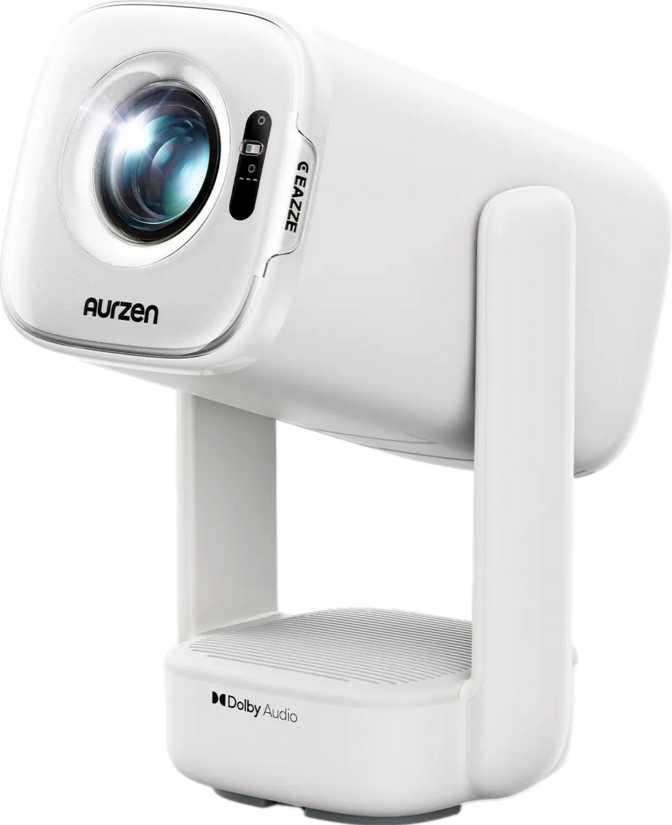
At roughly 231mm wide, 175mm deep, and 82mm tall, the Eazze D1 Air has the proportions of a chunky hardcover book. It weighs just over two kilograms — light enough to move between rooms without thinking twice, but substantial enough to feel like proper hardware rather than a toy. You can set it on a coffee table, a shelf, or a small tripod without worrying about it tipping over.
The footprint is compact without being aggressively miniaturized. Aurzen hasn't squeezed this into the smallest possible enclosure and sacrificed thermals or port placement in the process. There's room for the hardware to breathe, which matters for a lamp-based system during extended viewing sessions.
Port Layout and Physical Controls
The physical connectivity is deliberately streamlined: one HDMI input handles your streaming stick, gaming console, or laptop, and one USB port covers media playback or powering a small device. There's no wired network port and no legacy video connections — a deliberate nod toward the wireless-first audience this projector is designed for. A 3.5mm headphone jack gives you a quiet late-night audio option without needing a separate Bluetooth speaker.
The remote control is included in the box. Given the built-in smart platform and voice command support, the remote functions more like a hub than a necessity — but its presence means you're never stuck hunting for your phone just to adjust the volume.
- Width 231.5 mm
- Depth 175 mm
- Height 82 mm
- Weight 2,100 g (2.1 kg)
- Operating Power 65 W
- HDMI Ports 1
- USB Ports 1
- 3.5mm Audio Jack
- Remote Control
- Light Source Lamp (Non-Laser)
Picture Quality: 1080p in a Real-World Context
Resolution, brightness, and HDR — what the numbers actually mean
Resolution and What It Actually Delivers
Full HD 1080p is the native output resolution of the D1 Air. For a projector in this class, that's the right call. At the sizes most people will actually use — somewhere between 80 and 120 inches — 1080p delivers a clean, film-grain-free image that holds up from a normal viewing distance. You'd need to sit considerably closer than most rooms allow before pixel structure becomes visible at these sizes.
The maximum projection size of 120 inches is a meaningful upper bound rather than a marketing fantasy. At 120 inches in a completely dark room, brightness becomes the limiting factor rather than resolution.
Brightness Reality Check: What 300 ANSI Lumens Means
300 ANSI lumens is a measured, standardized figure. In a darkened room with blackout curtains or at night, the image looks punchy, colorful, and engaging at sizes up to about 100 inches. Push to the full 120 inches in darkness and you'll see a slight softening of perceived brightness, but it remains watchable and enjoyable.
In a bright living room with daylight coming through windows, ambient light becomes the enemy. This isn't a flaw unique to the D1 Air — it's a physical reality for any projector under roughly 500 lumens. For bedrooms, dedicated home theater setups, or evening use in any room, 300 lumens is comfortable and satisfying.
HDR Support and Color Accuracy
The D1 Air supports HDR10 and HLG — two of the three dominant high dynamic range formats in current content libraries. HDR10 is the standard format used across Netflix, Disney+, Amazon Prime Video, and the majority of Blu-ray content. HLG is the broadcast standard used in live TV and streaming broadcast content. Between the two, virtually all HDR content you're likely to encounter is covered.
HDR10
Covers Netflix, Disney+, Amazon, Blu-ray
HLG
Broadcast and live streaming standard
HDR10+
Absent — minor gap for most viewers
The one notable absence is HDR10+, the dynamic metadata variant used by some Amazon originals and Samsung-partnered content. For most viewers, this gap is invisible in practice — the vast majority of HDR content uses base HDR10, and the perceptible difference is subtle even on panels optimized for it.
Smart Platform and Wireless Connectivity
Where the D1 Air earns its keep over every rival in its class
Built-in Smart TV — No Streaming Stick Required
The Eazze D1 Air comes with a fully integrated smart TV platform. That means you can access your streaming subscriptions directly — without plugging in a Chromecast, Firestick, or Roku. The projector powers on and you're in the interface immediately.
The built-in smart platform is paired with a dedicated smartphone app, which effectively turns your phone into a second remote and content controller. This is particularly useful for quick searches, keyboard input, and navigating text-heavy interfaces where a physical remote becomes tedious.
Voice control is built in as well, allowing hands-free search, playback control, and navigation. This works in conjunction with the smart platform and is most useful when you're already watching content and don't want to pick up the remote.
Every Major Casting Standard, One Device
The connectivity list here is unusually complete for a projector in this price tier. Having all four casting protocols means the D1 Air doesn't discriminate by ecosystem — everyone in a mixed-device household can connect without adapters or workarounds.
-
Chromecast Built-In
Android and Chrome browser users cast directly from apps — no extra hardware needed.
-
AirPlay
iPhone, iPad, and Mac users get native screen mirroring and audio streaming.
-
Miracast
Covers Windows laptops and Android devices outside the Google casting stack.
-
Bluetooth + Wi-Fi
Connects wireless speakers, headphones, and keyboards. The backbone for the smart platform.
-
Dedicated Smartphone App
Turns your phone into a full controller — useful for text input and complex navigation.
Audio: 16 Watts That Actually Matter
Built-in speaker system and Dolby Atmos explained
Built-in Speaker System
The D1 Air houses a stereo speaker system delivering a combined 16 watts of output — 8 watts per channel. For a projector, this is a meaningful amount of power. Most portable projectors ship with mono speakers barely adequate for background audio; a true stereo configuration at this wattage produces genuine left-right separation and enough volume to fill a mid-sized room without straining.
Dolby Atmos Support
Dolby Atmos is present here, which means the D1 Air can decode and process the spatial audio metadata embedded in Atmos-encoded content from streaming services. Full spatial sound reproduction requires appropriate speaker placement, so the Atmos experience from two forward-firing drivers will be more about enhanced audio processing than true height-channel immersion — but content optimized for Atmos will sound better than it would on a standard stereo output path.
For users who want to push audio quality further, the 3.5mm output connects to a soundbar or AV receiver, and Bluetooth allows pairing with a quality wireless speaker. The absence of an S/PDIF optical output means audiophiles with optical-input receivers will need to route audio through HDMI or Bluetooth.
- Configuration Stereo (2-channel)
- Total Output Power 16W (2 × 8W)
- Dolby Atmos Supported
- 3.5mm Output Included
- Bluetooth Audio Out Supported
- S/PDIF Optical Not included
Who Should Buy the Aurzen Eazze D1 Air
Real use cases — and the honest scenarios where it falls short
-
Apartment and Rental Dwellers
A large-screen experience without mounting a permanent display. Compact size and wireless-first design suit flexible spaces.
-
Bedroom Cinema Enthusiasts
In a darkened bedroom, 300 lumens produces a genuinely excellent image. Evening is when this projector shines.
-
Multi-Room Setup Users
Practical to move from living room to bedroom to backyard without committing to a fixed installation.
-
Mixed-Device Households
AirPlay, Chromecast, Miracast, and Bluetooth together eliminate the ecosystem compatibility problem entirely.
-
Users Who Value Simplicity
Built-in smart platform, voice control, and companion app mean no stack of external devices needed to get started.
-
Bright Room or Daytime Viewing
Significant ambient daylight will frustrate you. A laser projector with 1,000+ lumens would serve you better.
-
Large Venue or Conference Use
300 lumens and a 120-inch maximum size is not suited for presentation environments with distant audiences.
-
Home Theater Purists
No wired network port and no lens shift limit physical installation precision in a dedicated theater room.
-
Reflex-Dependent Gamers
No input lag specification is available, which warrants investigation before purchase for competitive gaming.
How It Compares to the Alternatives
The D1 Air against typical budget and mid-range smart projectors
| Feature | Aurzen Eazze D1 Air | Typical Budget 1080p | Mid-Range Smart |
|---|---|---|---|
| Native Resolution | 1080p | 1080p | 1080p |
| Brightness | 300 ANSI lm | 200–350 ANSI lm | 400–800 ANSI lm |
| Smart Platform | Built-in | Rarely included | Usually included |
| AirPlay + Chromecast | Both | Rarely both | Often one only |
| Miracast | Occasionally | Occasionally | |
| Audio Output | 2×8W + Dolby Atmos | 1×5W mono typical | Varies |
| Wired Network Port | No | Occasionally | Often yes |
| Lens Shift | No | Rarely | Sometimes |
| Light Source | Lamp | Lamp | Lamp or Laser |
The D1 Air holds its own against more expensive alternatives specifically on the software and wireless connectivity side of the ledger. Where the brightness figure meets its ceiling — projectors at higher price points frequently offer laser light sources producing two to three times the lumen output — the D1 Air's connectivity and smart platform story remains difficult to match at the same price.
Honest Assessment: Strengths and Limitations
A balanced look — because credibility comes from telling both sides
Where It Genuinely Excels
The wireless ecosystem is the most complete in its class. The audio output is significantly better than average for a device this size — 16 watts of stereo power with Dolby Atmos processing is a pleasant surprise rather than a marketing afterthought. The built-in smart platform removes the friction that makes many projectors feel unfinished out of the box.
The full coverage of AirPlay, Chromecast, and Miracast on a single device is genuinely rare at this price tier. For households with mixed devices — Apple, Android, and Windows all coexisting — this alone makes the D1 Air stand apart from the competition.
Where It Makes Compromises
The brightness ceiling is the most important honest limitation, and it's one Aurzen doesn't try to disguise. 300 ANSI lumens is accurate, standardized, and realistic — and it means this projector performs its best in controlled lighting. That's a real constraint for daytime users or those in open-plan spaces.
The absence of lens shift is a minor inconvenience for permanent installations — you'll need to be deliberate about placement to get a square image without relying entirely on keystone correction, which can introduce image softness if applied too aggressively. The lack of a wired network port will matter in environments with unreliable Wi-Fi, but for the majority of buyers with solid home networks, it's a non-issue.
Common Questions Before You Buy
Real answers to the questions buyers search for most
A Clear Recommendation for the Right Buyer
The Aurzen Eazze D1 Air earns a confident recommendation for buyers who want a complete, no-compromise wireless experience in a compact projector — and who understand that "complete wireless experience" comes with a brightness trade-off that requires a controlled viewing environment.
If your primary use case is evening movie watching, bedroom cinema, or a flexible room-to-room setup where you control the lighting, the D1 Air delivers on every front that matters: sharp 1080p image, usable HDR, genuine stereo sound with real output power, and a wireless connectivity suite that accommodates every device your household is likely to own.
If you're hoping to use it in a bright living room during the day, or need a projector for presentation use in lit environments, the brightness output is a genuine obstacle that no amount of setup optimization will fully solve. In that case, a laser projector with three to four times the light output belongs on your shortlist instead. For its intended audience, the Eazze D1 Air isn't a compromise purchase — it's the right tool for the job, bought with clear eyes.
Overall Score
8.5
out of 10
Best for dark-room cinema, flexible living spaces, and mixed-device households