ATK Blazing Sky Duckbill Review: Built for Competitive Gaming
MiceThe ultralight wireless gaming mouse segment has matured rapidly, but it still presents a clear dividing line: mice that are genuinely light versus mice that merely claim to be. The ATK Blazing Sky Duckbill falls decisively in the first camp. At 46 grams, it ranks among the lightest wireless gaming mice available — a figure not achieved by cutting corners on internals, but through deliberate engineering. Underneath its minimalist shell sits one of PixArt's most advanced optical sensors, paired with an 8000 Hz polling rate that only the most competitive-tier mice have recently begun to offer. If you've been watching the performance peripherals space, you already know why those two specifications together matter. If you haven't, that's exactly what this review is for.
At a Glance
Polling Rate
Total Weight
Battery Life
PixArt Sensor
Design, Shape, and Build Quality
A Shape Built for Speed, Not Comfort Theater
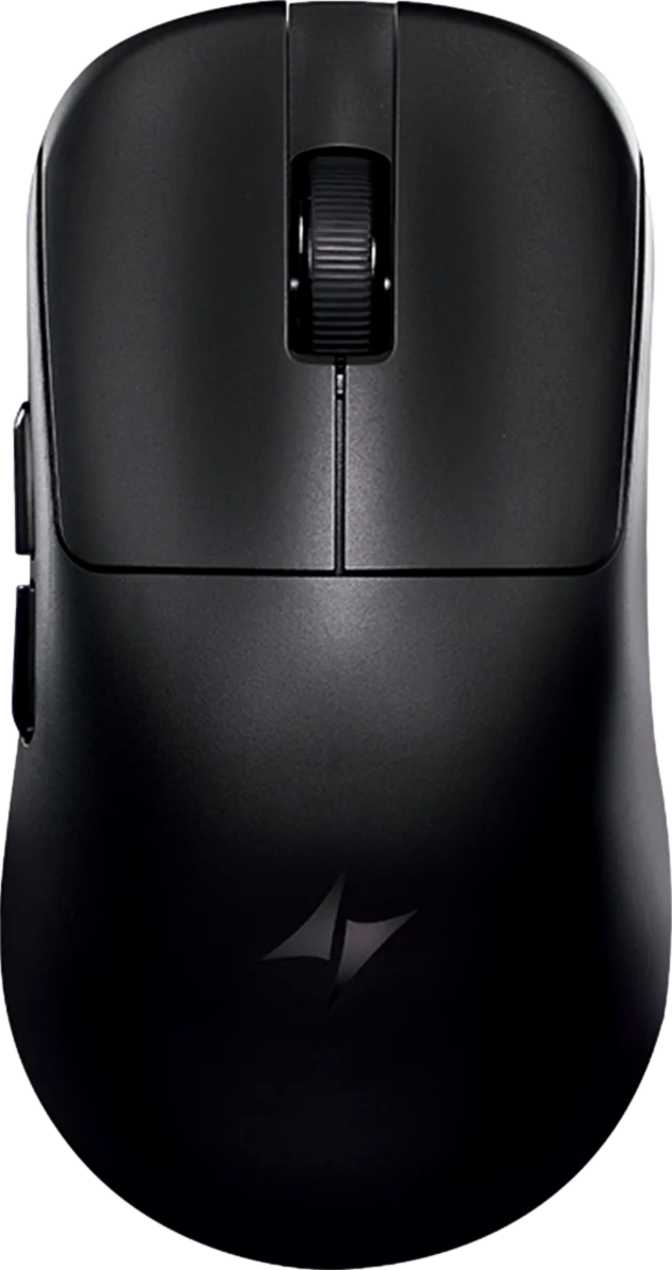
The name "Duckbill" is not marketing flair — it describes the mouse's geometry with unusual accuracy. The Blazing Sky Duckbill is wider at the front and narrows toward the rear, with a notably flat profile standing just under 38mm at its highest point. Most ergonomic gaming mice peak well above 40mm, with some approaching 45mm or more. This low arch is deliberate: it discourages deep palm contact and naturally promotes fingertip or aggressive claw grip.
The footprint is compact — 118mm front to back and 55mm across — which will feel immediately familiar to players with small to medium-sized hands, and may require real adjustment for those accustomed to larger, fuller shapes.
Weight: The Number That Changes Everything
vs 70–95g for standard gaming mice and 50–65g for typical ultralight competitors
Forty-six grams is a figure worth sitting with for a moment. A standard wired gaming mouse from a major brand typically weighs between 70 and 95 grams. The previous generation of "lightweight" mice celebrated the 60-gram threshold. The Blazing Sky Duckbill clears all of those benchmarks by a significant margin.
In practice, this matters most during extended sessions. The cumulative strain of moving a heavier mouse over four or six hours of gaming is something players often don't notice until they switch to something this light. Flicking, tracking, and repositioning all require meaningfully less physical effort — and for competitive first-person shooter players, that reduction translates directly to precision under fatigue.
Build and Aesthetic
The Blazing Sky Duckbill arrives without RGB lighting. There are no color zones, no lighting effects, no software-driven visual customization. For some buyers, this is a dealbreaker. For the performance-focused player, it's a deliberate omission that contributes to weight savings and battery longevity. The mouse reads as clean and purposeful — designed for a desk where milliseconds matter more than aesthetics.
Sensor and Tracking Performance
The PixArt PAW3950 Ultra: What It Actually Means
The sensor inside the Blazing Sky Duckbill is the PixArt PAW3950 Ultra — currently one of the most capable optical gaming sensors in any consumer mouse. PixArt is the dominant supplier of gaming-grade sensor chips and supplies components found inside products from nearly every major peripheral brand. The PAW3950 Ultra sits at the apex of their gaming lineup.
What makes a flagship sensor matter? For most players, it comes down to three things: reliable tracking at high speeds, accuracy in low-sensitivity configurations, and the complete absence of artificial corrections like cursor acceleration or positional smoothing. All three are characteristic of top-tier PixArt sensors.
The sensitivity range spans from an ultra-low floor suited to hyper-precise, slow-sensitivity setups favored by competitive FPS players, all the way to a ceiling so high it functions more as an engineering demonstration than a practical operating point. The tracking performance will not be the limiting factor in this mouse's ceiling. That ceiling is set by the player.
8000 Hz Polling Rate: Why More Reports Per Second Matters
Standard Gaming Mouse
Position update every 1 millisecond
ATK Blazing Sky Duckbill
Position update every 0.125 milliseconds
Most gaming mice communicate with your computer 1,000 times per second. The Blazing Sky Duckbill communicates 8,000 times per second. The result is cursor movement that appears smoother on screen and responds more immediately to physical input — a difference that becomes perceptible at high refresh rates and during rapid directional changes in competitive play.
For casual desktop use or standard office work, the difference is imperceptible. For competitive gaming at 144Hz or above — particularly fast-paced first-person shooters — the improvement in positional responsiveness can tighten aim consistency in measurable ways. One practical note: the elevated polling rate places more demand on your USB controller and CPU than standard polling. On modern gaming systems, this is a non-issue. On older hardware, a slight increase in CPU usage is possible.
Connectivity: Three Ways to Connect
2.4GHz Wireless
The primary mode for competitive gaming. This dedicated short-range wireless link delivers latency characteristics indistinguishable from a wired mouse in all real-world gaming conditions. This is the mode you'll rely on for serious play.
USB Wired
A direct, always-reliable connection when wireless isn't preferred or when the battery is depleted. Important: the cable serves as a fallback only — this mouse cannot be used while it is charging via USB.
Bluetooth 5.2
Broadens utility beyond the gaming desk. Pairing to a work laptop, secondary machine, or travel device makes the Duckbill genuinely multi-purpose. Bluetooth introduces more latency than 2.4GHz — negligible for office tasks, noticeable in fast-paced gaming.
Battery Life and Charging
150 Hours: Endurance That Stands Out
The Blazing Sky Duckbill is rated for approximately 150 hours of wireless use per charge. In practical terms: a player logging 15 hours per week would charge this mouse roughly once every two to three weeks. For moderate users, monthly charging is realistic. This figure is particularly impressive given the mouse's weight — packing this level of endurance into a sub-50-gram wireless chassis requires careful engineering.
Battery life measurements are typically taken at lower polling rates. Real-world runtime at maximum 8000 Hz polling may differ — but even accounting for that, the endurance on offer is well above category average.
Charging Limitations to Know Before You Buy
Two constraints deserve direct attention before purchase. First, the Blazing Sky Duckbill charges only via its included cable — there is no wireless or inductive charging option. Second, the mouse cannot be used while it is plugged in. This is not a "slow charge while playing" scenario: while charging, the mouse doesn't function. For players who charge consistently between sessions, neither limitation registers as a problem. For players who routinely let battery levels lapse, the no-play-while-charging restriction may occasionally cause real disruption.
Real-World Usage: Who This Mouse Is For — and Who It Isn't
This Mouse Is Built For
-
Competitive FPS and tactical shooter players who optimize for accuracy, low latency, and physical endurance across long sessions. The 46g weight, flagship sensor, and 8000 Hz polling reflect exactly those priorities.
-
Fingertip and claw grip users with small to medium hands who benefit from the flat, narrow, low-arch shape that rewards these techniques most naturally.
-
Single-station players who configure once and don't move their mouse between machines — getting all the benefit with none of the onboard memory constraint.
-
Players who want wireless without latency compromise — the 2.4GHz connection at elevated polling delivers exactly what a wired connection does, without the cable drag.
This Mouse Is Not Built For
-
Left-handed or ambidextrous players — the shape is right-hand-specific. There are no exceptions, no workarounds, and no ambidextrous variant.
-
MMO or productivity users who need six or more programmable buttons, complex macro support, or on-device profile libraries for switching contexts quickly.
-
Multi-machine users whose settings need to travel with the mouse. Without onboard memory, your configuration stays on your home machine every time you leave.
-
Players with large hands or a full-palm grip preference — the low, flat profile may feel insufficient for contact-heavy grip styles over extended sessions.
-
Players who want RGB — there is none. The Blazing Sky Duckbill is a performance tool, not a visual accessory, and that line has been drawn firmly.
Competitive Positioning: Where the Blazing Sky Duckbill Stands
The ultralight wireless mouse category has grown considerably, but most competitors cluster around 50 to 65 grams and default to standard 1,000 Hz polling rates. The Blazing Sky Duckbill sits noticeably lighter than the majority of that field, and its polling rate is substantially higher than what most direct competitors offer at any weight class.
| Feature | ATK Blazing Sky Duckbill | Typical Ultralight Competitor |
|---|---|---|
| Weight | 46g | 50–65g |
| Polling Rate | 8,000 Hz | 1,000 Hz |
| Sensor Tier | PixArt PAW3950 Ultra (Flagship) | Mid to high-tier optical |
| Battery Life | ~150 hours | 40–80 hours |
| Wireless Modes | 2.4GHz + USB + Bluetooth 5.2 | 2.4GHz + USB |
| Onboard Memory | None | 1–5 profiles (typically) |
| RGB Lighting | None | Commonly included |
| Warranty | 1 year | 1–2 years (varies) |
Where competitors often hold a clear advantage is onboard memory — many mice in this tier store between one and five profiles directly on the device, allowing configurations to travel without any software dependency. RGB is the other feature the broader market typically delivers and this mouse does not. For buyers who consider desk lighting part of their setup, competing options deliver it without major performance penalties.
An Honest Assessment
The Blazing Sky Duckbill's defining strength is coherence. Every design decision — the weight, the polling rate, the absence of RGB, the compact geometry — points toward the same objective: competitive performance with minimal compromise. This single-mindedness is uncommon in a market full of products trying to satisfy every buyer simultaneously and ending up optimized for none of them.
The sensor is a genuine differentiator. The PAW3950 Ultra is not a rebrand or a mid-tier chip dressed in premium packaging — it represents the current peak of consumer optical sensor technology and has no practical ceiling for any realistic use case.
The battery life is arguably the most underappreciated element of the package. Achieving 150 hours of endurance in a sub-50-gram wireless chassis is a real engineering accomplishment — a feature players will notice week after week without ever having to consciously think about it.
Where It Excels
- Industry-leading weight for a wireless mouse with a flagship-tier sensor inside
- PAW3950 Ultra sets no practical ceiling for any real-world gaming use case
- 150-hour battery endurance far exceeds the ultralight wireless category norm
- 8,000 Hz polling delivers perceptibly smoother tracking at high refresh rates
- Triple connectivity including Bluetooth 5.2 — genuinely multi-purpose beyond the gaming desk
Where It Falls Short
- No onboard memory means configurations don't travel with the mouse between machines
- Right-handed only — left-handed and ambidextrous players are fully excluded
- Cannot be used while charging — a meaningful constraint for players who let battery run low
- No RGB lighting for players who prioritize desk aesthetics alongside performance
- One-year warranty is shorter than what some competitors offer at comparable price points
Questions Real Buyers Ask Before Purchasing
Final Verdict
The ATK Blazing Sky Duckbill is built for a specific player: the competitive FPS enthusiast who treats every gram and every millisecond as a variable worth optimizing. For that player, it delivers an exceptional package — a certified flagship sensor, an industry-leading polling rate in a wireless chassis, battery endurance that outpaces most of the category, and a weight that undercuts nearly all direct competition.
It asks something in return: a settled, single-machine gaming setup so the absence of onboard memory doesn't disrupt you; a hand size and grip style compatible with the flat, narrow Duckbill geometry; and an acceptance that performance, not aesthetics, is the product's entire focus.
If those conditions match your situation — and for the dedicated, single-station competitive player, they often will — the Blazing Sky Duckbill stands as one of the strongest combinations of sensor quality, polling rate, weight, and battery endurance currently available in a wireless gaming mouse. It doesn't try to be everything. It tries to be the fastest possible tool for the player who has already decided that performance is the only specification that matters.
Purchase Verdict
A confident recommendation for right-handed competitive gamers with small to medium hands who game on a single machine. Evaluate carefully — or look to competitors offering onboard memory — if you regularly use your mouse across multiple setups, prefer a full-palm grip, or rely on profile portability as part of your workflow.