ATK 68 V2 Review: Hall Effect Gaming in a Compact 65% Package
KeyboardsAt a Glance
Recommended for Competitive GamingThe vast majority of gaming keyboards, regardless of price, operate on the same fundamental principle: press a key, two metal contacts touch, a signal fires. The ATK 68 V2 does not work that way. It uses magnetic sensing instead of physical contact to track every millimeter of every keypress in real time — and that difference unlocks a set of performance capabilities that simply cannot exist in a contact-based keyboard. If you are evaluating this board, you are almost certainly here because of rapid trigger, adjustable actuation, or the competitive edge that hall effect technology offers. This review examines whether the ATK 68 V2 delivers those features credibly, and whether the compromises baked into its design are ones you can live with.
Build Quality and Physical Presence
Solid construction that announces itself before you type a single key
For a compact keyboard that spans only 320 mm in width — roughly the footprint of a standard hardcover novel — the ATK 68 V2 carries real weight. At 820 grams, it is heavier than most 65% boards, and that density is intentional. An aluminum internal plate combined with an aluminum-and-plastic exterior shell produces a frame with no meaningful flex under aggressive typing or gaming inputs. The board stays planted.
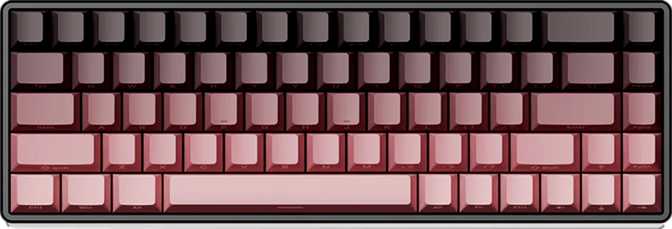
It ships in two colorways — black and white, both restrained in their appearance. There is no aggressive gamer styling, no excessive branding, no angular chassis design fighting for visual attention. This is a keyboard that looks at home on a work desk as easily as a gaming setup.
One ergonomic constraint is worth naming clearly: the ATK 68 V2 ships at a fixed typing angle. There are no adjustable incline feet. If the default height and angle do not match your preferred wrist position, there is no built-in solution. No wrist rest is included either, though at this size category that is expected rather than exceptional.
The cable detaches — a small but meaningful detail. Replacing a damaged cable, swapping to a custom aftermarket option, or packing the board for travel without cable stress is straightforward. The connection itself is USB wired, which is exactly appropriate for a keyboard built around polling rate precision.
Build Highlights
- Aluminum Plate InteriorRigid, precise typing platform
- Gasket Mount SuspensionCushioned, sound-dampened feel
- Detachable USB CableReplaceable and customisable
- Black & White ColorwaysRestrained, professional aesthetic
- No Adjustable FeetFixed incline — no tilt options
Hall Effect Switches: The Technology Behind the Feature Set
Understanding what makes the ATK 68 V2 distinct starts here
A traditional mechanical switch works by physically pressing two metal contacts together. The moment those contacts touch, the keystroke registers. This is mechanically reliable, but it has physical limits: the contact point is fixed, there is a natural dead zone before re-actuation can occur, and over millions of keypresses, contacts wear and can develop inconsistencies.
The Gateron Jade switches in the ATK 68 V2 use a completely different mechanism. Instead of physical contact, they use a magnet and a sensor. The sensor reads the position of the magnet continuously throughout the entire keypress. There is no fixed contact point. The keyboard firmware decides, in real time, where actuation should happen based on the position data it receives from the sensor. This is the architectural foundation that makes everything else on this board possible.
Feature Deep-Dive
The Gateron Jade switches travel 3.5 mm from rest to bottom-out — a standard linear travel distance. What is different is that actuation can be set anywhere within that range, from just barely moving the key at 0.1 mm of travel, all the way down to the bottom of the stroke.
At the sensitive end, 0.1 mm actuation means a keystroke registers from the lightest brush — lighter than most people can intentionally avoid when resting fingers on keys. This extreme setting is useful in specific high-reflex gaming scenarios, but requires a deliberate touch during normal typing. Most users will land somewhere between 1.5 mm and 2.5 mm for general use, balancing responsiveness with comfort and error prevention.
The actuation force required to move these switches is light. At 36 grams, less pressure is needed to depress a key than you would use to trigger most gaming mice. Rapid, effortless keystroke sequences are the upside. Fingers with a tendency to rest on keys may produce unintended inputs at more sensitive settings.
A standard keyboard has a dead zone in its actuation logic. When you release a key, it does not reset until it physically travels back past the reset threshold — a point that sits above the actuation point. Between the actuation moment and the reset moment is a gap. In a game where direction changes or ability inputs are time-critical, that gap costs you.
Rapid trigger removes the gap entirely. Once enabled, a key resets the instant it begins traveling upward — no matter where in its range it sits. A key pressed 2 mm deep resets the instant your finger starts lifting, not when it clears an arbitrary mechanical threshold. The practical result in competitive gaming: strafing counter-movements, ability resets, and rapid re-inputs become measurably faster. The keyboard stops being a physical constraint in your reaction chain.
Dual actuation lets you assign two separate actions to a single key, triggered at different press depths. A shallow press can produce one output; a full press produces another.
The clearest gaming application is movement control: pressing a key halfway could register as walking, while pressing it to the bottom registers as sprinting. This mimics the analog behavior of a controller thumbstick on a keyboard, and in games designed to read these inputs, it adds a layer of movement nuance that binary keyboard inputs cannot replicate.
Building on dual actuation, the 68 V2 supports full analog input. Rather than a binary pressed/not-pressed signal, the keyboard can communicate press depth as a continuous value across the key's full travel. In compatible games and applications, this translates to proportional control — the deeper you press, the greater the effect magnitude.
Think of it as the difference between a light switch and a dimmer. Standard keyboards are light switches. The ATK 68 V2, when connected to software that reads analog input, behaves like a dimmer. This is most useful in simulation genres and select action games — the application ecosystem is currently limited but growing.
N-key rollover means that no matter how many keys you press simultaneously, the keyboard registers every single one of them without any dropping or ghosting. For gaming, this is the expected baseline at any competitive tier. The ATK 68 V2 meets it without exception, ensuring your inputs never get lost in multi-key situations.
Input Precision at 8,000 Hz
How fast the keyboard communicates with your computer
The polling rate describes how many times per second the keyboard reports its state to the computer. At 8,000 Hz, the ATK 68 V2 reports 8,000 times per second — eight times more frequently than the 1,000 Hz standard found on nearly every other gaming keyboard.
Under normal gaming conditions and on displays running at typical refresh rates, the difference is difficult to perceive in isolation. Where it becomes relevant is when combined with rapid trigger — the two features compound each other. Faster polling means that rapid trigger's positional detection is sampled more frequently, making the keyboard's tracking of key position more granular and its reset detection more precise.
If you are on a 240 Hz or higher monitor playing at very high frame rates, 8,000 Hz polling has a theoretical edge. On a standard 60 Hz setup, you are unlikely to notice a measurable practical difference from the extra polling rate alone. The value is real — it just requires the right setup context to express itself.
Keycaps, Lighting, and Daily Typing Feel
What your fingers and eyes will experience every session
PBT Shine-Through Keycaps
The keycaps are PBT plastic in a shine-through variant. PBT is harder and denser than the ABS plastic used on most budget keyboards, which matters for two reasons: it does not develop the greasy shine from finger oils that ABS does over time, and it has a crisper texture under the fingers.
The shine-through feature means the keycap legends are transparent, allowing the backlighting to pass through them directly rather than leaking around the edges. This is the correct construction for RGB keyboards — legends stay bright and legible, and the lighting appears clean rather than hazy.
The keycap profile is Cherry — one of the most universally comfortable and well-tested profiles in mechanical keyboards. Cherry profile keys have a medium height and a slight curvature on each row that follows natural finger position. If you have typed on any mainstream mechanical keyboard in the past decade, you have almost certainly used Cherry profile and found it comfortable.
RGB Backlighting
The south-facing LED orientation is the right configuration for shine-through keycaps. The LEDs point through the switch housing upward, illuminating the legend from below without creating the optical interference that can occur with other LED positions. The result is even, consistent lighting through each keycap legend.
RGB lighting is present and fully illuminated, though the specific effects and customization depth depend on ATK's companion software. The 68 V2 lacks a dedicated display panel or physical dial for on-board adjustment, so software access is required for deep lighting configuration.
Layout, Compatibility, and Customization
What you get, what you give up, and one significant caveat
The 65% Layout
At 65%, the ATK 68 V2 retains its arrow keys along with a small cluster of navigation keys — a meaningful distinction from 60% boards, which typically omit them. What disappears: the number pad, the dedicated function row, and much of the navigation block. For most gamers, the function row loss is inconsequential. For productivity workflows that depend on F-key shortcuts, the function-layer access requires an adjustment.
Standard ANSI US layout with conventional key sizing means any standard keycap set you find online will fit this board without compatibility concerns.
Hot-Swap Switches
The switch sockets are hot-swappable, meaning switches can be pulled out and replaced without soldering. If you want to try a different hall effect switch character, or if a switch fails over time, replacement is a simple tool-based process.
Hall effect sockets only — standard Cherry MX-compatible switches use a different mechanism and will not function in these housings.
Mac Compatibility
The ATK 68 V2 is explicitly designed with Mac compatibility in mind. Mac users can expect standard key mapping support, with modifier keys that map to the expected Mac functions without manual adjustment.
This consideration is genuinely uncommon in gaming keyboards and broadens the board's appeal to users who work on Macs but game on PCs — or who use Macs exclusively. Media controls are accessible through a function-layer combination, which is expected at this form factor.
No QMK, VIA, or ZMK Support
The ATK 68 V2 does not support QMK, ZMK, or VIA — the open-source firmware frameworks that many keyboard enthusiasts consider essential for layer customization, macro programming, and key remapping. Every advanced feature on this board, including rapid trigger configuration, actuation point adjustment, and dual actuation setup, runs through ATK's proprietary software. If that software is discontinued, abandoned, or incompatible with future operating systems, the board's defining features may become inaccessible. For enthusiasts who prioritize open-source firmware control, this is a genuine disqualifier, not a minor footnote.
Who the ATK 68 V2 Is Right For — and Who Should Look Elsewhere
Match your needs against this board's strengths and constraints before deciding
Built For These Buyers
- Competitive FPS and fast-paced multiplayer gamers who want rapid trigger's performance advantage on a compact layout that does not crowd the desk
- Gamers upgrading from standard mechanical keyboards who want to experience the measurable difference hall effect technology provides in high-movement-input games
- Users who want a compact board that keeps arrow keys — the 65% layout hits a sweet spot that TKL-avoiders and 60%-regreteers both appreciate
- Mac and PC cross-platform users who want one keyboard that works cleanly on both without configuration headaches
- Anyone anticipating switch changes over time — the hot-swap design future-proofs the investment without requiring technical expertise
Not the Right Fit For
- Open-source firmware enthusiasts who expect QMK or VIA support — the ATK 68 V2 does not offer it, and that is unlikely to change
- Users who need adjustable typing angle — the fixed incline is non-negotiable, and there is no built-in workaround if it does not suit your wrist position
- Typists who prefer heavier, tactile switches — hall effect options here deliver a light linear feel, and switch character variety within the HE ecosystem is limited
- Productivity power users who rely on the function row — losing F1–F12 as dedicated keys will slow down workflows that depend on them daily
- Buyers who value extended warranty coverage — one year is on the short end, especially for a keyboard with electronics-dependent premium features
Competitive Context
How the ATK 68 V2 stacks up against the most frequently compared alternatives
The hall effect gaming keyboard category is growing, but it remains notably smaller than the broader mechanical keyboard market. The ATK 68 V2's distinguishing position within this field: it bundles rapid trigger, dual actuation, analog input, adjustable actuation, hot-swap support, and an 8,000 Hz polling rate into a 65% layout that keeps arrow keys. No single competitor currently packages all of those elements in that exact form factor.
| Feature | ATK 68 V2 | Wooting 60HE | Apex Pro TKL |
|---|---|---|---|
| Form Factor | 65% (Arrow Keys Included) | 60% (No Arrow Keys) | TKL / Full-Size |
| Switch Technology | Hall Effect | Hall Effect | Electromagnetic |
| Rapid Trigger | Yes | Yes | Yes |
| Dual Actuation | Yes | No | No |
| Analog Input | Yes | Yes | No |
| Hot-Swappable | Yes | No | No |
| 8,000 Hz Polling | Yes | No | Varies by Generation |
| Open-Source Firmware | No | No | No |
Competitor specifications are based on publicly available product information and are subject to change. Verify current specifications directly with each manufacturer before purchasing.
Honest Assessment
What the ATK 68 V2 genuinely gets right, and where it falls short
Where It Excels
The Gateron Jade hall effect switches deliver genuinely adjustable actuation with a light, fast linear feel that is unique to the hall effect mechanism. Rapid trigger is present and functional. Dual actuation adds a layer of input sophistication that most keyboards at this size do not offer, and the 8,000 Hz polling rate is best-in-class within the compact keyboard category.
Hot-swap compatibility future-proofs the hardware — if you want to experiment with different hall effect switch characters, or if a switch eventually fails, the keyboard can be refreshed without any technical expertise. PBT shine-through keycaps at Cherry profile are the correct quality tier for a board at this price point, and the south-facing LEDs produce clean, even legend illumination.
The 65% layout's retention of arrow keys is a meaningful differentiation from 60% competitors, and the gasket mount adds a cushioned typing character that top- and bottom-mounted boards at the same tier typically cannot match.
Where It Falls Short
The 820-gram frame will surprise compact board buyers. This is a heavy keyboard for its size, and users who frequently travel with their peripherals or who prefer lighter boards will feel the difference compared to typical 65% options.
The software dependency is the primary long-term risk. Without QMK or VIA, every advanced feature on this board is gated behind ATK's proprietary software. That software needs to remain maintained, updated, and compatible with future operating systems for the lifetime of the keyboard. This is a risk inherent to the category, but it is a real one that deserves eyes-open acceptance.
The fixed typing angle and absence of adjustable incline feet is a constraint that even modestly priced keyboards frequently address. It limits ergonomic customization in a way that affects daily comfort for users whose preferred position differs from the board's default.
The one-year warranty period is shorter than what several competitors offer for boards at comparable price points — a conservative coverage window for a keyboard whose premium value is tied to complex electronics.
Questions Buyers Commonly Ask
Real concerns, answered directly
Yes, in a limited way. Out of the box, the keyboard functions as a standard keyboard — keystrokes register, and the lighting operates in its default mode. However, configuring rapid trigger sensitivity, setting custom actuation depths, enabling dual actuation, and remapping keys all require ATK's software. The hardware's defining capabilities are software-unlocked, not hardware-default.
No. Hall effect switches use a different internal mechanism from standard mechanical switches — the sensing is magnetic rather than contact-based, and the housing design differs accordingly. The hot-swap sockets on the 68 V2 are compatible with hall effect switches only. If you want to swap, you are choosing between different hall effect switch options, not the full Cherry MX-compatible ecosystem.
With careful actuation configuration, yes. At extreme sensitivity settings, resting fingers on keys will produce unintended inputs. But the actuation distance is tunable across a wide range, and at a moderate setting, the Gateron Jade switches offer a light, smooth typing experience that many users find comfortable. The Cherry-profile PBT keycaps contribute positively to daily typing comfort. The board functions well as a primary desktop keyboard if you spend a few minutes tuning the actuation for your typing style rather than leaving it at its most sensitive gaming preset.
In isolation, most users will not perceive the difference in everyday gaming. The real benefit surfaces when rapid trigger is active — higher polling means the keyboard samples key position more frequently, making its detection of key movement direction more precise and its rapid trigger response more granular. On high-refresh setups at competitive frame rates, 8,000 Hz provides a theoretical input precision edge. On standard refresh rate setups, the difference is unlikely to be perceptible in daily use.
The keyboard is designed to map correctly to macOS key functions without manual adjustment, making it usable on Mac out of the box. Whether ATK's software — which controls all the advanced features including rapid trigger and actuation configuration — is fully available and functional on macOS should be confirmed directly with ATK before purchasing if Mac is your primary platform.
Final Recommendation
The ATK 68 V2 is a technically capable compact keyboard that makes a genuine case for the hall effect approach. If rapid trigger, adjustable actuation, dual actuation, and analog input are features you actively want — and the 65% layout fits your workflow — this board delivers on those promises with a solid physical build, a high-quality switch and keycap package, and a polling rate that leads the category.
Buy If...
- Hall effect features are your primary goal
- You play fast-paced competitive games
- A 65% with arrow keys suits your setup
- You want a hot-swap, future-proof build
Look Elsewhere If...
- You need QMK, VIA, or ZMK support
- Adjustable typing angle is essential
- You prefer heavy or tactile switches
- Extended warranty coverage matters to you
One-year warranty period. All advanced features require ATK proprietary software. No QMK, VIA, or ZMK support included.