Apollo Phantom 2.0 Stellar Review: Power, Range, and Real-World Truth
Electric ScootersThere's a growing category of electric scooters that has quietly outpaced the original promise of urban micro-mobility. These aren't commuter tools. They're performance machines that happen to fold. The Apollo Phantom 2.0 Stellar sits at the sharp end of that category — a dual-motor, highway-adjacent scooter built for riders who've already owned something fast and found it lacking.
If you're arriving at this page wondering whether the Phantom 2.0 Stellar is worth the commitment, that's the right question. The answer isn't for everyone, and this review won't pretend otherwise.
At a Glance
Build Quality and Physical Design
Construction and Materials
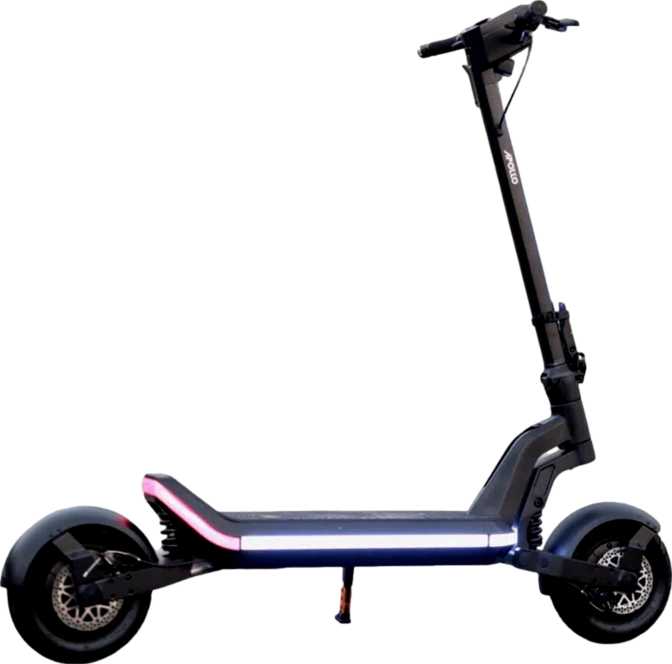
The Phantom 2.0 Stellar carries itself with the kind of physical presence that makes other scooters look like prototypes. At just under 50 kilograms — roughly the weight of a large motorcycle battery pack — this machine announces its ambitions before you've even powered it on. That weight is the first thing to understand about this scooter, because it informs everything about how you'll live with it.
The frame is wide and planted. At nearly 1,300mm across the handlebars and standing around 1,460mm tall in riding position, this is a full-size vehicle. It doesn't disappear into a corner of your apartment the way a lightweight commuter does. Riders with access to a garage, a storage unit, or ground-floor access will be far better served than those counting on daily stair carries.
Despite the mass, the scooter does fold — a meaningful feature for loading into a vehicle or storing flat. Don't expect to fold it and carry it under your arm; this is trunk-and-hoist territory, not subway-tuck territory.
Tires and Suspension
The 11-inch pneumatic tires are meaningfully larger than what most performance scooters ship with. Air-filled tires absorb road imperfections rather than transmitting them directly into your joints — a real difference over longer rides and on imperfect surfaces. Combined with the full suspension system, the ride character at speed is noticeably more composed than you'd expect from something without a physical seat.
The suspension isn't decoration at these performance levels. At 85 km/h, small bumps become large events very quickly. A properly tuned suspension system is what separates a scooter that's fast from one that's genuinely rideable at its top speed.
Lighting and Weather Resistance
Integrated front and rear lighting is standard equipment here, not an afterthought. The IP66 rating means the scooter is fully protected against dust and can withstand powerful, directed jets of water. You can ride through heavy rain with confidence. You can rinse it down. What it doesn't mean is that it can be submerged — but for real-world riding, IP66 is about as comprehensive as weather protection gets on two wheels.
Performance: What 6,700 Watts Actually Means
Dual-Motor Power Delivery
Most electric scooters on the market — including many marketed as powerful — run a single motor producing somewhere between 500W and 1,500W of rated output. The Phantom 2.0 Stellar runs two motors with a combined output of 6,700W. That's not a marginal upgrade over the competition; it's a different category of machine.
In practical terms: when you open the throttle from a standstill, the acceleration is the kind that shifts your weight backward and demands that you're holding on with intention. Peak power delivery at lower speeds is where riders feel the difference most — merging onto roads, clearing intersections, or pushing past slower traffic. The dual-motor configuration distributes power across both wheels, with real implications for traction and stability under hard acceleration, particularly on wet roads or loose surfaces.
Top Speed and Real-World Velocity
The 85 km/h top speed (approximately 53 mph) puts the Phantom 2.0 Stellar into a category that intersects with light traffic. This is not a scooter you ride at full speed in a bike lane. At these velocities, appropriate protective gear — helmet, gloves, jacket — isn't a recommendation. It's a prerequisite.
The practical value of a high top speed isn't always about reaching it. A scooter with ample headroom above typical riding speeds feels more composed and less strained at 40–50 km/h than a maxed-out machine struggling to keep pace.
Climbing Capability
A 30-degree climbing angle is steep. For context, most residential streets max out around 10–15 degrees. San Francisco's famously challenging hills peak around 31 degrees. The Phantom 2.0 Stellar handles real-world inclines without the motor loading up or speed deteriorating mid-climb — a direct consequence of having enough power in reserve that hills don't represent a meaningful demand on the system. Riders in hilly cities who've been disappointed by underpowered scooters losing momentum on ascents will notice the difference immediately.
Braking and Load Capacity
Dual-Brake System
Dual brakes — front and rear — are non-negotiable at these speeds. Stopping a 50kg machine traveling at 70+ km/h is a serious engineering problem. The Phantom 2.0 Stellar's braking setup is designed around the performance envelope the motors create, which is the only responsible way to build a scooter in this class.
150 kg Load Capacity
The 150kg maximum load capacity is unusually generous for this category, where most scooters cap out at 100–120kg. Heavier riders who've hit the load ceilings of other premium scooters will find the Phantom 2.0 Stellar accommodating without the performance compromises that come from operating near a machine's load ceiling.
Battery, Range, and Charging
How Far and How Long
The 1,800 Wh battery pack is one of the largest found on any production scooter. Many well-regarded performance scooters ship with battery packs in the 500–800 Wh range — the Phantom 2.0 Stellar carries more than double that capacity in most comparisons.
The practical result is a maximum range of approximately 90 kilometers on a single charge. This figure is subject to conditions: speed, rider weight, terrain, temperature, and riding style all compress or extend actual range. For context, most daily urban commuters cover 20–30 km round-trip — even aggressively discounting the rated range, the Phantom 2.0 Stellar comfortably handles multiple days of normal city use on a single charge.
Estimated Range by Riding Style
Range varies by speed, rider weight, terrain, and temperature. Figures are illustrative and based on typical electric vehicle performance patterns.
Charging Realities
The 10-hour charge time is the honest cost of that large battery pack. There's no shortcut — more energy storage means more time to replenish it. This isn't a scooter you can top up in an hour between errands. The practical pattern for most owners is overnight charging, which works smoothly in day-to-day life but requires planning if you've run the battery low and need range the same day.
The removable battery is a genuinely useful design decision. You're not required to route a charging cable to wherever the scooter is parked. You can carry the battery pack indoors — to an office, an apartment, a hotel room — and charge it there independently. For riders without outdoor power outlets or those who park in locations without charging access, this is the difference between practical ownership and a constant logistical problem.
Regenerative Braking
When you brake, the motors run in reverse and recover some of that kinetic energy back into the battery. The regenerative braking system contributes both to modest range extension and to a natural, engine-braking feel that experienced riders quickly come to rely on for speed management. On downhill-heavy routes, the cumulative energy recovery adds up — and the braking feel becomes part of the riding experience rather than just a charging mechanism.
Smart Features and Connectivity
The dedicated smartphone app integration brings the Phantom 2.0 Stellar into a connected ecosystem. At this performance tier, companion apps typically surface performance mode selection, ride statistics, GPS-based features, and remote locking — reflecting the scooter's positioning as a premium, considered purchase rather than a commodity product.
Who Should Buy the Apollo Phantom 2.0 Stellar
- Performance-first riders who've owned fast scooters and want more — more range, more power reserve, more capability on terrain and in weather.
- Heavier riders who've hit the load ceilings of other premium scooters and experienced performance degradation as a result.
- Long-distance commuters covering 30–60 km daily and wanting genuine range margin rather than battery anxiety.
- Riders in hilly environments where lesser motors struggle or fail to maintain consistent speed on sustained climbs.
- All-weather commuters who ride regardless of forecast and need IP66-grade weatherproofing to back that up.
- Riders with vehicle storage who can load it into a trunk without daily portability demands.
- Apartment dwellers above ground floor who need to carry their scooter up stairs or through a crowded lobby daily — the weight makes this a recurring physical challenge.
- Casual or infrequent riders who don't need this performance level and would be better served by something lighter and less expensive.
- New riders without prior experience on high-speed electric scooters. The power delivery and top speed demand experience and judgment.
- Riders in low-power jurisdictions — at 6,700W and 85 km/h, street legality is not guaranteed in most regions.
- Anyone expecting quick top-ups between uses. The 10-hour charge time is a hard constraint for time-sensitive schedules.
How the Phantom 2.0 Stellar Compares
The performance scooter market at this tier is relatively small but meaningful. Here's how the Phantom 2.0 Stellar stacks up against the primary categories of alternatives.
| Criteria | Apollo Phantom 2.0 Stellar | High-End Single-Motor | Dual-Motor Mid-Range |
|---|---|---|---|
| Combined Motor Power | 6,700W | 1,500–2,500W | 2,000–4,000W |
| Top Speed | 85 km/h | 45–65 km/h | 55–75 km/h |
| Battery Capacity | 1,800 Wh | 500–800 Wh | 700–1,200 Wh |
| Max Range | ~90 km | 40–60 km | 50–80 km |
| Scooter Weight | ~49 kg | 18–28 kg | 25–38 kg |
| IP Rating | IP66 | IP54–IP55 typical | IP55–IP65 typical |
| Suspension | Front + Rear | Often front-only | Front + Rear |
| Tire Size | 11" | 8–10" | 10–11" |
| Load Capacity | 150 kg | 100–120 kg | 100–136 kg |
Strengths and Honest Limitations
Where It Excels
The motor system produces power in a class that eliminates hills as a variable in route planning. The battery ensures that range limitations won't define your day under normal riding conditions. The IP66 rating and the pneumatic tire and suspension combination mean that neither weather nor road quality compromise the riding experience — conditions that regularly defeat lighter, less engineered alternatives.
The removable battery is a practical win that compounds value over months of use. Charging without needing physical access to the scooter itself is a quality-of-life feature that separates considered engineering from spec-sheet thinking. The 150kg load ceiling also opens the scooter to riders routinely shut out by the category standard.
Where It Asks for Compromise
The weight is the scooter's most persistent limitation — not a flaw in execution, but an unavoidable consequence of building something with a battery this large and motors this powerful. Riders who need a scooter they can fold and carry frequently will fight this machine every time they try.
The 10-hour charge time is long in absolute terms. While overnight charging solves the problem for most, it doesn't solve it for everyone. At these speeds and outputs, rider competence, appropriate protective gear, and jurisdictional compliance become real responsibilities.
There's also no seat — a notable absence on a machine of this weight and range capability. Extended rides at 80+ km/h are physically demanding in a standing position, and riders with knee or lower-back sensitivities should factor this into their assessment before purchasing.
Questions Buyers Ask Before Purchasing
Final Verdict
The Apollo Phantom 2.0 Stellar is not trying to be all things. It's a high-performance electric scooter built around maximum capability — range, power, weatherproofing, and load tolerance — and it delivers on that mandate without meaningful qualification.
The weight is real and it matters. If daily portability is your primary need, this scooter will frustrate you. But for the rider who has outgrown what the broader market offers — who commutes long distances and needs genuine range, who lives somewhere hilly and needs a motor that doesn't flinch, who has a practical storage and charging setup to match the machine — the Phantom 2.0 Stellar is the kind of purchase that ends the search.
Purchase Verdict
Buy it if you need what it does. Don't buy it if you need something it isn't. For experienced riders with real performance demands and appropriate storage, this is the definitive choice in its category.