Anker Soundcore Liberty 5 Pro Max: Full Review and Real-World Test
Wireless EarbudsThe Anker Soundcore Liberty 5 Pro Max isn't a product that enters its category quietly. It arrives carrying a specification list that reads like a checklist of premium features: an OLED display built into the charging case, Bluetooth 6.1, LDAC high-resolution audio, eight microphones, three-device multipoint connectivity, and Dolby Atmos support. The real test is whether those components add up to a cohesive daily experience — or whether the checklist conceals trade-offs that only reveal themselves after hours of use. This review examines both sides honestly.
Specifications at a Glance
The OLED Display Case: A Different Kind of First Impression
The charging case makes its most immediate statement before the earbuds ever reach your ears. Built into the case lid is a 1.78-inch OLED display — not a row of LED dots, but a full panel using the same display technology found in flagship smartphones. At a glance, it reports the exact battery percentage of each earbud and the case itself, eliminating the guesswork of decoding blinking light sequences that most earbud cases still rely on.
OLED is the right technology choice for this application. True blacks and strong contrast perform in all lighting conditions: the display remains clearly readable in direct sunlight yet doesn't bleed light into a dark bag when idle. Because OLED only powers active pixels, the display works alongside the battery life rather than against it.
The case is built to travel. An included travel bag — a dedicated carrying pouch for the case — protects it from scratches and makes it easy to locate inside a larger bag. It is a small but considered inclusion that reflects the overall premium positioning of the package.
- Per-earbud battery percentage
- Case battery level at a glance
- Readable clearly in bright sunlight
- No cryptic LED patterns to decode
Earbud Design and Fit
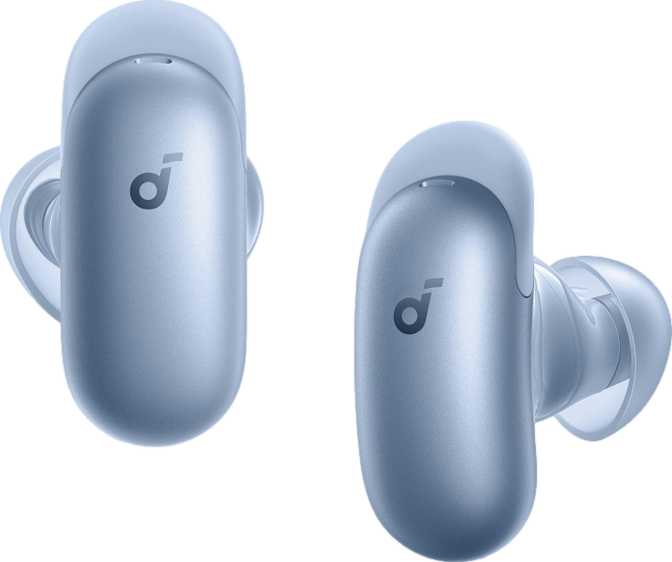
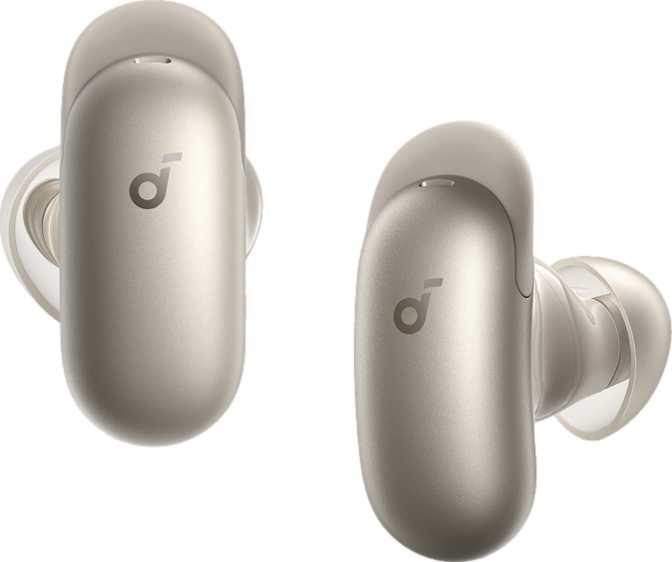
The earbuds use a standard in-ear form factor, inserting directly into the ear canal and relying on silicone ear tips for both comfort and passive acoustic seal. At approximately 11 grams each, they are light enough that the physical presence mostly disappears after the first twenty minutes of wear. Extended sessions of two to three hours are unlikely to produce the ear fatigue that heavier earbuds create.
There are no wing tips or stabilizing fins — the seal and security come entirely from the ear tip. Choosing the right size from the included selection is more critical here than with designs that use a physical anchor. A proper tip fit directly affects bass response and the effectiveness of passive noise isolation, which works in parallel with the active cancellation system. Anyone switching from earbuds with wing tips should spend a few minutes on tip sizing before their first long session.
The IP55 rating means the earbuds withstand limited dust ingress for everyday use and water jets from any direction. Heavy rain, gym sweat, and outdoor runs in poor weather are all covered without concern. Submersion is outside the specification, but for any activity above water, IP55 covers virtually every scenario a daily wearer encounters.
Sound Performance
The Liberty 5 Pro Max builds its audio around three interlocking components — the physical driver, Dolby Atmos processing, and LDAC codec support. Understanding each individually makes the overall audio picture clearer.
The Driver
The 9.2mm dynamic driver is a deliberate size choice. Large enough to generate genuine low-frequency impact and bass body, yet compact enough to reproduce high-frequency detail with accuracy and speed. The practical result is a balanced character — full bass that complements rather than overwhelms, midrange clarity where vocals and most instruments live, and high-frequency extension that adds air and definition. The driver covers the full audible frequency range, from the lowest tones a human ear can perceive to the highest, capturing everything any recording contains.
Dolby Atmos
Dolby Atmos support is present, and it matters specifically when source content supports it. Atmos is an object-based audio format where sound elements are placed spatially in a three-dimensional field. On Atmos-encoded streaming content, the Liberty 5 Pro Max produces a wider, more enveloping soundstage than standard stereo from the same source.
What it does not include is head-tracking spatial audio — the processing doesn't adjust dynamically as your head moves. For streaming music and film on Atmos-capable platforms, the benefit is real and perceptible. For those expecting a dynamic head-tracking system, that capability is absent.
LDAC Audio
LDAC defines the audio ceiling of the Liberty 5 Pro Max. Developed by Sony and now part of the Android Open Source Project, LDAC transmits audio at significantly higher data rates than standard Bluetooth codecs — sufficient bandwidth to carry high-resolution files without compression artifacts.
To access this, your source device must support LDAC. Most major Android phones do. Apple devices use AAC instead, which is capable for standard streaming quality but does not unlock the high-resolution pipeline. AAC is also fully supported for all users.
Active Noise Cancellation and Passive Isolation
Active noise cancellation works by using microphones to sample incoming sound and generate inverse audio signals that cancel it — particularly effective against consistent low-frequency noise like aircraft engines, traffic, and air conditioning. The Liberty 5 Pro Max feeds its ANC system with dedicated microphones specifically positioned to sample external noise.
Passive noise isolation — the physical barrier formed by a properly sealed in-ear tip — works in parallel, reducing environmental noise before active cancellation even begins. The layered approach means effective noise reduction is greater than either system achieves independently. Getting the tip fit right before a noisy commute or flight significantly increases the practical ANC result.
The ambient sound mode uses external microphones to intentionally pass in environmental audio, enabling situational awareness — at a crossing, during a brief conversation, or in an open office — without removing the earbuds. Switching between modes is handled directly from the earbud touch panel.
Battery Impact of ANC
Battery Life and Charging
The Liberty 5 Pro Max's battery story is generous at every layer. Each full earbud charge delivers around twelve hours of playback without ANC — sufficient for most single-day use cases without opening the case. The case carries enough additional charge to refill the earbuds approximately three full times, bringing the combined total to roughly 50 hours before the case itself needs power.
Wireless charging is supported — any standard Qi charging pad tops up the case without a cable. For those who already keep a wireless pad on a desk or nightstand, this is a frictionless daily habit. USB-C wired charging is also available and tends to be faster when the case is significantly depleted.
Fast charging is included. A short time connected to a charger adds meaningful listening time — practical for the moments when you realize the case is depleted before leaving. A full charge from flat takes approximately 90 minutes. The OLED display reports exact percentages for each component, so you will never be caught off-guard by unexpected depletion.
Battery Life Overview
Earbuds and ANC values shown relative to 50-hour combined maximum.
Connectivity
Bluetooth 6.1 in Practice
The Liberty 5 Pro Max ships with Bluetooth 6.1 — a genuinely current-generation wireless standard. The primary improvements over earlier Bluetooth versions are energy efficiency and connection precision. For day-to-day use, the most tangible effects are faster initial pairing, more stable connections in crowded wireless environments such as offices, transit hubs, and airports, and reduced reconnection time when taking earbuds out of the case. Practical wireless range reaches approximately 10 meters under clear conditions — sufficient for moving between rooms while leaving a source device on a desk.
Codec Support
| Codec | Supported | Best For |
|---|---|---|
| LDAC | Android high-resolution audio | |
| AAC | iPhone and standard Android streaming | |
| aptX Adaptive | Qualcomm-device users | |
| aptX HD | Qualcomm legacy HD | |
| aptX | Standard Qualcomm codec | |
| Bluetooth LE Audio | Next-generation BT standard |
3-Device Multipoint
The Liberty 5 Pro Max maintains simultaneous Bluetooth connections to three separate devices at once — laptop, phone, and tablet all at the same time. When a call arrives on your phone while audio plays from your laptop, the earbuds switch automatically. When the call ends, they return to the laptop audio. No manual disconnection or re-pairing is needed. Most earbuds in this category cap at two simultaneous connections.
Audio Latency: 91ms
The specified audio latency of 91 milliseconds is worth addressing directly for mobile gamers. Human perception of audio-to-video desynchronization typically begins above 100ms, so video content and general use feel synchronized. For competitive gaming where audio cues matter in split-second decisions, this latency may be noticeable. A dedicated low-latency gaming mode is not included. For all non-gaming use cases, 91ms is a non-issue.
Call Quality and the Eight-Microphone Array
Eight microphones is an exceptional count for wireless earbuds, and the configuration serves two purposes simultaneously. A subset feeds the ANC system, sampling external noise to generate cancellation signals. The remainder are configured for voice pickup using beamforming — focusing on the speaker's voice and suppressing background noise at the point of capture, before it reaches the other end of a call.
In a busy coffee shop, noisy office, or outdoor environment, the noise-canceling microphone system captures voice clearly while actively suppressing the surroundings. For remote workers, call quality in wireless earbuds has historically been the weakest link. Eight microphones with dedicated voice noise cancellation is a credible answer to that problem.
A mute function is accessible directly from the earbud touch controls — instant silence during calls without needing to unlock a phone screen. Voice commands connect the earbuds to whatever voice assistant is configured on the paired device.
- Dedicated noise-canceling microphones for calls
- Beamforming voice pickup technology
- Mute function via earbud touch control
- Voice assistant commands supported
Daily-Use Features Worth Knowing
Beyond audio and connectivity, the Liberty 5 Pro Max includes a set of everyday features that shape the ownership experience. Here is an honest look at what is included and what is notably absent.
Included Features
- Ambient Sound Mode — pipe in surroundings without removing the earbuds
- Find My Earbuds — locate misplaced earbuds via the companion app
- Voice Prompts — spoken connection status and battery announcements
- Touch Controls — on-earbud panel for playback and mode switching
- Voice Commands — hands-free voice assistant access
- Travel Bag — protective carrying pouch included in the box
Notable Omissions
- No In-Ear Detection — music does not auto-pause when an earbud is removed
- No NFC Pairing — tap-to-pair is not available
- No Notification Reading — notifications are not read aloud
- No Head-Tracking Spatial Audio — Dolby Atmos is fixed, not dynamic
- No aptX Support — Qualcomm codec users fall back to AAC
Who the Soundcore Liberty 5 Pro Max Is Built For
Buy If You Are...
-
An Android LDAC user who prioritizes audio quality
LDAC, Dolby Atmos, and the 9.2mm driver combine into a high-resolution audio pipeline that genuinely exceeds what standard Bluetooth delivers. This is the primary use case the Liberty 5 Pro Max is built for.
-
A multi-device professional
Three-device multipoint, an eight-microphone call system, and a mute function make these earbuds credible as a primary remote-work headset rather than just a music accessory with a call feature bolted on.
-
A frequent commuter or traveler
ANC, IP55 weather resilience, generous combined battery life, an OLED case for quick battery checks before departure, and an included travel bag cover every aspect of the transit routine.
-
A gym user or outdoor exerciser
IP55 handles heavy sweat and rain without concern. The lightweight in-ear design stays comfortable through extended sessions.
Consider Alternatives If You Are...
-
An iPhone user seeking maximum audio quality
LDAC is unavailable on iOS. The earbuds function fully on iPhone using AAC, but the high-resolution audio pipeline — one of the Liberty 5 Pro Max's strongest differentiators — doesn't apply. Other earbuds at this price integrate head-tracking spatial audio that works particularly well within the Apple ecosystem.
-
A Qualcomm aptX user
The aptX codec family is entirely absent. Devices that support aptX Adaptive but not LDAC will operate on AAC only, missing both high-resolution codec pathways.
-
A competitive mobile gamer
The 91ms audio latency is acceptable for all non-gaming use but is not positioned for competitive gaming. A dedicated low-latency gaming mode is not included.
-
Someone who relies on auto-pause
In-ear detection is absent. Removing an earbud does not pause playback automatically. Users accustomed to this workflow will feel its absence daily.
How It Stacks Up Against the Premium Category
The Liberty 5 Pro Max competes directly in the upper tier of the true wireless market. The comparison below shows where it leads, where it matches, and where it trails the typical premium-tier benchmark.
| Feature Area | Liberty 5 Pro Max | Typical Premium Tier |
|---|---|---|
| Case Display | 1.78" OLED Panel | LED indicators — no screen |
| Bluetooth Standard | Version 6.1 | Version 5.2–5.3 common |
| LDAC Hi-Res Audio | Supported by most competitors | |
| Multipoint Connections | 3 Devices | 2 devices — typical |
| Microphone Count | 8 Microphones | 4–6 typical |
| Wireless Case Charging | Common at this price tier | |
| Weather Protection | IP55 | IPX4–IPX5 typical |
| In-Ear Auto-Pause | Standard in this tier | |
| Head-Tracking Spatial Audio | Present in select flagships | |
| aptX Codec Support | Varies by product | |
| Audio Latency | 91ms | Varies — some offer gaming modes |
Strengths and Honest Trade-offs
What Works Well
- The OLED case display changes the daily ownership experience in a real, compounding way. Knowing exact battery states with a single glance — not an app check or blinking light interpretation — reduces friction that accumulates across hundreds of days of use.
- The audio pipeline — LDAC ingestion, Dolby Atmos processing, and a balanced 9.2mm driver — represents a coherent philosophy: receive the best wireless signal available and deliver it with spatial character. For LDAC-capable Android devices, this is a genuinely differentiated experience.
- Bluetooth 6.1 is forward-looking. For a device expected to serve two or more years, being on current-generation wireless connectivity ensures the Liberty 5 Pro Max won't feel dated as the ecosystem matures around it.
- Eight microphones with dedicated voice noise suppression, three-device multipoint, and a mute function make these earbuds genuinely viable as a professional remote-work headset — not just a music accessory with call capability attached.
- The feature density — OLED display, BT 6.1, LDAC, wireless charging, 3-device multipoint, IP55, 8 microphones — at the Liberty 5 Pro Max's price point represents a value argument that established audio brands at higher prices struggle to counter directly.
Honest Trade-offs
- The absence of in-ear detection is an odd omission at this specification level. It costs relatively little to implement and is standard on most competing products. Users who value automatic pause on earbud removal will notice this gap every single day without exception.
- The LDAC-exclusive high-resolution codec path narrows the ideal audience considerably. iPhone users and Qualcomm aptX device users receive no premium codec benefit — they get AAC, which is capable, but the premium audio pipeline is simply not accessible from their devices.
- The 91ms latency figure, while acceptable for everyday use and video content, disqualifies the Liberty 5 Pro Max for competitive mobile gaming where audio timing precision directly affects performance. No low-latency mode is present.
- Head-tracking spatial audio — now a differentiating feature at the flagship tier — is absent. Dolby Atmos processing expands the soundstage on supported content, but the experience does not respond dynamically to head movement the way competing flagship earbuds now do.
Questions Real Buyers Ask Before Purchasing
These are the questions buyers most commonly search for before committing to the Soundcore Liberty 5 Pro Max.
Final Verdict
The Bottom Line
The Anker Soundcore Liberty 5 Pro Max is a technically credible premium earbuds offering that succeeds most clearly for a specific audience: Android users on LDAC-capable devices who want professional audio quality, multi-device flexibility, and call capability from a single pair of earbuds. For that user, the feature density relative to price is genuinely competitive with established flagships that cost meaningfully more.
Know which scenario applies to you before buying. For the right buyer — an Android LDAC user who values multipoint connectivity, call quality, and a premium charging case experience — the verdict is clear: this is a strong purchase. For the wrong buyer, the spec list is genuinely appealing, but several of its best features simply do not apply.