AE60 Ultra Drone Review: An Honest Look at 8K Performance
DronesAt a Glance
Key specifications translated into real-world terms
29 min
Max Flight Time
12 km
Control Range
8K
Video Resolution
33 MP
Stills Resolution
~40 min
Full Charge Time
727 g
Aircraft Weight
What the AE60 Ultra Actually Delivers
The aerial photography market has reached an interesting inflection point. Entry-level drones take decent vacation footage, professional cinema rigs cost more than a car, and the middle ground — where most serious hobbyists and working creatives actually live — has become genuinely crowded. The AE60 Ultra enters this space with a specification profile that reads like a challenge: 8K video resolution, a 33-megapixel still camera, charging times that change how you plan a shooting day, and a control range that puts most of your city within reach. Whether those numbers translate into real-world shooting confidence is what this review is here to determine.
Design and Physical Presence
Size, Weight, and Portability
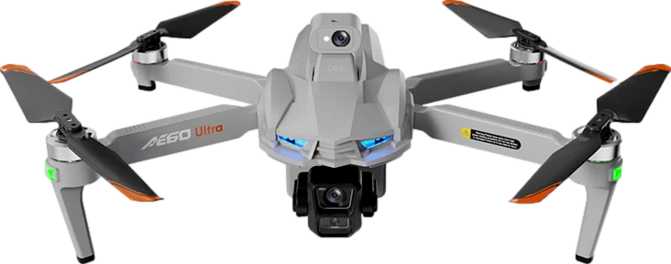
The AE60 Ultra is a physically substantial aircraft. Unfolded, its arm span reaches roughly 420mm across both dimensions — a commanding footprint that reflects the serious imaging payload it was designed to carry. When folded down to its travel configuration, the 128mm vertical profile is what matters for bag-readiness. It fits a dedicated drone case or a well-padded backpack compartment, though standard daypacks will feel tested.
At 727 grams, the AE60 Ultra sits in a weight bracket that matters for more than just aerodynamics. Most countries use 250 grams as the threshold below which recreational drones face simplified or waived registration requirements. The AE60 Ultra sits well above that line. Depending on where you fly, expect to register the aircraft with the relevant aviation authority before it ever leaves the ground — and in some regions, additional certifications apply. Confirming local requirements before purchase is the correct first step.
What the Build Communicates
The design choices here prioritize performance over ultralight convenience. When you hold a 727-gram aircraft, you feel that it was engineered to carry real camera hardware rather than minimized to hit a regulatory threshold. The arm geometry at this scale also contributes meaningfully to in-air stability — wider motor spacing helps dampen the micro-movements that can degrade video clarity, particularly in crosswind conditions.
Physical Specifications
- Unfolded Span
- 420 × 420 mm
- Folded Height
- 128 mm
- Weight
- 727 g
- Weather Protection
- None — Not Weather-Sealed
The Camera System: Where the AE60 Ultra Makes Its Case
33-megapixel stills, 8K video, and a dual-camera configuration
33MP RAW Stills
At this resolution, a single frame contains enough detail to support aggressive cropping in post-processing without the result looking soft or compromised. Photographers supplying images to print, editorial, or large-format display clients will find the resolution comfortably adequate for demanding deliverables.
RAW files preserve the full sensor data before any in-camera processing — giving precise control over exposure recovery, color grading, and white balance during editing. A JPEG-only aerial camera forces you to accept the manufacturer's processing decisions; RAW gives you that authority later.
8K / 30fps Video
8K capture enables confident 4K output cropping — reframe, stabilize, or zoom footage in editing without visible quality loss in the final deliverable. It future-proofs your archive and provides resolution headroom for digital zoom operations in post without visible degradation.
At 30 frames per second, the footage is optimized for cinematic output and smooth aerial movement. The 110-degree field of view captures broad landscapes and architectural context without the barrel distortion that more aggressive wide-angle settings introduce.
Dual Camera Setup
A secondary FPV camera provides a live flight-perspective feed during flight, separate from the main imaging camera. It improves situational awareness during complex maneuvers and opens the aircraft to immersive first-person flying as a secondary mode alongside cinematic capture.
In-camera panorama stitching assembles wide-angle or 360-degree compositions automatically, without requiring post-processing software — a genuine convenience for fast-turnaround deliverables.
Flight Performance: Range, Speed, and Time Aloft
Operational capability assessed in real-world conditions
29 min
Max Flight Time
~83% of category ceiling (~35 min)
12 km
Max Control Range
Well beyond visual line-of-sight limits
~50 km/h
Maximum Speed
Calibrated for cinematic, not racing
How Far and How Fast
The control range extends to 12 kilometers — a distance that, in practical terms, is limited less by the aircraft's capability and more by local aviation law. Most jurisdictions require pilots to maintain visual line of sight with the drone, which effectively tops out at roughly 500 to 800 meters in clear conditions for a human observer. The 12km figure represents the outer boundary of what the communication link can sustain — meaningful in rare legally-permitted scenarios, and reassuring as a buffer against signal degradation in congested radio frequency environments such as dense urban areas.
The maximum speed of approximately 50 kilometers per hour tells you what this aircraft was designed to do. It was not built for racing. It was built for controlled, precise aerial movement — the smooth, deliberate camera work that cinematic and commercial imaging requires. Pilots who routinely operate in genuinely gusty terrain will encounter this ceiling more frequently than those flying in sheltered environments.
29 Minutes Aloft: The Honest Accounting
Nearly half an hour of flight time per battery is a respectable figure for an aircraft in this weight class. In practical shooting terms — accounting for takeoff, positioning, test passes, and the deliberate choice to land with reserve charge rather than flying to automatic cutoff — active capture time per flight runs closer to 20 to 22 minutes. That still represents enough time for a real estate fly-through sequence, a complete landscape session, or meaningful coverage of a compact outdoor event.
Obstacle Detection
Active sensor coverage reduces collision risk in standard flying environments
GPS Positioning
Hover-lock, waypoint navigation, and accurate return-to-home targeting
Return to Home
Auto-triggers on low battery, signal loss, or manual pilot activation
Intelligent Flight Modes
Automated flight patterns for consistent, repeatable cinematic results
Battery and Charging: A Genuine Field Advantage
Fast charging that changes how you plan a shooting day
Fast Charging That Reshapes the Shooting Day
The AE60 Ultra's most underrated specification is how quickly its large battery recharges. A cell of this capacity — easily large enough that standard consumer charging hardware would take well over two hours to refill it — reaches full charge in approximately 40 minutes. That fast-charge performance is rare at this battery size, and its value is felt most acutely in real field conditions rather than on a specification comparison table.
With conventional 90-minute or longer charge cycles, a single-battery shooting day means spending nearly as much time waiting as flying. The AE60 Ultra's 40-minute window changes that rhythm: fly for close to half an hour, charge during a natural break — a location recce, lunch, a client briefing — and be ready to fly again before the break ends. On a serious production day, that efficiency compounds significantly.
The Removable Battery Advantage
The battery is physically removable and field-swappable. With two batteries and a portable charger, back-to-back flights with minimal downtime become achievable — one battery in the aircraft, one on charge, rotating on a near-continuous cycle. More importantly, removability has a long-term ownership implication: when a battery's capacity degrades over time (a certainty with lithium cell chemistry), you replace a battery, not an aircraft. Sealed battery designs force an all-or-nothing decision when capacity fades. Removable batteries let the aircraft outlive multiple power sources.
Charge Time Comparison
The Controller, Storage, and Connectivity
Built-in display, 128GB storage ceiling, and the positioning sensor suite explained
Built-In Display
The remote control includes a dedicated built-in display — which means a smartphone is not required to see a live feed from the aircraft's cameras. In direct outdoor sunlight, smartphone screens frequently struggle with brightness and visibility, and some devices enter thermal protection modes during extended sessions that dim the display or reduce performance. A purpose-built controller display avoids these issues. Setup time from bag to airborne is shorter and more consistent, and the phone stays available for navigation, client communication, and everything else a working day demands.
Smartphone compatibility is also supported for pilots who prefer app-based flight planning, detailed telemetry monitoring, or integrated social sharing workflows — a supplement to the built-in display, not a prerequisite.
Storage: Planning Is Not Optional at 8K
The aircraft accepts memory cards up to 128 gigabytes in its external slot. Even compressed 8K video can consume between one and two gigabytes per minute of footage; shooting in RAW stills mode pushes individual file sizes into the tens of megabytes per frame. A 128GB card can fill faster on an 8K shooting day than many pilots expect.
High-speed cards are required — 8K capture demands fast write speeds to record without interruption. Multiple cards and a method to offload footage between flights are part of the honest cost of operating a camera at this resolution tier.
The Full Positioning Sensor Suite
GPS, gyroscope, accelerometer, and compass work together as the aircraft's spatial intelligence layer — the combination that keeps the drone level through turbulence, compensates for wind drift during stationary shots, and ensures precise three-dimensional positional awareness at all times. For video capture specifically, this sensor cluster is as foundational to image quality as any optical stabilisation system.
GPS
Precise positional anchor for hover-lock, waypoints, and accurate return-to-home
Gyroscope & Accelerometer
Constant attitude correction, wind drift compensation, and video stability data
Compass
Three-dimensional directional awareness and precise heading lock in the field
Smartphone Support
Flight planning apps, detailed telemetry, and social sharing workflows
Who Should Buy the AE60 Ultra — and Who Should Not
Matching the right operator to the right platform
Ideal For
-
Working Content Creators & Videographers
Those who need deliverable-ready 8K or high-resolution 4K footage without renting professional cinema drones.
-
Real Estate & Property Professionals
Operators who need compelling video sequences and high-resolution stills from a single flight and a single battery charge.
-
Landscape & Travel Photographers
Shooters stepping up from consumer-entry drones who want RAW files and serious resolution without moving to industrial equipment.
-
Technically Engaged Hobbyists
Pilots who have completed foundational flight training, understand local regulations, and want a platform that matches their growing skill level.
Look Elsewhere If...
-
Regulatory Simplicity Is Your Priority
The weight places this aircraft in the registration-required bracket in most jurisdictions. Buyers focused on minimizing regulatory overhead should look at sub-250g models.
-
You Shoot in All-Weather or Coastal Conditions
Anyone whose regular locations involve rain, coastal spray, or consistently high humidity faces a meaningful operational constraint without moisture protection.
-
High-Speed or Acrobatic FPV Flying
The speed ceiling and flight characteristics are calibrated for cinematic work. Pilots seeking a pure speed or freestyle maneuverability platform will find this drone misaligned.
-
Absolute Beginners With No Flight Experience
This aircraft carries real imaging hardware with real replacement costs. Developing fundamental flight competence on a lower-stakes training platform first is genuinely prudent.
How the AE60 Ultra Positions Against the Competition
Feature-by-feature breakdown across the consumer-prosumer drone tier
| Capability | AE60 Ultra | Typical Competitor Range |
|---|---|---|
| Video Resolution | 8K / 30fps | 4K to 6K most common; 8K uncommon |
| Still Image Resolution | 33 Megapixels | 20 to 50 MP across the tier |
| RAW Stills Capture | Present in many, but not universal | |
| Obstacle Detection | Standard at this performance tier | |
| Maximum Flight Time | ~29 minutes | Roughly 25 to 35 minutes typical |
| Battery Charge Time | ~40 minutes | 60 to 90+ minutes more common |
| Moisture / Weather Protection | None | Absent in most consumer-prosumer models |
| Built-In Controller Display | Present in select models; not universal |
Strengths and Honest Weaknesses
What the AE60 Ultra Gets Right
The AE60 Ultra's most compelling quality is the internal coherence of its feature set. The combination of a high-resolution RAW-capable still camera, 8K video, rapid battery charging, a removable power cell, and a built-in controller display feels genuinely intentional — each capability supports the others in a way that adds up to a credible professional shooting tool rather than a spec-inflated consumer product. The 33-megapixel sensor and the ability to shoot in RAW format are the kind of specifications that make the difference between footage you can use professionally and footage you have to apologize for.
The charging speed deserves particular emphasis because its value is felt most clearly in real field conditions. A drone that is ready to fly again in 40 minutes changes a half-day shoot into a full-day one. That is a productivity advantage that competitors with 90-minute charge cycles simply cannot match without requiring a second battery.
Where It Falls Short
The absence of weather protection is a genuine operational constraint and must be treated as such — not softened as a minor footnote. For most buyers in temperate climates, the practical impact is a constant attention to weather forecasts, occasional cancelled shoots, and a standing rule against flying in any conditions that carry moisture risk. For marine photographers, documentary crews, or event coverage professionals who cannot reschedule around weather windows, it is a disqualifying constraint.
The top speed, appropriate for cinematic flying, does mean the aircraft will be pushed perceptibly off course in meaningful crosswinds. The storage ceiling, while not small in absolute terms, can feel tight against a full day of 8K RAW capture — meaning fast, high-capacity storage media is a required part of the ownership picture, not an optional accessory.
Questions Real Buyers Ask Before Purchasing
Answers to the most common concerns before you commit
Final Verdict
AE60 Ultra — Who Should Pull the Trigger
4 / 5 — Recommended
The AE60 Ultra makes a clear and coherent case for a specific type of buyer. It delivers a genuinely capable imaging platform — 8K video, 33-megapixel RAW stills, fast charging, and a workflow-forward controller with a built-in display — in a package that asks for real engagement in return: regulatory registration, weather-aware scheduling, post-production investment, and attentive operation.
The purchase decision comes down to two honest questions. First: does your shooting environment allow you to work within the moisture protection constraint? If your regular locations make flying in rain or near water unavoidable, this aircraft's limitations are a genuine mismatch. Second: does your actual output format and editing workflow leverage the 8K and RAW capabilities — or are you paying for ceiling you won't use? 8K provides meaningful creative flexibility in post and a strong archive for future-proofing, but if your distribution is 4K YouTube and compressed social media delivery, the incremental value narrows considerably.