Ulefone Armor Pad 5 Pro: Full Review of a Rugged OLED Powerhouse
TabletsMost tablets are designed with the assumption that you will use them carefully — indoors, on a clean desk, with dry hands, within arm's reach of a charger. The Ulefone Armor Pad 5 Pro rejects that assumption entirely. This is a device built around a concrete premise: some professionals cannot protect their gear from the environments they work in, and a tablet that survives the job earns its cost many times over.
What separates this from a typical rugged tablet is the quality of its core components. An OLED display on a rugged chassis, a processor built on a 4-nanometer manufacturing node, and a battery capacity in a different league from anything else in this segment — these are not compromises dressed up as features. They are legitimate specifications that matter operationally to the buyers this device was designed to serve.
The trade-offs are real and worth understanding before purchase. This review covers all of them without flattery.
Key Specifications at a Glance
Design and Build: Engineered for Punishment
Dimensions and Weight in Context
Holding the Armor Pad 5 Pro for the first time, there is no ambiguity about what it is. Its footprint of roughly 180 × 270 mm and a thickness approaching 28 mm place it firmly in heavyweight territory. At 1,327 grams, you are carrying more than twice the mass of a typical slim 11-inch consumer tablet — a fact you will feel in your hand, in your bag, and in any jacket pocket it will not fit inside.
That weight is not waste. The bulk reflects reinforced housing, an integrated cellular modem, and most significantly, the enormous battery cell inside. For users working in environments where a tablet must survive drops, vibrations, and rough handling rather than sitting on a clean desk, the heft is a trade-off to make consciously — not one the marketing tries to hide.
IP68 Protection — What It Really Means
The IP68 rating is the headline protection figure. IP68 means the tablet is fully dust-tight and rated for sustained water submersion beyond the depths covered by IP67, the rating more commonly found on consumer devices. This is not splash resistance — it is genuine waterproofing. Drop this into a puddle, rinse it under a running tap after a muddy worksite, or use it in heavy rain, and it will survive without damage.
For buyers weighing this against a consumer tablet with a vague “splashproof” marketing claim: IP68 and rugged construction are categorically different. The Armor Pad 5 Pro was built to be abused; most consumer tablets were built to forgive the occasional accident.
| Screen Size | 11 inches |
| Weight | 1,327 grams |
| Thickness | 27.8 mm |
| Dimensions | 269.7 × 179.5 mm |
| IP Rating | IP68 Waterproof |
| Build | Rugged Reinforced |
| Glass Protection | Gorilla Glass 3 |
| Anti-Reflection | Yes |
Display: Where This Tablet Surprises
An OLED Panel in a Rugged Chassis
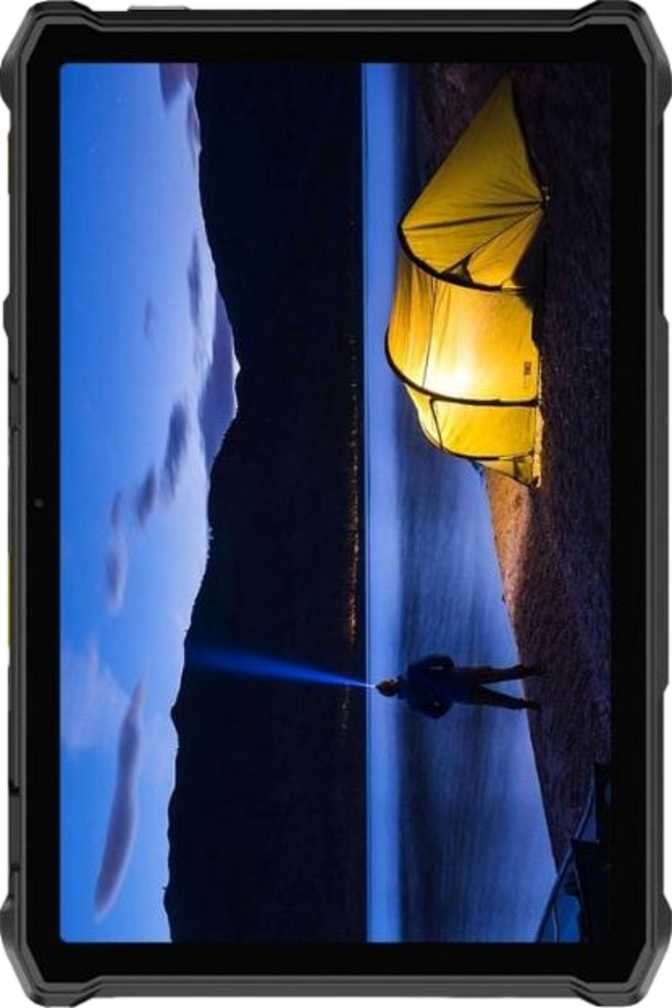
The 11-inch OLED/AMOLED display is genuinely unexpected on a rugged tablet at this price tier. OLED technology delivers true blacks and contrast ratios that LCD-based displays cannot replicate — the panel here carries a contrast ratio of 5,000,000:1, the inherent advantage of a technology where pixels that should be black are simply switched off entirely. For field technicians reviewing diagnostic imagery or engineers examining schematics, this level of detail and contrast makes a practical difference.
Brightness and Outdoor Visibility
At 900 nits of typical brightness, the display remains comfortably usable in bright outdoor conditions — one of the primary environments rugged tablets occupy. The anti-reflection coating on the glass cuts glare in a way that matters more in practice than raw brightness figures suggest. The combination of these two characteristics makes this screen among the more outdoor-capable options in the category.
Refresh Rate and Touch Responsiveness
The 120Hz refresh rate delivers visibly smooth scrolling and interaction across complex software interfaces. The 240Hz touch sampling rate — which registers finger input at twice the frequency of the display refresh — ensures touch response feels immediate and precise even with gloved hands or in wet conditions, both common in the professional environments this device targets.
Performance: Serious Processing Power
The Chipset
The processor inside the Armor Pad 5 Pro is built on a 4-nanometer manufacturing process — the same node used in flagship consumer chips. This matters because smaller transistor sizes translate directly to better power efficiency and thermal management. A chip this dense can do more work while generating less heat and consuming less battery than older-node processors handling the same workloads, which is precisely what field use demands.
The CPU uses a big.LITTLE architecture split across two clusters: four performance cores running at 2.6 GHz and four efficiency cores at 2.0 GHz. The device intelligently routes demanding tasks to the performance cores and background processes to the efficiency cores, extending battery life without sacrificing responsiveness when you need it.
RAM, Storage, and Expandability
The 12GB of DDR5 memory is a configuration that would sit comfortably in a mid-to-high-end consumer flagship. DDR5 is the current generation of memory technology, offering significantly higher bandwidth than its predecessor. With 512GB of built-in storage and a microSD slot for further expansion, capacity ceases to be a practical concern — whether you are storing offline maps, large media libraries, or extensive field documentation.
Software Platform
Android 15 ships out of the box — the current generation of the platform — with full split-screen multitasking, Picture-in-Picture mode, a complete suite of privacy controls, and on-device machine learning support. Multi-user operation and child lock features make it practical for shared-device deployments common in industrial and logistics environments.
| Chip Node | 4nm |
| CPU Configuration | 4×2.6GHz + 4×2.0GHz |
| Architecture | big.LITTLE (HMP) |
| RAM | 12GB DDR5 |
| RAM Speed | 6,400 MHz |
| Max RAM Support | 16GB |
| Internal Storage | 512GB |
| Expandable | Yes (microSD) |
| GPU | Mali G615 MC2 |
| GPU Clock | 1,047 MHz |
| DirectX | DirectX 12 |
| Android Version | Android 15 |
Battery Life: The Defining Advantage
The battery capacity here is not a specification to skim past. This cell is roughly equivalent to five high-capacity smartphone batteries stacked together — nearly three times the battery found in a typical consumer 11-inch tablet. The gap is not incremental; it is categorical.
Under moderate mixed use — field software, camera, connectivity, and moderate screen time — two full days without charging is a realistic baseline. In lighter workloads, three to four days between charges is achievable. For workers on multi-day site deployments, offshore shifts, or field assignments far from reliable power, this is operationally significant in ways that a 9,000 mAh competitor simply cannot match.
The 120W wired charging speed is exceptional for a device this size. Even a cell this large recovers meaningful charge in 30–40 minutes, making it practical to top up quickly during short breaks. There is no wireless charging — a deliberate trade-off given the rugged construction and the fast wired alternative available.
Cameras: More Capable Than Expected
Rear Dual-Camera System
The rear camera array features two 64-megapixel sensors. That raw resolution means individual photographs contain enormous detail — useful for documenting site conditions, capturing serial numbers or fine print, photographing damage for reports, or any professional documentation task where image clarity matters.
The system supports a full suite of manual controls — ISO, focus, white balance, and exposure — giving experienced users complete command over the image. A dual-tone LED flash ensures accurate color rendering in mixed or low-light environments, and continuous autofocus during video keeps documentation footage sharp throughout.
Front Camera
The 32-megapixel front-facing camera, with an f/2.45 aperture, is well-suited for video calls, remote collaboration, and teleconferencing — use cases that have become central to field work. It handles reasonably lit indoor and outdoor environments without difficulty.
| Rear Cameras | Dual 64MP |
| Front Camera | 32MP (f/2.45) |
| Flash | Dual-tone LED |
| Manual Controls | ISO, Focus, WB, Exposure |
| Autofocus | Touch AF + Continuous AF |
| HDR Mode | Yes |
| Slow Motion | Yes |
| Time-lapse | Yes |
| Optical Zoom | None |
| OIS | No |
Connectivity: Well-Stocked but Missing 5G
Wi-Fi 6E
Operates across three frequency bands including the less-congested 6 GHz spectrum. In dense environments — warehouses, site offices, conference facilities — Wi-Fi 6E provides more reliable, higher-throughput connections than older standards can deliver.
Dual SIM LTE
Two SIM cards active simultaneously provide redundant carrier coverage for areas where a single network has gaps. LTE is adequate for the vast majority of field applications. There is no 5G — a relevant consideration for operations in advanced 5G deployment areas.
GPS + Galileo
Multi-constellation satellite navigation draws positioning data from multiple global networks simultaneously, improving fix accuracy and reliability in environments where one satellite system may have an obstructed view.
USB 3.2 Type-C
High-speed wired data transfer makes moving large files — high-resolution images, video footage, datasets — to and from a computer fast and practical. The same port handles charging at 120W.
Full Connectivity Overview
Audio
Stereo speakers and a physical 3.5mm headphone jack are both present — a combination that is becoming rarer on consumer devices but remains practical for professional contexts. The stereo speaker arrangement provides a wider soundstage than a mono setup, making it more useful for training videos, collaborative review sessions, or playing media during downtime.
The physical headphone jack means wired headsets and audio equipment connect without adapters, which matters in professional environments where wireless accessories may be prohibited or impractical. The device does not support high-resolution Bluetooth audio codecs — LDAC and the aptX family are absent. For the core professional audience, this is unlikely to register as a concern. Those seeking to pair premium wireless headphones should expect standard SBC/AAC audio quality via Bluetooth.
- Stereo speakers
- 3.5mm headphone jack
- Bluetooth 5.4 audio
- No LDAC / aptX support
Real-World Use Cases
-
Field Service and Inspection Workers
Who need a device that survives the job rather than demanding careful handling between tasks. -
Construction and Engineering Professionals
Who need reliable computing on-site without concern for dust, rain, or accidental drops. -
Warehouse and Logistics Operations
Where tablets are shared, handled roughly, and expected to run all day without charging. -
Outdoor Professionals
Surveyors, utility workers, forestry, and agriculture — where IP68 is a baseline operational requirement. -
Emergency Services and First Responders
Where device failure under stress is not an option and battery endurance is critical. -
Anyone Who Has Destroyed a Consumer Tablet
And wants to stop replacing hardware every time conditions get demanding.
-
Portability Is a Priority
At 1.3 kg and nearly 3 cm thick, this is not a comfortable companion for light bags, couch reading, or commuting. -
Premium Multimedia Consumption
No HDR10, no Dolby Vision, and no high-resolution audio codecs mean dedicated media tablets deliver a richer entertainment experience. -
5G-Dependent Workflows
If your operations require 5G cellular bandwidth, this tablet is limited to LTE networks. -
Casual, Light Everyday Use
If your environment does not justify the protection level, you are carrying significantly more device than the situation requires.
Competitive Positioning
The Armor Pad 5 Pro occupies a clear niche: consumer-grade display technology and a modern processor in a rugged body, at the cost of portability. Here is how it stacks up against the logical alternatives a buyer in this category would be weighing.
| Feature | Ulefone Armor Pad 5 Pro | Typical Consumer 11" Tablet | Typical Competing Rugged Tablet |
|---|---|---|---|
| Display Type | OLED, 120Hz | LCD/IPS, 60–90Hz | LCD/IPS, 60Hz |
| Waterproofing | IP68 | None / IPX4 Splash | IP67–IP68 |
| Battery Capacity | ~24,200 mAh | ~7,000–9,000 mAh | ~7,000–13,000 mAh |
| Fast Charging | 120W Wired | 18–45W | 18–33W |
| Chipset Node | 4nm | 4–5nm | 6–12nm (often older) |
| 5G Support | No | Sometimes | Rarely |
| Weight | ~1,327g | ~450–600g | ~900–1,100g |
| Headphone Jack | Yes | Rarely | Sometimes |
Strengths and Weaknesses
-
IP68 WaterproofingBest-in-category protection against dust and sustained water immersion — genuine waterproofing, not splash tolerance.
-
OLED DisplayA genuine differentiator in the rugged segment — true blacks, vivid color, and contrast ratios that LCD panels simply cannot replicate.
-
Battery in a Different LeagueThe 24,200 mAh cell is not incrementally better than the competition — it is categorically ahead for multi-day field endurance.
-
120W Fast ChargingPrevents the large battery from becoming a charging liability — meaningful recovery is achievable in under an hour.
-
4nm ProcessorA modern, efficient chip that outpaces the older-node processors common in the rugged tablet category.
-
512GB + Expandable StorageStorage ceases to be a practical concern over the device's entire working lifetime.
-
Android 15 with Full Feature SetCurrent-generation software with enterprise privacy controls, multi-user support, and modern app compatibility.
-
Heavy and BulkyAt 1,327 grams and nearly 28 mm thick, extended handheld use becomes tiring and portability is non-existent.
-
No 5GA real gap for buyers in advanced 5G deployment areas or workflows that depend on maximum cellular throughput.
-
No Wireless ChargingMinor for most buyers given the 120W wired alternative, but worth flagging for those accustomed to charge pads.
-
Gorilla Glass 3 OnlyFunctional protection, but trails the Glass 5 and Victus versions now found on newer consumer devices.
-
No OIS on CamerasLimits handheld video quality — camera shake will be visible without stabilization in lower light.
-
OEM-Dependent Software UpdatesOS updates depend on Ulefone's schedule — not guaranteed to track Android releases as closely as Pixel or Samsung flagship lines.
Common Questions Before You Buy
The Right Tool for the Right Job
The Ulefone Armor Pad 5 Pro is a well-executed rugged tablet that earns its bulk through genuine capability rather than padding the specification sheet. The combination of IP68 waterproofing, a legitimate OLED display, a modern 4nm processor, and an industry-outlying battery capacity makes a compelling case for any buyer whose environment routinely puts devices to the test.
It is not a tablet for everyone, and it is not trying to be. If your days are spent at a desk or in a coffee shop, a lighter and thinner consumer tablet will serve you better. But if your days put your equipment through conditions most devices were not designed to survive — and if you need the confidence that your tablet will still be running at the end of a long, punishing shift — the Armor Pad 5 Pro delivers on the promise its design makes. The single most notable gap is the absence of 5G; for the majority of professional deployments where LTE remains the operational standard, it is a non-issue. For buyers already in 5G-first environments, it requires a deliberate decision.