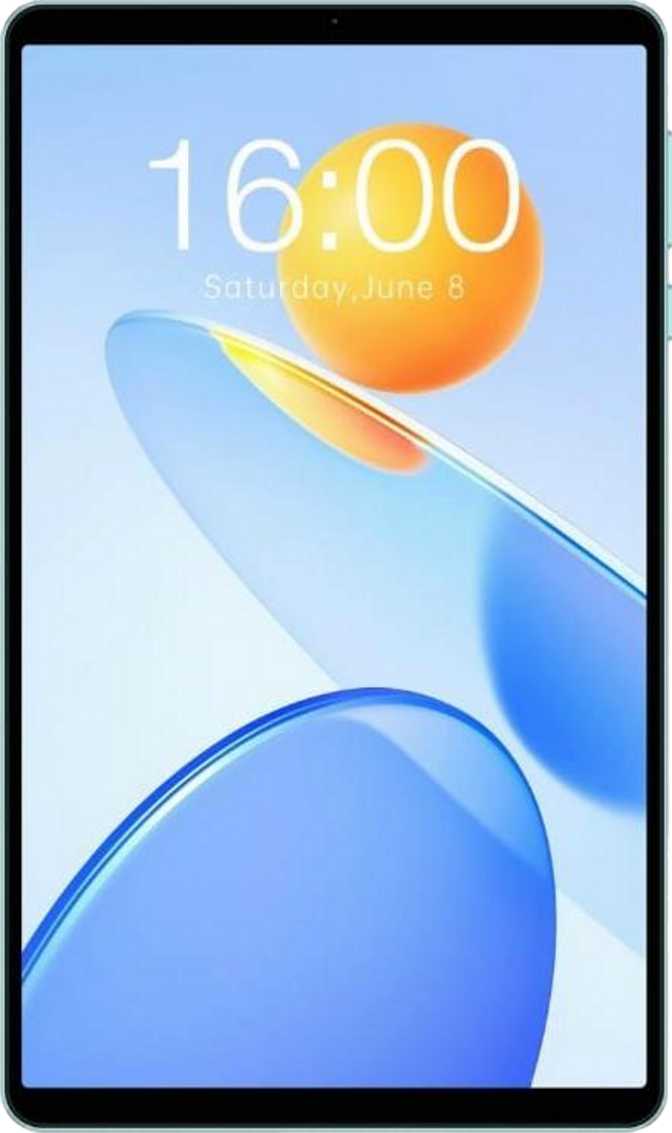
Teclast P50 Mini Review: A Compact Budget Tablet That Earns Its Place
TabletsA Compact Tablet That Overdelivers Where It Counts
The compact Android tablet space is crowded with devices that use "affordable" as cover for cutting every feature worth having. The Teclast P50 Mini takes a sharply different position — pairing Android 15, a smooth 90Hz IPS display, dual-SIM 4G LTE, and stereo speakers in a frame weighing under 350 grams. Whether that combination holds up under real-world scrutiny, or whether meaningful compromises lurk beneath the surface, is exactly what this review settles.
Overall Score
Key Specifications at a Glance
Design and Build Quality
At 345 grams and just 8.2 millimeters thin, the P50 Mini sits in a genuinely comfortable carrying position. For context, 345g is roughly the weight of a large apple or a standard paperback novel — light enough to hold one-handed during a commute without your wrist complaining, and thin enough to slide into the back pocket of a jacket or small bag without a noticeable bulge.
The physical footprint — 214.6mm wide and 126.5mm tall — places this firmly in the compact tablet category, noticeably smaller than mainstream 10-inch slates. That makes it significantly more pocketable and one-hand friendly. The trade-off is that side-by-side multitasking, spreadsheet work, or anything that benefits from screen real estate will feel squeezed by comparison.
The USB-C port handles both charging and data transfer, which is the right call for a modern device. Data speeds are capped at USB 2.0 standards — adequate for everyday file transfers, but unsuitable for high-speed external storage or video output.
-
No water resistance
No rated protection of any kind — keep it away from rain and splashes. -
No fingerprint scanner
Authentication relies on PIN, pattern, or basic face unlock only. -
No stylus support
No active digitizer beneath the glass — pen input is not available. -
No branded glass protection
No Gorilla Glass equivalent. A screen protector is a worthwhile investment.
Display: 90Hz Smoothness on a Budget Panel
Screen Size and Sharpness
The 8.68-inch IPS LCD panel resolves at 1340 × 800 pixels — approximately 180 pixels per inch. At typical reading and viewing distances, text looks clean and fine detail is entirely usable. Move the tablet closer or examine small typography and individual pixels become noticeable. This is not a retina-class display; it's a functional, comfortable panel that fits its price tier without embarrassing itself.
IPS technology delivers genuinely useful real-world benefits: wide viewing angles mean color consistency and brightness hold up when you tilt the screen or share it with someone beside you — unlike the cheaper TN panels still found in some competing budget devices.
The 90Hz Advantage
The 90Hz refresh rate is the P50 Mini's most immediately perceptible advantage at this price. Most budget tablets are locked to 60Hz — where motion looks acceptable but not fluid. At 90Hz, scrolling through web pages, swiping between apps, and navigating the home screen all feel noticeably smoother. It's a tactile improvement that makes the device feel more responsive than its processor score would otherwise suggest.
Performance: Honest Assessment of a Budget Chipset
The P50 Mini runs an eight-core processor built on a 12-nanometer manufacturing process. All cores operate at 1.6GHz with no premium high-performance cluster — this chip is tuned for efficiency and endurance, not peak throughput. Here is what that means in practice.
RAM and Storage
The 4GB of physical RAM comfortably handles what this tablet is designed for — social media, streaming, email, light document work, and web browsing with several tabs open. Power users who keep memory-intensive apps running alongside multiple browser sessions will notice the system reloading background apps more frequently than on a device with 6–8GB.
The 128GB of built-in storage is a genuine differentiator at this price. Most direct competitors start at 64GB, which fills quickly once the operating system, pre-installed apps, and your own content are accounted for. Storage uses eMMC 5.1 technology — not the fastest type available, but consistent with the performance tier.
The included microSD slot allows meaningful storage expansion for media files and offline content. A software virtual RAM feature can extend the apparent memory pool up to 14GB total by borrowing from storage — useful for light multitasking, though not a substitute for physical RAM under genuine load.
Graphics and Gaming Expectations
The Mali G57 MP1 graphics processor supports DirectX 12 and OpenGL ES 3.2, covering the full Play Store catalog. Casual titles, 2D games, and older 3D games run without issue. Demanding modern 3D games with high-resolution textures will require reduced graphical settings to maintain playable performance.
- Social media, streaming, and YouTube
- Email, messaging, and light documents
- Casual and 2D gaming titles
- Web browsing with several open tabs
- Video editing or demanding 3D gaming
- Heavy multitasking with 10+ active apps
Android 15: The Software Advantage
Running Android 15 straight out of the box is one of the P50 Mini's most meaningful credentials in its price class. Many competing budget tablets ship with Android 12 or 13, leaving buyers on an aging platform with fewer security patches and missing quality-of-life features. Android 15 is a mature, feature-complete experience — and the P50 Mini arrives with it pre-installed.
Connectivity: 4G LTE Without 5G — What That Means
The P50 Mini includes a full 4G LTE cellular radio with two SIM card slots — a feature many tablet buyers specifically seek to avoid relying on a phone hotspot. Here is a structured breakdown of the full connectivity picture.
4G LTE
Dual SIM slots with download speeds up to 300 Mbps and uploads to 100 Mbps — more than sufficient for streaming, video calls, and general browsing on a 4G connection.
No 5G SupportWi-Fi
Supports both Wi-Fi 4 (802.11n) and Wi-Fi 5 (802.11ac), covering all modern home and office routers. Wi-Fi 6 is absent, though this only matters in dense, high-throughput environments.
Wi-Fi 4 & 5Bluetooth 5.0
Reliable, low-latency pairing with wireless headphones, speakers, and keyboards. Audio codec support is limited to the standard baseline — premium wireless audio codecs such as aptX and LDAC are absent.
No aptX / LDACGPS & Navigation
Full GPS with Galileo satellite support for improved positioning accuracy. All major navigation apps work normally. No compass sensor is present, so directional orientation while stationary is unavailable.
No Compass SensorAudio: A Genuine Strength
Stereo speakers are not a given on a budget tablet at this size and price. Many competitors cut costs by fitting a single speaker, which pushes all audio from one direction and creates a noticeably worse experience during landscape video viewing. The P50 Mini ships with a full stereo setup — a meaningful upgrade that makes media consumption, video calls, and casual gaming sound considerably better than the single-speaker competition.
The 3.5mm headphone jack adds practical value that continues to shrink in the broader device market. Use any wired headphones you already own without an adapter, and sidestep Bluetooth's battery drain during longer listening sessions. This is an increasingly uncommon inclusion in new devices at any price.
Cameras: Set Your Expectations Accordingly
Cameras are rarely a strength of budget tablets, and the P50 Mini does not break that pattern. These sensors are functional utilities — not imaging tools.
Captures images at 5 megapixels and records 1080p video at 30 frames per second. Perfectly adequate for scanning documents, capturing quick reference shots, and video calls. Manual controls for ISO, white balance, exposure, and focus are available for those who want to experiment with settings.
- 1080p / 30fps video recording
- Touch autofocus
- Manual ISO and exposure controls
- No optical image stabilization
- No HDR shooting mode
- No burst mode or slow-motion
A 2-megapixel front sensor covers the basics for video calls on Zoom, Google Meet, WhatsApp, and similar platforms. Image quality is functional at best. There is no front-facing flash, which means low-light video calls depend entirely on ambient room lighting.
Battery Life and Charging
The 5,000mAh battery is a solid capacity for an 8.68-inch tablet. The efficient 12-nanometer processor runs cool and draws relatively little power during typical use — a characteristic that works directly in favor of endurance. The chip's 10-watt thermal envelope means the device is not generating aggressive heat that accelerates battery drain.
Based on the hardware profile — screen size, processor efficiency class, and typical usage patterns covering web browsing, streaming, and light productivity — expect a full day of moderate use on a single charge. Heavier users pushing screen brightness alongside constant cellular data and intensive apps will likely need to plug in before day's end.
Wireless charging is not supported. The battery is sealed and non-removable, which is standard for this form factor.
Who Should Buy the Teclast P50 Mini
This tablet fills a specific niche well. Understanding whether you fit that niche is the most important purchase decision you can make.
-
Students and learners
Note-taking, reading, e-learning platforms, and research browsing in a portable, affordable form factor. -
Commuters and travelers
A compact, SIM-enabled device for streaming and connectivity without tethering to a phone hotspot. -
Family shared-device users
Multi-user profiles and child lock make it a reasonable second screen for households with children. -
Light productivity users
Browser, email, streaming, and basic office apps in a pocketable form — this device handles all of it comfortably.
-
Stylus input
No active digitizer. Sketching, handwriting, or precision note-taking require a different device entirely. -
Biometric security
No fingerprint scanner. Face unlock is convenience-grade authentication, not security-grade. -
Demanding gaming
The processor has a hard ceiling. AAA mobile titles at high settings will struggle to maintain smooth performance. -
5G connectivity
Only 4G LTE is supported. Buyers in strong 5G areas who rely heavily on cellular data should look elsewhere.
How It Compares to Natural Alternatives
The P50 Mini's positioning becomes clearest when placed beside its direct competitors in the compact budget tablet segment.
| Feature | Teclast P50 Mini | Budget Rival A 8–9", No LTE |
Budget Rival B 8–9", LTE, Older OS |
|---|---|---|---|
| Display Refresh Rate | 90Hz | 60Hz | 60Hz |
| Android Version | Android 15 | Android 13 | Android 12 |
| 4G LTE | Yes — Dual SIM | No | Yes — Single SIM |
| Stereo Speakers | Sometimes | Rarely | |
| 3.5mm Headphone Jack | Sometimes | ||
| Internal Storage | 128GB | 64GB | 64–128GB |
| Expandable Storage | |||
| Fingerprint Scanner | Sometimes | Rarely | |
| NFC | |||
| 5G Support |
Honest Strengths and Weaknesses
The P50 Mini's clearest strengths come from decisions Teclast made where direct competitors routinely cut corners. The 90Hz display is the most immediately perceptible — it elevates the daily experience in a way that raw spec numbers don't fully capture on paper.
- 90Hz display feels genuinely premiumScrolling and navigation are noticeably smoother than every 60Hz competitor in the same price bracket.
- Android 15 is a real differentiatorMost competing devices ship years behind on software. The P50 Mini starts current and fully featured.
- Dual-SIM LTE with 128GB storageConnected independence and genuine storage room — a rare combination at this price and size.
- Stereo speakers and headphone jack togetherBoth features are increasingly uncommon in budget devices. Having both simultaneously is a meaningful win.
- Compact, genuinely lightweight buildExtended one-handed use is realistic — not a given in this size and price category.
The weaknesses here are real and practical — not minor footnotes. Several of these limitations have genuine day-to-day impact depending on how you plan to use the device.
- No fingerprint scannerA meaningful security and convenience gap, especially noticeable for anyone switching from a modern smartphone.
- Display pixel density is modestText reads cleanly at arm's length, but won't impress anyone accustomed to a current mid-range phone screen.
- Processor has a hard performance ceilingCapable within its lane, but memory-intensive and graphically demanding workloads reveal its limits quickly.
- No water resistance whatsoeverZero-rated protection. A spill or being caught in rain carries genuine risk with no safety margin.
- Indirect OS update pathwaySecurity patches route through Teclast rather than Google — patch timing is a long-term consideration for multi-year ownership.
Frequently Asked Questions
Answers to the questions real buyers search for before committing to a purchase.
Final Verdict
The Teclast P50 Mini earns its place as one of the more thoughtfully configured compact budget tablets available. It does not pretend to be a flagship — it is not a productivity powerhouse, a photography tool, or a gaming machine. What it is: a well-connected, smoothly operating compact slate that ships with a genuinely current operating system and a display that feels considerably better to use than its price suggests.
The 90Hz screen, dual-SIM 4G LTE, stereo audio, Android 15, and 128GB storage form a package that is genuinely difficult to match at this size and price. The processor does its job without ambition. The cameras are passable utilities. The missing fingerprint sensor and total lack of water resistance are real shortcomings that require practical adjustments in daily life.
You want a portable, connected everyday tablet for streaming, reading, commuting, and light productivity — and you are not expecting flagship performance or premium build quality.
Biometric security, stylus input, premium camera output, or 5G connectivity are non-negotiable. Those needs point firmly toward a significantly higher budget.