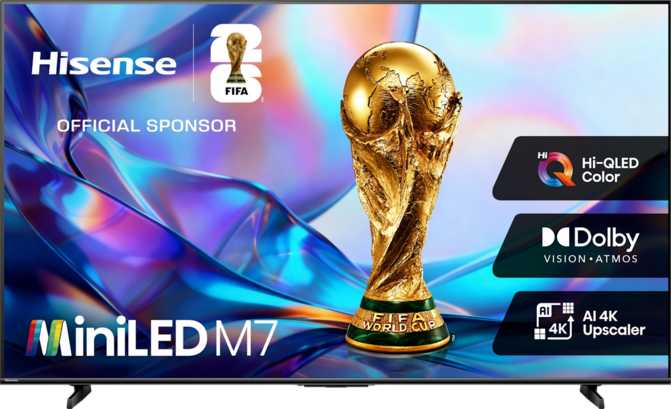
Hisense 65M7QG 65-Inch TV Review: Mini-LED QLED Meets Full HDR
TVsNot every large-screen TV justifies the space it takes up on your wall. The Hisense 65M7QG makes a compelling case for itself by stacking picture technologies — Mini-LED backlighting, QLED color enhancement, and a full suite of HDR formats — into a 65-inch panel at a price point that would have been unthinkable from this combination of features just a few years ago. Whether it belongs in your living room depends on what you actually do with your TV, and that's exactly what this review breaks down.
- 65" Mini-LED QLED
4K UHD — 3840 × 2160 px - 1.07 Billion Colors
10-bit color depth - All 4 HDR Formats
Dolby Vision, HDR10+, HDR10, HLG - 4× HDMI 2.1
Full 4K device connectivity - 30W Dolby Atmos Audio
Stereo — no subwoofer - 60Hz Native Panel
Not suited for 120fps gaming
Display Technology: What Mini-LED QLED Means for Your Picture
The Backlight Advantage
Most televisions in this price range rely on a relatively small number of backlight zones behind the LCD panel. Mini-LED technology changes that equation meaningfully: instead of large LEDs, the backlight uses a far greater number of much smaller LED units grouped into more precise dimming zones.
The practical result is that bright areas of an image — a lit candle, an explosion, a white title card — can glow intensely while the dark areas around them stay deep, without the hazy halo effect that plagues conventional LED TVs. For viewers who watch a lot of night scenes, space documentaries, or any content with strong contrast between bright and dark elements, this is a genuine, visible difference.
QLED Color and the Billion-Color Claim
The QLED layer refers to a quantum dot film placed between the backlight and the LCD panel. Quantum dots are nanoscale particles that convert light into very precise wavelengths — producing purer, more saturated colors, particularly in reds and greens that standard LED panels tend to reproduce less accurately.
The panel is rated to display over one billion distinct color shades, which comes from its 10-bit color depth. An 8-bit panel produces roughly 16.7 million colors. A 10-bit panel expands that to over a billion by allowing finer gradations between shades — this matters most in HDR content, where subtle sky gradients, skin tone variations, and shadow detail are preserved rather than crushed into flat blocks.
Resolution and Viewing Distance
The 4K panel resolves 3840 by 2160 pixels across 64.5 actual inches of screen area. At approximately 68 pixels per inch, the pixel density is well-calibrated for a living room viewing distance of 7 to 11 feet. Sit closer than 6 feet and you may begin to perceive the pixel grid; sit at the recommended distance and the image will appear continuous and sharp.
HDR Support: A Complete Format Ecosystem
The 65M7QG supports every major HDR format currently in active use. You will never hit a compatibility wall regardless of where your content comes from.
HDR10
The baseline open standard supported by virtually all 4K Blu-rays, streaming platforms, and gaming consoles.
HDR10+
Dynamic metadata upgrade to HDR10, supported by Amazon Prime Video — adjusts brightness and color tone scene by scene.
Dolby Vision
The premium HDR format used by Netflix, Apple TV+, Disney+, and Vudu — carries the most granular dynamic metadata available.
HLG
Hybrid Log-Gamma — the broadcast standard used for live television and select streaming services delivering HDR.
Refresh Rate: Understanding the 60Hz Ceiling
The panel runs at a native 60Hz refresh rate, meaning it renders 60 frames per second at maximum. For film content, cable television, and streaming video — all of which are delivered at 24, 25, or 30 frames per second — this is completely adequate.
Where it becomes relevant is gaming and fast-action sports. Modern gaming consoles and high-end PCs can output at 120 frames per second, which on a 120Hz-capable TV produces substantially smoother motion in fast games. The 65M7QG's four HDMI 2.1 ports can physically accept a 120fps signal, but the panel itself cannot display it natively — the TV will either cap or interpolate the signal.
For the vast majority of TV users — streaming subscribers, casual console gamers, sports fans, and movie watchers — the 60Hz panel is not a limitation in day-to-day use.
60Hz is perfectly fine if you:
- Stream from Netflix, Disney+, or Prime Video
- Watch films delivered at 24 or 30fps
- Play story-driven or casual console games
- Follow live sports broadcasts on cable or streaming
Viewing Angles: Where the Panel Earns Its Place in Open Rooms
Many LCD panels suffer from color shift and contrast loss when viewed from an angle. The 65M7QG is rated at 178 degrees of horizontal and vertical viewing angle — figures that describe performance across nearly the full arc of the screen. Whether viewers are seated directly in front, lounging at a diagonal, or positioned at the far end of a wide sectional sofa, the picture remains consistent.
The anti-reflection coating compounds this advantage. In brightly lit living rooms or spaces with windows opposite the screen, untreated panels can become mirrors. The coating reduces glare meaningfully, making daylight and lamp-lit environments far more comfortable viewing conditions.
An ambient light sensor adds one more layer of intelligence: the TV automatically adjusts backlight intensity based on room brightness, so the picture doesn't wash out in sunlight or overwhelm you with excess brightness at night.
- No color shift at wide angles
- Anti-reflection coating included
- Ambient light sensor auto-adjusts
Sound: Capable, But with a Clear Ceiling
The built-in speaker system delivers a combined 30 watts through two channels — a reasonable output for a room that doesn't require thunderous volume. Dolby Atmos decoding is present, which means the TV can process and spatially render Atmos-encoded soundtracks from streaming services, even without the physical overhead speaker array that a true Atmos setup requires. The result is improved spatial audio compared to standard stereo processing, though it won't replicate a dedicated home theater system.
There is no built-in subwoofer. Bass response will have a ceiling that limits how physically immersive action sequences or music-heavy content feels. Viewers who care deeply about audio should plan for a soundbar or external audio system.
Both HDMI ARC and eARC are supported. eARC — the upgraded standard — can pass uncompressed, high-definition audio formats including Dolby TrueHD and DTS:X, the formats found on 4K Blu-ray discs. If you invest in quality external audio, this TV supports the connection standard to take full advantage of it. An optical digital output provides a further option for older audio equipment.
Audio Specifications
- Total output power
- 30W (2 × 15W)
- Configuration
- Stereo
- Dolby Atmos
- Yes
- Dolby Digital Plus
- Yes
- HDMI ARC / eARC
- Both
- Optical digital out
- Yes
- Built-in subwoofer
- No
- 3.5mm headphone jack
- No
Connectivity: Four HDMI 2.1 Ports and the One-USB Caveat
Four HDMI 2.1 ports is a generous allocation that covers a full complement of modern devices: a gaming console, a streaming stick, an AV receiver, and a cable box can all be connected simultaneously without unplugging anything.
The single USB port is the connectivity layout's most obvious limitation. The TV supports USB recording — meaning you can attach a flash drive to record live TV directly — but with only one port, that drive occupies the only available slot. Connecting other USB devices simultaneously is simply not possible.
Wireless connectivity covers Wi-Fi 5 (802.11ac), which handles all current streaming demands with ample headroom. Bluetooth 5.3 enables connection to wireless headphones and keyboards with low latency and reliable pairing. Miracast support allows Android devices to wirelessly mirror their screen, and AirPlay extends the same capability to iPhones, iPads, and Macs.
| Interface | Specification | Quantity |
|---|---|---|
| HDMI | Version 2.1 | 4 |
| USB | USB-A (recording) | 1 |
| Ethernet | RJ45 LAN | 1 |
| Wi-Fi | Wi-Fi 5 (802.11ac) | Built-in |
| Bluetooth | Version 5.3 | Built-in |
| Miracast | Android mirroring | Built-in |
| AirPlay | Apple casting | Built-in |
Smart TV Features and Voice Control
The built-in smart platform supports Google Assistant and Amazon Alexa voice control, allowing hands-free search, content discovery, smart home control, and general queries through the remote or connected speaker devices. Apple Siri and HomeKit are not supported, which matters to users deeply embedded in the Apple ecosystem who prefer unified smart home control.
The TV includes a built-in web browser, sleep timer, child lock, and USB recording — the kind of utility features that rarely make headlines but get used frequently over the lifetime of the device. Smartphone remote control is supported, allowing a connected phone to substitute for the physical remote.
The physical remote does not recharge — it operates on replaceable batteries. This is an operational footnote rather than a flaw, but worth noting for buyers who prefer the rechargeable remotes now increasingly common in the premium segment.
Voice Assistant Compatibility
- Google Assistant
- Amazon Alexa
- AirPlay (Apple content casting)
- Apple Siri
- Apple HomeKit
Built-in Utility Features
- Web browser
- Sleep timer
- Child lock
- USB recording
- Smartphone remote control
Physical Footprint and Installation
At roughly 1.45 meters wide and 84 centimeters tall, the 65M7QG occupies the footprint you'd expect from a 65-inch screen. Its depth of just over 76 millimeters keeps it relatively slim when wall-mounted or placed on a cabinet.
At approximately 20.6 kilograms, this is a two-person lift. Wall mounting is VESA-compatible, meaning a wide range of standard wall brackets will physically fit the TV. Anyone planning a flush wall mount should verify their bracket's weight rating and, ideally, hire a professional installer for a panel at this weight.
Power draw during active use sits at 220 watts — appropriate for a panel of this size and technology. Standby consumption drops to just half a watt, which is negligible on any electricity bill. The operating temperature range runs between 5°C and 35°C, covering all normal indoor environments without exception.
Physical Specifications
- Width
- 1,445 mm
- Height
- 838 mm
- Depth
- 76.2 mm
- Weight
- 20.6 kg
- VESA Mount
- Compatible
- Active power
- 220W
- Standby power
- 0.5W
- Operating temp.
- 5°C – 35°C
- Warranty
- 1 year
Honest Strengths and Weaknesses
- Mini-LED backlighting delivers excellent contrast and dark scene performance without the burn-in risk that affects OLED panels
- QLED quantum dot layer produces vibrant, accurate color — particularly strong in reds and greens where standard LEDs fall short
- 10-bit panel with over a billion colors ensures gradient accuracy and shadow nuance in all HDR content
- All four major HDR formats supported — no streaming service or Blu-ray disc will be incompatible
- Four HDMI 2.1 ports provide enough connections for every current-generation device simultaneously
- 178° viewing angles and anti-reflection coating make this ideal for wide-room and bright-room setups
- eARC support enables lossless audio passthrough to premium soundbars and AV receivers
- 60Hz native panel caps the frame rate — 120fps gaming modes from PS5 and Xbox Series X are not supported
- Only one USB port — USB recording takes it over entirely, blocking all other USB device connections
- No Apple HomeKit or Siri integration — a real limitation for households built around Apple's smart home ecosystem
- No built-in subwoofer — bass response has a ceiling that limits physical immersion in action films and music
- Wi-Fi 5 maximum — Wi-Fi 6 or 6E network owners won't benefit from improved bandwidth or latency headroom
- Remote control runs on replaceable batteries — rechargeable remotes are now common at this price tier
- Only one year of manufacturer warranty — shorter than the two or three years some competitors provide
Who This TV Is For — and Who Should Look Elsewhere
- Streaming-first households consuming content from Netflix, Disney+, Apple TV+, and Prime Video in Dolby Vision or HDR10+
- Living rooms with multiple seating positions, wide diagonal angles, or significant ambient light throughout the day
- Console gamers who primarily play story-driven, single-player, or casual titles where 60fps is the expected standard
- Home theater builders planning to add a soundbar or AV receiver who want eARC passthrough for lossless audio
- Buyers who want Mini-LED QLED picture quality and full HDR format coverage without paying a flagship-tier premium
- Play competitive online games or fast-paced titles where 120Hz and Variable Refresh Rate meaningfully improve the experience
- Plan to connect multiple USB devices simultaneously — a second USB port is simply unavailable on this model
- Are deeply embedded in Apple's ecosystem and need native HomeKit integration for unified smart home control
- Require more than one year of manufacturer warranty coverage without purchasing a separate extended plan
- Prioritize absolute black levels above all else — OLED panels at a similar price offer per-pixel perfect blacks that no LCD can match
How It Compares to the Competition
The Hisense 65M7QG sits between two common 65-inch alternatives at similar price points. Understanding these trade-offs is essential before committing.
| Feature | Hisense 65M7QG | Typical 65" OLED | Typical 65" IPS LED |
|---|---|---|---|
| Backlight Type | Mini-LED zones | Self-emissive (per-pixel) | Edge / Direct LED |
| Peak Brightness | High (Mini-LED advantage) | Moderate | Moderate |
| Black Levels | Very good | Perfect (absolute black) | Moderate |
| Color Volume | High (QLED quantum dots) | Good | Moderate |
| Burn-in Risk | None | Present with static content | None |
| Native Refresh Rate | 60Hz | Typically 120Hz | Often 120Hz |
| HDR Format Support | All four major formats | Varies by brand | Varies |
| Viewing Angles | Near-perfect (178°) | Perfect | Good |
vs. OLED at a Similar Price
OLED delivers perfect black levels and typically a 120Hz panel — neither of which the 65M7QG can match. In return, the Mini-LED QLED here outperforms most OLEDs in raw brightness, which is critical for HDR highlights and daytime viewing. It also carries no burn-in risk, making it a safer long-term choice for households where news tickers, sports scoreboards, and gaming HUDs remain on-screen for extended periods.
vs. Standard LED at a Similar Price
Against conventional edge-lit or direct-lit LED competitors at similar or lower prices, the 65M7QG's Mini-LED dimming is a clear picture quality upgrade for any scene that combines bright highlights and dark shadows. Standard LED panels simply cannot produce the same local contrast performance.