GravaStar Mercury V60 Pro: The Hall Effect 60% for Competitive Gaming

GravaStar Mercury V60 Pro: The Hall Effect 60% for Competitive Gaming

Keyboards
4.1 Overall Score
Recommended for Competitive Gaming

Performance at a Glance

Switch TechnologyExceptional
Performance FeaturesExceptional
Build QualityVery Good
Value for Competitive GamersVery Good
Firmware & CustomizationLimited

Key Specifications

  • 60% Form Factor — ANSI US Layout
  • Hall Effect UFO Magnetic Switches — Linear, 40 g
  • 8,000 Hz Ultra-High Polling Rate
  • Adjustable Actuation: 0.1 mm to 3.7 mm
  • Rapid Trigger + Dual Actuation + Analog Input
  • Hot-Swappable Switches
  • PBT Double-Shot OEM Profile Keycaps
  • Wired USB — Detachable Cable
  • 860 g — Aluminum Plate & Mixed Chassis

Most 60% mechanical keyboards face a quiet identity crisis: they are designed to look like gaming hardware but perform like any other keyboard underneath. The GravaStar Mercury V60 Pro refuses that compromise. It belongs to a newer wave of compact boards that transplant tournament-grade input technology into the smallest usable form factor — the kind of hardware that was exclusive to full-size flagship boards barely two generations ago.

Magnetic switches, adjustable actuation from a fraction of a millimeter to nearly the full key depth, rapid trigger response tied to directional movement rather than fixed thresholds, and analog key input that partially replicates what a controller thumbstick does. This is not a 60% keyboard that happens to have a gaming badge — it is a competitive input device that happens to be compact.

Design and Build Quality

The Mercury V60 Pro's physical character is established the moment you pick it up. At close to 860 grams, it is meaningfully heavier than most keyboards in its size class — a weight that translates directly into stability. During fast, forceful keystrokes, it does not slide, flex, or move. That solidity comes from a design that layers an aluminum structural plate and aluminum case reinforcements over a plastic chassis foundation. Neither fully plastic nor fully metal, the construction favors rigidity over softness in the typing experience.

The aluminum plate beneath the switches is the structural backbone of the keyboard's typing character. Plates made from this material transfer energy efficiently and create a tight, firm sensation when keys bottom out. This sits deliberately at the stiffer end of what the keyboard market offers. If you have used keyboards with polycarbonate, brass, or foam-dampened builds that produce a cushioned, muted feel, the Mercury V60 Pro will feel noticeably more direct. That is a design choice aligned with competitive gaming input, where feedback clarity matters more than acoustic softness.

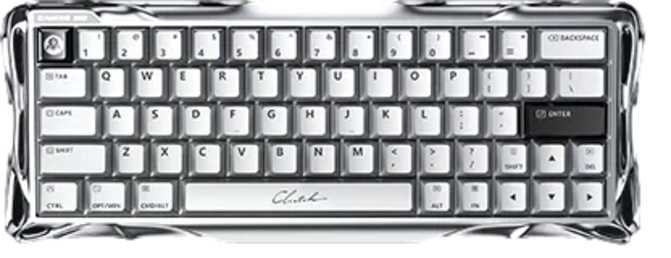
The color options — Silver and Gray — are clean and metallic without leaning into the angular aggression common in gaming peripherals. Adjustable tilt feet cover multiple positions for comfortable wrist angles. A wrist rest is not included; most users will want to source one separately for extended sessions. The detachable cable allows independent replacement or upgrade without touching the keyboard itself.

Physical Specifications

Dimensions
325 × 125.8 × 41 mm
Weight
860 g
Case Material
Aluminum + Plastic
Plate Material
Aluminum
Available Colors
Silver, Gray
Adjustable Feet
Yes
Wrist Rest
Not Included
Cable
Detachable
Warranty
1 Year

Typing Character: Firm and Direct

The aluminum plate favors feedback clarity over cushioned softness. Expect a tighter, more precise feel than boards using polycarbonate or layered foam dampening.

The Switch Technology Behind the Performance

Understanding Hall effect switches is key to understanding why this keyboard commands a premium — and why the features it offers cannot exist on conventional hardware.

Standard Mechanical Switches

Work by bringing two metal contacts together inside the switch housing. The moment those contacts touch, the keypress registers. Over time, contacts oxidize, wear, and drift — the feel changes subtly but persistently. The actuation point is factory-fixed and there is no continuous position sensing throughout the keystroke.

GravaStar UFO Magnetic Switches

Use magnetic sensors to detect key position with no physical contact at any point. The sensor knows exactly where the key is throughout its entire travel range — continuously, not just at a fixed trigger point. No contact means no wear of that kind. This continuous position awareness is the foundation for every advanced feature on this keyboard.

Switch Feel
Linear
No bump, no click — smooth full travel
Actuation Force
40 g
Light — easy on fingers over long sessions
Total Travel
3.5 mm
Full-depth standard-height keyboard
Actuation Range
0.1 – 3.7 mm
No fixed factory trigger point

Actuation, Rapid Trigger, and Dual Actuation

These three features collectively define what separates magnetic switch keyboards from every alternative. Each addresses a specific limitation of conventional keyboard hardware.

Adjustable Actuation

On a standard keyboard, the actuation point is factory-fixed. On the Mercury V60 Pro, you decide where it happens — anywhere from barely a breath past the resting position to near full depth. Different keys on the same keyboard can each have their own actuation depth.

  • Set shallow for near-instant WASD response
  • Set deeper to eliminate accidental keypresses
  • Per-key configuration available

Rapid Trigger

Standard keyboards require a fixed reset distance before a key can re-register — a mandatory dead zone in every keystroke cycle. Rapid trigger eliminates it. The keyboard watches the direction of key movement, not absolute position. The instant the key reverses from downward to upward, it resets immediately — ready to fire again wherever it stopped.

For counter-strafing in tactical shooters, where input timing directly affects in-game accuracy, this removes a mechanical obstacle that conventional hardware imposes on every player.

Critical for Counter-Strafing

Dual Actuation

Assigns two separate functions to a single key at two distinct depths in the same keystroke. Press lightly for the first function. Press deeper on the same keypress and the second fires. One physical key, two discrete inputs in a single motion — not available on conventional hardware.

  • Walk at shallow press, sprint at full depth
  • Reload and interact on the same key
  • Unlocks control schemes impossible on contact switches

Analog Key Input

Thanks to continuous magnetic position sensing, individual keys can behave like analog joystick inputs rather than binary on/off switches. In games that support analog input, pressing a movement key halfway causes your character to move at half speed. The depth of the press determines the intensity of the input — the same proportional behavior a controller thumbstick provides.

Whether you actually use this depends entirely on your game library. Competitive shooters and fast-paced PC titles use binary input and will not benefit. Open-world games, RPGs, and action titles designed with variable movement speed will respond to it noticeably, providing controller-like nuance without leaving keyboard and mouse.

Game Compatibility Note

Analog key input requires games built to accept analog controller input. Most competitive multiplayer titles use binary input only; this feature benefits character-based games with variable movement speed built into their design.

8,000 Hz Polling Rate

The Mercury V60 Pro communicates with the host system at 8,000 times per second — eight times higher than the 1,000 Hz standard that has defined high-performance gaming peripherals for years. At this rate, the keyboard reports its state every 0.125 milliseconds.

In isolation, the difference between 1,000 Hz and 8,000 Hz may not be universally perceptible, and most game engines do not update at a frequency that fully leverages either rate. However, in conjunction with rapid trigger at tight sensitivity settings, the higher polling rate reduces the window between a physical direction change and software acknowledgment — ensuring the hardware is never the bottleneck in the input chain.

8,000
Reports per Second
0.125 ms
Per Report Interval

Keycaps: Substance Over Flash

The included keycaps are double-shot PBT — a material and construction combination that directly affects how the keyboard looks and feels after months or years of use. PBT (polybutylene terephthalate) is harder and more chemically stable than the ABS plastic used on the majority of gaming keyboard keycaps. ABS keycaps develop a shine on heavily used keys as the surface wears smooth. PBT resists this surface degradation considerably better, maintaining its original texture through sustained use.

The double-shot manufacturing process creates the legends — the printed characters — not by printing them on the surface but by molding two separate layers of plastic together. The character is a physically distinct layer embedded in the keycap body. It cannot be worn off, faded by sunlight, or degraded by skin oils. The legends on these keycaps will remain sharp for the life of the keyboard.

The keycap profile is OEM — a shape with slight sculpting across rows and a familiar medium height that the majority of keyboard users will recognize immediately. The layout uses standard key dimensions throughout, meaning any aftermarket 60% keycap set will fit directly without hunting for unusual sizes.

Keycap Specifications

Material
PBT
Construction
Double-Shot
Profile
OEM
Backlit
Yes (RGB)
Layout
Standard ANSI US
Aftermarket Fit
Any Standard 60%

Universal Aftermarket Compatibility

Standard key sizes across every position mean any 60% aftermarket keycap set fits directly. No proprietary sizing restrictions limit your customization options.

Hot-Swap Support and Firmware Ecosystem

Hot-Swappable Switches

The Mercury V60 Pro supports hot-swappable switches — the physical switches can be removed and replaced without soldering. A standard switch puller tool pressed at the corners of each switch releases it from the PCB socket. A malfunctioning switch is a minutes-long fix, not a repair-center trip. Experimenting with different Hall effect switch variants to tune feel or sensitivity is a supported, damage-free process.

N-Key Rollover (NKRO) — Fully Supported

Every simultaneous keypress registers independently regardless of how many keys are held at once. No dropped inputs during complex multi-key sequences.

Hot-Swap Switches
Onboard Memory
N-Key Rollover
RGB Backlighting
QMK / VIA / ZMK
USB Passthrough

Firmware: Proprietary Ecosystem

The Mercury V60 Pro does not support QMK, ZMK, or VIA — the open-source platforms that many enthusiasts consider non-negotiable. These tools provide granular control over every key's behavior, support complex macros, and allow unlimited remapping through community-maintained software that runs entirely on the keyboard hardware.

The keyboard operates through GravaStar's proprietary software instead. All performance features — rapid trigger, adjustable actuation, dual actuation, analog input — are configurable through that software. Settings are stored in onboard memory and remain active once the software is closed.

No QMK / VIA Support

For competitive gamers configuring actuation and trigger settings, this is unlikely to be a hardship. For users who require open firmware portability or advanced remapping beyond what the GravaStar software offers, this is a firm and permanent limitation.

Who Should Buy This — and Who Should Not

Right For

  • Competitive FPS Players

    Tactical shooters and battle royale titles where counter-strafing, rapid inputs, and input precision directly affect outcomes.

  • Gamers Moving to a 60% Layout

    Maximum desk space and mouse room without sacrificing input quality. No compromises on the switch technology side.

  • Players Interested in Analog Input

    Controller-style graduated movement in supported games, without leaving keyboard and mouse entirely.

  • Users Prioritizing Durability

    Hall effect switches and PBT double-shot keycaps are both built to outlast conventional gaming peripheral build choices.

Not Right For

  • Dual-Purpose Work and Gaming Users

    The 60% layout removes the number row, function row, and navigation cluster. Frequent users of those keys face a high, permanent adaptation cost.

  • QMK and VIA Users

    The closed proprietary firmware offers no open customization depth or community tooling. Existing QMK configurations cannot be ported.

  • Mac Users

    Not designed with macOS key labeling or default mappings. Functional but requires remapping and will not feel native.

  • International Layout Users

    ANSI US layout is the only option available. Non-US configurations are not supported.

  • Tactile or Heavy-Switch Preference

    Linear 40 g actuation is a specific feel. Hot-swap allows switch replacement within Hall effect options only — not a path to contact-based tactile switches.

Competitive Comparison

How the Mercury V60 Pro stacks up against the established players in the hall effect compact keyboard segment.

Feature GravaStar Mercury V60 Pro Wooting 60HE Razer Huntsman Mini Analog
Switch Technology Hall Effect (UFO Magnetic) Hall Effect (Lekker) Hall Effect (Analog Optical)
Rapid Trigger
Adjustable Actuation
Dual Actuation Exclusive
Analog Key Input
Polling Rate 8,000 Hz 1,000 Hz 1,000 Hz
Hot-Swap
Keycap Material PBT Double-Shot PBT ABS
Open Firmware

Mercury V60 Pro Advantage

Leads the segment with the highest polling rate and dual actuation — a feature not offered by either major competitor. PBT double-shot keycaps included as standard exceed the Razer's ABS offering on durability.

Wooting 60HE Ecosystem Advantage

The Wooting benefits from a longer market track record, mature companion software, and a larger community with extensively documented configurations and competitive settings.

Honest Assessment

Where It Excels

The Mercury V60 Pro's hardware ambition is genuine and the execution is consistent. The switch technology is not marketing vocabulary — Hall effect sensing genuinely enables rapid trigger, adjustable actuation, dual actuation, and analog input in ways that contact switches cannot replicate. Every one of those features is fully present. GravaStar did not partially implement them or restrict them behind premium tiers.

The build quality communicates that the keyboard was designed to last. The aluminum-reinforced structure and the PBT double-shot keycaps are both choices that favor durability over short-term cost reduction. The weight and rigidity translate into a stable, consistent physical experience that many lighter compact keyboards do not achieve.

The 8,000 Hz polling rate leads the field at this form factor. Whether the full advantage is extractable in a given game engine is application-dependent, but it ensures this hardware is never the bottleneck in the input chain.
The Real Limitations

The absence of QMK and VIA support means this keyboard exists in GravaStar's proprietary firmware world. For the competitive gaming audience this product targets, that is unlikely to be a daily problem. For anyone who considers open firmware a requirement, this board is not the answer.

The 60% form factor carries permanent consequences. There is no temporary workaround for the missing keys — you will use function layers for tasks you currently do without thinking. For dedicated gaming, this trade is generally worth making. For anyone trying to use the same keyboard for productivity and gaming, the adaptation cost is high and ongoing.

The single-year warranty is shorter than some competitors offer at comparable price points. For a keyboard at this performance tier, it is worth factoring into a long-term ownership calculation.

Questions Buyers Ask Before Purchasing

Answers to the most searched questions about the GravaStar Mercury V60 Pro.

Rapid trigger addresses a real and measurable problem: the reset dead zone on conventional keyboards introduces a physical constraint on how quickly alternating key inputs can register. For counter-strafing specifically — a technique where input timing directly affects in-game accuracy — eliminating the reset dead zone removes a mechanical obstacle. The difference is most impactful in tactical shooters where movement precision is foundational. For its intended audience it is a genuine hardware advantage, not marketing vocabulary.

The theoretical argument is sound: no physical contact means no contact wear. Magnetic sensing hardware degrades on a different and slower pathway than contact-based hardware under everyday use. The GravaStar UFO switch is newer to market than some Hall effect alternatives with longer commercial histories, so long-term real-world data is still accumulating at scale. The technology itself has a strong durability foundation by design.

Yes. The keyboard functions as a standard USB input device immediately on connection, without any software. The advanced features — adjustable actuation levels, rapid trigger sensitivity, analog input profiling, dual actuation mapping — require the GravaStar software to configure. Once configured, those settings are stored in onboard memory and remain active without the software running.

The standard ANSI US layout uses entirely conventional key sizes across every position — including the spacebar and modifiers. Any 60% aftermarket keycap set sold to ANSI specifications will fit directly without modification. This is a meaningful freedom compared to keyboards with non-standard sizing that restrict compatibility to the manufacturer's own ecosystem.

Ultra-high polling rates can increase CPU interrupt overhead on some configurations, particularly older hardware. On a modern gaming PC, 8,000 Hz from a single peripheral is unlikely to cause any perceptible performance impact. The polling rate can typically be configured to a lower value through the companion software if any compatibility or performance issue arises.

The Mercury V60 Pro connects via USB as a standard HID (Human Interface Device), which means it may function on platforms that accept USB keyboard input. Advanced features like rapid trigger and analog input depend on software and hardware support beyond standard HID, and are not guaranteed to operate on consoles. It is designed and optimized for PC use.
Final Verdict

Built for One Purpose — and Excellent at It

4.1 / 5

The GravaStar Mercury V60 Pro is a purpose-built competitive gaming keyboard that earns its feature list. Hall effect switch technology here is not a buzzword badge — it is the foundation for four distinct capabilities (rapid trigger, adjustable actuation, dual actuation, analog input) that are fully implemented and directly relevant to the competitive gaming audience this product targets.

The build quality clears a premium bar: aluminum reinforcement, PBT double-shot keycaps, and a weight that communicates structural seriousness. The polling rate leads comparable alternatives in its class.

The honest ceiling on this recommendation is the firmware ecosystem and the form factor commitment. The proprietary software locks you into GravaStar's tooling for configuration. The 60% layout is a permanent choice. If neither is a dealbreaker for your use case, the Mercury V60 Pro earns a strong recommendation.

Buy If You Are a Competitive FPS Player

Counter-strafing, rapid input, 60% form factor — this hardware is built for you.

Skip If You Need a Dual-Use Board

Missing keys, closed firmware, and wired-only are permanent traits — not temporary ones.

Giulia Ferrara Florence, Italy

Mechanical Keyboard Reviewer & Switch Tester

Human factors researcher and mechanical keyboard enthusiast who reviews switches, keycap sets, and keyboard acoustics. Runs force-curve measurements, actuation consistency tests, and long-term click lifespan endurance to match every typist with their ideal typing experience.

Mechanical Keyboards Switch Testing Keycaps Typing Ergonomics Keyboard Acoustics
  • MSc in Human Factors Engineering
  • Keyboard Layout Certified Instructor
View Full Profile