Govo GoSurround 320 Review: Strong Audio, Real Limitations
SoundbarsMost people buying a soundbar are solving a familiar and frustrating problem: the speakers built into their television produce thin, compressed audio that makes dialogue hard to follow and music feel like background noise from another room. The Govo GoSurround 320 targets that buyer directly — a compact, stereo Bluetooth soundbar designed to sit below a television and deliver an immediate, appreciable improvement over factory-installed sound.
The Key Differentiator at This Price
Where most products at this tier offer baseline wireless audio, the GoSurround 320 ships with aptX Adaptive codec support — a Bluetooth audio technology you typically encounter on products that cost significantly more. That one feature reframes how everything else should be evaluated.
Design and Build Quality
Physical dimensions, weight, and everyday handling
A Bar Built to Disappear Into Your Setup
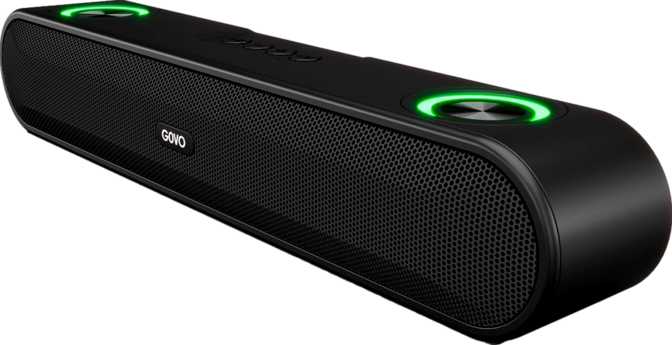
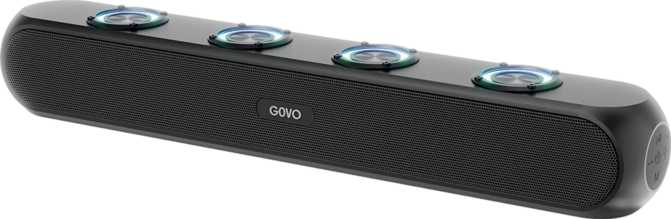
The GoSurround 320 is a compact soundbar — just under half a meter wide — making it a natural fit below televisions in the 32 to 43-inch range. Its profile is genuinely low: slim enough to sit beneath the screen of virtually any television without encroaching on the picture, even on sets that position their panels close to their stands. The depth front to back is nearly equal to the height, giving the unit an almost square cross-section that keeps it visually undemanding from any angle.
At one kilogram, this is a light soundbar by any measure. The practical benefit is real: solo wall-mounting is straightforward, and moving it between rooms takes no effort at all. For households where the same bar might serve a bedroom television during the week and a living room screen on weekends, the weight makes that flexibility frictionless.
All user controls are integrated directly into the unit's body. There is no remote control, no companion smartphone app, and no voice assistant integration. The daily ergonomic implications of those absences are significant enough to warrant their own section — see Daily Ergonomics below.
| Width | 500 mm |
| Height | 78 mm |
| Depth | 76 mm |
| Weight | 1.0 kg |
| Configuration | 2.0 Stereo |
Bluetooth Audio Quality: The Specification That Earns Attention
Codec support explained in plain terms — and why it matters more than most buyers realize
The codec — the algorithm used to compress and transmit audio wirelessly — has a direct and audible effect on what arrives at the speaker. Most budget Bluetooth soundbars use a basic codec that compresses audio aggressively, softening high-frequency detail and flattening the stereo image in ways experienced listeners notice and casual listeners often feel without being able to name. The GoSurround 320 supports three codecs, and the progression from one to the next is meaningful.
For Apple Devices
Apple's preferred wireless audio format. When an iPhone, iPad, or Mac connects, the stream uses AAC rather than the fallback baseline — preserving considerably more detail across the frequency range, especially in the upper registers where compression artefacts surface first.
Near-CD Quality
Supported by most current Android smartphones, aptX delivers wireless audio with clarity approaching a 16-bit, 44.1kHz lossless file. Stereo placement becomes more precise, instruments separate more cleanly, and the sound feels less processed compared to basic Bluetooth.
High-Res Wireless
Qualcomm's most capable consumer audio codec. It adjusts bitrate dynamically in real time, supporting 24-bit, 96kHz high-resolution transmission — the quality tier of lossless streaming services, delivered wirelessly. At this price point, aptX Adaptive is genuinely uncommon.
aptX Adaptive ensures the wireless connection is never the bottleneck in audio quality. Compatible devices include select Android smartphones from Sony, OnePlus, ASUS, and others. The codec does not guarantee the speaker drivers resolve every detail — but it means the transmission itself is not the limiting factor.
Sound Profile: What Stereo Actually Delivers
Two channels, assessed honestly
The GoSurround 320 is a two-channel stereo soundbar. Two drivers — left and right — with no dedicated subwoofer, no center channel, and no surround sound processing of any kind. That said, stereo handled well is a genuine and substantial upgrade for most real-world use cases.
Built-in television speakers typically fire downward or toward the wall and produce a narrow, collapsed sound field. A properly placed stereo soundbar widens that presentation, moves dialogue ahead of the listener rather than behind or beneath them, and gives music the room it needs to breathe. The improvement is immediate and consistent — it does not require a trained ear.
For a bedroom television, a home office monitor, or a smaller living room where the priority is "much better than TV speakers" rather than "cinematic home theater" — the stereo output here is more than adequate.
The "GoSurround" branding creates a reasonable expectation of spatial or multi-channel sound. The hardware produces standard two-channel stereo.
Content mixed in Dolby Atmos, DTS:X, Dolby Digital, or Dolby Digital Plus plays back as flat stereo without any spatial processing whatsoever.
Connectivity: Where It Works and Where It Does Not
Two clean inputs — and several meaningful absences
The GoSurround 320 connects via Bluetooth or a physical wired analog input. The wired option accepts audio from any device with a standard headphone-style output — covering televisions, consoles, computers, and older source equipment with no Bluetooth capability. It is a zero-latency, zero-pairing connection that works reliably where wireless does not apply.
The most significant absence is HDMI ARC. On modern smart televisions, HDMI ARC has become the standard audio routing path for a soundbar — a single cable that carries audio from the TV, supports volume control via the TV remote, and in its eARC form handles lossless audio formats. Without it, connecting this soundbar to a recent smart TV requires either the television's Bluetooth output or a wired analog cable. Both work; neither is as clean or integrated as HDMI.
The absence of Wi-Fi rules out native streaming integrations entirely. There is no Spotify Connect, no AirPlay 2, no Chromecast built in. Every audio source must be a Bluetooth device within range or a physically connected input.
| Connection Type | Available |
|---|---|
| Bluetooth (aptX Adaptive) | |
| Wired Analog Input | |
| HDMI ARC / eARC | |
| Wi-Fi | |
| Optical / Digital Input | |
| NFC Tap-to-Pair | |
| Spotify Connect | |
| AirPlay 2 | |
| Microphone Input |
Daily Ergonomics: The Remote Control Problem
A limitation that compounds with every session
The GoSurround 320 is operated entirely through controls on the unit itself. There is no remote control, no smartphone app, no voice assistant compatibility, and no support for Amazon Alexa, Google Assistant, or Siri.
This becomes a practical friction point in normal use. Soundbars are installed at a distance from the listener — that is the premise. Adjusting volume or switching inputs requires leaving your seat and physically interacting with the bar.
In practice, most users work around this by controlling Bluetooth volume through their phone, which changes the stream level from the source device rather than the soundbar's own amplifier, or by relying on a smart TV's remote to pass audio commands where supported. These workarounds function, but they are workarounds.
Many competitors at this price bracket include at minimum a basic infrared remote. For users with mobility considerations, or for anyone whose soundbar is wall-mounted at an inconvenient height, the absence of a remote is more than a minor inconvenience — it affects every single session.
- Infrared or Bluetooth remote
- Dedicated smartphone app
- Voice command support
- Google Assistant, Alexa, or Siri
- On-device control panel (only option)
Who This Soundbar Is Right For
Matching the product to the actual buyer — with no sales spin
- Upgrading from built-in TV speakers in a smaller room with a television in the 32 to 43-inch range
- A user whose phone supports aptX or aptX Adaptive who values audio transmission quality over smart features
- Someone who wants minimal setup — pair once over Bluetooth, optionally plug in a cable, done
- Anyone whose television outputs Bluetooth audio, making the wireless path complete without additional hardware
- A user who streams high-resolution audio and wants the wireless connection to match the source quality
- A remote control as a baseline expectation — there is no remote included with this soundbar
- Dolby Atmos, DTS:X, or any form of surround sound processing for cinematic content
- HDMI ARC integration for a clean single-cable setup with a modern smart television
- Spotify Connect, AirPlay, or platform-native streaming without a phone as the intermediary
- Coverage in a larger room where two channels alone will not produce adequate fill
Competitive Positioning
How the GoSurround 320 sits within its category
Entry-level Bluetooth soundbars share a common formula: compact stereo enclosure, Bluetooth connectivity, and one or two wired inputs. The GoSurround 320 follows that formula in every way except one — codec support. That single exception is either the reason to buy this soundbar or the reason to look further, depending entirely on your priorities.
| Feature | GoSurround 320 | Typical Budget Rival | Mid-Range With Remote |
|---|---|---|---|
| Bluetooth Codec Ceiling | aptX Adaptive | AAC / Basic BT | aptX or AAC |
| Remote Control | Often included | ||
| HDMI ARC | Rarely | Often included | |
| Wi-Fi / Smart Streaming | Sometimes | ||
| Wired Analog Input | Usually included | ||
| Atmos / Surround Processing | Sometimes |
Competing products that include HDMI ARC or a remote control tend to sit at a higher price or sacrifice codec quality to hit the same cost target. Products with broader smart features typically require a meaningfully larger budget. The GoSurround 320 makes a coherent if narrow choice: prioritize the audio pathway over the convenience wrapper, and accept the resulting gaps.
Strengths and Limitations, Stated Plainly
No spin — what works, what does not, and what genuinely needs naming
The codec story is the GoSurround 320's clearest and most defensible strength. aptX Adaptive at this price tier is unusual, and for a buyer pairing it with a compatible smartphone and using high-quality streaming sources, the wireless audio quality ceiling is higher than what the surrounding market typically offers.
The compact footprint is genuinely unobtrusive. At just under half a meter wide and barely 78mm tall, it disappears under a screen without commanding the room — a practical benefit that makes wall-mounting and repositioning equally straightforward.
The wired input adds a practical, zero-hassle fallback that some budget soundbars omit entirely, preserving compatibility with older televisions and non-Bluetooth sources without any extra hardware.
The remote control omission is the sharpest limitation, and it is not a subtle one. A fixed installation device that requires physical interaction for every volume change introduces daily friction that most competitors at this price have long since eliminated.
The absent HDMI connectivity is a close second. Modern television setups increasingly assume HDMI ARC as the audio path, and routing around it — via Bluetooth or analog cable — adds steps and compromises integration with the TV remote.
The "GoSurround" branding creates a surround sound expectation the hardware does not deliver. A buyer who purchases based on that name impression will find a two-channel stereo speaker on unboxing, which is a different product from what was imagined.
Questions Real Buyers Ask Before Purchasing
Direct answers to the searches people run before spending money
Final Verdict
A Focused Bet on Audio Quality
The Govo GoSurround 320 is a stereo Bluetooth soundbar that makes one deliberate bet: deliver higher-quality wireless audio transmission than the price category normally allows, and trim everything else to get there. aptX Adaptive support is its most compelling attribute — a real specification with audible impact for a buyer whose phone supports it.
The limitations are equally real. No remote control is a daily inconvenience. No HDMI connectivity limits integration with modern televisions. No Wi-Fi means no smart features, no native streaming, no voice control.
Buy it if...
Wireless audio quality from a compatible phone is your primary concern, and a simple Bluetooth-plus-wired setup fits your use case.
Skip it if...
A remote control is non-negotiable, you need HDMI ARC, or Dolby Atmos is on your checklist.
Overall Verdict Score
Audio Codec Quality9.0
Connectivity5.5
Daily Ergonomics5.0
Build & Design7.5
Value for Money7.0