Garmin Vivoactive 6 Full Review: A Balanced Smartwatch Built to Last
SmartwatchesThe Garmin Vivoactive 6 sits at a thoughtful intersection — polished enough for daily life, capable enough for serious fitness tracking, and compact enough that you actually want to wear it every single day. Knowing what this watch does well, and what it deliberately omits, is the key to a confident purchase decision.
4.0 / 5 — Highly Recommended
A coherent, well-executed smartwatch for recreational fitness, swimming, golf, and everyday wellness tracking. Best-in-class battery endurance for an AMOLED device at this tier.
A Compact Watch That Wears Like One
Physical Presence
At 42.2mm across and just under 11mm thick, the Vivoactive 6 wears like a traditional mid-size watch rather than the oversized computer strapped to the wrists of many fitness wearables. At 36 grams, it is light enough that forgetting you are wearing it is a real possibility — which matters enormously for sleep tracking accuracy and all-day comfort.
The case is a near-perfect square-circle hybrid: wide enough to display content clearly, compact enough to disappear under a shirt cuff. Anyone who has found larger GPS watches awkward during everyday wear will appreciate this footprint immediately.
Durability
Gorilla Glass 3 protects the display — not sapphire glass as found on some premium competitors, but meaningful resistance against everyday knocks, bag drops, and countertop encounters. True sapphire glass would add cost and weight without benefiting the majority of buyers here.
The band is 20mm wide and replaceable with any standard 20mm strap — no proprietary adapters, no premium Garmin pricing required. The watch is rated to operate from -20°C through 60°C, meaning it handles sauna sessions and winter runs with equal composure.
Band note: The 20mm standard width means aftermarket straps are plentiful and inexpensive — metal, silicone, leather, or nylon options are all compatible without adapters.
| Case Diameter | 42.2 × 42.2 mm |
|---|---|
| Thickness | 10.9 mm |
| Weight | 36 g |
| Band Width | 20 mm (standard) |
| Glass | Gorilla Glass 3 |
| Water Rating | 5 ATM / 50 m |
| Temp. Range | -20°C to 60°C |
| Display Type | 1.2" AMOLED |
| Resolution | 390 × 390 px |
| Pixel Density | 459 PPI |
| Always-On | Yes |
| Touch Screen | Yes |
| Replaceable Band | Yes |
Display Quality
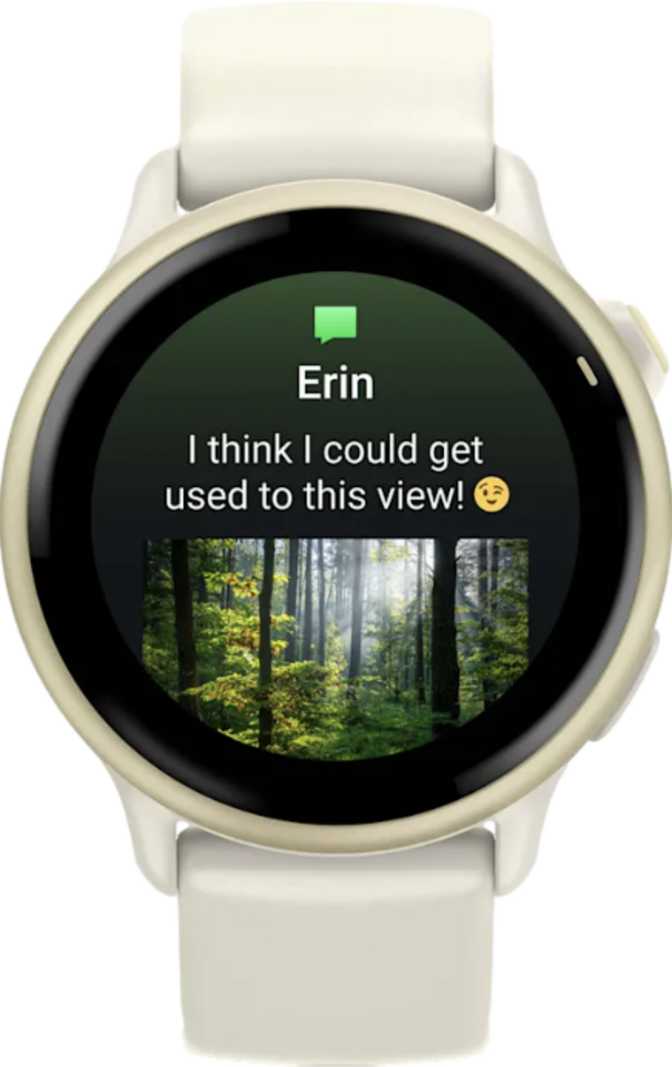
The 1.2-inch AMOLED screen is the centerpiece of the experience. At 459 pixels per inch across a 390 × 390 resolution, text is crisp, icons are sharp, and color accuracy is vivid — noticeably better than the older transflective memory-in-pixel displays found on previous Vivoactive generations and many competing watches at this price tier.
The always-on display mode lets you read time and data without raising your wrist or tapping the screen. Using it consistently will reduce battery life from the headline figure. Outdoors in direct sunlight, AMOLED panels can struggle compared to MIP displays, but Garmin has tuned brightness well enough to remain readable in most conditions.
What It Tracks — and How Well
The Vivoactive 6 carries a focused sensor package covering the health and fitness metrics most users genuinely need, without the altitude instruments or clinical features reserved for specialist devices.
Heart Rate & HRV
Continuous optical monitoring
The continuous optical heart rate sensor powers several layers of health intelligence simultaneously. Beyond basic beats per minute, it drives heart rate variability analysis — the subtle beat-to-beat variation that correlates with recovery quality, stress load, and physiological readiness.
HRV data is presented as a nightly average trend. Over weeks, it becomes one of the most honest indicators of whether your training load is appropriate or whether fatigue is quietly accumulating. Resting heart rate is tracked continuously, with alerts for unusual highs or lows. VO2 max is estimated from GPS and heart rate data during outdoor runs and tracked over months as a gauge of cardiovascular progress.
GPS & Navigation
GPS + Galileo dual GNSS
Built-in GPS means leaving your phone at home for runs, walks, and rides without losing accurate distance, pace, and route data. Galileo satellite support — the European counterpart to GPS — improves position accuracy in dense urban environments and areas with limited sky visibility such as forested trails or city canyons.
One meaningful caveat: there is no barometric altimeter. Elevation is inferred from GPS altitude rather than measured from air pressure, which is generally less accurate on hilly terrain. For most wellness-focused users this will rarely matter. For trail runners and mountaineers who track elevation gain as a core metric, it is a genuine limitation.
Blood Oxygen (SpO2)
Pulse oximeter monitoring
The pulse oximeter estimates blood oxygen saturation — useful for understanding how your body processes oxygen during sleep, at altitude, and through recovery. This is a wellness trend indicator, not a medical-grade diagnostic tool, but as a daily data layer it adds meaningful context to your overall health picture when tracked over time.
Motion & Orientation
Accelerometer, gyroscope, compass
An accelerometer and gyroscope work together to track movement in three dimensions — counting steps accurately regardless of arm position, measuring swim stroke count, and detecting sudden falls. The compass adds directional awareness for outdoor navigation.
There is no dedicated cadence sensor for cycling. Cyclists wanting cadence data need to pair an external ANT+ sensor, which the watch supports natively, but it requires additional hardware to achieve.
Missing Sensors Worth Knowing About
Battery Life That Changes Your Habits
The battery story is one of the strongest arguments for the Vivoactive 6 over AMOLED-screen competitors from Apple and Samsung — and it is worth understanding why in practical terms.
Battery Figures at a Glance
What This Means Day-to-Day
Eleven days of endurance on an AMOLED display is a strong number. Competing AMOLED watches from Samsung and Apple require daily or near-daily charging — meaning the Vivoactive 6 plugs in two to three times less frequently per month. For users who find daily charging a friction point, or who want uninterrupted overnight sleep tracking, this endurance is a genuine differentiator.
With GPS running continuously, 21 hours of tracking covers an ultramarathon, a full day of hiking, or a multi-hour cycling event without reaching for a charger mid-session. For daily runners averaging an hour of GPS use per day, expect real-world endurance in the seven-to-nine-day range — still comfortably ahead of the competition.
Charging: What to Know
The Vivoactive 6 uses a proprietary magnetic cable — no wireless Qi charging and no solar option. A spare cable is worth having for travel. Charging from empty to full takes approximately 90 minutes, which is standard for the category.
Key Features Explained in Real-World Terms
Raw spec values don't reveal the full story. Here is what each major feature actually delivers in practice.
Golf Mode
Preloaded course maps deliver distances to the pin, hazard yardages, and score tracking directly on your wrist — replacing a standalone GPS rangefinder. For anyone who plays golf regularly, this single feature can justify a significant portion of the purchase price compared to dedicated golf devices.
Pool & Open-Water Swim
The 50-meter water resistance is not just marketing — pool swim tracking includes stroke count detection and SWOLF scoring, a combined measure of efficiency that helps guide technique improvement. Open-water distances are recorded via GPS, making this a genuinely capable aquatic companion.
Sleep Tracking & Smart Alarm
Nightly tracking records sleep duration and stages — light, deep, and REM — which feed into your HRV trend data. The Smart Alarm detects a lighter sleep phase within a defined window before your alarm time, waking you with less grogginess than a fixed alarm typically causes.
Offline Music (8GB Storage)
Eight gigabytes of onboard storage holds a substantial offline music library for direct playback to Bluetooth headphones, with no phone required. For runners who prefer to leave the phone at home entirely, this enables truly untethered workouts without sacrificing a soundtrack.
Women's Health Tracking
Period tracking, ovulation prediction, and fertile window notifications are built into the platform rather than offered as stripped-down additions. Predictive cycle dating integrates with the watch's overall health trends, keeping reproductive health data on the wrist alongside fitness metrics.
Garmin Pay (NFC)
Payment credentials are stored directly on the watch, so Garmin Pay works at compatible contactless terminals without your phone or wallet. Notification mirroring and incoming call accept/reject control reduce how often you need to reach into a pocket during the day.
Fall Detection
The combined gyroscope and accelerometer can detect a hard fall and alert emergency contacts if the wearer is unresponsive. Useful for solo outdoor activities, older wearers, and anyone training in remote locations where an incident could otherwise go unnoticed for hours.
ANT+ Ecosystem
ANT+ support connects the Vivoactive 6 to a wide range of third-party fitness hardware — chest strap heart rate monitors, cycling power meters, and gym equipment with ANT+ transmitters — extending capability well beyond the built-in sensor set when you need it.
HRV & VO2 Max Trends
HRV tracking and VO2 max estimation grow more valuable the longer you wear the watch. Tracked across months, these figures become reliable indicators of genuine cardiovascular progress — or early signals of accumulated fatigue before it becomes performance-limiting.
Depth vs. Breadth: What It Covers
The Vivoactive 6 tracks a focused set of activities thoroughly rather than attempting to cover every sport superficially. These deliberate choices define its strengths and its limits.
Tracked With Care
- Steps, distance, and pace with continuous all-day monitoring
- GPS-tracked outdoor runs, walks, and cycling sessions without a phone
- Pool swimming with stroke count and SWOLF efficiency scoring
- Golf with preloaded course maps, pin distances, and score tracking
- Sleep stages with HRV integration and Smart Alarm waking
- Calorie burn estimation and food and water intake logging
- Auto-activity detection — logging begins when purposeful movement is detected
- Live GPS location sharing with contacts during outdoor sessions
Notably Absent
- No multi-sport transition mode for triathlon or duathlon events
- No turn-by-turn route navigation — maps are present for reference only
- No barometric elevation tracking — GPS altitude estimation only
- No native cycling cadence — requires an external ANT+ sensor to add
- Not designed for diving or snorkeling activities
- No fast GPS lock — brief satellite acquisition delay before outdoor sessions
Who Should Buy It — and Who Shouldn't
The Vivoactive 6 is well-matched to specific buyers and genuinely wrong for others. Being clear-eyed about which camp you fall into saves time and money.
A Strong Match For
Daily Wellness Trackers
Want HRV, SpO2, sleep, and stress data in a comfortable package they will actually wear around the clock
Casual to Moderate Runners
Logging three to five runs per week who want GPS accuracy and heart rate data without carrying a phone
Regular Swimmers
Need genuine water resistance and stroke-count intelligence, not simply splash protection
Golfers
Replacing a dedicated GPS rangefinder with wrist-based pin distances and scoring, at no extra hardware cost
People Who Resent Daily Charging
One-to-two-day smartwatch battery life is a dealbreaker for them — the Vivoactive 6 recharges far less often
Android Phone Owners
Garmin Connect works equally well on Android and iOS — a real advantage over the iOS-only Apple Watch
Not the Right Choice For
Trail Runners & Mountaineers
Depend on barometric elevation accuracy and turn-by-turn navigation that this watch cannot provide
Triathletes
Need structured multi-sport transition modes not available on this model — the Forerunner range is the right tool
Medical Users
Seeking ECG capability or irregular heartbeat notifications for clinical health monitoring purposes
Cyclists Who Track Cadence
Want native cadence data as a core training metric without purchasing additional external hardware
Buyers Wanting Independent Calls
The Vivoactive 6 requires a paired phone nearby for all communication features — there is no cellular radio
How It Stacks Up Against the Competition
The Vivoactive 6 competes against the Apple Watch SE, Samsung Galaxy Watch FE, and its own stablemate, the Garmin Forerunner 265. Here is a feature-level breakdown across the metrics that drive real purchasing decisions.
| Feature | Garmin Vivoactive 6 | Apple Watch SE | Samsung Galaxy Watch FE | Garmin Forerunner 265 |
|---|---|---|---|---|
| Battery (typical) | ~11 days | ~18 hours | ~40 hours | ~13 days |
| AMOLED Display | ||||
| Built-in GPS | ||||
| Barometric Altimeter | ||||
| Multi-Sport Mode | Limited | Limited | ||
| ECG | ||||
| Contactless Payments | Garmin Pay | Apple Pay | Samsung Pay | Garmin Pay |
| Golf Mode | 3rd-party only | |||
| Swim Stroke Tracking | ||||
| Offline Music | 8 GB | 32 GB | 16 GB | 8 GB |
| Platform Support | iOS + Android | iOS only | Android preferred | iOS + Android |
| Warranty | 1 year | 1 year | 1 year | 1 year |
Battery figures reflect typical real-world usage estimates. The Apple Watch SE and Samsung Galaxy Watch FE both require daily or near-daily charging — a fundamental lifestyle difference from the Vivoactive 6's weekly-plus cycle.
Strengths and Weaknesses
Where the Vivoactive 6 earns its asking price — and where it falls short of expectations.
Where It Excels
Coherent Design Philosophy
Every decision in this watch — the compact case, the 11-day battery, the AMOLED clarity, the focus on wellness over elite athletic metrics — points in the same direction. This is a watch that knows what it is, and that clarity makes it unusually good at being exactly that.
A Display Upgrade That Delivers
The AMOLED screen brings the Vivoactive line to visual parity with premium alternatives from Apple and Samsung, without surrendering the battery advantage that defines Garmin's appeal. Text is genuinely crisp; colors are accurate and vibrant rather than washed out.
Golf Mode Is a Sleeper Feature
For anyone who plays golf even semi-regularly, having on-course GPS distances on the wrist eliminates an entire separate device from the bag. It is the kind of feature that, if you need it, can be reason alone to choose this watch over otherwise similar options.
Battery Endurance That Changes Behavior
When you stop thinking about whether the watch will survive through the night, you start actually relying on it — for sleep data, HRV trends, and uninterrupted activity logging. That reliability compounds into genuinely useful long-term health insight over weeks and months.
Where It Falls Short
No Barometric Altimeter
The missing barometer is the most functionally significant absence. GPS-based elevation is less accurate than pressure-based measurement on varied terrain. This is a clear signal that the watch was not built for trail racing or alpine pursuits — for its target user it rarely matters, but it limits the audience.
Multi-Sport Gaps Will Frustrate Triathletes
Without structured multi-sport transition modes, anyone training across swim, bike, and run in a single session will find the Vivoactive 6 inadequate. The Garmin Forerunner range addresses this gap at higher cost and is the right tool for that audience.
No Wireless Charging
The proprietary magnetic cable is a minor inconvenience that becomes more noticeable if you have been using a Qi-enabled device. A spare cable is worth purchasing for travel, since replacements are Garmin-specific.
One-Year Warranty Is On the Short Side
Standard for consumer electronics, but brief for a device positioned as a long-term health companion. Garmin's customer service track record is generally solid, but buyers expecting multi-year primary use should factor this in.
Questions Buyers Ask Before Purchasing
Direct answers to the queries that consistently surface before a decision is made.
Our Recommendation
The Garmin Vivoactive 6 is a well-executed product for a well-defined audience. If you want a daily health companion that tracks sleep, stress, heart rate variability, and fitness with genuine depth — packaged in a comfortable, attractive watch that lasts nearly two weeks on a charge — this delivers without compromise.
It earns its position by being clear about its identity. It does not attempt to replace a Fenix or a Forerunner 265 for athletes who need advanced training tools, and it does not try to out-fashion an Apple Watch. What it offers instead is a balanced, mature platform: the Garmin health ecosystem's best features in a form factor that disappears into daily life.
For recreational fitness users, golfers, swimmers, Android owners who have been underserved by wearables, and anyone who has quietly resented daily smartwatch charging — the Vivoactive 6 is a confident recommendation.
Buy It If
- Long battery life is a non-negotiable priority
- You swim, golf, run, or monitor sleep daily
- You use an Android phone and want full health tracking
- You want the Garmin ecosystem in an everyday, slim package
Skip It If
- Trail running or mountaineering demands barometric altitude
- Triathlon training requires multi-sport transition support
- You need ECG monitoring for health management
- Wireless charging or cellular independence is essential